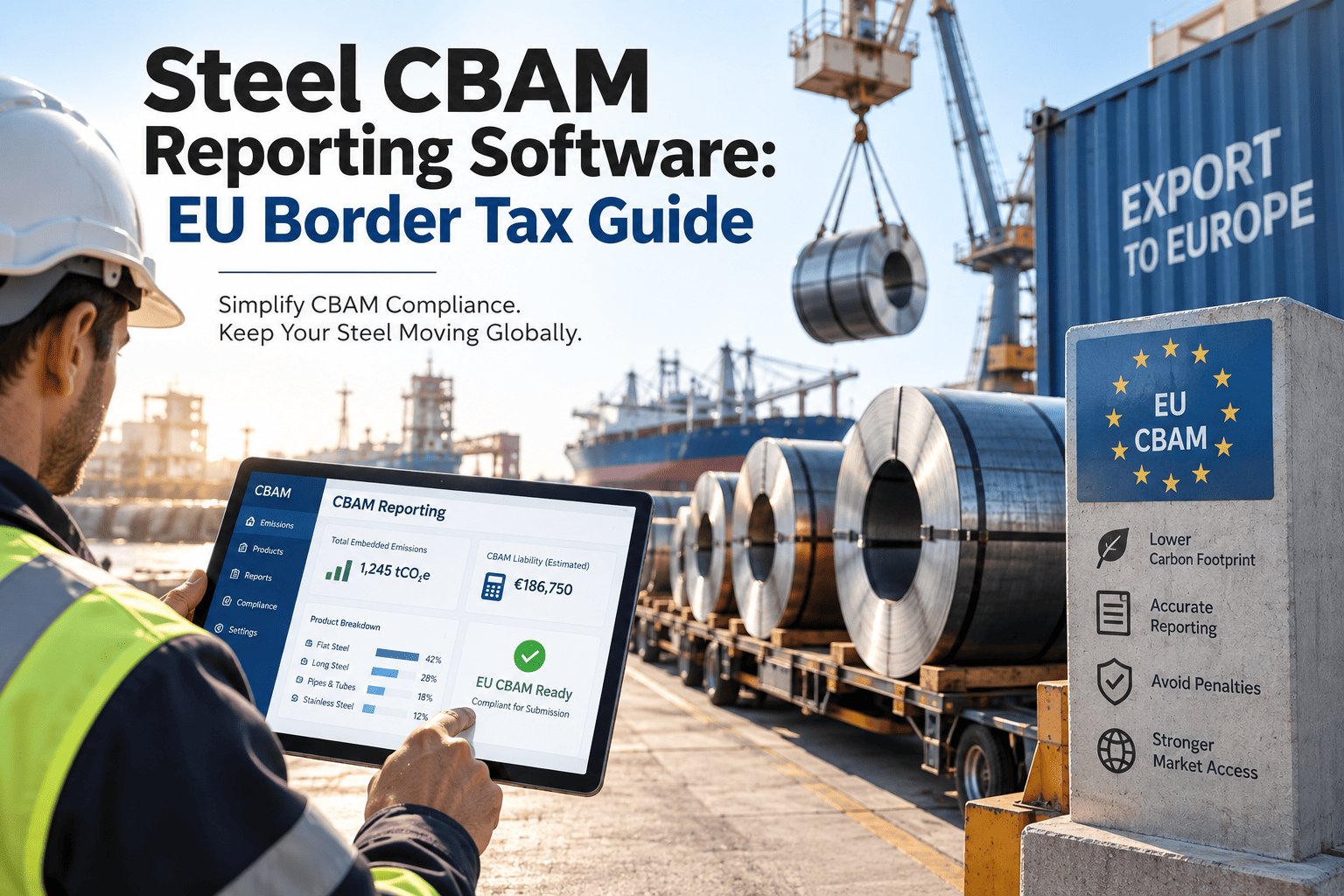
The Carbon Border Adjustment Mechanism moved from a reporting exercise to a financial obligation on January 1, 2026. Steel producers and EU importers can no longer treat embedded emissions data as a compliance afterthought handled once a quarter in a spreadsheet — every shipment now needs an auditable, Sign Up Free installation-level emissions figure that can survive third-party verification, or it defaults to a benchmark number that is almost always more expensive Book a Demo.
EU Carbon Border Adjustment Mechanism
CBAM's definitive phase means every ton you ship to Europe now needs a defensible emissions number
Annual declarations, third-party verified data, and certificate obligations tied to EU ETS pricing have replaced the transitional reporting-only period. A connected CMMS turns installation-level emissions tracking into a routine operational record instead of a year-end scramble.
What Changed
From quarterly reporting to annual, verified, financially binding declarations
CBAM's transitional phase ran from October 2023 through the end of 2025, requiring quarterly reports of embedded emissions with no financial exposure attached. That grace period is over.
Since January 1, 2026, the definitive phase requires EU importers to hold authorized CBAM declarant status, submit one verified annual declaration instead of four quarterly ones, and surrender CBAM certificates priced against the weekly EU ETS allowance market. The first annual declaration covering 2026 imports is due by September 30, 2027, with certificate sales opening on the common central platform in February 2027.
Transitional phase
Quarterly embedded emissions reporting required. No certificates, no financial obligation.
Definitive phase begins
Authorized declarant status required. Annual declarations replace quarterly reports. Certificate cost exposure starts accruing on every covered shipment.
Certificate sales open
CBAM certificates become purchasable on the common central platform, priced against weekly EU ETS allowance values.
First annual declaration due
Covers all 2026 imports, with verified embedded emissions and certificate surrender required.
What Counts As Embedded Emissions
Six iron and steel categories, and what each one must report
EU sector-specific guidance for iron and steel divides covered goods into six aggregated categories, each with its own calculation scope. Getting the category wrong is one of the most common sources of rejected declarations.
| Good Category | Emissions Scope | Key Note |
|---|---|---|
| Sintered ore | Direct plus electricity-related indirect | The main exception requiring indirect emissions inclusion |
| Ferro-alloys | Direct emissions | Precursor emissions carried into downstream complex goods |
| Pig iron | Direct emissions | Treated as a precursor for crude steel calculations |
| Direct reduced iron (DRI) | Direct emissions | Relevant for hydrogen and natural gas DRI routes alike |
| Crude steel | Direct emissions | EAF route excludes electricity emissions even though power is the main input |
| Iron or steel products | Direct emissions, plus embedded precursor emissions | Covers flat steel, bar, rod, wire, tube, pipe, and fastener products |
Post-consumer scrap carries zero embedded emissions under the framework, and precursors produced inside the EU or in CBAM-exempt territories are treated the same way, which matters for exporters blending scrap into their charge mix.
Why The Number You Report Matters
Actual emissions data versus EU default values
Every declarant faces a choice: report verified, installation-specific emissions, or fall back to EU-published default values when supplier data isn't available or can't pass third-party verification. The financial gap between those two paths can be substantial.
Default benchmark values
Applied automatically when actual data is missing or unverified. For conventional BF-BOF steel routes, default values commonly run well above what an efficient, well-instrumented plant would actually measure — meaning declarants pay for emissions they may not have generated.
Verified actual emissions
Requires installation-level data, calculated under EU-approved methodology and confirmed by an accredited third-party verifier. A lower, defensible number directly reduces the certificate obligation — but only if the underlying data can withstand an audit.
Get your embedded emissions data audit-ready
Book a walkthrough and we will show how OxMaint captures the process and maintenance records that support a defensible, installation-level CBAM emissions figure.
Root Causes Of Rejected Declarations
Why steel exporters struggle to defend their emissions numbers
Emissions data lives outside the production record
Energy consumption, fuel mix, and process parameters that drive an emissions calculation sit in separate systems from the actual heat, batch, or production run they belong to.
No traceable link between data and assumptions
Verifiers expect documented assumptions, data sources, and calculation methods behind every figure. Data that can't be traced back to its origin is routinely rejected.
Precursor emissions aren't tracked upstream
Complex steel products must carry embedded emissions from sintered ore, pig iron, DRI, ferro-alloys, and crude steel — data that is easy to lose if precursor records aren't linked to the final product.
Verification readiness is treated as a year-end task
Building an audit trail after the reporting period closes is far harder than capturing it continuously as production happens.
Building The Discipline
A practical CBAM data workflow for steel producers and exporters
Map production data to CBAM good categories
Classify every shipped product against the six iron and steel categories so the correct emissions scope — direct only, or direct plus indirect — is applied from the start.
Capture energy and process data at the source
Fuel consumption, electricity use, and process parameters are logged against the specific production run or heat, not reconstructed later from utility bills.
Link precursor records to finished products
Embedded emissions from upstream sintered ore, pig iron, DRI, ferro-alloys, or crude steel are traced through to the final shipped good.
Maintain a continuous audit trail
Every data source, assumption, and calculation step is documented as production happens, so third-party verification doesn't require a data reconstruction project.
Generate the annual declaration package
Verified emissions data, precursor traces, and supporting documentation are compiled into a package ready for the declarant's annual CBAM submission.
Where OxMaint Fits
How OxMaint supports CBAM-ready operational data
OxMaint does not file CBAM declarations — it captures the maintenance, inspection, and production data that makes an emissions figure defensible when a verifier asks where the number came from.
Asset and process data capture
Furnace, DRI, and rolling mill operating parameters are logged against specific production runs, building the traceable record CBAM verification requires.
Inspection and compliance records
Calibration checks on metering and monitoring equipment are scheduled and logged, supporting the data-quality expectations of third-party verifiers.
Mobile data entry at the source
Operators log fuel, energy, and process readings from the shop floor via mobile workflows instead of reconstructing them later from disconnected systems.
Reporting dashboards
Production and energy data roll up into dashboards that compliance teams can hand to verifiers or use to prepare the annual declaration package.
FAQ
Frequently asked questions about steel CBAM reporting
When is the first CBAM certificate obligation for steel imports?
The definitive phase began January 1, 2026. The first annual declaration, covering all 2026 imports, is due by September 30, 2027, with CBAM certificates purchasable starting February 1, 2027.
What happens if we can't provide verified actual emissions data?
The declaration falls back to EU-published default values, which for many conventional steelmaking routes are set well above what an efficient plant would actually measure, increasing the certificate obligation.
Does electric arc furnace steel report electricity emissions?
Under current guidance, electricity-related emissions are excluded from definitive-period embedded emissions calculations for crude steel produced via the EAF route, even though electricity is the primary energy input.
Does scrap-based steel have an advantage under CBAM?
Post-consumer scrap is treated as carrying zero embedded emissions, which can meaningfully lower the reported emissions intensity of steel produced with a high scrap charge, provided that scrap content is properly documented.
Can OxMaint help prepare data for CBAM verification?
OxMaint can be configured to capture production, energy, and inspection data at the source, building the traceable operational record that supports a CBAM emissions calculation. Book a demo at calendly.com/oxmaintapp/30min to review your reporting workflow.
Don't let a missing data trail set your CBAM certificate cost
Build a continuous, auditable emissions record from the shop floor up, so your declaration reflects what your plant actually produces.
Free 14-day trial · No credit card