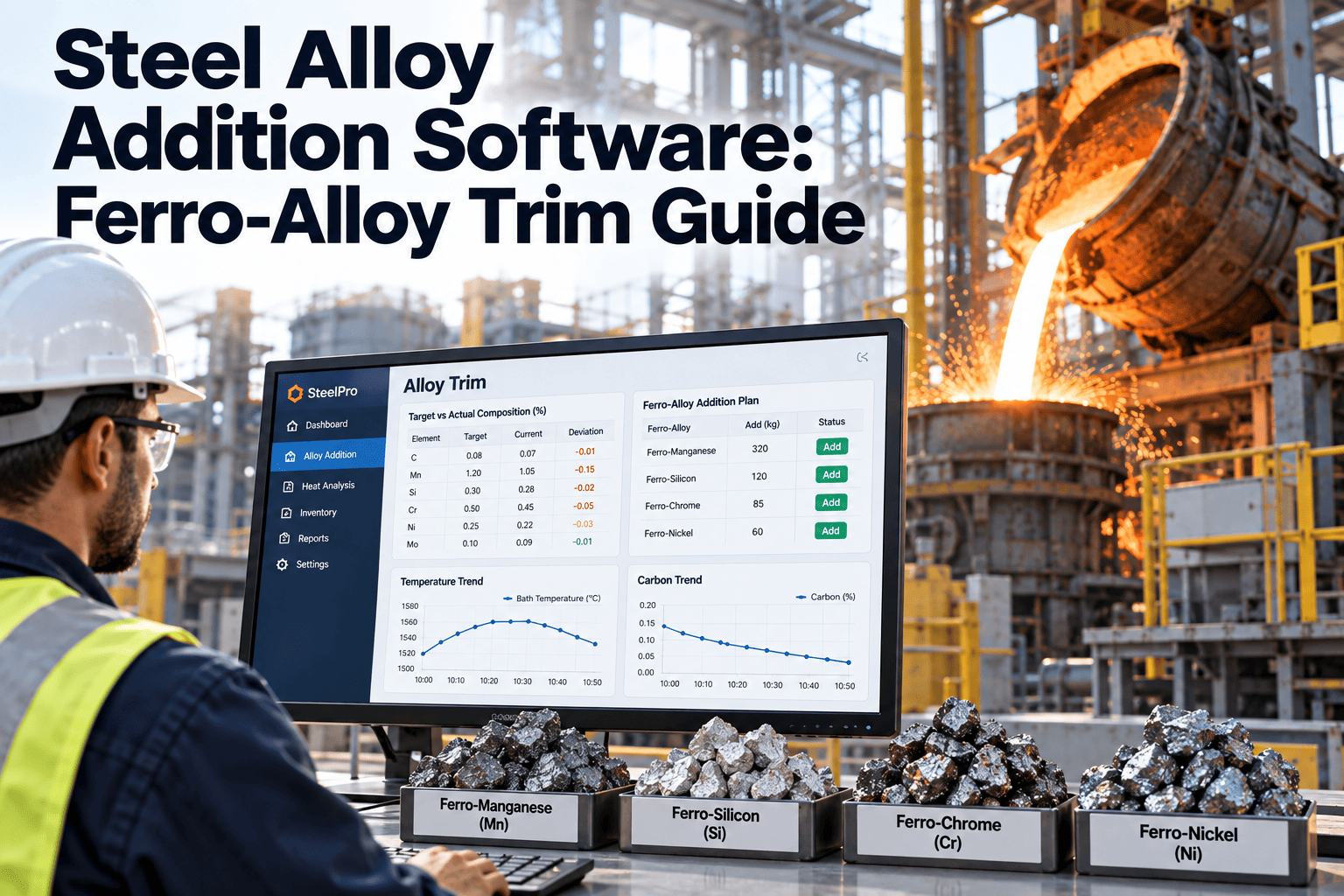
Ferro-alloy trim additions are where steelmaking chemistry meets steelmaking cost, and the gap between the two is usually measured in silence rather than alarms. A ladle that gets a slightly heavy ferro-manganese addition because the last spectrometer reading was ten minutes stale does not trigger a stoppage — it just quietly burns margin on every heat that follows the same habit. Tracking trim additions against real ladle chemistry data, instead of a fixed recipe card on the wall, is what turns that silent waste into a number a metallurgical manager can act on, and a good place to see the gap in your own data is a Start Free Trial against last month's alloy consumption log.
Every over-add ferro-alloy trim is a margin you never see
Ferro-silicon, ferro-manganese, and ferro-chrome trims priced by the tonne add up fast when they are dosed to a standard recipe instead of the ladle's actual chemistry. A connected CMMS turns trim history into a trend you can audit heat by heat.
Three ways trim additions drift away from actual chemistry
Ferro-alloy trim waste rarely comes from one bad heat. It comes from small, repeated gaps between what the ladle needs and what the recipe card says to add.
Recipe-based dosing over actual analysis
Fixed addition tables built for an average heat chemistry systematically over-dose ladles that started closer to spec, since the recipe cannot see where that heat actually began.
Stale spectrometer readings drive the trim decision
A reading taken before the last deoxidation step no longer reflects the ladle's true state, so the resulting trim addition is calculated against chemistry that has already moved.
Recovery-rate assumptions go untracked
Ferro-alloy recovery rates shift with ladle temperature, slag chemistry, and stirring intensity, but many shops apply one flat recovery factor across every grade and every heat.
What over-adding actually costs by alloy type
Trim alloys are priced per tonne of contained element, so even a small over-add compounds fast across a full production run.
| Ferro-Alloy | Typical Trim Range | Common Over-Add | Waste Driver |
|---|---|---|---|
| Ferro-manganese | 2–8 kg per tonne of steel | 0.3–0.9 kg per tonne | Fixed recipe vs pre-trim analysis |
| Ferro-silicon | 1.5–5 kg per tonne of steel | 0.2–0.6 kg per tonne | Flat recovery-rate assumption |
| Ferro-chrome | 3–12 kg per tonne of steel | 0.4–1.1 kg per tonne | Stale spectrometer reading |
| Ferro-molybdenum | 0.5–3 kg per tonne of steel | 0.1–0.3 kg per tonne | Grade-change carryover error |
How a single over-add traces back through the ladle sequence
Most over-adds are not one decision, they are the end of a short chain of small timing and data gaps earlier in the tap-to-trim sequence.
Step four is where most of the drift accumulates. A fixed recovery-rate assumption applied to every heat, regardless of temperature or slag condition, is the single most common reason a calculated trim addition ends up heavier than the ladle actually needed.
A 12-heat sequence shows what tracking trim history catches
A mid-sized EAF shop logged ferro-manganese additions across a 12-heat sequence to compare recipe-based dosing against chemistry-linked trim calculation.
Across the sequence, heats dosed by fixed recipe averaged 0.62 kg per tonne above the chemistry-calculated requirement, while heats where the trim was recalculated against the latest spectrometer reading came within 0.11 kg per tonne of target. Over a single production week at typical heat volumes, that gap alone represented several tonnes of ferro-manganese consumption that a trend view would have flagged after the third or fourth heat, not the twelfth.
Turn your alloy consumption log into a trim accuracy trend
Connect ladle chemistry and inventory data so every trim addition is checked against target, not just against a recipe card.
What a chemistry-linked alloy addition workflow needs
Reducing trim over-add is a data discipline problem before it is a metallurgy problem. This checklist covers the parts most shops are missing.
Connecting alloy addition records to inventory and reporting
Oxmaint does not calculate metallurgical chemistry, but it structures the addition, inventory, and reporting data melt shop teams need to see trim variance clearly.
Alloy inventory tracked by heat consumption
Ferro-alloy stock levels update against logged addition records, so consumption trend and reorder points reflect real usage, not estimated draw-down.
Mobile logging at the ladle station
Operators record trim additions against the heat number from a mobile workflow, keeping the addition record tied to the same asset and batch data as everything else in the melt shop.
Variance dashboards by grade and alloy
Standing reports compare logged additions against target ranges by grade, surfacing over-add or under-add drift before it becomes a quarter-end cost surprise.
Steel alloy addition tracking — common questions
What causes most ferro-alloy over-addition in steelmaking?
A fixed recovery-rate assumption applied uniformly across grades and heat conditions is the most common driver, followed by trim calculations based on a stale spectrometer reading.
How much can chemistry-linked trim calculation actually save?
Savings vary by shop, but tracking recipe-based versus chemistry-linked trim additions side by side over a production run is the only reliable way to see your own gap.
Can alloy addition data connect to existing spectrometer systems?
Yes, addition logs can reference the same heat number used by lab analysis systems, keeping chemistry and consumption data aligned without duplicate entry.
Does this replace the metallurgist's trim calculation?
No, it records and trends the decisions already being made so patterns like recovery-rate drift or recipe over-reliance become visible over time.
How quickly can a shop see its first trim variance report?
Most shops see an initial variance view within one to two production weeks of connecting addition logs and inventory data. Book a Demo to walk through your own alloy consumption history.
Stop losing margin to alloy additions nobody is trending
Bring ferro-alloy addition and inventory data into one workflow and see trim variance by grade before it shows up in next quarter's cost report.
Free 14-day trial · No credit card