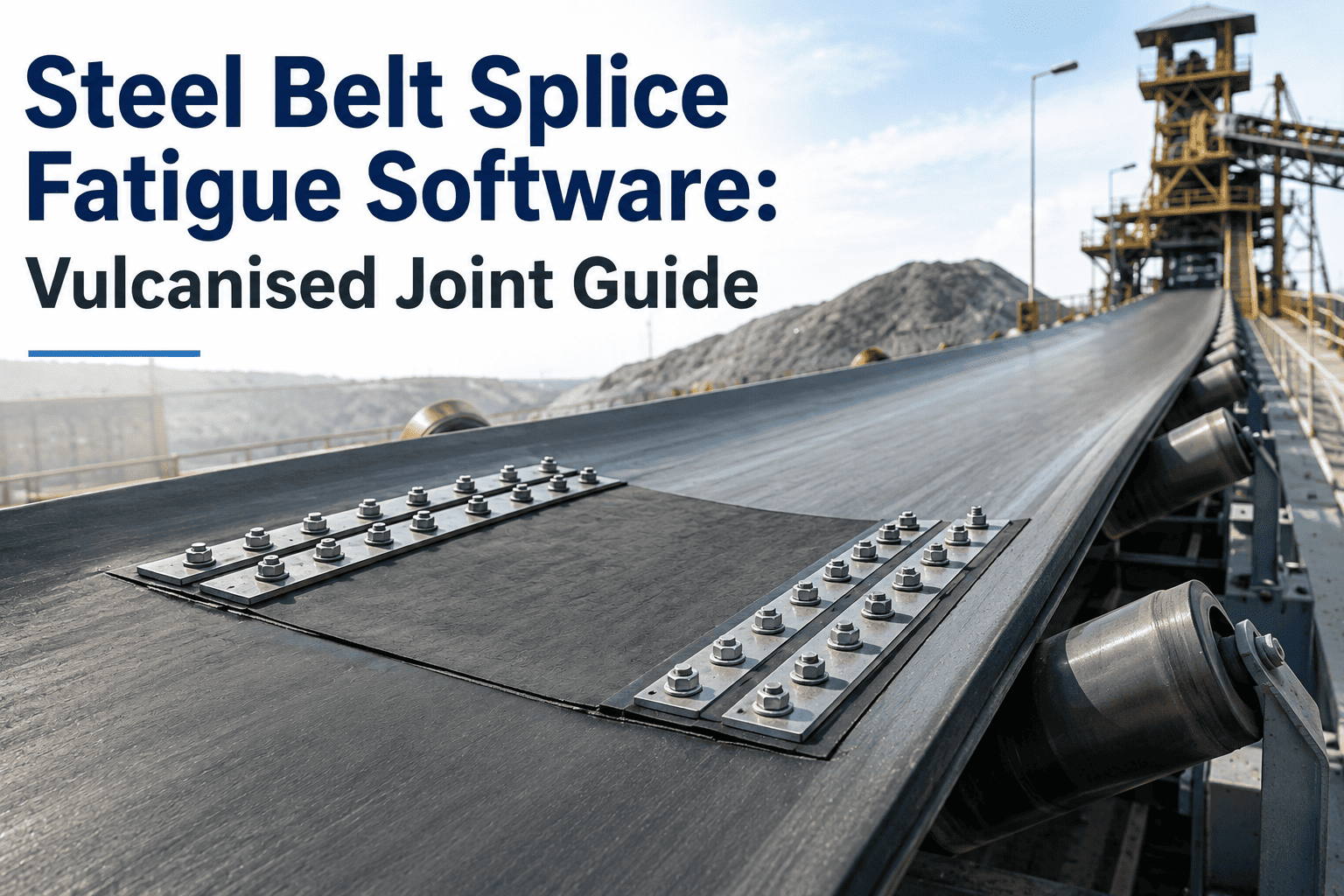
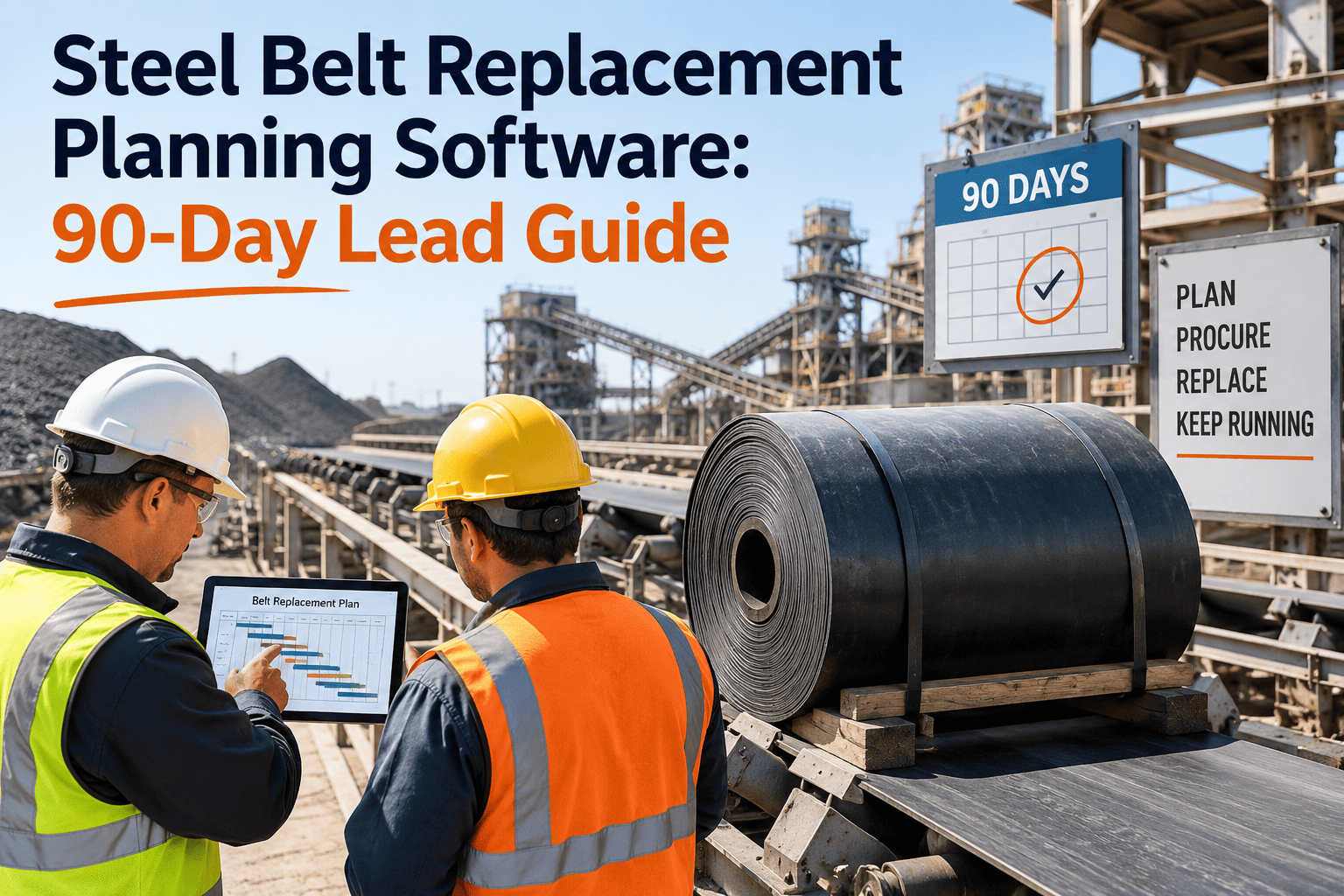
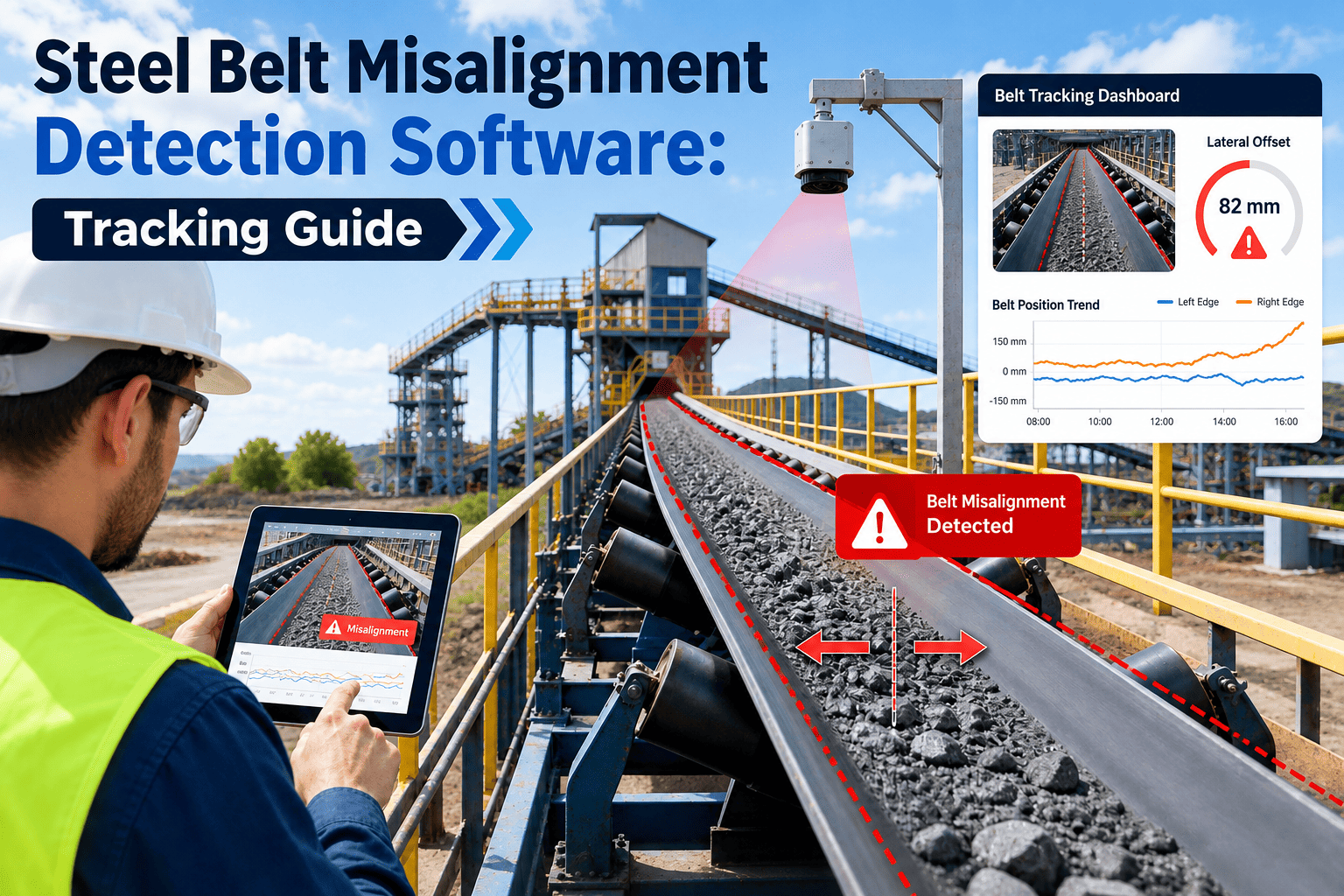
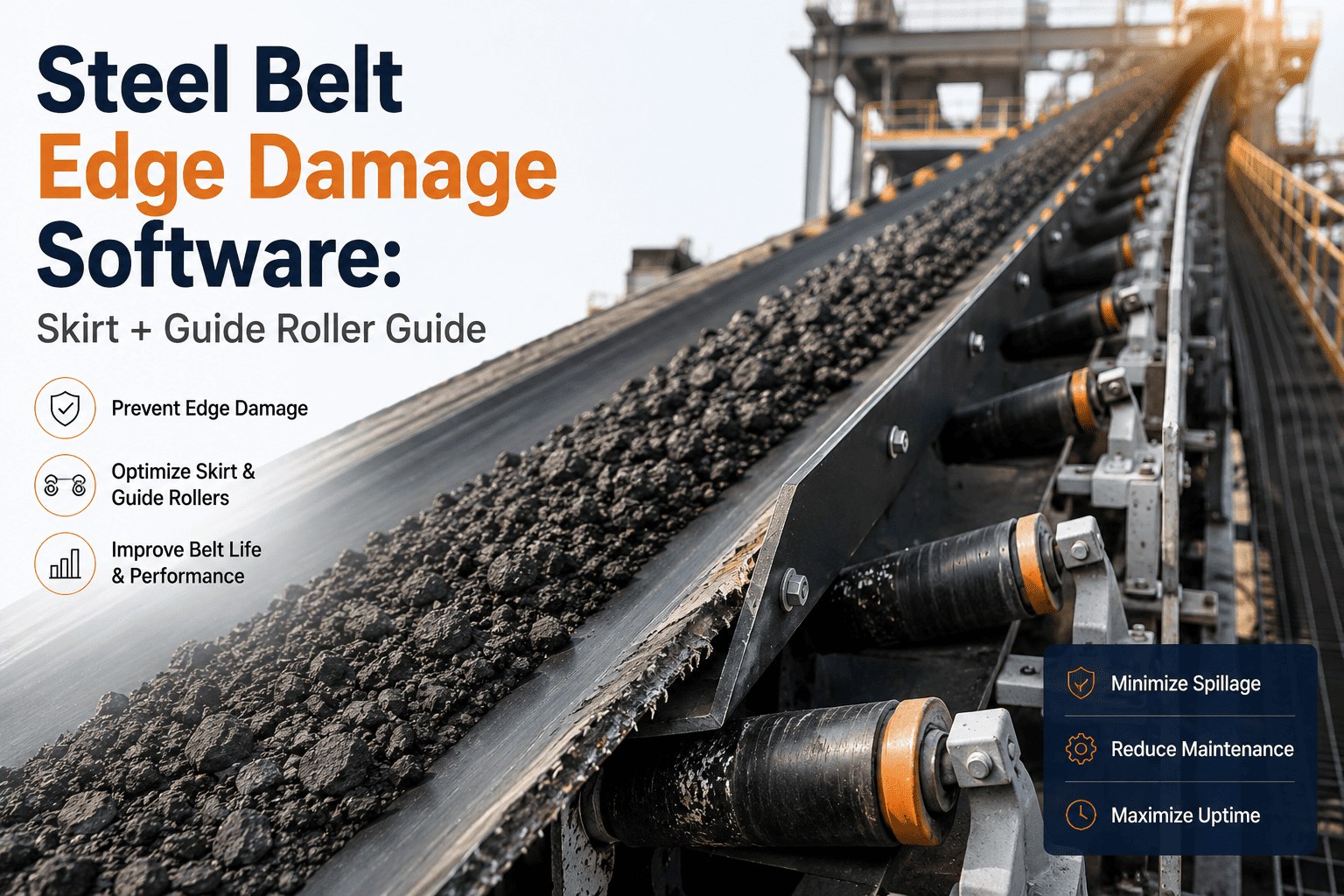
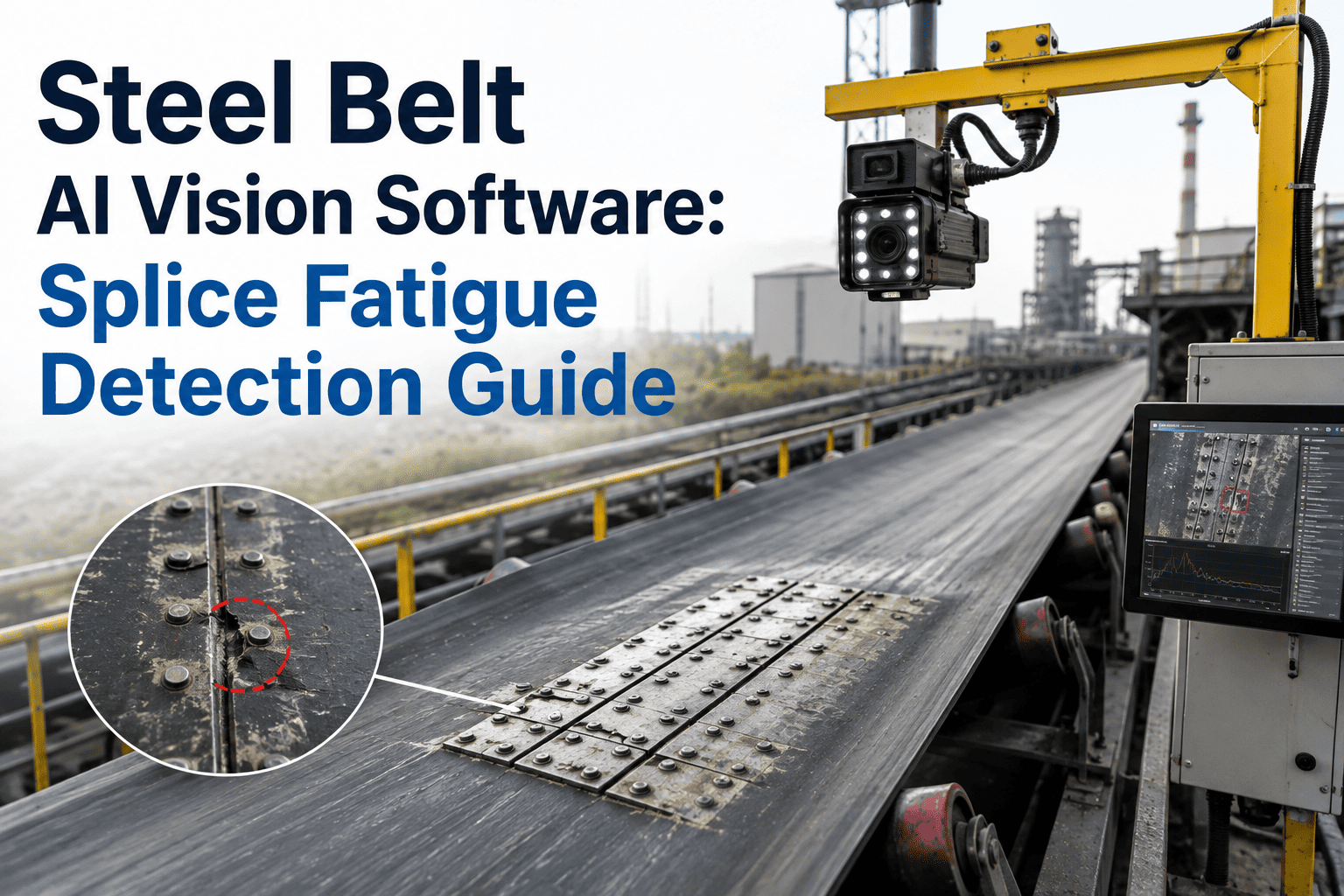
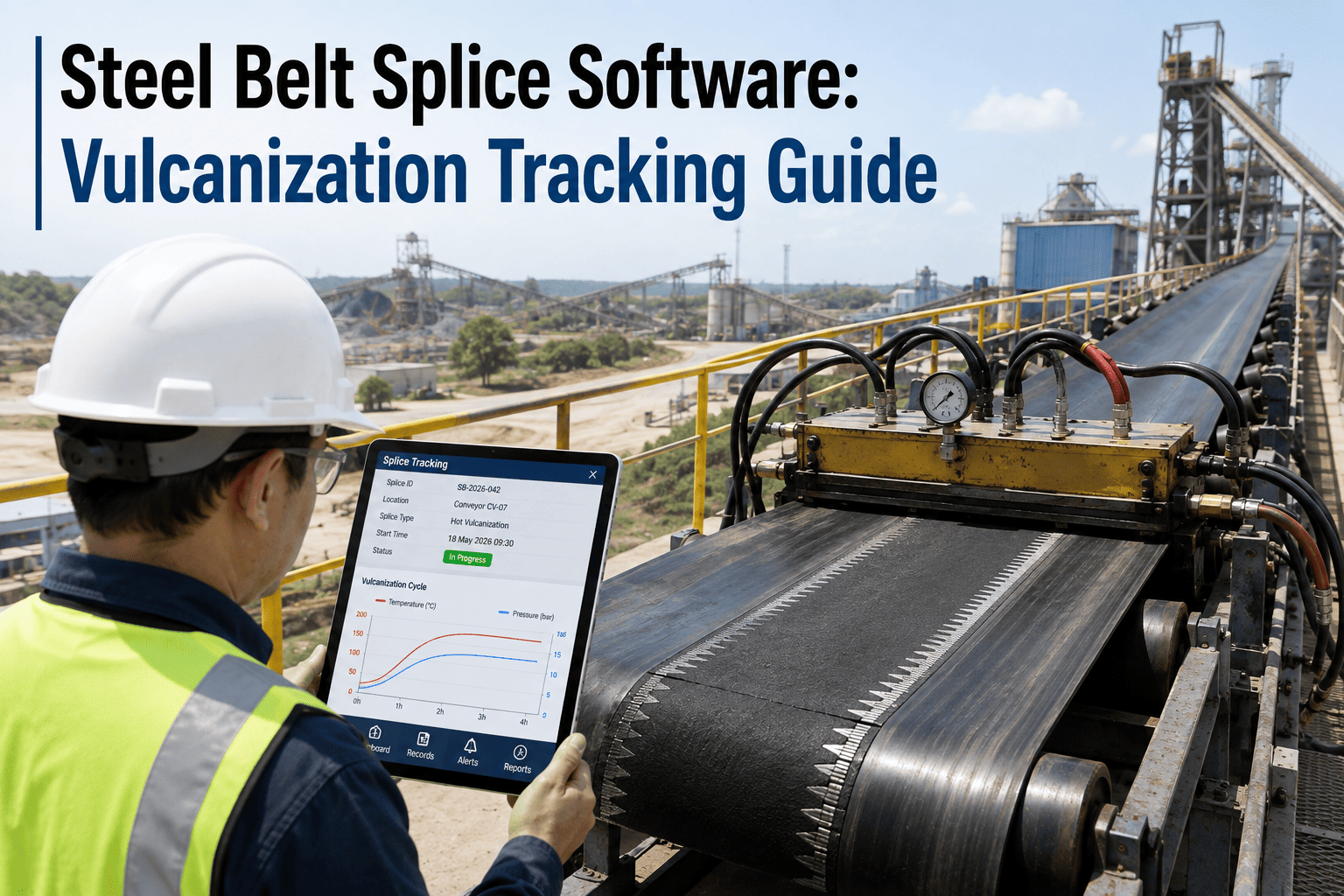
Roughly ninety percent of in-service conveyor belt failures start at the splice, not in the belt body — and on a long overland conveyor feeding a steel plant's ore yard, sinter plant, or coke handling circuit, that joint might be one of fifty or more stitched into the belt's endless loop. A vulcanised splice looks permanent once it is cured, but underneath the cover it is a rubber compound carrying the full tension load across an overlap of interlaced steel cords, and every cycle of loading, every degree of thermal swing, and every year of adhesion aging pushes it a little closer to separation. When a splice lets go mid-run, the belt does not just stop — it can whip, spill a full load, and take a shift or more to re-splice and restart. See how splice fatigue tracking fits into a connected conveyor maintenance record before your next major belt outage.
Conveyor Reliability · Vulcanised Splices · Steel CMMS
Steel Belt Splice Fatigue Software for Vulcanised Joints
Vulcanised splices carry the entire tension load of a conveyor belt through a narrow overlap zone, and they are engineered to fail slowly before they fail suddenly — elongating, cracking at the cover, and losing adhesion at the edge over months of service. The warning signs are almost always visible well before separation, but only if elongation, crack length, and splice temperature are actually measured, recorded, and compared against the last reading instead of eyeballed once a week and forgotten. Splice fatigue software turns that comparison into a trend line instead of a guess.
90%
Of in-service belt failures trace back to a splice, not the belt body
50+
Vulcanised joints stitched into a single long overland conveyor loop
$2–8M
Typical cost of an unplanned conveyor outage, including lost production
Splice Structure
Anatomy of a Vulcanised Joint
A steel cord splice is not a seam — it is an engineered overlap where two belt ends are stripped, interlaced, and re-cured into a single continuous structure. Understanding the four zones inside that overlap explains why fatigue shows up as gradual elongation and cover cracking rather than a clean, sudden break, and why the repair for one zone rarely fixes a failure that started in another.
Zone 1
Overlap Length
Belt ends are staggered and overlapped by one to five meters depending on belt strength rating and cord diameter, spreading the tension transfer over as much cord length as possible to avoid a stress concentration.
Zone 2
Interlaced Steel Cords
Alternating cords from each belt end are laid parallel and embedded into the opposite side, so the splice carries load through cord-to-rubber bond rather than cord-to-cord contact.
Zone 3
Rubber Compound Fill
Over the splice length, the rubber compound alone carries the tension load between cord ends — the same job the steel cords do everywhere else in the belt.
Zone 4
Cover and Edge Seal
A top and bottom cover layer is re-cured over the splice, and the edge seal keeps moisture and contaminants from working into the cord bed from the sides.
Failure Mechanisms
Three Ways a Splice Fatigues Before It Fails
A splice rarely fails without warning. Fatigue shows up first as one of three measurable symptoms, each with its own early signal, root cause, and consequence if the trend is never recorded. Recognizing which symptom is developing changes what the maintenance team does next — an elongating splice needs a length trend and a possible early re-splice, while a cracking cover needs a repair patch and closer inspection interval until the next planned outage.
Symptom 01
Elongation and Cord Slip
Early signal: gradual increase in the distance between reference markers on either side of the joint, often starting slowly and then accelerating.
Root cause: cord-to-rubber bond breaking down under repeated tension cycling and shock loading at the idler pass, especially on belts running above rated tension.
Consequence if missed: sudden splice separation, whipping belt ends, and a full-length shutdown to re-splice.
Symptom 02
Cover Crack Propagation
Early signal: hairline cracking at the splice cover edge, usually starting where the taper meets the parent belt and growing with each flex cycle.
Root cause: flexing over pulleys and idlers combined with cover rubber that was under-cured or has aged past its flex life for the operating temperature.
Consequence if missed: crack reaches the cord bed, moisture ingress accelerates corrosion, and the splice loses strength from the inside out.
Symptom 03
Edge Delamination and Adhesion Loss
Early signal: visible lifting at the splice edge where cover and carcass are starting to separate, sometimes with a faint hollow sound when tapped.
Root cause: improper original vulcanization parameters, thermal cycling on hot-material belts, or age-related adhesion decay that outpaces the surrounding rubber.
Consequence if missed: delamination spreads across the joint width, cutting the splice's effective load-carrying area.
Real Cost
What a Missed Splice Failure Actually Costs
A splice that separates mid-run rarely stays a small problem. The cost stacks up across four categories before the belt is even back in service, which is why catching the trend early is worth far more than the price of the inspection round that spots it.
Spillage and Cleanup
A whipping belt end can dump a full load of ore, coke, or hot sinter across the gantry and surrounding structure, taking a cleanup crew hours before the area is even safe enough to re-enter and begin repairs.
Downstream Downtime
Every process the belt feeds — blast furnace charging, sinter supply, ore transfer, coke handling — stops the moment the belt does, often for far longer than the physical re-splice work itself actually takes.
Emergency Re-Splice Premium
A planned re-splice slotted into a scheduled outage costs a fraction of an emergency call-out crew working around the clock, at overtime rates, to get the belt running again before the next production shift.
Safety Exposure
A splice failure under full tension is a genuine safety hazard for anyone working near the belt line, which is exactly why most steel plant safety programs treat splice condition as a critical, non-negotiable inspection item rather than an optional weekly task.
Temperature and Cycling
Thermal Swings Age a Splice Faster Than Tonnage Does
On belts running hot sinter, coke, or slag, the splice zone sees repeated thermal cycling that most of the belt body never experiences to the same degree. Adhesion breaks down at a different rate than the surrounding rubber, and without a temperature history tied specifically to the splice record, that acceleration stays invisible until the joint is already lifting at the edge.
Record Requirements
What a Splice Fatigue Record Should Actually Capture
A splice condition note that just says "checked, okay" is worthless six months later when the same technician cannot remember what "okay" looked like, or has moved to a different shift entirely. A usable splice fatigue record captures six specific data points against every joint, every time, so the next inspection compares against a real number instead of a memory.
Elongation
Marker-to-Marker Distance Trend
Reference marks either side of the splice measured on a fixed schedule, plotted as a trend line so a sudden jump in the rate of change stands out clearly against the normal, slow creep every splice shows over time.
Cracking
Crack Length and Location Photos
Photo or vision-scan record of any cover crack at the splice, with length noted and location marked against the joint's reference layout.
Temperature
Splice Zone Thermal History
Surface temperature readings taken at the splice logged alongside the material actually being conveyed at the time, so thermal cycling severity is tied to real production conditions rather than an assumed average.
Adhesion
Edge Lift and Bond Test Results
Tactile and visual check for edge lifting at every inspection round, escalated to a bond pull test if lifting is confirmed.
Age
Splice Date Against Manufacturer Interval
Installation date or last re-splice date tracked carefully against the manufacturer's recommended service interval for that specific belt class and its actual operating conditions.
Action
Automatic Re-Splice Work Order
A work order raised automatically the moment elongation, crack length, or splice age crosses the configured threshold — not left for the next inspection round to notice by chance.
Monitoring Approach
Four Ways Mills Monitor Splice Condition
Splice monitoring ranges from a technician's hands and eyes to fixed magnetic elongation systems on high-tension steel cord belts. Each method catches a different symptom and misses a different one, which is why most mills run at least two of the four in parallel rather than relying on a single technique to catch every failure mode.
None of these methods replaces a written record. A magnetic elongation system that stops the conveyor on a critical reading is only useful if the reading is logged against splice age, prior trend, and repair history — otherwise it becomes an unexplained alarm instead of a data point that improves the next re-splice decision.
Inspection Cadence
How Splice Tracking Fits the Conveyor PM Calendar
Splice fatigue tracking works best layered onto the maintenance rounds a conveyor crew is already running, rather than treated as a separate program that competes for the same technician's time.
Daily
Operator Walkdown
A visual pass at the loading and discharge points, flagging any obvious spillage, misalignment, or splice edge disturbance for follow-up.
Weekly
Tactile Splice Check
Every splice on the conveyor is checked by hand and eye for lifting, elongation, and cracking, with condition logged against the joint's record.
Monthly
Elongation Measurement Round
Reference marker distances are measured and compared to the prior reading, with any rate-of-change increase flagged for supervisory review.
Annual
Full Splice Audit and Re-Vulcanization Planning
Every splice on the belt is audited for elongation, crack length, adhesion, and remaining life estimate, and the findings feed directly into next year's re-splice budget, spare belt planning, and outage schedule.
Why It Matters
What Changes When Splice Fatigue Is Tracked Instead of Guessed
The value of splice tracking is not really the sensor or the checklist — it is what the plant stops having to react to once the data exists.
Earlier
Warning Before Separation
Elongation and crack trends flag a failing splice weeks ahead of the point where visual inspection alone would catch it.
Planned
Re-Splice Instead of Emergency Repair
A threshold-triggered work order turns a catastrophic mid-shift failure into a scheduled outage on the plant's own timeline.
Traceable
Splice History by Joint
Every splice carries its own install date, condition trend, and repair history instead of one generic note for the whole belt.
Budgeted
Re-Vulcanization Costs Forecast
Age and condition trends across every splice on the fleet feed a re-splice budget instead of a surprise capital request.
Common Questions
Belt Splice Fatigue — Frequently Asked Questions
Why do most conveyor belt failures start at the splice instead of the belt body?+
The splice carries tension through rubber-to-cord bonding rather than continuous steel cord, so it is the belt's weakest structural point under repeated cyclic loading, and the first place fatigue accumulates.
How is splice elongation different from normal belt stretch?+
Normal belt stretch happens gradually across the whole loop and is compensated automatically by the take-up unit. Splice elongation is localized cord slip inside the joint itself and signals bond failure, not ordinary wear.
Can a cracked splice cover keep running safely?+
A shallow surface crack can often run to the next planned stop if tracked closely, but any crack reaching the cord bed should be scheduled for repair immediately.
Book a demo to set up crack-length thresholds for your belts.
How often should splice elongation actually be measured?+
Monthly is standard for most steel plant conveyors, moving to continuous magnetic monitoring on high-tension steel cord belts where a sudden failure carries the highest safety and production risk, or on any conveyor with a known history of splice problems.
How does Oxmaint tie splice condition into the conveyor maintenance record?+
Every splice gets its own record with elongation trend, crack photos, temperature history, and age, linked to the conveyor asset so a re-splice work order triggers automatically at threshold.
Start a free trial to connect it to your belt fleet.
Splice Life, Tracked Not Guessed
Stop Finding Out a Splice Failed the Moment It Separates
Elongation, cracking, and adhesion loss all show up in the data long before a splice lets go mid-shift. Oxmaint turns every joint into a tracked record — trend, threshold, and automatic work order — so re-splicing happens on your maintenance schedule instead of on the belt's terms during an unplanned outage.