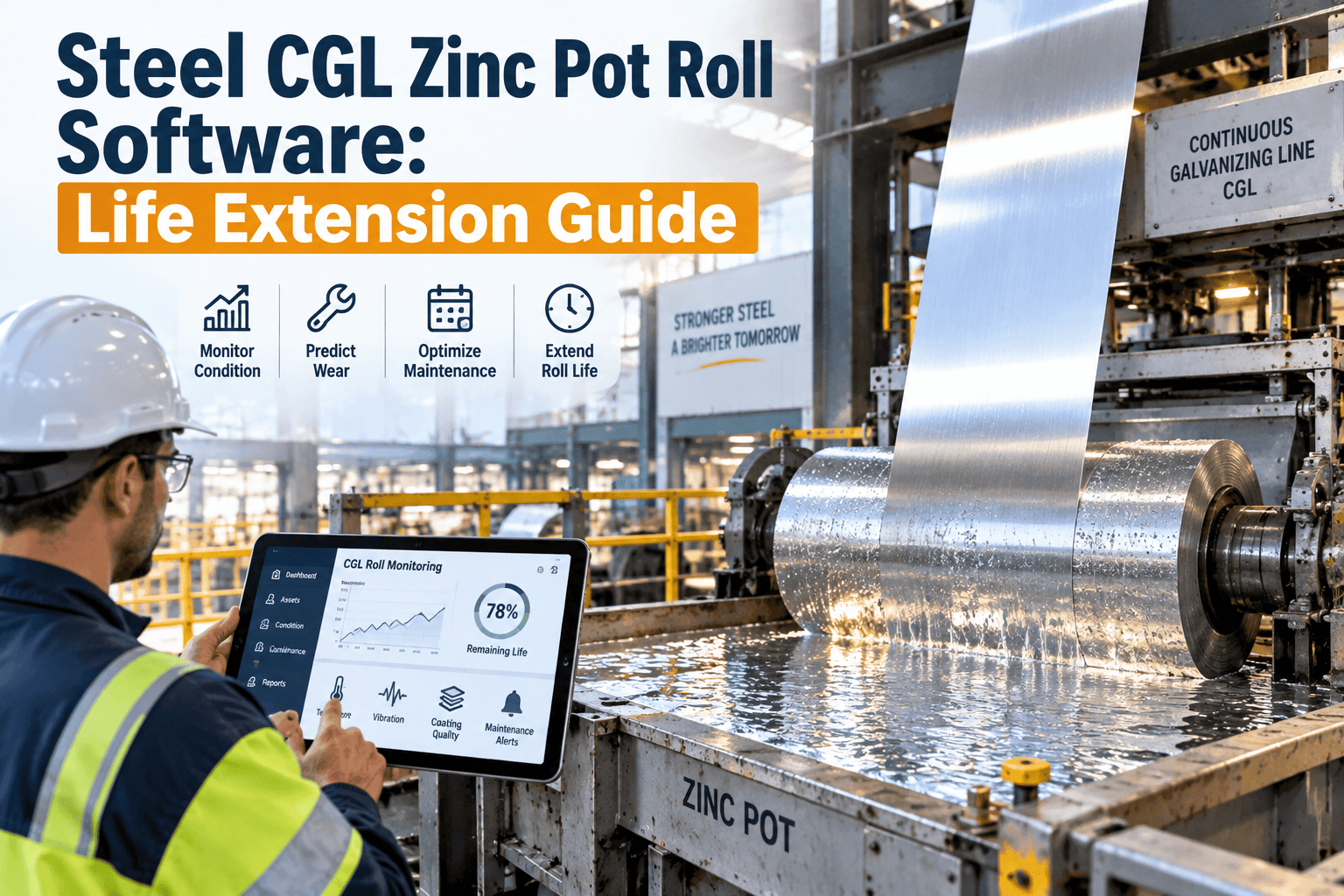
On a continuous galvanizing line, the rolls that run inside the molten zinc pot decide how long the line can run between stops. Dross builds up on bearings and sleeves, ceramic surfaces wear, and a roll that stops turning true begins to mark the strip. Steel CGL zinc pot roll management is about catching that drift early and pulling hardware on your terms. This guide shows how Oxmaint maintenance management software gives every roll assembly a life record.
Steel CGL Zinc Pot Roll Software: Life Extension Through Condition Tracking
The Failure Chain Inside the Pot
Pot roll problems rarely start with a sudden break. They build through a chain of small changes, and each link is a chance to act before the strip pays for it.
Pot Hardware Components and What Wears
Treat each component as its own record. A roll body can outlive several sleeve and bearing sets, and a single lifetime number hides which part actually failed.
| Component | Function | Typical wear or failure mode | What to record |
|---|---|---|---|
| Sink roll | Turns the strip from the snout path to the vertical exit | Surface wear, groove wear, dross adhesion, roll marks transferred to strip | Serial number, groove depth, surface condition, campaign tonnage |
| Stabilizer rolls | Limit strip vibration and flutter above the sink roll | Uneven wear, contact marks, bearing play | Position, contact condition, clearance readings |
| Sleeves | Wear surface between shaft and bearing | Erosion, cracking, thermal shock damage in ceramic grades | Material grade, outside diameter, cracks, supplier batch |
| Bearings | Support the roll while immersed in zinc | Wear, dross intrusion, chipping; materials vary by line, such as cobalt alloy, ceramic, or carbide | Material, bore size, clearance, install and pull dates |
| Arms and bushings | Hold rolls in position within the pot | Corrosion, distortion, loose fits | Alignment readings, repair history |
| Bath condition | Determines dross formation rate | Aluminium drift, temperature swings, high dross generation | Bath temperature, aluminium readings, dross removed |
Dross: The Root Cause to Manage
Dross is the link between bath chemistry and roll life. Two kinds matter, and each has a different control handle. Your process team and supplier set the practice; the maintenance record ties dross events to hardware life.
Top dross
- Aluminium-iron compounds that float on the surface
- Can attach to the strip and rolls near the exit
- Influenced by aluminium level and strip entry conditions
- Managed by regular skimming and bath control
Bottom dross
- Iron-zinc compounds that settle to the pot floor
- Risk rises when it is stirred up during roll changes or strip disturbances
- Influenced by temperature, iron pick-up, and pot practice
- Managed by scheduled removal and by avoiding disturbance
What to log about dross
- Dross removal dates and quantities
- Bath temperature and aluminium readings on the same day
- Strip defects reported after dross events
- Condition of rolls and bearings at the next pull
Give Every Pot Roll Assembly a Life Record
Reading Strip Symptoms Back to the Pot
Strip defects have many possible sources, including the furnace, entry section, and air knives. Use the table below to decide when the pot hardware deserves a look first.
| Strip symptom | Possible pot-side cause | Check first |
|---|---|---|
| Marks repeating at the roll circumference | Damaged roll surface or dross stuck to the roll | Roll surface condition and rotation |
| Dross specks or pick-up | Disturbed top dross or dross carried by the strip | Skimming record, bath readings, dross events |
| Coating weight variation | Strip instability from stabilizer roll or bearing wear | Stabilizer roll clearance and vibration trend |
| Strip tracking drift | Roll alignment or arm condition | Alignment readings from last install |
| Slip marks or surface scuffing | Sink roll not turning with the strip | Rotation versus strip speed |
Condition Indicators for Roll Life Extension
Set trigger values from your supplier's data and your own line history. The maintenance system should hold those values and act on them, rather than relying on memory or guesswork.
| Indicator | Source | How it is used | Maintenance action |
|---|---|---|---|
| Roll rotation versus strip speed | Where instrumented, a rotation sensor or operator observation | Trend the ratio; widening slip suggests bearing or sleeve wear | Raise inspection work order, plan pull |
| Strip vibration or tracking drift | Line instrumentation, operator log | Compare against the same product and speed | Check stabilizer roll and arm condition |
| Surface defect rate | Quality system or inspection station | Link roll marks and dross pick-up to the roll in service | Review dross practice, plan pull |
| Campaign tonnage | Production data since install | Compare to past campaign results for the same hardware | Trigger planned pull window |
| Hours submerged | Install and pull dates | Detect time-based degradation independent of tonnage | Schedule review at set intervals |
| Pull measurements | Inspection at roll pull | Sleeve diameter, bearing clearance, groove depth versus limits | Reuse, refurbish, or scrap decision |
Roll Pull Day: An Inspection and Recording Workflow
Every pull is the best data collection opportunity in the campaign. A fixed checklist stops that evidence from being lost when the crew rushes back to production.
-
Record condition as pulledPhotograph the roll, sleeve, and bearings. Note dross state, deposits, and how freely the roll turns.
-
Measure wearTake sleeve diameter, bearing clearance, shaft condition, and groove depth. Enter values against each component.
-
Assign a cause-of-pull codeUse a controlled list: dross buildup, bearing wear, sleeve crack, strip defect, planned campaign end, other.
-
Decide reuse, refurbish, or scrapApply the limits from the supplier and your own records. Log who made the decision and why.
-
Preheat the replacement assemblyFollow the supplier procedure, because ceramic components are sensitive to thermal shock. Log preheat times and temperatures.
-
Install and log the baselineRecord clearances, alignment, and the start of the new tonnage counter.
-
Compare with the last campaignReview tonnage, cause-of-pull, and defects against the previous assembly of the same type.
Feeding the Record: Production, Quality, and Bath Data
Roll life only makes sense when it is linked to what the line produced and what the strip looked like. Three data streams need to meet in one record.
Production data
- Tonnage and line speed
- Product mix and strip width
- Stops and restarts
Quality data
- Defect codes by coil
- Rejects and downgrades
- Customer complaints traced to coils
Bath and process data
- Bath temperature
- Aluminium readings
- Skimming and dross removal
Link them by time and coil
Defects are reported per coil, while wear belongs to the roll assembly. Timestamps and coil identifiers let you say which assembly was in service when a defect pattern began.
The Roll Assembly Passport
Build one traceable record per assembly so nothing depends on a single person's memory. These fields answer most questions raised after a bad campaign.
- Identity
- Roll, sleeve, bearing set, and arm serial numbers, with supplier and material grade
- Installation
- Install date, starting clearances, alignment readings, and tonnage counter start
- Preheat log
- Preheat start, duration, and temperatures before immersion
- In-service history
- Tonnage, hours submerged, dross events, and linked strip defects
- Pull record
- Pull date, cause code, measurements, photographs, and disposition
- Refurbishment
- Work done, by whom, and results after repair
Running a Campaign Review After Each Pull
Hold a short review within days of every pull, while the evidence is fresh. Use the same agenda each time so campaigns can be compared fairly.
- What did the assembly run: tonnes, hours submerged, and product mix?
- What condition was each component in when it was pulled?
- Which cause code applies, and does the evidence support it?
- What changed since the last campaign: supplier, bath practice, line speed, or installation method?
- What actions follow: trigger limits, dross practice, or spare plan?
- Who owns each action, and by what date?
Before and After: Run-to-Failure Versus Condition-Based Management
Most lines already track something. The change is moving from reacting to defects towards pulling hardware at a moment you choose.
Run-to-failure habits
- Roll pulled after defects or a stop
- Cause of failure argued from memory
- Spare assemblies prepared in a hurry
- Campaign length varies with no explanation
- Records live in logbooks and spreadsheets
Condition-based routine
- Pull planned from indicators and tonnage
- Cause-of-pull coded at every inspection
- Spare assemblies preheat-ready before the pull
- Campaign results compared by hardware type
- Records linked to work orders and quality events
Handling and Thermal Shock Practices
Ceramic sleeves and bearings can resist wear well, but they are sensitive to sudden temperature change and impact. Most early ceramic failures start with handling, so build the handling rules into the work order.
- Follow the supplier's preheat curve before immersion, and log the actual times and temperatures
- Keep assemblies dry and protected in storage and transit
- Avoid impacts during lifting, mounting, and fitting
- Check fits and clearances against the drawing before the assembly goes into the bath
- Inspect for chips and cracks at receipt, not only at install
- Record who installed the assembly and which supplier procedure was used
Spare Assembly Pipeline
Life extension fails when a good assembly is not ready. Track every spare through its states, so the next pull is a planned swap and not a scramble.
Readiness rules for spares
- Hold at least as many ready assemblies as the pull schedule requires
- Quarantine any assembly with cracks or out-of-limit measurements
- Log storage location and storage conditions
- Record preheat before every install
Oxmaint capabilities for the pot roll routine
- Asset management: serialised records for roll, sleeve, bearing, and arm.
- Work orders: planned pull, inspection, refurbishment, and install jobs with checklists.
- Preventive and condition-based triggers: tonnage, hours, and reading-based alerts.
- Inventory: spare assemblies and components by state and location.
- Reporting: campaign length, cause-of-pull mix, and unplanned stop trends.
Measures That Show Life Extension Is Working
Pick a small set and review them monthly with production and quality. Each one should lead to a decision.
Common Pot Roll Management Mistakes
These patterns show up on many lines. Each one has a practical fix that fits inside a maintenance system.
Safety and Traceability Around the Zinc Pot
Molten zinc is unforgiving. Moisture on tools or hardware entering the bath can cause violent splashing, so procedures and permits belong in the same system as the inspection record.
- Permits, lockout, and hot work controls attached to each pull and install work order
- Dry, preheated tools and hardware before contact with the bath
- Protective equipment and exclusion zones set for every lift
- Thermal shock precautions logged for ceramic components
- Traceability records kept for customers who require quality system evidence, for example automotive supply chains
Frequently Asked Questions
What shortens zinc pot roll life the most?
Dross on bearings and sleeves, thermal shock, alignment errors, and bath instability all contribute. Record each pull's cause code so your own data shows which dominates.
How do I know a pot roll is drifting?
Look for widening slip between roll and strip speed, growing vibration, and rising roll-mark defects. Track them in Oxmaint beside campaign tonnage.
Should pulls be based on tonnage or condition?
Use both. Tonnage sets the planning window, and condition indicators can pull it forward or push it back. Review results after every campaign.
Why record ceramic sleeve and bearing data separately?
Components fail at different times, and material grades and suppliers differ. Separate records show which combination lasts longest on your line.
What can a CMMS add to a galvanizing line?
Serialised asset history, planned pull work orders, spare tracking, and campaign reports. You can book a demo to review a pot roll setup.