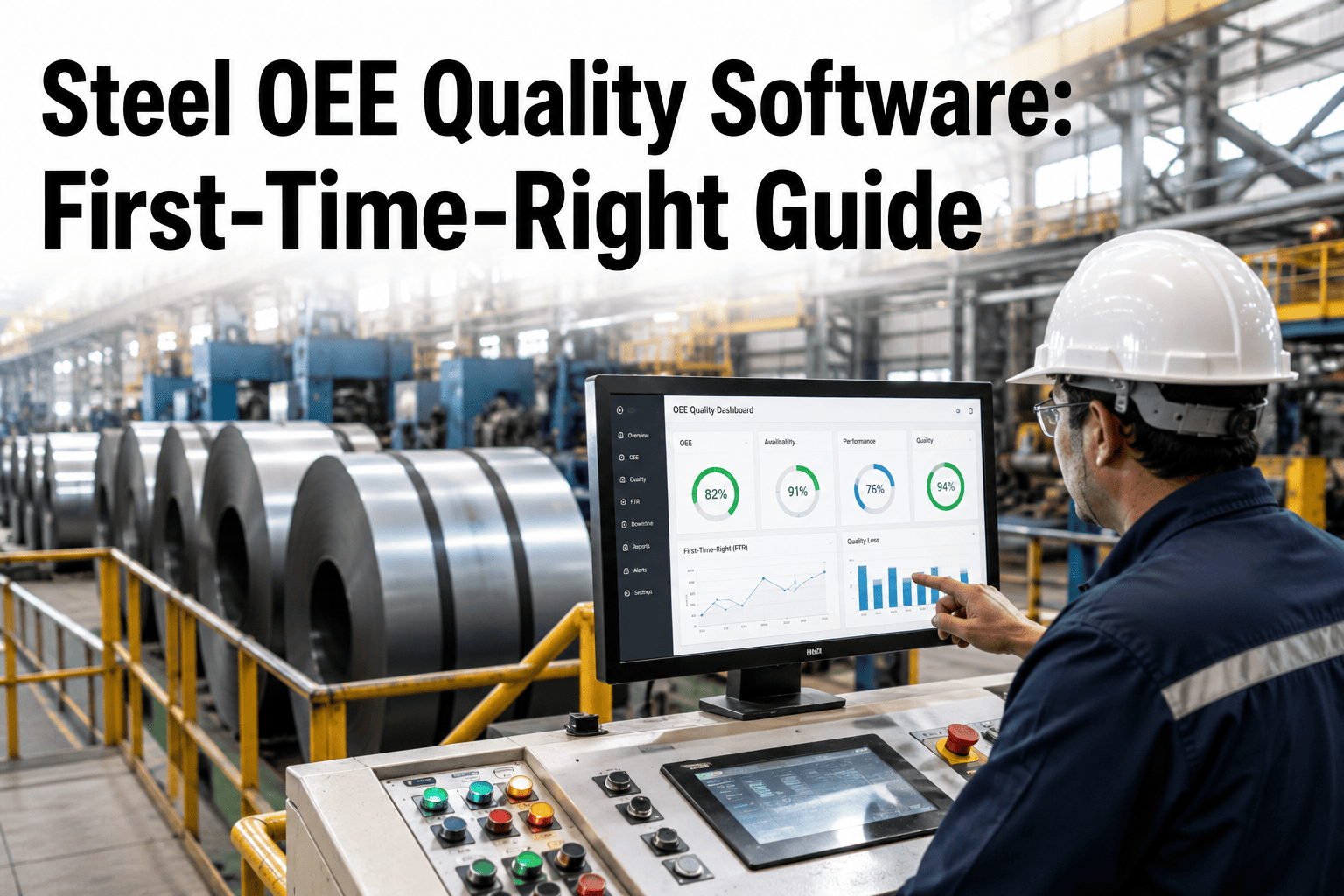
Most steel plants proudly report an OEE number in the 80s, then miss their monthly yield target anyway, and the gap almost always traces back to one factor nobody tracks properly: Quality. Availability and Performance are easy — a stoppage log and a speed reading are enough — but Quality asks a harder question: of everything produced, how much was first-time-right with no rework, no downgrade, and no rejection? Without a system tracking scrap, rework loops, and grade downgrades at the machine level, plants either skip the Quality factor entirely or estimate it from a monthly average, which hides exactly the losses that matter. A CMMS-driven Quality module closes this gap by tying every reject, downgrade, and rework event to the machine, shift, and process step that caused it, turning a rounded-up guess into a real, defensible OEE number.
Vanity OEE vs. Real OEE: The Numbers Side by Side
| Metric | Without Quality Tracking | With CMMS Quality Module |
|---|---|---|
| Quality factor source | Monthly average estimate | Machine and shift-level FTR data |
| Scrap visibility | Total tons only, no cause | Scrap tied to machine, shift, defect type |
| Rework tracking | Not counted in OEE | Counted as a Quality loss, not hidden output |
| Reported OEE | 78% to 85% (often inflated) | 62% to 71% (accurate) |
| Root cause linkage | Manual investigation, days later | Automatic link to work order and asset |
The Quality Factor: Why Most Steel Plants Get OEE Wrong
The OEE formula multiplies three factors together: Availability, Performance, and Quality. Availability tracks how much scheduled time the line actually ran. Performance tracks how close it ran to its rated speed. Quality tracks how much of what was produced was actually good — first-time-right, with no rework and no downgrade. The first two factors come from equipment sensors and are relatively simple to automate. Quality is different because it depends on lab results, visual inspection, and downstream rejection data that often lives in a separate system, updates late, and is recorded at the shift or day level rather than the machine level. Many plants respond by either dropping Quality from the calculation entirely or plugging in a rough estimate, which produces an OEE number that looks strong on a dashboard but does not reflect what customers actually received as first-time-right product. A CMMS-driven Quality module fixes this by capturing every reject, rework, and downgrade event at the point it happens, linked to the exact machine and shift, so the Quality factor becomes measured data instead of a guess.
How CMMS-Driven Quality Tracking Calculates True OEE
Accurate Quality tracking starts at the point where a defect is identified, not at the end of the month. Inspectors and operators log rejects, rework, and downgrades directly against the machine and shift where the product was made, using the same system that already tracks work orders and downtime. Each entry is tagged with a defect type, so the plant can separate a dimensional defect caused by worn rolls from a surface defect caused by a lubrication issue. This tagging is what enables root cause separation: the system can show whether a spike in rejects lines up with an open maintenance alarm on the same machine, a specific batch of incoming material, or a process parameter drifting outside its set range. Once enough of these tagged events accumulate, the CMMS calculates first-time-right percentage automatically for every line, shift, and product grade, and multiplies it into a true OEE figure alongside Availability and Performance. When a defect is traced to a mechanical cause, a corrective work order is generated directly from the quality event, closing the loop between what the customer received and what maintenance does next.
Results After Switching to Real OEE Tracking
A bar and wire rod mill in Ohio had reported OEE in the low 80s for years using an estimated Quality factor. After deploying machine-level scrap and rework tracking across its finishing lines, the true Quality factor came in at 71%, dropping calculated OEE to 64%. The gap traced almost entirely to two causes: a roll wear pattern on one stand producing a recurring dimensional defect, and a changeover procedure generating three to five minutes of off-spec output on every grade switch. Both were fixed within the first quarter — a revised roll change interval and a documented changeover sequence — recovering roughly 4 points of true OEE and reducing customer-facing downgrades by nearly a third.
We thought our OEE problem was downtime. Once we tracked Quality properly, we found out our real problem was a changeover procedure nobody had looked at in years. Fixing it moved the number more than any maintenance project we had running.— Quality Manager, Bar and Wire Rod Mill, Ohio, USA