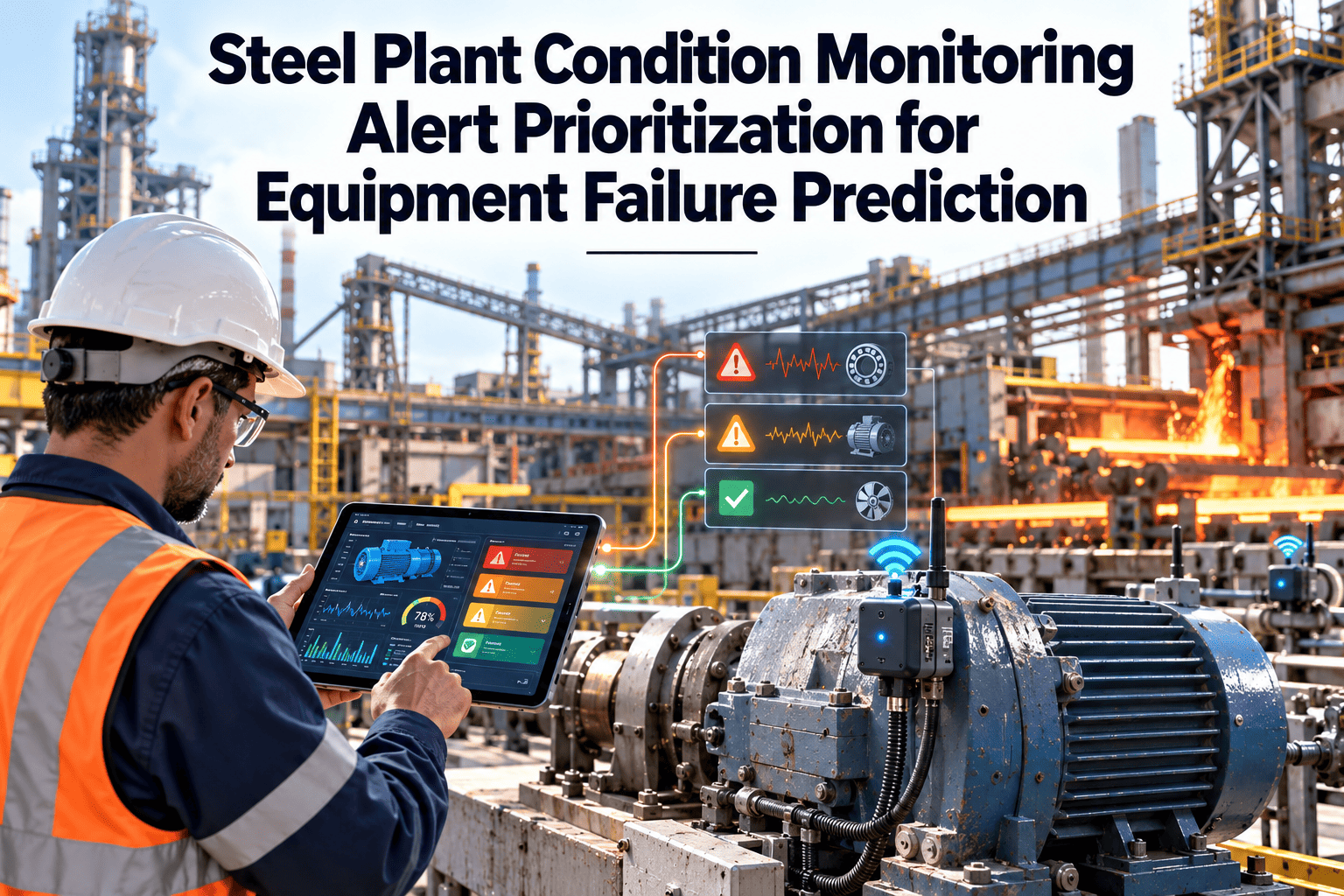
Bearings sit under almost everything that matters in a steel plant: mill stands, fans and blowers, conveyor drives, pumps, gearboxes, cranes and descaling systems. Most of them fail slowly, then suddenly, and the slow part is where a monitoring program earns its keep. This guide explains how to combine vibration, temperature, lubrication condition and failure history into one bearing program for critical assets, and how a steel plant CMMS turns each reading into a scheduled action.
Steel Plant Bearing Condition Monitoring for Reliability
A bearing rarely goes from healthy to seized overnight. It passes through stages that vibration, heat and oil condition can show weeks or months ahead, if someone is trending them. Oxmaint keeps the readings, alarms and work orders for every monitored bearing in one asset record.
Where Bearing Failures Hurt Most in a Steel Plant
Bearings fail everywhere, but the consequences are not equal. A worn idler bearing is a nuisance. A seized roll chock bearing or main drive bearing can stop a line, damage the roll or housing, and take days to recover.
What Actually Drives Bearing Wear
Monitoring only helps if you also remove causes. In steel plants a handful of conditions account for most premature wear.
| Root cause | How it shows up | Best detection | Corrective action |
|---|---|---|---|
| Contaminated or degraded lubricant | Grinding sound, rising temperature, discolored purge | Oil analysis, grease inspection, ultrasonic readings | Flush, replace seals, fix lube routes and intervals |
| Too little or too much grease | Heat from metal contact or churning | Housing temperature trend, ultrasonic level | Set grease quantity per bearing and log each event |
| Misalignment | Elevated vibration at running speed multiples, uneven wear | Vibration spectrum, laser alignment checks | Re-align, check soft foot and coupling condition |
| Unbalance or looseness | Strong vibration at running speed or harmonics | Overall velocity and spectrum | Balance, tighten, repair mounting |
| Water and scale ingress | Corrosion pits, early spalling, seal failure | Oil water content, seal inspection | Upgrade sealing, correct spray patterns |
| Overload and shock | Cage and rolling element damage, axial vibration | Load data with vibration trend | Review process conditions with operations |
| Electrical current through the bearing | Fluting on the race, noise | Inspection at overhaul, motor checks | Insulated bearings or shaft grounding |
Choosing the Right Technique for Each Bearing
No single measurement covers every case. Match the method to the machine's speed, load and consequence of failure.
Overall vibration velocity
Measured in mm/s RMS on the bearing housing. It reads machine condition well and maps to severity zones, but it is largely blind to early bearing defects.
Envelope or demodulated spectrum
Picks out repetitive impacts and compares them with the bearing's defect frequencies on the outer race, inner race, rolling element and cage. This is the main tool for finding bearing faults early.
Temperature
Simple and robust. A rise against the bearing's own baseline, corrected for load and ambient, flags lubrication and friction problems.
Ultrasound
Sensitive to friction and lubrication starvation, and useful on slow bearings where vibration energy is low.
Oil analysis and debris
Particle count, water content and wear metals show how the lubricant is aging and what is wearing inside it.
Acoustic walkaround
A trained ear or stethoscope still catches clicking, knocking, grinding and squealing between instrument readings.
Reading Vibration Against Standards
Many plants still quote ISO 10816 limits. The 10816 parts have been superseded by the corresponding ISO 20816 parts, though the zone limits are widely embedded in existing contracts and monitoring systems. Check which edition your OEMs and sensors follow.
- Casing measurements are typically broadband RMS velocity over roughly 10 to 1,000 Hz.
- Limits depend on machine class, power and mounting, so use the class that fits each asset.
- Set alert levels from each bearing's own baseline as well as the standard, because a change can matter long before a zone boundary is crossed.
- Use accelerometers rated for the housing temperature near hot process areas.
Turn Every Bearing Reading Into a Scheduled Action
Register the bearing, store the baseline and let Oxmaint raise the inspection, lubrication or replacement work when a trend crosses its alert level.
Build the Bearing Register First
Monitoring programs stall when nobody can say which bearings exist. The register is the foundation, and it can start small.
Start with the bearings on your most critical lines, then widen coverage as the data proves its value.
Set Alarm Levels That People Will Act On
Too many false alarms train people to ignore the system. Review thresholds after each confirmed finding and each false positive.
Lubrication Is Part of Condition Monitoring
Plants often run vibration and lubrication as separate programs. They fail together in practice, so link them.
Separate programs
- Grease added on a fixed round, quantity unknown
- Vibration data held in a different tool
- A rising reading does not trigger a lube check
- Seal damage found only at teardown
Linked program
- Grease quantity and date recorded per bearing
- Readings and lubrication events on one asset
- An alert creates a lubrication check first
- Seal condition inspected on a schedule
- Record purge color, debris and smell during greasing.
- Track contamination and water content for oil-lubricated bearings.
- Check seals and breathers, which are cheap to fix and costly to ignore.
From Alert to Replacement: The Work Order Path
Using Failure History to Improve the Program
Every removed bearing is evidence. If teardown findings stay in a workshop notebook, the same failure repeats.
| Question | Data needed | Decision it supports |
|---|---|---|
| Which positions fail repeatedly? | Failure count by asset and position | Redesign, resize or re-seal the position |
| How long did bearings really last? | Install and removal dates, operating hours | Interval and spare stocking |
| Was the failure caught early? | Alert date versus removal date | Whether measurement intervals are right |
| What caused the damage? | Failure codes from teardown | Lubrication, sealing and alignment fixes |
| Which brands or lots underperform? | Supplier and batch on the part record | Purchasing and warranty claims |
Measurement Practice: Getting Data You Can Trust
A trend is only as good as the repeatability of each reading. Most false alarms trace back to inconsistent measurement, not to the bearing.
Special Cases in Steel Plants
Where a failed bearing can destroy a roll or housing, base replacement on condition and inspection at each roll or chock change, not on calendar time alone.
Spare Bearings and Stocking Strategy
Early warning has little value if the part is not available. Link monitoring to stocking so an alert can start a purchase or reservation immediately.
- Classify bearings by criticality and lead time, and hold stock for long-lead, high-consequence positions.
- Reserve the spare against the work order as soon as the alert is confirmed.
- Track refurbished and new units separately, with their service history.
- Record storage conditions and shelf age for greased or sealed bearings.
Evidence Your Auditors and OEMs Will Ask For
Bearing records matter beyond maintenance. They support warranty discussions, insurance reviews and internal reliability audits.
Holding this in the same system that schedules the work means the evidence exists without extra paperwork, and it can be produced in minutes when someone asks.
Common Mistakes That Weaken Bearing Programs
A 90-Day Plan to Launch the Program
People and Skills Behind the Program
Tools do not diagnose bearings on their own. Someone has to measure consistently, interpret the data and decide what to do.
- Train inspectors on measurement points, sensor handling and what abnormal sounds and temperatures look like.
- Give a small group of analysts responsibility for confirming alerts and recommending action.
- Involve lubrication technicians, since many bearing problems start with how grease is applied.
- Hold a short monthly review of confirmed findings with maintenance and operations.
Capture what each finding taught the team in the work order notes, so knowledge stays with the asset when people change roles.
KPIs for the Bearing Program
| KPI | Reading it correctly |
|---|---|
| Bearing failures per period on monitored assets | Should fall as coverage and response improve |
| Lead time from alert to action | Shows whether warnings convert into plans |
| Confirmed findings versus false alarms | Measures threshold quality |
| Unplanned downtime from bearings | Links the program to production impact |
| Lubrication task completion | Tracks the cheapest reliability work in the plant |
How Oxmaint Supports a Bearing Monitoring Program
Frequently Asked Questions
Catch Bearing Wear While You Still Have Options
Bring vibration, temperature, lubrication and failure history into one record. Oxmaint helps your team plan the replacement, not react to the breakdown.