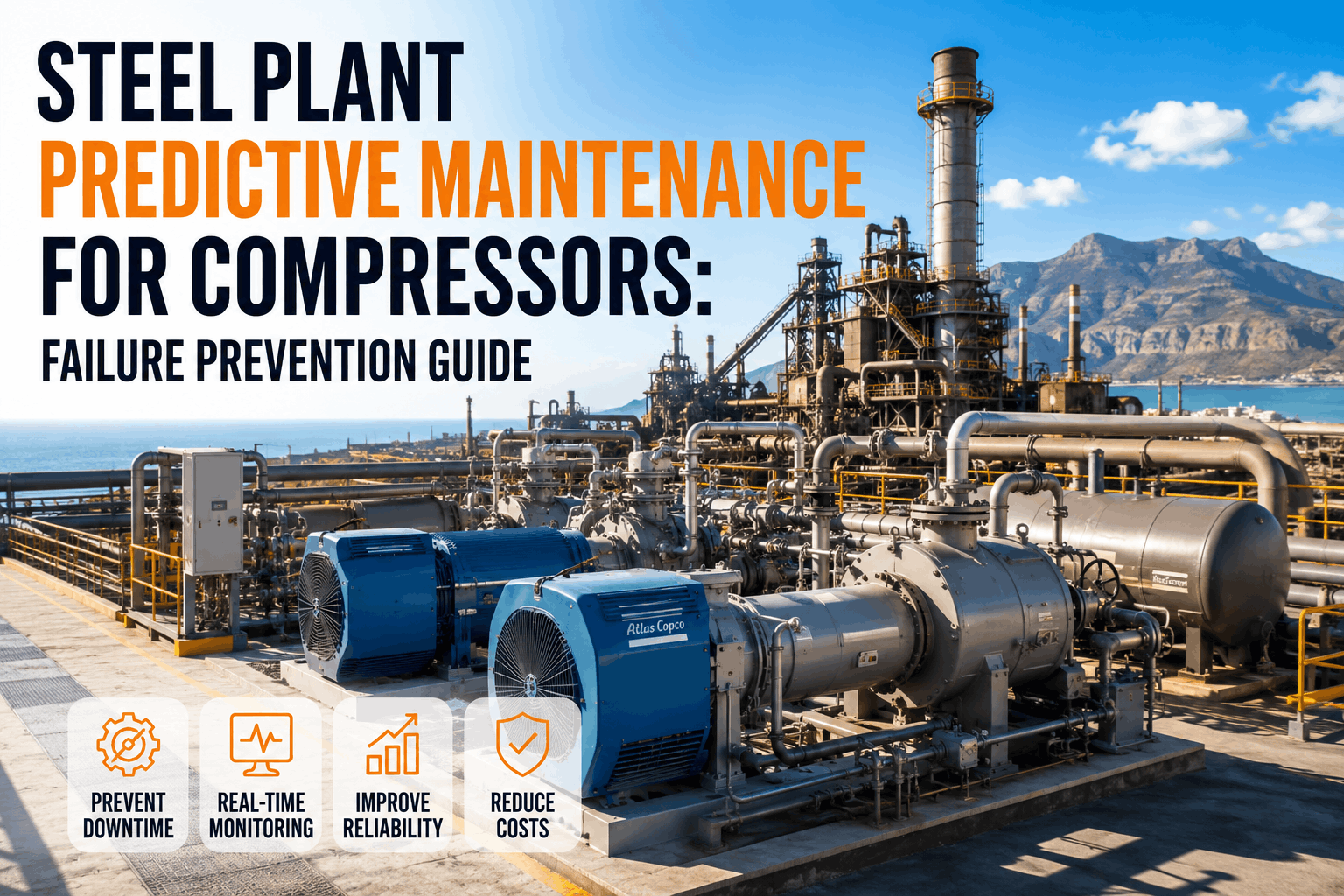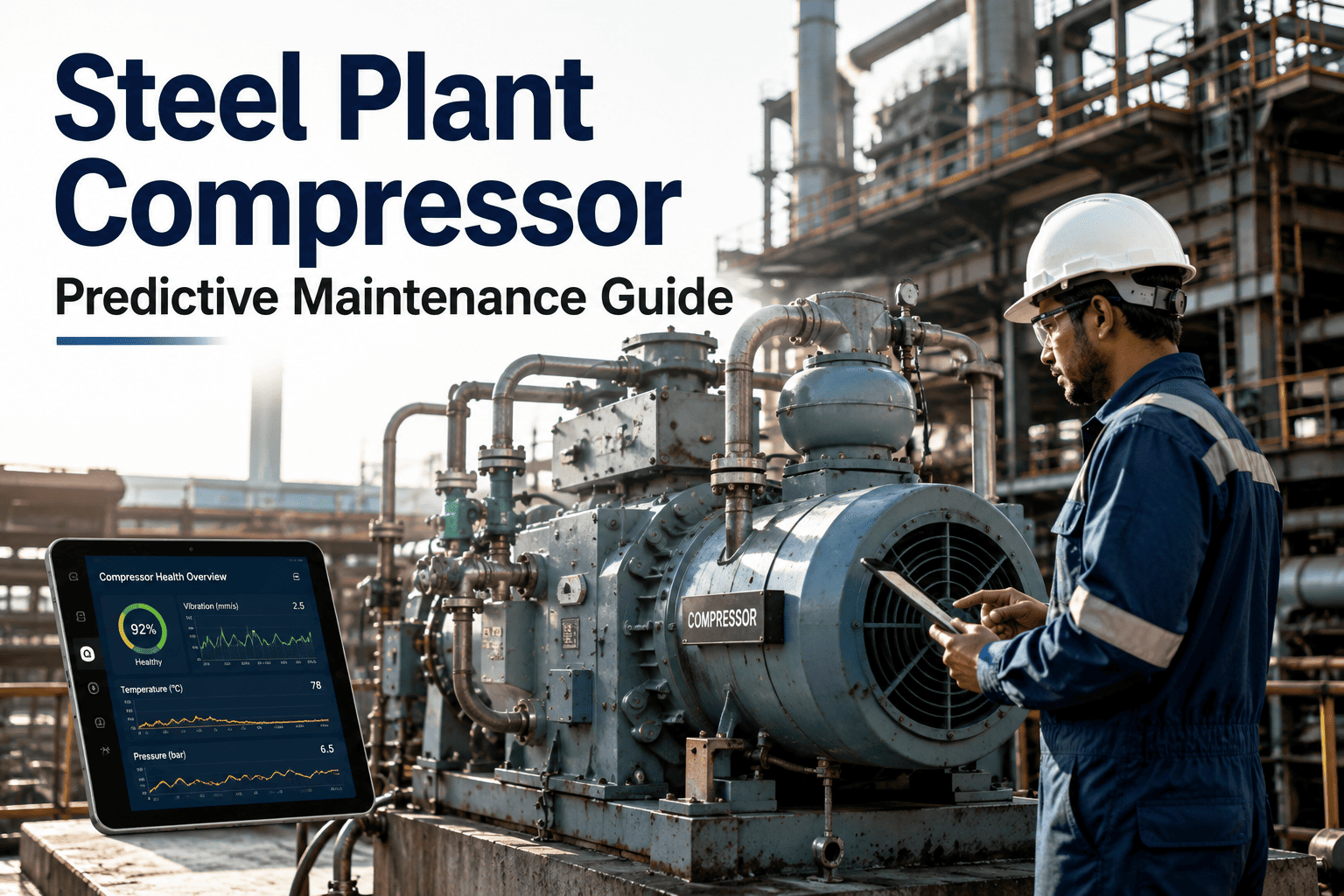
Steel plant compressor maintenance is the linchpin of uninterrupted ironmaking and steelmaking — a single blast furnace blower trip can idle a 10,000-ton-per-day operation and erase $1M+ in revenue over a shift. Predictive maintenance for steel plant compressors shifts reliability teams from reactive firefighting to data-driven planning by combining vibration analysis, oil condition trending, and cooler performance monitoring to detect bearing wear, valve degradation, and capacity drift weeks before failure. By deploying a CMMS like OxMaint to automate work orders, asset tracking, and condition-based triggers, mills protect critical compressed air, oxygen, and nitrogen systems while cutting unplanned downtime 30–50%. Ready to modernize your program? You can Start Free Trial today or schedule a guided walkthrough.
Is a critical compressor failure quietly building in your steel plant right now?
Blast furnace blowers, oxygen compressors, and instrument-air packages run at the edge of their limits. By the time vibration or temperature trips a shutdown, a bearing or valve has already failed. OxMaint catches the trend weeks earlier — turning unplanned outages into scheduled fixes.
Steel plant compressors: which assets need predictive maintenance most?
A typical integrated steel mill operates four to six critical compressor families. Each carries a different failure signature, criticality rating, and monitoring requirement. Here is how a modern steel plant compressor CMMS prioritizes them.
| Compressor Type | Criticality | Primary Failure Modes | Recommended Monitoring |
|---|---|---|---|
| Blast Furnace Blower | Critical — full mill stop | Rotor unbalance, thrust bearing wear, blade erosion | Vibration (ISO 10816), oil debris, discharge temp |
| Oxygen Compressor | Critical — safety & supply | Valve plate fatigue, seal oil degradation, hot spots | Valve chamber temp, oil moisture, intercooler ΔP |
| Nitrogen Compressor | High — purge continuity | Intercooler fouling, capacity-control drift | Capacity trend, stage ΔT, valve lift |
| Instrument Air Compressor | High — automation & valves | Air-end wear, moisture carryover, dryer failure | Dewpoint, motor current, unload cycle frequency |
| Process Air Turbo-Blower | High — BOF / combustion | Surge events, coupling wear, lube oil pressure loss | Surge margin, oil pressure, vibration envelope |
Blast furnace blower maintenance: a predictive monitoring playbook
Blast furnace blower predictive maintenance targets rotor dynamics, bearing health, and aerodynamic stability. Deploy these five condition-based work streams to catch failures 10–21 days before a trip.
Track overall velocity (mm/s RMS) per ISO 10816 and high-frequency envelope (gE) for bearing impacts. A 2× line-frequency spike on a BF blower pinpoints rotor unbalance; an envelope crest factor above 5.0 signals early outer-race spalling. Configure automatic work-order generation when either trend breaches 60% of alarm threshold.
Sample main and auxiliary oil every 500 operating hours or 30 days. Trend viscosity, water content (target <50 ppm for turbomachinery), particle count (ISO 4406 ≤16/14/11), and ferrous debris index. A 3× rise in ferrous particles over three consecutive samples indicates active bearing or gear wear — trigger a borescope inspection immediately.
Log intercooler and aftercooler inlet-to-outlet temperature differential and compare against design ΔT. A 15–20% narrowing of the ΔT band over 90 days signals tube fouling or cooling-water flow restriction. Schedule off-line tube cleaning before discharge temperature forces a derate or trip.
For variable-inlet and IGV-controlled blowers, trend actual vs. commanded capacity at matched discharge pressures. Capacity drift exceeding 5% indicates IGV linkage wear, controller calibration loss, or internal seal degradation. Simultaneously monitor surge margin — a narrowing margin below 10% demands antisurge-valve recalibration.
On reciprocating oxygen and process compressors, embed surface thermocouples on each valve chamber. A single valve running 8–12°C above its siblings indicates leaking plates or broken springs. Tag the valve for replacement during the next planned outage — a 30-minute swap prevents a crosshead failure that costs 48+ hours of downtime.
Cost of reactive vs. predictive steel compressor maintenance
A mid-sized integrated mill running 180 critical assets typically spends $42K–$80K per year on unplanned compressor repairs, emergency labor, and expedited spare parts. Predictive maintenance backed by a CMMS flips that cost structure — and pays back fast.
Example: A blast furnace blower bearing detected 14 days early saves 36 unplanned outage hours. At $50K/hr lost production value, $8K emergency repair premium, and $4K expedited freight, a single avoided failure returns $1.812M — against an annual PdM + CMMS investment of $60K.
| Metric | Reactive / Calendar-Based PM | Predictive + CMMS (OxMaint) |
|---|---|---|
| Unplanned compressor downtime / yr | 120–200 hours | 40–80 hours |
| Mean time to detect failure | At trip or after damage | 10–21 days before trip |
| Emergency repair premium | $8K–$15K per event | $0–$2K (scheduled labor) |
| Spare-parts rush freight | $4K–$12K per event | $0 (stocked from inventory forecast) |
| Compliance & audit readiness | Manual logbooks, gaps common | Full digital audit trail, ISO 55000 aligned |
| Annual maintenance cost / asset | $8K–$12K | $4K–$7K |
How to deploy compressor predictive maintenance in a steel plant — 6-month roadmap
Moving from reactive steel plant blower PM to a full predictive program is a phased effort. Here is a proven six-month timeline that most mills can execute with a dedicated reliability engineer and a CMMS.
Register all compressors in the CMMS. Rank by criticality (A/B/C). Capture design specs, OEM manuals, baseline vibration spectra, and current oil samples. Define ISO 10816 alarm zones per machine.
Install permanent vibration sensors on A-critical blowers and oxygen compressors. Define portable data-collection routes for B/C assets. Connect oil analysis lab results to the CMMS asset record.
Convert calendar-based PMs to condition-based triggers. Configure the CMMS to auto-generate work orders when vibration, temperature, or oil trends breach thresholds. Eliminate redundant PMs.
Map bill-of-materials for each compressor to spare-parts stock. Set min/max levels driven by PdM failure predictions. Pre-stage bearings, valves, and seals for A-critical machines to cut repair lead time 60%.
Launch maintenance analytics dashboards. Track MTBF, MTTR, planned-vs-unplanned downtime ratio, and PdM coverage percentage. Begin weekly reliability huddles around the data.
Quantify downtime reduction and cost savings. Present ROI to leadership. Expand predictive routes to pumps, motors, and fans. Refine alarm thresholds based on six months of operating data.
Book a 30-minute demo — watch OxMaint catch a compressor fault before it trips your line
Bring your top three critical compressors. We will load them into a live workspace, map your PdM triggers, and show the work-order automation end-to-end.
How OxMaint powers steel plant compressor predictive maintenance
OxMaint is an AI-powered CMMS and EAM platform built for maintenance and reliability teams. It connects condition data, work orders, spares, and analytics into one system — so compressor CMMS workflows are automated, not manual.
Connect vibration, oil, and temperature data to automatic work-order generation. When a BF blower bearing trend breaches threshold, OxMaint creates, assigns, and prioritizes the work order — no manual entry. Cut unplanned downtime 30–50%.
Maintain a complete digital twin of every compressor — design specs, OEM manuals, BOM, maintenance history, and condition baselines in one record. Full traceability for ISO 55000 and internal audits.
Link PdM failure predictions to inventory min/max levels. OxMaint pre-stages bearings, valves, and seals before a predicted failure — eliminating $4K–$12K per-event rush freight and cutting repair lead time 60%.
Real-time MTBF, MTTR, planned-vs-unplanned downtime, and PdM coverage across all compressors. AI-driven failure prediction surfaces the top 5 at-risk assets every week — so reliability engineers focus where it matters.
We deployed OxMaint across our blast furnace blowers and oxygen compressors. Vibration trending caught a main bearing fault 12 days before it would have tripped the furnace. That single save paid for the platform for three years.
Steel plant compressor maintenance — your questions answered
Predictive maintenance for steel plant compressors uses condition-monitoring data — vibration analysis, oil sampling, temperature trending, and capacity tracking — to detect bearing wear, valve degradation, and cooler fouling 10–21 days before failure. Unlike calendar-based PM, it triggers work orders only when asset condition demands it, reducing unnecessary maintenance while preventing unplanned downtime. A CMMS like OxMaint automates the data-to-work-order workflow.
Blast furnace blowers should have continuous vibration and temperature monitoring with monthly oil sampling and quarterly borescope inspections. Major overhauls typically follow OEM hour-based intervals (40,000–80,000 hours), but a condition-based program may extend that by 15–20% if PdM data confirms healthy internals. Never skip monthly oil analysis — it is the single most cost-effective early-warning tool. You can set up these schedules automatically when you Start Free Trial with OxMaint.
ISO 10816 (or its successor ISO 20816) is the primary standard for measuring and evaluating mechanical vibration of reciprocating and turbomachinery compressors. It defines severity zones (A through D) based on RMS velocity in mm/s. Most steel plants set alarm thresholds at the zone B/C boundary (typically 3.5–7.1 mm/s depending on machine class) and trip at the zone C/D boundary. OxMaint lets you configure per-asset alarm zones aligned to ISO 20816.
A CMMS centralizes asset records, automates work-order generation from condition triggers, tracks spare-parts inventory against PdM predictions, and provides maintenance analytics (MTBF, MTTR, downtime cost). It replaces spreadsheets and paper logs with a digital audit trail aligned to ISO 55000. Steel plants using a CMMS typically cut unplanned compressor downtime 30–50% and reduce emergency repair premiums by 70–90%. Book a walkthrough at calendly.com/oxmaintapp/30min to see it live.
The most common oxygen compressor failures are valve plate fatigue (cracked or broken plates from cyclic loading), seal oil degradation leading to contamination, intercooler tube fouling causing elevated discharge temperatures, and capacity-control drift from worn inlet valves. Oxygen service adds fire-risk severity, so discharge temperature monitoring per valve chamber is critical. A 8–12°C rise on one valve compared to its siblings is the leading indicator of imminent valve failure.
Stop reacting to compressor failures — start predicting them
Join the steel plants using OxMaint to protect blast furnace blowers, oxygen compressors, and instrument-air systems with AI-powered predictive maintenance. Deploy in days, see ROI on the first avoided failure.
Free 14-day trial · No credit card