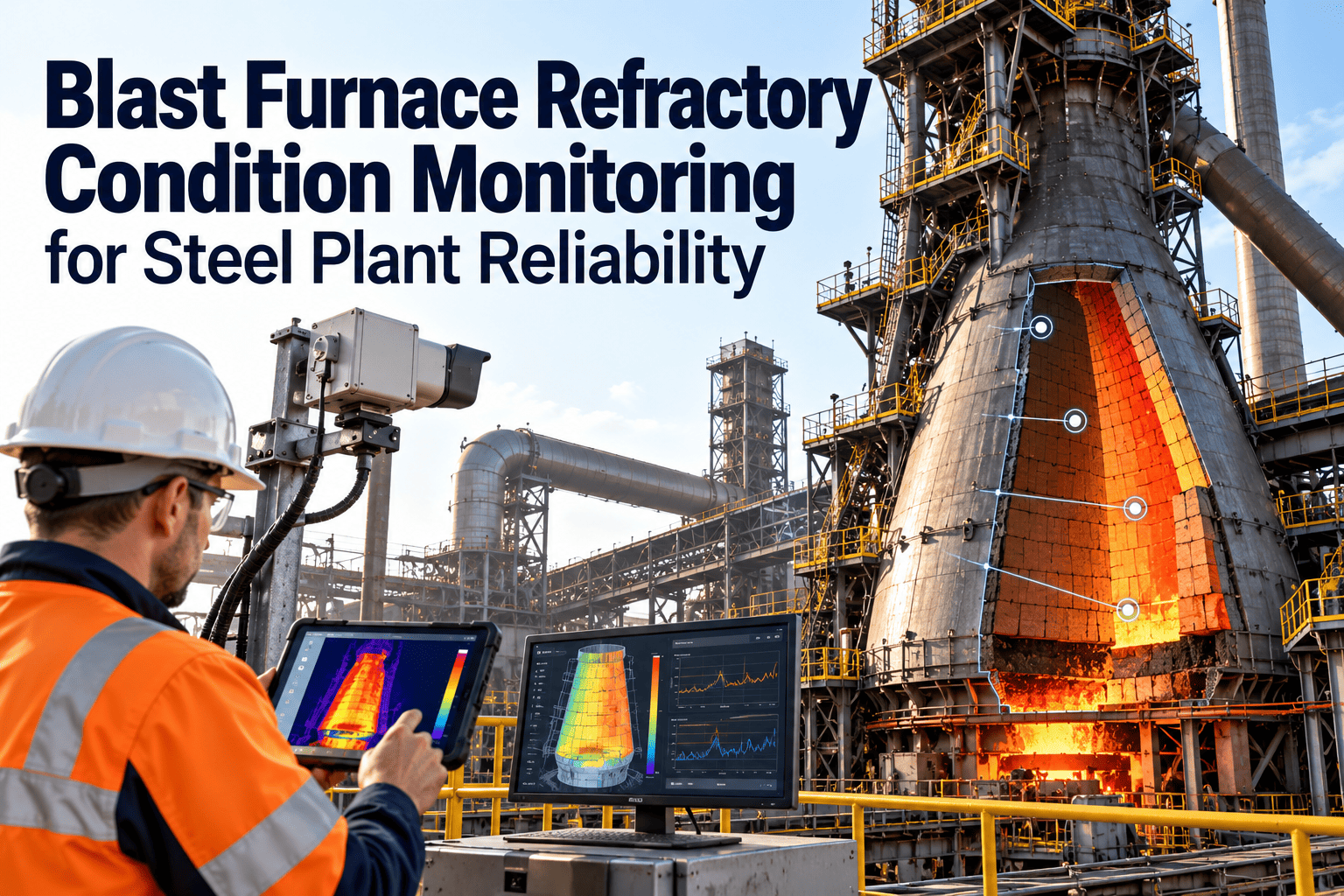
Modern blast furnaces employ sophisticated turbo-blower maintenance programs combining vibration monitoring, oil analysis, surge protection, and predictive analytics to prevent unplanned failures. With blower motors reaching 29 MW and compressors handling flows up to 1.5 million cubic meters per hour, these machines represent both massive capital investments and single points of failure that can halt an entire steel plant. Understanding blower failure modes and implementing proactive maintenance strategies is the difference between controlled operations and disaster.
Why Blower Reliability is Non-Negotiable
The blast furnace blower occupies a unique position in steel plant operations—it cannot simply be shut down for maintenance without triggering a cascade of consequences that extend far beyond the blower house.
Uncontrolled Shutdown
Blower failure causes immediate loss of blast pressure, leading to uncontrolled furnace shutdown. Slag enters tuyeres and bustle main, requiring extensive recovery procedures. Unlike planned shutdowns with 34-step procedures over 30 days, emergency stops cause severe operational damage.
$500,000+/Hour Losses
Steel and metallurgy sectors experience average hourly downtime costs exceeding $500,000. A 4-day cooling period plus 1 day maintenance plus 3-day restart means 8 days minimum for even minor repairs—representing millions in lost production.
Gas Backflow Risk
The snort valve must maintain positive pressure to prevent blast furnace gas from traveling back into the blower system. Blower failure with improper valve response creates explosion and poisoning hazards from carbon monoxide-rich furnace gas.
Turbo-Blower Types and Configurations
Different furnace sizes and operational requirements demand different blower configurations. Understanding these differences is essential for effective maintenance strategy development.
Centrifugal Turbo-Blowers
Most blast furnaces are equipped with centrifugal turbo-blowers provided with three or four stages. These machines compress atmospheric air to the required pressure through multiple impeller stages.
Axial Compressors
Very large blast furnaces use axial compressors that handle massive volume flows within relatively small casings. Modern designs deliver up to 1.5 million m³/hour at pressures up to 25 bar.
High-Speed Turbo Blowers
Modern high-speed designs use permanent magnet motors with variable frequency drives, achieving speeds up to 60,000 RPM. Air bearing and magnetic bearing variants offer reduced maintenance.
BPRT Integrated Systems
Blast Furnace Power Recovery Turbine (BPRT) systems integrate the blower with a top gas recovery turbine on a common shaft, recovering energy from blast furnace gas to reduce net power consumption.
Implement Comprehensive Blower Monitoring
Protect your blast furnace operations with real-time vibration analysis, oil condition monitoring, and predictive maintenance analytics.
Critical Failure Modes
Understanding blower failure mechanisms enables targeted monitoring and prevention strategies. Each failure mode has distinct signatures and prevention approaches.
Surge
CriticalMechanism: Violent flow reversal when process restricts compressor flow below minimum. Gas surges backward through the compressor at frequencies of 0.6-2.5 Hz typically.
Damage: Rotor shifts axially, slamming into thrust bearings. Dry gas seals (with tolerances of ten-thousandths of an inch) are severely damaged. Bearing failure follows rapidly.
Detection: Axial vibration increase, flow reversal frequency monitoring (0.4-8 Hz range), sudden efficiency loss, characteristic noise.
Prevention: Anti-surge control systems with bypass/recycle valves, proper surge margin maintenance, real-time operating point monitoring on HMI.
Choke (Stonewall)
CriticalMechanism: Compressor operates at maximum flow with insufficient process restriction. Gas velocity increases beyond design limits, particularly dangerous in axial compressors with narrow operating margins.
Damage: Blade damage and catastrophic failure in axial compressors. Months of production loss reported from undetected choke events. Often overlooked as OEMs focus on surge protection.
Detection: Acceleration peaks near blower inlet, HMI graphic showing choke line proximity, specialized monitoring independent from anti-surge systems.
Prevention: Install anti-choke valve downstream of anti-surge blowoff, independent anti-choke control, proper valve sizing for unloaded conditions.
Bearing Failure
HighMechanism: Progressive degradation of journal or thrust bearings from lubricant contamination, misalignment, or thermal stress. Fluid-film bearings operate on oil films as thin as 1/10 mm.
Damage: Without effective cooling/lubrication, bearing seizure occurs. Shaft damage, seal destruction, and potential catastrophic rotor failure follow.
Detection: Proximeter probes measure shaft-to-bearing gaps to 1/100 mm precision. Vibration signature changes, temperature rise, oil analysis showing wear metals.
Prevention: Continuous vibration monitoring, oil analysis every 3 months, proper lubricant selection, temperature monitoring.
Misalignment
HighMechanism: Coupling misalignment between driver (motor) and driven (compressor) equipment. High angular stiffness couplings transmit excessive loads to bearings during thermal growth.
Damage: Immediate bearing damage during cold startup if pre-set alignment is incorrect. Seal and vibration damage reported within one month of operation in documented cases.
Detection: Inboard bearing vibration exceeding alarm/trip limits, bearing temperature rise, coupling inspection during shutdowns.
Prevention: Proper coupling selection (lower angular stiffness), comprehensive rotordynamic analysis, thermal growth compensation, laser alignment verification.
Lubrication Failure
HighMechanism: Oil degradation from oxidation, contamination, or thermal breakdown. Viscosity changes outside ±10% limits indicate critical condition. Acid number >3 signals corrosive conditions.
Damage: Accelerated wear of gears, bearings, and seals. Varnish formation restricts oil passages. Heat buildup from friction causes cascading failures.
Detection: Oil analysis showing viscosity deviation, elevated acid number, wear metal presence (Fe, Cu, Al), water contamination, visual inspection (black/brown oil).
Prevention: Oil changes every 500-1000 hours, quarterly oil analysis, proper oil selection with R&O inhibitors, temperature control, filtration.
Mechanical Looseness
MediumMechanism: Fasteners loosen over time from vibration and thermal cycling. Foundation settling, improper torque during assembly, or fretting corrosion at interfaces.
Damage: Increased vibration accelerates wear throughout the machine. Pipe fatigue failures from excessive movement. Foundation interface degradation.
Detection: Vibration increases at harmonics of running speed, visible fretting corrosion (reddish-brown dust), pipe movement observation.
Prevention: Proper torque specifications, vibration monitoring for trending, periodic bolt checks, foundation inspections.
Condition Monitoring Technologies
Comprehensive blower monitoring integrates multiple technologies to provide complete visibility into machine health and early warning of developing problems.
Vibration Analysis
Core predictive technology for rotating machinery. Every component produces unique vibration signatures—bearings, gears, rotors, impellers. Trending reveals degradation patterns months before failure.
Oil Analysis
Lubricant condition reveals both oil health and machine wear. Spectroscopic analysis identifies wear metal sources—iron from gears, copper from bearings, aluminum from seals.
Temperature Monitoring
Bearing temperatures, motor windings, oil temperatures, and discharge temperatures provide direct indication of thermal stress and cooling system effectiveness.
Surge/Choke Protection
Real-time operating point monitoring relative to compressor map limits. Anti-surge and anti-choke controls prevent operation in unstable regions.
Performance Monitoring
Efficiency calculations from flow, pressure, and power measurements reveal degradation from fouling, wear, or seal leakage before vibration signatures appear.
Control System Diagnostics
PLC/DCS integration for complete system health—actuator positions, valve responses, sensor validation, and communication integrity.
Maintenance Schedule Framework
Effective blower maintenance combines time-based, condition-based, and predictive approaches to maximize reliability while minimizing unnecessary interventions.
| Interval | Task | Method | Key Parameters |
|---|---|---|---|
| Continuous | Vibration monitoring | Online system | Alarm at 1x, 2x running speed changes |
| Continuous | Bearing temperature | RTD/thermocouple | Alarm 10°C above baseline, trip 20°C |
| Continuous | Surge/choke monitoring | Control system | Operating point relative to limits |
| Daily | Visual inspection | Operator rounds | Leaks, noise, unusual conditions |
| Weekly | Oil level check | Sight glass | Middle of glass when stopped |
| Monthly | Filter differential pressure | Gauge reading | Replace at specified ΔP |
| Quarterly | Oil analysis | Laboratory | Viscosity, AN, wear metals, water |
| 500-1000 hrs | Oil change | Drain and fill | Or per oil analysis results |
| Semi-annual | Comprehensive vibration | Portable analyzer | Full spectrum analysis, trending |
| Annual | Alignment verification | Laser alignment | Thermal growth compensation |
| Annual | Control system calibration | Instrument technician | Transmitters, actuators, valves |
| Major Overhaul | Complete inspection | Planned outage | Bearings, seals, impellers, casing |
Vibration Analysis Best Practices
Vibration monitoring is the cornerstone of turbo-blower predictive maintenance. Proper implementation requires understanding both the technology and the machine-specific signatures.
Collect baseline vibration data immediately after installation or overhaul. This "birth certificate" enables meaningful comparison throughout the machine's life. Include full spectrum analysis at multiple load points.
- Measure at design operating conditions
- Document ambient temperature and load
- Capture startup and coastdown data
- Store original alignment records
Install sensors at each bearing location in horizontal, vertical, and axial directions. The horizontal direction is most sensitive to unbalance and misalignment. Proximeter probes for fluid-film bearings.
- Driver inboard and outboard bearings
- Compressor inboard and outboard bearings
- Gearbox input and output shafts
- Axial position (thrust) monitoring
Each fault type produces characteristic vibration patterns. Training and experience are necessary to recognize patterns in spectrum and time waveform plots.
- Unbalance: 1× running speed, in-phase
- Misalignment: 2× running speed dominant
- Bearing defects: Specific frequencies (BPFO, BPFI, BSF)
- Looseness: Harmonics of running speed
Set alarm and trip levels based on machine-specific data, not generic standards. Operators lose confidence in systems that generate spurious alarms. ISO 10816 provides guidance.
- Alarm: 2× baseline or absolute limit
- Trip: 4× baseline or critical limit
- Trending: 20% change triggers investigation
- Validate with process correlation
Oil Analysis Program
Lubricant analysis provides insight into both oil condition and machine wear without disassembly. A systematic program catches problems months before they cause failure.
Essential Oil Tests
Primary indicator of oil condition. Changes indicate oxidation, contamination, thermal degradation, or wrong lubricant.
Measures acid concentration from oxidation. High AN indicates corrosive conditions requiring immediate oil change.
Iron (gears), Copper (bearings), Aluminum (seals). Trending reveals wear rate acceleration indicating developing problems.
Water accelerates oxidation and reduces lubricant film strength. Indicates cooler leaks or condensation issues.
Oil Program Best Practices
- Sampling consistency: Same location, same conditions, same procedures every time
- Sample while running: Captures suspended particles before settling
- Baseline new oil: Establish virgin oil reference for comparison
- Quarterly minimum: More frequent for critical equipment
- Track trends: Single values less meaningful than trending
- Correlate with events: Document oil changes, repairs, load changes
Air Blast System Integration
The blower operates within a complex air blast system. Effective maintenance requires understanding these interconnections and their impact on blower operation.
Turbo-Blower
Compresses atmospheric air to required pressure. Surge protection critical. Must maintain positive pressure to prevent gas backflow.
Cold Blast Main
Connects blower to hot blast stoves. Temperature 150-250°C from compression heat. Includes snort valve for rapid pressure release.
Hot Blast Stoves
Regenerative heaters preheat blast air to 1,000-1,300°C. Cyclic operation with valves coordinated with blower output.
Tuyeres
Water-cooled copper injectors deliver hot blast to furnace. 20-40 tuyeres around circumference. Failure affects blast distribution.
Critical Valves Affecting Blower Operation
| Valve | Function | Blower Impact |
|---|---|---|
| Snort Valve | Rapid pressure decrease to atmosphere | Must maintain positive pressure—prevents gas backflow to blower |
| Hot Blast Valve | Isolates individual stoves | Affects downstream resistance, impacts operating point |
| Cold Blast Valve | Regulates flow to each stove | Malfunction can cause surge from sudden resistance change |
| Atmospheric Valve | Releases stove to chimney | Improper operation changes system pressure dynamics |
| Anti-Surge Valve | Bypass/recycle during low demand | Critical protection—failure leads to surge damage |
A major integrated steel plant implemented comprehensive turbo-blower condition monitoring combining vibration analysis, oil program, and predictive maintenance.
Approach: Continuous online vibration monitoring with proximeter probes at all bearings, quarterly oil analysis with trending, integration with plant DCS for alarm management.
Key Finding: Vibration trending detected bearing degradation 3 months before predicted failure, enabling planned repair during scheduled furnace maintenance rather than emergency shutdown.
ROI: Single avoided emergency shutdown (valued at $4M+ in lost production) paid for 10 years of monitoring program costs.
Protect Your Blast Furnace Blower Investment
Implement comprehensive condition monitoring with vibration analysis, oil program management, and predictive maintenance to ensure continuous reliable operation.