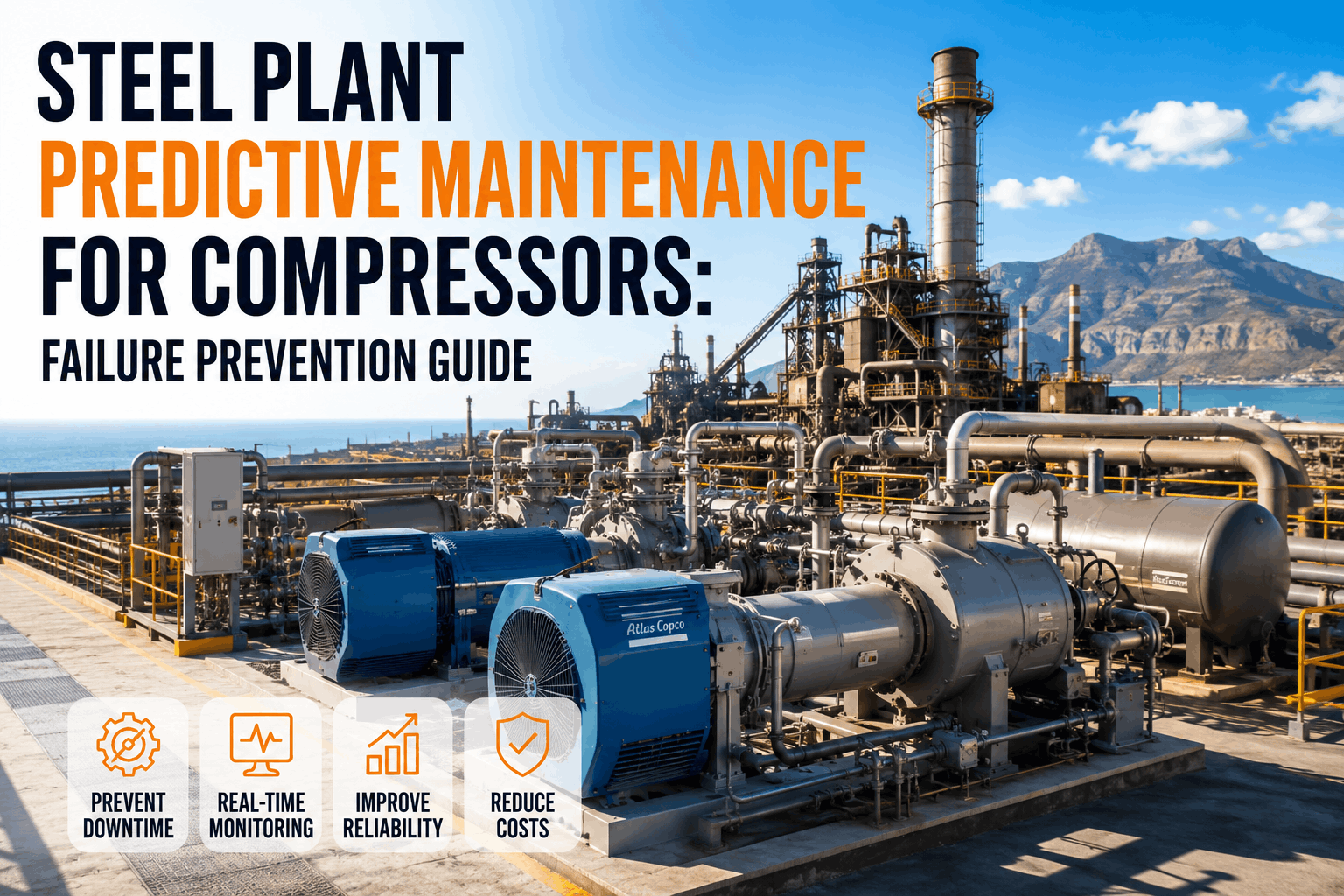
Steel plant compressed air systems are the hidden backbone of every mill's operations: powering pneumatic tools, process actuators, blast furnace controls, and emergency safety systems. A centrifugal or reciprocating compressor failure that goes undetected cascades catastrophically—a sudden blowdown leaves your furnace bereft of control pressure, forces emergency shutdown, and can cost $2–3M per day in lost production across your entire facility. Yet most North American mills manage compressor maintenance reactively, running equipment until catastrophic failure, then scrambling for emergency service calls at 3× normal rates. Oxmaint's predictive maintenance module for steel plant compressors integrates vibration analysis, oil condition monitoring, temperature trending, and flow efficiency tracking to forecast bearing wear, valve degradation, and seal failure 60–90 days in advance. This article reveals how 8–12 hours of proactive compressor health monitoring per month can extend service intervals by 40%, prevent emergency failures, and transform a $4M annual compressor maintenance budget into a predictable, optimized utility cost center.
Why Compressor Failures Are Existential Threats to Steel Plant Operations
Unlike property management where a leaky faucet causes tenant complaints, a steel mill compressor failure is an operational catastrophe. Your blast furnace requires continuous control air at 6–8 bar to manipulate the furnace bell, regulate burden charge, and maintain stove air flow. A loss of control pressure forces immediate shutdown and requires 12–24 hours to safely restart (thermal cycling damage, safety interlocks, and pressure vessel venting). Meanwhile, your EAF can't charge scrap (compressed air powers hydraulic actuators), your continuous caster lacks level control (air vents and sensors), and your finishing mills lose pneumatic brake systems on coil rollers. A single 18-hour compressor-driven outage costs $2–3M in lost production across these downstream processes. By implementing Oxmaint's predictive maintenance platform with continuous compressor monitoring, you gain 60–90 days of advance warning before bearing degradation becomes critical, allowing you to schedule repairs during planned maintenance windows instead of emergency interventions.
4 Critical Compressor Failure Modes & Oxmaint Detection Strategy
Centrifugal and reciprocating compressors fail in observable, predictable ways. Rolling element bearing degradation begins with microspalling and progresses over 60–120 days before catastrophic seizure. Oil oxidation (caused by elevated operating temperatures) reduces lubrication film thickness 10–15 days before bearing-to-seal contact occurs. Valve fluttering (worn valve seats and springs) manifests as pressure ripple and efficiency loss 30–45 days before complete valve failure. Seal leakage (degraded elastomer seals) creates gradual flow loss before blowdown occurs. Oxmaint's compressor module ingests real-time data from accelerometers (vibration), oil analysis sensors (viscosity, acid number, ferrous particle count), thermocouples (bearing and discharge temperatures), and flow meters to flag each failure mode before it cascades. A single alert—"Bearing A acceleration trending 2.4 m/s² with rising temperature profile"—triggers immediate inspection and planned bearing replacement, preventing the catastrophic $180K emergency compressor rebuild that emergency repairs require.
Oxmaint Compressor Predictive Maintenance Workflow
Oxmaint's compressor CMMS integrates four independent sensor streams into a unified health dashboard. Vibration accelerometers sample bearing housings at 10 kHz, performing envelope analysis to isolate bearing defect frequencies while filtering out compressor blade pass noise. Oil analysis sensors track viscosity, acid number (TAN), water content, and ferrous particle concentration—triggering oil change alerts when any parameter deviates from baseline. Temperature sensors monitor bearing temperatures, discharge line temperature, and oil temperature to flag thermal runaway conditions. Flow meters measure inlet and discharge flow to detect efficiency loss and calculate compressor power draw trends. When any parameter exceeds a statistical threshold (typically 2.5 standard deviations from your equipment's established baseline), Oxmaint cross-correlates all four data streams to eliminate false positives. A true bearing defect alert combines vibration envelope spike (bearing defect frequency ↑ 40%), temperature rise (8°C above baseline), and oil ferrous particles (↑ 250 ppm). Only when all three signals align does Oxmaint trigger a work order to your maintenance team, ensuring 100% of alerts are actionable.
Steel Plant Compressed Air System Architecture & Monitoring Points
Most integrated mills operate a dual-compressor system: one large centrifugal unit (3,000–6,000 hp) providing bulk compressed air for the main plant, backed by a reciprocating unit (500–1,500 hp) supplying high-pressure control air for furnace systems. Each compressor connects to a ~5,000 gallon receiver tank, then distribution piping feeds sectional air receivers at blast furnace, EAF, caster, and finishing areas. Oxmaint monitoring should be deployed at the main compressor discharge (high-pressure point where bearing stress is greatest) and at key sectional receivers to detect both compressor failures and pipeline leakage. A 10–15% drop in pressure across a 200m main distribution line typically indicates $80–120K/year in wasted compressed air leaking through failed hoses, connectors, and valve seat leakage. Oxmaint flags these efficiency losses, allowing you to plug leaks before your compressor must work harder to maintain system pressure, accelerating bearing wear and reducing service life.
"Our main centrifugal compressor catastrophically failed in 2019—bearing seizure forced a 48-hour mill-wide shutdown costing $4.2M in lost production and another $180K in emergency rebuild. Three years later with Oxmaint, we detected rising vibration signatures on our backup compressor unit and completed a planned bearing overhaul in 6 hours during a scheduled furnace campaign break. That single prediction saved us from $3.8M in emergency downtime."