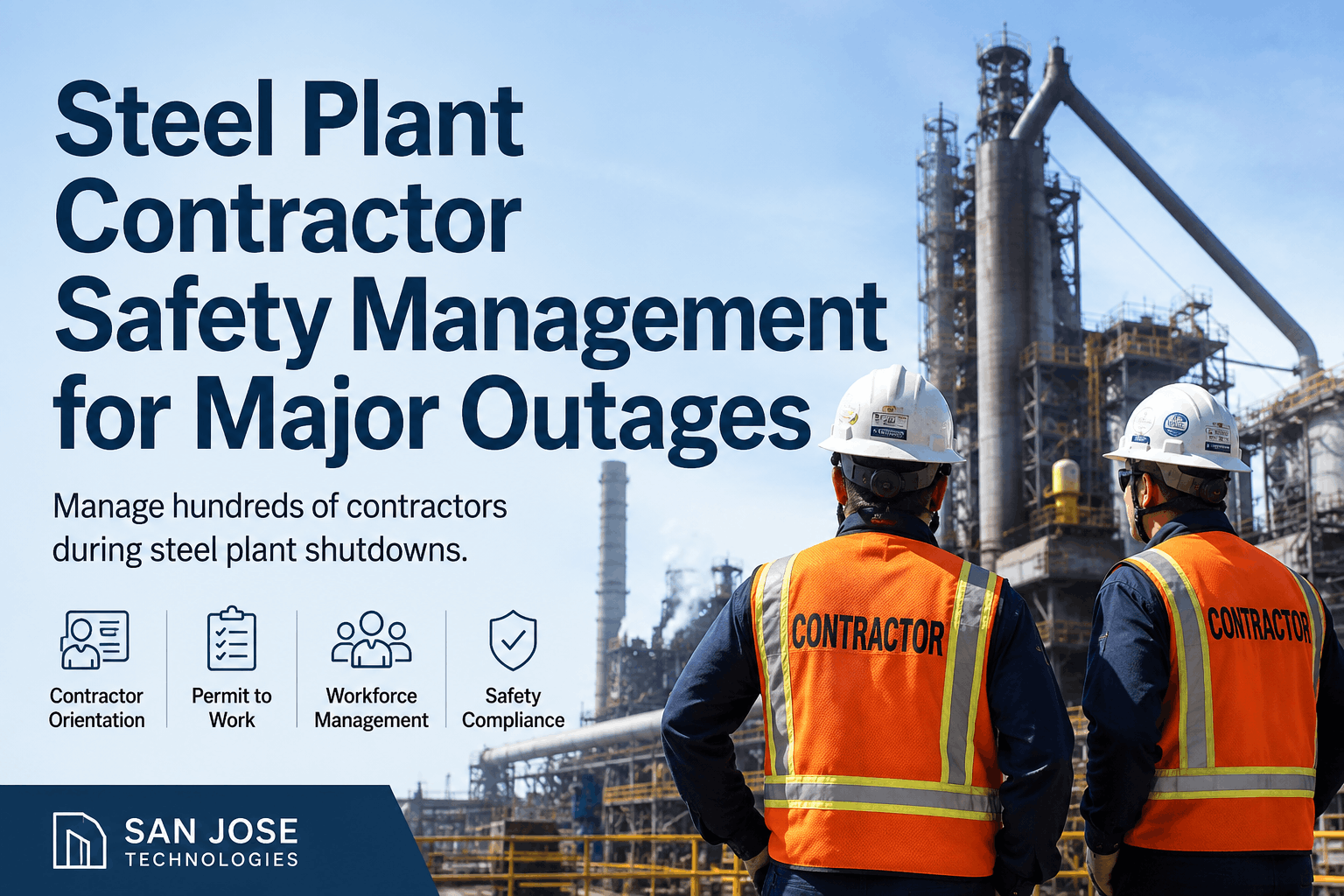
Steel plants reported 67 fatalities globally in 2024, with contractor vulnerabilities identified as a critical safety gap by the World Steel Association.Effective contractor safety management starts before the first toolbox talk: pre-qualification criteria that verify safety performance, structured site orientation programs that build shared safety culture, and CMMS-integrated permit systems that maintain control across every contractor activity. Book a demo to see how OxMaint's contractor management module transforms external workforce safety from compliance paperwork into proactive risk control.
Steel Plant Contractor Safety Management: Pre-Qualification, Orientation & Monitoring
Pre-qualification screening, automated orientation tracking, permit-to-work integration, and real-time contractor performance monitoring — built into your existing CMMS for seamless multi-employer safety management.
Why Contractor Safety Breaks Down in Steel Plants
Steel manufacturing involves inherent process safety hazards — molten metal at temperatures exceeding 1000 degrees celsius, confined spaces within furnaces and vessels, overhead crane operations, and permit-required hot work across every production area. When external contractors enter this environment without rigorous safety integration, the risk multiplies. Industry data shows contractor employees account for a disproportionate share of serious injuries and fatalities at steel facilities, not because contractors lack competence, but because safety management systems fail to bridge the gap between plant standards and external workforce execution.
Inconsistent Pre-Qualification
Plants select contractors based on cost and technical capability while safety performance metrics remain unverified. Without standardized pre-qualification criteria — TRIR, EMR, written safety programs, training records — high-risk contractors gain site access and bring their incident history with them.
Generic Site Orientation
Orientation programs deliver general safety videos that contractors ignore because content does not match the specific hazards they will encounter. Effective orientation requires hazard-specific training, emergency response procedures for the work zone, and verification testing to confirm comprehension.
Permit System Disconnects
Permit-to-work processes designed for plant employees fail when contractors enter the workflow. External teams bypass lockout procedures, misunderstand confined space protocols, or start hot work without proper atmospheric testing — because the permit system was never integrated with contractor management.
No Performance Tracking
Once a contractor starts work, visibility disappears. Plants have no systematic method to track contractor safety performance, near-miss reporting, training compliance, or incident trends — until a serious injury forces reactive investigation instead of proactive intervention.
What to Verify Before Contractors Enter Your Steel Plant
Contractor pre-qualification establishes the safety baseline before any work begins. Plants that implement rigorous pre-qualification screening report significantly lower contractor incident rates compared to facilities that rely on informal vetting or verbal assurances. The pre-qualification process must verify both lagging safety indicators that reveal past performance and leading indicators that demonstrate active safety management capability.
| Pre-Qualification Criteria | Verification Method | Acceptable Threshold |
|---|---|---|
| Total Recordable Incident Rate | 3-year OSHA 300 log summary | Below BLS industry average for contractor classification |
| Experience Modification Rate | Workers compensation carrier letter | EMR at or below 1.0 |
| Days Away Restricted Transfer Rate | OSHA 300A annual summary | DART below industry benchmark |
| Written Safety Program | Document review for site-specific hazards | Programs covering confined space, hot work, fall protection, LOTO |
| Insurance Coverage | Certificate of insurance with endorsements | General liability minimum 2M, workers comp statutory limits |
| Training Records | Certification verification for crew assigned to project | OSHA 30-hour, hazard-specific training current within 12 months |
| Past OSHA Citations | OSHA inspection history disclosure | No willful or repeat violations within 5 years |
| Financial Stability | Credit check and bonding capacity | Sufficient resources to complete project without cutting safety corners |
OxMaint digitizes contractor pre-qualification with automated credential tracking, expiration alerts, and approval workflows that ensure only qualified contractors access your steel plant.
Book a Demo Start Free TodayBuilding Contractor Safety Culture Through Effective Orientation
Site orientation is the critical handoff where plant safety expectations transfer to contractor teams. Generic orientation fails because contractors receive information overload without retention mechanisms or hazard-specific context. Effective orientation programs are modular, hazard-focused, and include verification testing to confirm contractors can identify the specific risks in their assigned work zones and respond appropriately to emergency conditions.
General Safety Fundamentals
Plant layout, emergency assembly points, incident reporting procedures, stop work authority, and PPE requirements for all plant zones. Duration 45 minutes with facility tour component.
Hazard-Specific Modules
Tailored training for the work zone and task assigned — hot work procedures for welders, confined space entry protocols for maintenance contractors, crane safety for rigging crews. Duration 60-90 minutes per hazard category.
Permit System Integration
Hands-on training with actual permit forms, lockout-tagout demonstration, atmospheric testing equipment familiarization, and communication protocols with plant operations. Duration 45 minutes with equipment demonstration.
Verification Testing
Written or practical assessment confirming contractor comprehension of emergency procedures, hazard recognition, and permit requirements. Minimum 80 percent pass rate required before site access granted.
Maintaining Control Across Multi-Employer Operations
Permit-to-work systems prevent unauthorized high-risk activities by requiring formal authorization, hazard assessment, and control verification before work begins. When contractors operate outside the permit system or plant employees issue permits without verifying contractor competency, the entire safety framework collapses. CMMS integration ensures every contractor work order automatically triggers the appropriate permit workflow with contractor-specific requirements and competency verification built into the approval chain.
Hot Work Permits
Contractor must demonstrate current hot work training, atmospheric testing capability, fire watch assignment, and extinguisher placement. Permit approval requires plant operations sign-off confirming area isolation and combustible material removal. CMMS tracks permit status and auto-expires after shift completion.
Confined Space Entry Permits
Contractor entry team must include competent person certified in atmospheric monitoring, rescue equipment deployment, and communication protocols. Pre-entry atmospheric testing results logged in CMMS with continuous monitoring requirements throughout entry duration. Auto-escalation if monitoring readings approach alarm levels.
Lockout-Tagout Permits
Plant operations identifies all energy sources and isolation points. Contractor provides lockout devices and verifies zero energy state before work authorization. CMMS maintains digital lockout log with contractor identification, lock serial numbers, and removal authorization workflow preventing premature re-energization.
Overhead Crane Permits
Contractor must provide certified rigger credentials, lift plan with load calculations, and equipment inspection records. CMMS validates crane operator certification status and enforces exclusion zone requirements. Real-time permit status visible to plant operations for coordination with production activities.
Real-Time Contractor Safety Tracking
Contractor safety performance must be continuously monitored and measured against the same standards applied to plant employees. Without systematic tracking, unsafe contractors remain on site until a serious incident forces removal. CMMS-based contractor management enables real-time visibility into training compliance, near-miss reporting participation, permit violations, and incident trends — with automated escalation when performance thresholds are breached.
Percentage of contractor personnel with current certifications for assigned tasks. Target 95 percent or above. Auto-alerts when individual certifications approach expiration.
Near-miss reports per 100 contractor work hours. Target 3.0 or higher indicating active hazard identification culture. Low reporting rates signal disengagement from safety processes.
Percentage of contractor work orders with complete permit documentation before work authorization. Target 100 percent. Any deviation triggers immediate supervisor intervention and corrective action.
Contractor TRIR calculated from hours worked and OSHA recordable injuries. Target below 1.0 for steel industry contractors. Quarterly review triggers contractor re-evaluation if rate exceeds threshold.
How OxMaint Delivers Contractor Safety Management
OxMaint integrates contractor management directly into the CMMS work order system — eliminating the disconnected spreadsheets, paper orientation logs, and manual permit tracking that create safety gaps in multi-employer environments. Every contractor interaction with your steel plant flows through a single system where pre-qualification status, orientation completion, permit requirements, and performance metrics are automatically tracked and enforced.
Automated Pre-Qualification
Digital credential repository with expiration tracking for insurance certificates, training records, safety program documentation, and OSHA logs. Automated renewal reminders and approval workflows ensure only current, qualified contractors access the facility. Integration with third-party pre-qualification databases including ISNetworld and Avetta.
Digital Orientation Tracking
Online orientation modules with hazard-specific content, video demonstrations, and comprehension testing. Contractor personnel cannot receive site access badge until orientation completion verified in CMMS. Orientation records linked to individual contractor employee profiles with automatic refresher requirements based on configurable time intervals.
Permit Workflow Integration
Work order creation automatically triggers permit requirement evaluation based on task classification and work location. Permit templates enforce contractor-specific approval chains with competency verification checkpoints. Real-time permit status dashboard shows all active contractor permits with atmospheric monitoring data, emergency contact information, and isolation verification.
Performance Analytics Dashboard
Contractor safety scorecard with training compliance, incident rates, near-miss participation, and permit violations tracked per contractor company and individual project. Automated escalation alerts when performance thresholds breached. Quarterly contractor review reports with trend analysis and re-qualification recommendations.
Transform contractor safety from compliance burden to competitive advantage. OxMaint gives steel plants the contractor management infrastructure that industry-leading facilities use to maintain zero contractor incidents.
Start Free Today Book a DemoExpert Review: Multi-Employer Safety in Steel Manufacturing
Key Insights from Multi-Employer Safety Analysis
Contractor Safety Management Questions
Protect Your People, Your Plant, and Your Liability Position
OxMaint transforms contractor safety from disconnected paperwork into systematic risk control — pre-qualification screening that keeps high-risk contractors off your site, orientation programs that build shared safety culture, permit integration that maintains control across multi-employer operations, and performance tracking that identifies problems before incidents occur.
Book a Demo Start Free Today