A 280-tonne ladle crane at a flat products plant completed its pre-shift inspection at 6:15 AM using the same paper checklist it had used for eleven years. At 9:40 AM the main hoist brake failed to hold under dynamic load during a ladle transfer from the secondary metallurgy bay. The crane dropped 180 millimetres before the secondary brake engaged. No personnel were injured. The post-incident review found that the brake lining wear measurement from three inspections ago — logged on a paper sheet filed in a binder — showed a reading 0.3 mm above the replacement threshold. The result had been recorded. It had never become a work order. Oxmaint converts every crane inspection finding into a tracked work order — so a brake lining measurement above threshold generates a replacement task automatically, carries a deadline tied to next scheduled use, and escalates if unacknowledged before the crane returns to service. Book a demo to see crane inspection scheduling configured for your fleet.
Three Failure Modes That Turn Steel Plant Crane Inspections Into Safety and Downtime Events
Steel plant cranes operate in the highest-risk maintenance environment in manufacturing — lifting molten metal, scrap charges, and hot slabs in congested bays at temperatures that degrade lubrication, accelerate rope fatigue, and shorten brake lining life at rates far above standard crane manufacturer assumptions. Three structural failures in maintenance management convert routine inspections into undetected hazards.
Paper checklist inspections produce findings. Those findings sit in a binder. Converting a finding into a work order requires a supervisor to review the binder, assess severity, create the task, assign it, and track completion — manually, every time. Under shift pressure this chain breaks. Findings above replacement thresholds are recorded and left in the same binder until the next inspection. Sign up for Oxmaint to auto-generate work orders from inspection findings.
Wire rope replacement on steel plant cranes based on calendar interval alone ignores the two factors that actually determine rope life: accumulated lift cycles under load and observable condition degradation from broken wires, corrosion, and deformation. A ladle crane rope used on continuous casting service accumulates cycles at three times the rate of a maintenance crane on the same calendar. Fixed-interval replacement leaves rope in service past its actual limit on high-cycle applications and replaces it prematurely on low-cycle cranes. Book a demo to see cycle-based rope life tracking in Oxmaint.
Third-party thorough examination, load testing records, and in-service inspection certificates are managed by the safety department in separate folders disconnected from the maintenance CMMS. When an insurance assessor or factory inspector requests the full inspection record for a specific crane over the past twelve months, the answer involves multiple people, multiple filing systems, and significant retrieval time — with a meaningful risk that a gap in the record is discovered under audit rather than before it. Sign up for Oxmaint to consolidate all crane inspection and compliance records.
Crane Types in Steel Plants and Their Distinct Maintenance Requirements
Steel plant crane fleets typically comprise four operationally distinct crane types — each lifting different loads, operating in different thermal and chemical environments, and subject to different statutory and internal inspection frequencies. Effective maintenance management requires tracking each type with the appropriate inspection intervals, component life triggers, and compliance frameworks rather than applying a single crane PM schedule across the fleet.
Highest-consequence crane class in the plant — lifting 200 to 350-tonne laden ladles of liquid steel at up to 1,600°C above production floors. Main and auxiliary hoist systems, dual brake systems, and load cell monitoring require inspection intervals more frequent than standard overhead crane regulations. CMMS inspection scheduling must enforce pre-shift brake tests, weekly hoist condition checks, and monthly wire rope examination as mandatory — not optional — before crane authorisation. Sign up for Oxmaint to configure ladle crane pre-shift inspection enforcement.
Charging cranes operate under high-cycle, high-impact loading conditions — lifting scrap buckets, pig iron charges, and ore charges with shock loading that accelerates rope fatigue and structural fatigue at attachment points faster than smooth-lift cranes. Grab mechanism hydraulics, rope sheave wear, and end carriage wheel flange condition carry shorter inspection intervals than general-purpose EOT cranes in the same building. Cycle counting drives replacement scheduling more reliably than calendar date for this crane class. Book a demo to see charging crane cycle-based PM in Oxmaint.
General overhead travelling cranes for maintenance handling, slab and bloom yard service, and coil handling operate under lower thermal stress but high utilisation. Bridge structural inspection, cross-travel motor and brake condition, and runway rail condition require scheduled inspection separate from hoist systems. Long-travel buffer and end stop condition, electrical collector shoe wear, and festoon system integrity are often overlooked in favour of hoist-focused checks. Sign up for Oxmaint to build complete EOT crane PM templates covering all subsystems.
Teeming and ingot stripper cranes operate in the most thermally aggressive environment in the plant — above casting pits and ingot stripping bays where radiant heat from moulds and hot ingots continuously cycles hoist rope, sheave, and hook assembly temperatures. Rope lubrication interval and hook inspection frequency must be set at higher rates than general-purpose cranes. SWL test record and heat exposure log for hook and hook assembly require permanent retention as safety-critical asset records. Book a demo to see teeming crane inspection scheduling in Oxmaint.
Wire Rope Inspection, Cycle Counting, and Retirement Life Management
Wire rope on steel plant cranes is a safety-critical consumable that fails by fatigue — driven by accumulated bend cycles over sheaves and drums rather than by calendar age alone. A ladle crane rope making four lifts per hour during a 20-hour production day accumulates 80 bending cycles at the drum dead end and over each sheave per day. The same rope running two lifts per hour on a maintenance crane accumulates 40 cycles — at half the rate. Applying the same calendar replacement interval to both cranes either replaces the ladle crane rope dangerously late or replaces the maintenance crane rope unnecessarily early.
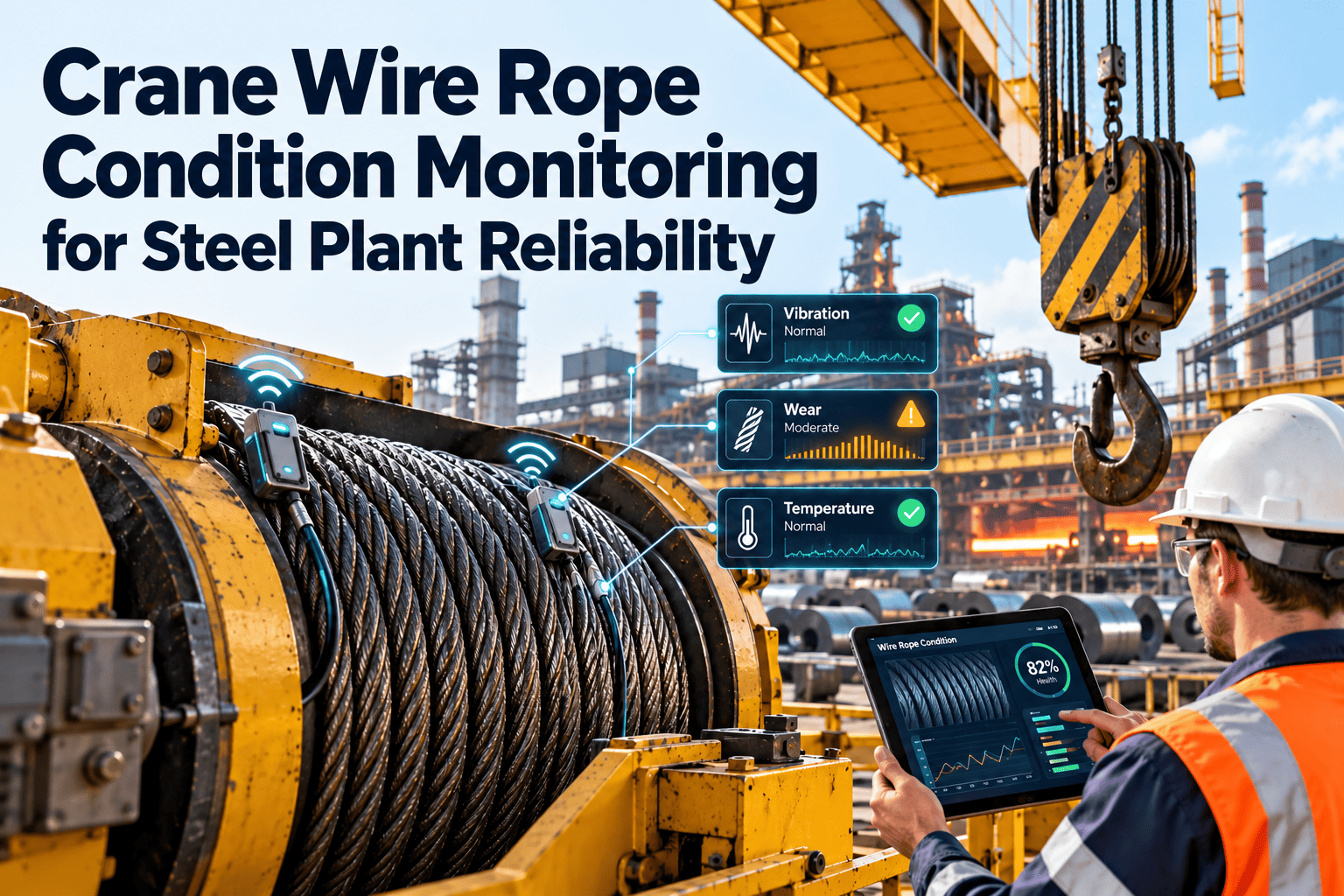
Oxmaint tracks wire rope life on a dual-metric basis per rope and per crane — accumulated lift cycles counted from production data or manual increment, and observable condition parameters recorded at each inspection. When a rope reaches either its cycle limit or a condition threshold — broken wires per lay length exceeding the retirement criterion, visible kinking or bird-caging, or corrosion pitting at the drum dead end — a rope replacement work order generates automatically and the crane is flagged for restriction from loaded service until the replacement is confirmed. Sign up for Oxmaint to configure cycle-based rope life tracking for each crane class in your fleet.
Broken wire count per lay length recorded at each monthly inspection per rope section. When count reaches the retirement criterion for the crane's rope construction and lay length, replacement work order generated and crane restricted automatically — no supervisor decision required before the work order fires.
Dead end termination at the drum is the highest-fatigue point on the rope. Oxmaint schedules dedicated drum dead end inspection at monthly intervals and generates an immediate inspection work order after any abnormal event — blocked sheave, overload signal, or emergency stop under load — that may have introduced shock loading at the termination.
Worn sheave grooves accelerate rope fatigue by increasing rope-to-groove contact stress and bending radius deviation. Oxmaint records sheave groove diameter and profile at each rope change — when a new rope is installed on a worn groove, the system flags the sheave for replacement before the rope is run, preventing premature rope failure driven by sheave condition.
Lubrication interval for steel plant crane ropes is adjusted per crane type — ladle cranes operating in high-temperature environments require shorter lubrication intervals than standard because heat drives out lubricant faster. Oxmaint sets per-crane lubrication schedules based on crane class and generates the work order automatically at the correct interval regardless of which maintenance team manages that crane bay.
Brake System Maintenance: Pre-Shift Testing, Lining Life, and Load Cell Integration
Crane brake systems are the single highest-consequence maintenance component in the steel plant crane fleet. A ladle crane main hoist brake failure with a laden ladle is a potential fatality event. Effective brake maintenance requires three connected capabilities: enforced pre-shift brake testing that cannot be bypassed or skipped, brake lining life tracking that generates a replacement work order before lining thickness reaches the minimum — not after — and load cell monitoring that provides continuous data on actual loads applied to the brake system versus its rated capacity.
In Oxmaint, each crane's brake system is configured with: pre-shift test protocol as a mandatory inspection item that must be completed and recorded before the crane is released for loaded service; brake lining thickness thresholds for each brake position (main hoist, auxiliary hoist, long travel, cross travel) that generate replacement work orders automatically when measurements approach the minimum; and load cell data integration that logs peak loads per shift and triggers an inspection work order when a load exceeds a configured percentage of SWL. Book a demo to see brake maintenance configuration for your ladle crane specifications.
Pre-shift brake test is configured as a mandatory inspection gate in Oxmaint — the crane's operational status does not clear for loaded service until the test inspection is recorded as complete with the technician's attribution and timestamp. If the pre-shift test is not completed within the configured window before shift start, the crane's status remains amber and a supervisor notification fires automatically. For ladle cranes, the pre-shift brake test record feeds directly into the daily compliance log without additional documentation effort. Sign up for Oxmaint to configure pre-shift brake test enforcement for your crane class.
Each brake position carries an individual lining thickness record in Oxmaint — measured at each monthly inspection and recorded per brake. When the measured thickness reaches 120% of the minimum (warning threshold), a scheduled replacement work order is generated for the next planned crane maintenance window. At 100% of minimum, the work order is elevated to urgent and the crane is flagged pending replacement confirmation. Replacement confirmation closes the work order and resets the thickness counter from the new lining measurement. Book a demo to see lining threshold configuration for your brake system specifications.
Load cell data from ladle and charging cranes integrates with Oxmaint via API or OPC-UA feed. Peak load per lift is logged against the crane's asset record alongside the timestamp and hoist operator. When a lift registers above the configured inspection trigger level — typically 90% of SWL for ladle cranes — an automatic post-lift inspection work order is created for the brake system and wire rope, ensuring that any overload or near-SWL event is followed by a physical check before the next loaded lift. Sign up for Oxmaint to connect your load cell data feed to automatic post-lift inspection scheduling.
Paper-Based Crane Inspection vs Oxmaint CMMS
The difference between paper crane inspection records and a connected CMMS is not record-keeping format — it is whether inspection findings produce action. A paper binder stores the data. Oxmaint makes it enforce maintenance.
What Steel Plants Measure After Crane CMMS Deployment
The measurable improvement pattern after deploying Oxmaint for steel plant crane maintenance follows a consistent sequence. Unplanned crane outages fall in the first quarter as inspection findings convert to work orders rather than binder entries. Statutory compliance gaps close within 30 days as all inspection records consolidate into a single exportable system. Wire rope and brake component reactive replacements reduce over 90 days as cycle-based and threshold-based scheduling replaces fixed-calendar and visual-only decisions.
We had fifteen cranes across three bays, fifteen paper binders, and no way to know at a glance whether every pre-shift test had been done that morning. After Oxmaint the dashboard shows us the status of every crane before the first ladle is lifted. We caught two brake lining findings that had been sitting in paper records for six weeks before they generated work orders. Neither crane has had an unplanned outage in the eight months since deployment.
Frequently Asked Questions
Every Crane Inspection Finding Should Become a Work Order Before the Crane Returns to Service.
Pre-shift brake test enforcement. Wire rope cycle and condition tracking. Load cell overload inspection triggers. Statutory compliance records. Fleet dashboard across all crane classes. Live in two weeks.