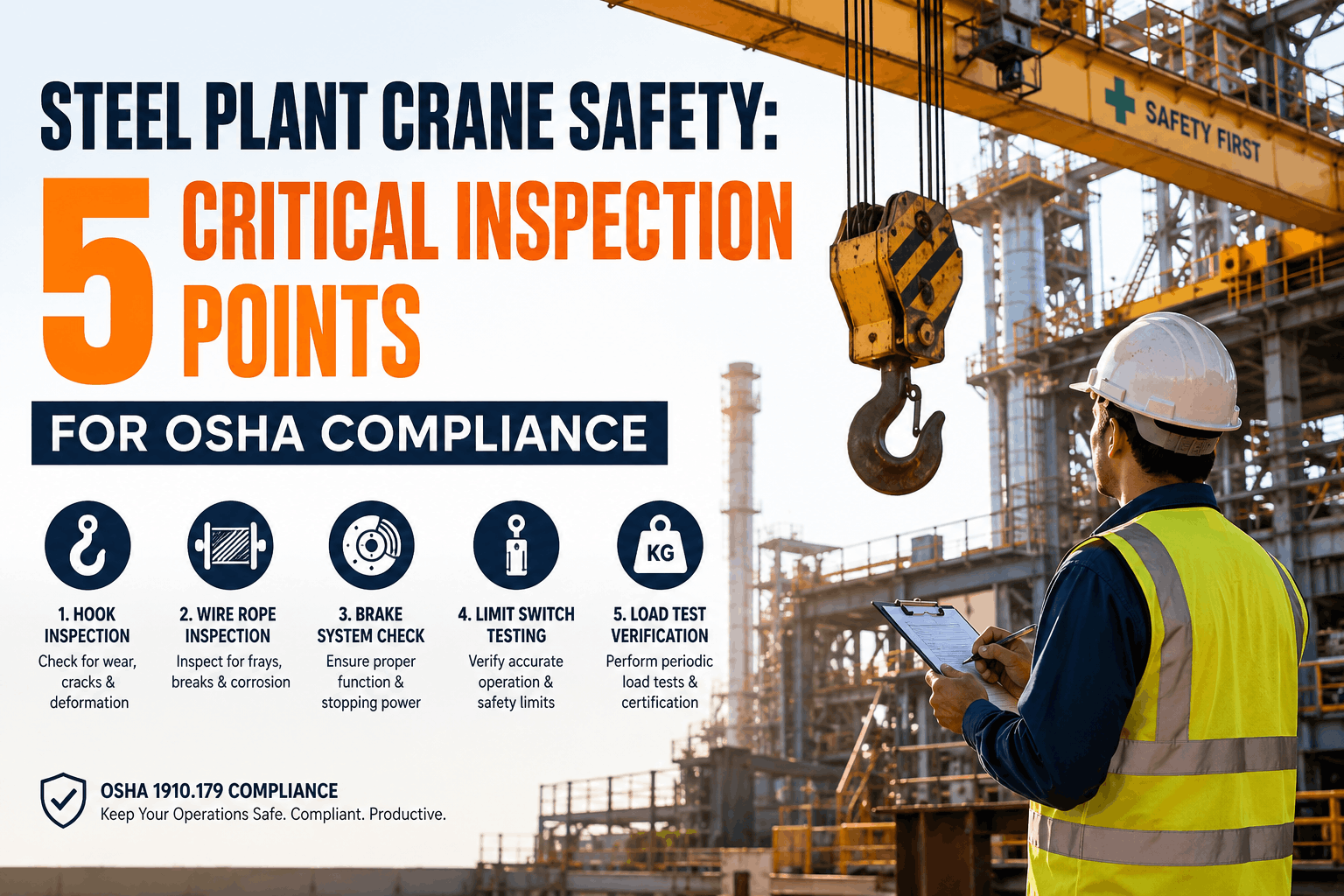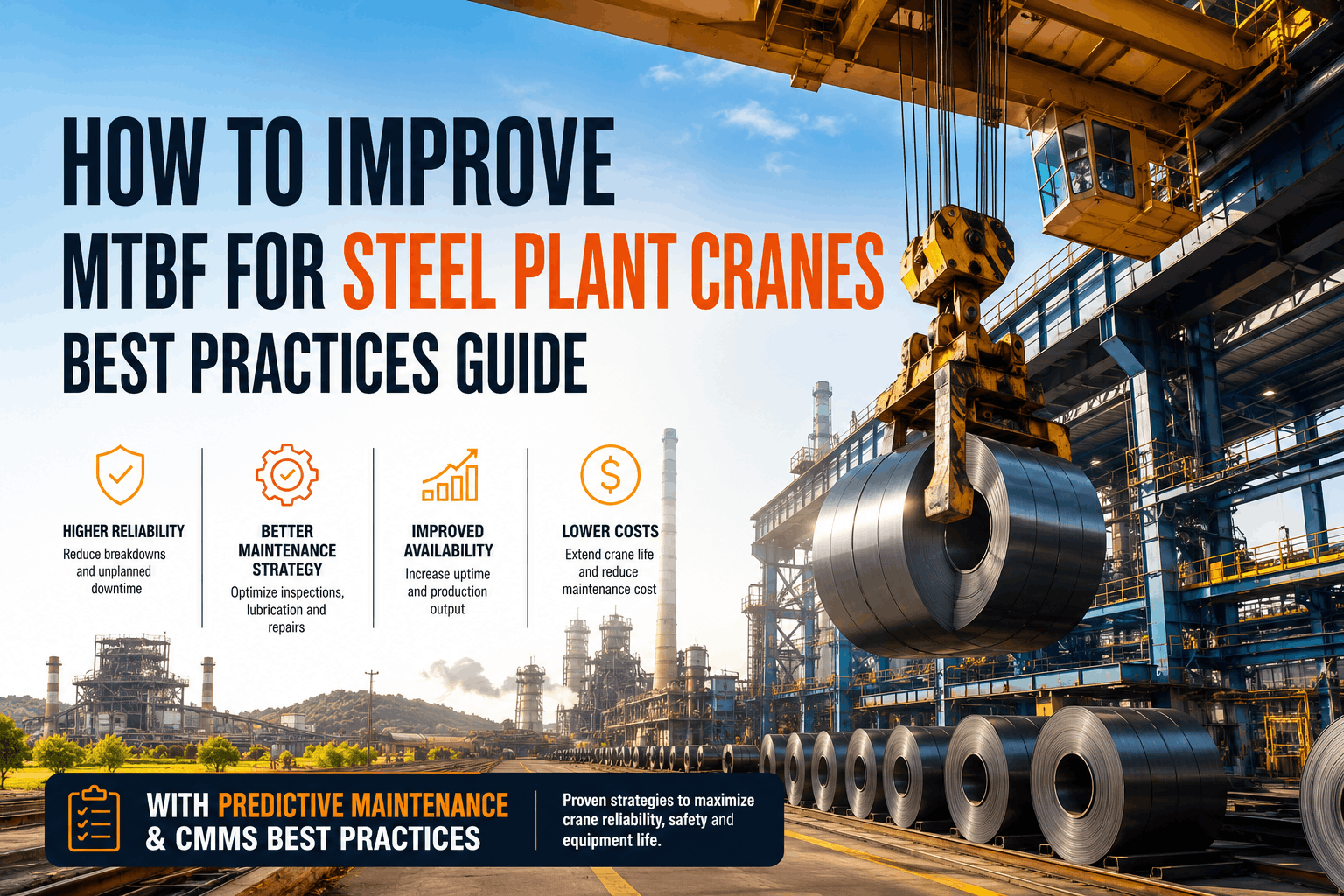
Steel plant overhead cranes are the circulatory system of material movement—they operate continuously throughout the facility, moving coils, slabs, and semi-finished steel between process stations. When a crane fails, production cascades to a halt. Repairs often require specialist contractors from out of state, extensive downtime (48-96 hours typical), and emergency labor premiums adding 200-300% to standard repair costs. A single catastrophic overhead crane failure in a hot mill can cost $80,000-$180,000 in combined equipment, emergency labor, and lost production revenue. Steel plants that implement comprehensive crane maintenance programs focused on wire rope integrity, hook condition, brake reliability, and electrical system robustness achieve Mean Time Between Failures (MTBF) improvements of 300-500%—meaning a crane that historically failed every 18 months now operates reliably for 4-5 years between significant repairs. The maintenance difference is not complex—it centers on systematic inspection protocols, accurate documentation, and condition-based replacement of wear items before failure occurs. OxMaint's crane maintenance tracking system schedules every inspection mandated by OSHA and industry standards, documents wire rope condition, tracks load test intervals, monitors brake system wear, and logs electrical circuit continuity—transforming crane reliability from a maintenance gamble into a predictable, regulated asset.
Steel Plant Crane MTBF Improvement: Comprehensive Maintenance Best Practices
Crane failures cost steel mills $80K-$180K per incident. This complete guide covers wire rope inspection protocols, hook condition assessment, brake maintenance procedures, electrical reliability standards, load test procedures, and regulatory compliance—ensuring maximum crane availability and extended operational life.
Understanding Crane Failure Modes: Why Steel Plants Lose Lifting Equipment
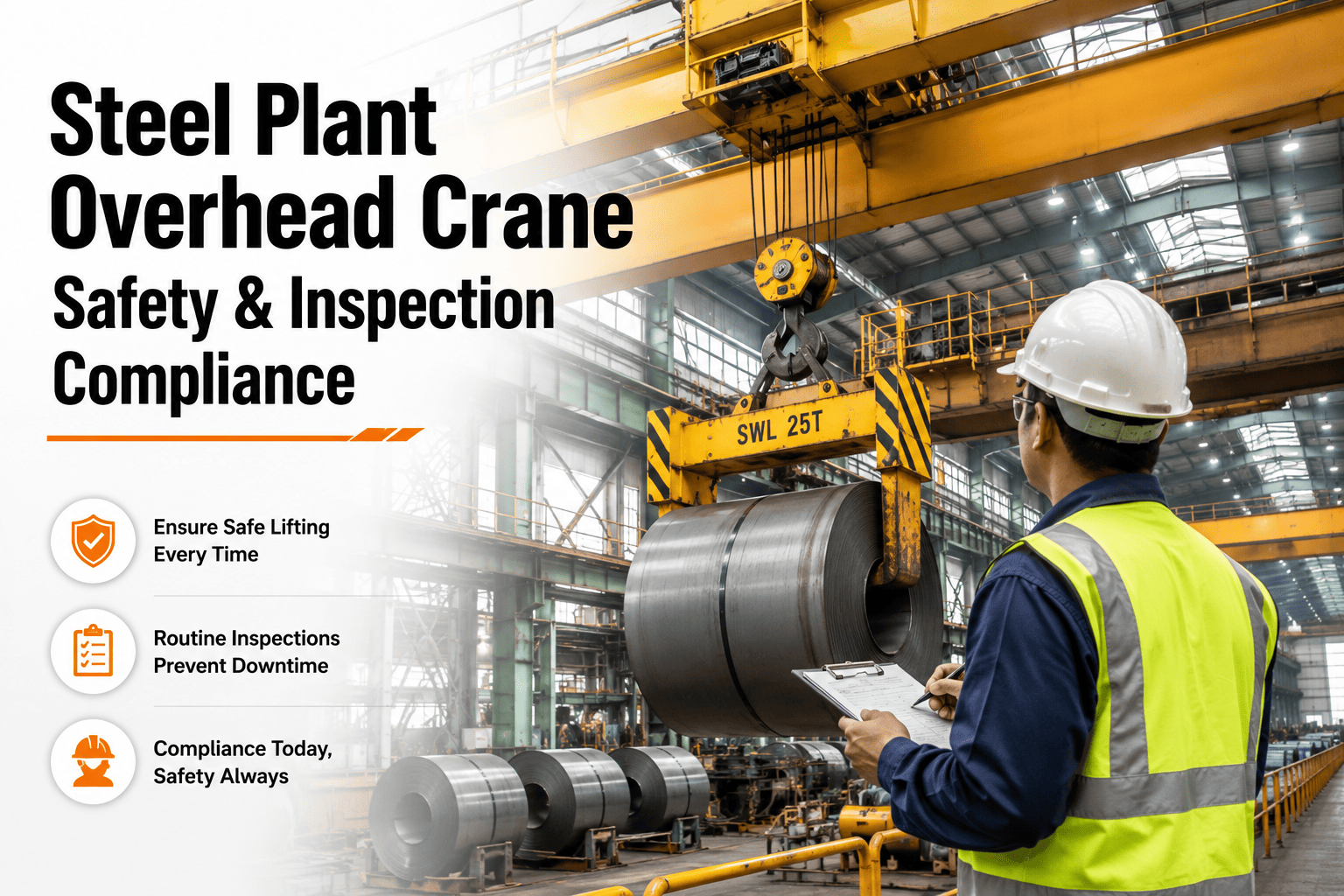
Overhead electrical traveling (EOT) cranes in steel plants operate in one of the most demanding industrial environments—extreme temperature swings from hot mill operations, continuous duty cycles with minimal rest periods, vibration from track misalignment, and contamination from mill scale dust and hydraulic oil mist. Crane failures occur through distinct and preventable failure modes: wire rope degradation accounts for 35-40% of failures, developing through stress corrosion cracking, fatigue fracturing, and wear from sheave contact; brake system degradation represents 25-30% of failures, progressing through lining wear, spring fatigue, and actuator seal failure; hook wear causes 15-20% of failures as stress concentrations propagate at the base radius or hook eye; electrical system faults account for 10-15% through contactor burnout, limit switch failure, or control circuit intermittent connections. Unlike machinery operated in controlled environments, steel mill cranes cannot be rested or removed from service for extended maintenance—they must be maintained while in service or replaced with backup capacity. Most U.S. steel mills implement OSHA-mandated inspection frequencies: monthly visual inspections, quarterly detailed wire rope examinations, annual load tests at 125% of rated capacity, and triennial hook magnetic particle inspection. Facilities that exceed these minimum regulatory requirements—implementing detailed digital documentation, trending wear rates, and executing condition-based replacements—achieve 85-90% reduction in unplanned crane failures and extend crane service life from 20-25 years to 30-35+ years. OxMaint's compliance-focused crane tracking system maintains regulatory inspection records, documents defect findings, tracks remediation completion, and schedules load tests—ensuring OSHA compliance while generating the data needed for MTBF improvement analysis.
Wire Rope Management: The Primary Determinant of Crane Service Life
Wire rope is the single most critical component determining crane service life and failure risk. Modern 6×19 or 8×19 independent wire rope cores (IWRC) used in steel mill cranes are engineered for 10-15 year service life at rated load and duty cycle. However, this theoretical life is achieved only under controlled conditions—protected from corrosion, proper lubrication, correct sheave sizing, and balanced loading. Steel mill environments accelerate wire rope degradation through multiple mechanisms: stress corrosion cracking develops in high-strength wire (1770+ MPa breaking strength) when chloride contamination contacts stressed wire under sustained tension—a mechanism that can reduce rope life from 15 years to 3-5 years without corrosion protection. Rotating bend fatigue occurs at sheave contact points where bending stress reverses thousands of times per shift—fatigue cracks nucleate at the wire surface and propagate inward until sudden rope fracture occurs. Wear from sheave friction causes incremental diameter loss—a rope losing 7-10% diameter experiences proportional loss of load-carrying capacity. Lubrication breakdown reduces internal strand friction and increases internal wire-to-wire contact wear. OSHA regulations mandate monthly visual rope inspections and quarterly detailed examinations. Steel plants implementing advanced wire rope management establish baseline rope diameter measurements at installation using precision calipers, then repeat measurements at each inspection interval to establish wear rate trends. A rope gaining 15% diameter loss in 12 months is deteriorating 3-4 times faster than normal—signal that corrosion protection is failing and rope replacement should be planned. Facilities also establish lubrication schedules: application of rope lubricant (low-chloride, low-sulfur formulations) every 6 months in normal environments, every 3 months in hot mill areas where oxidation accelerates lubrication breakdown. Schedule a wire rope assessment with our specialists to establish baseline rope condition and optimal replacement intervals for your facility's duty cycle.
Brake System Reliability: Ensuring Safe Load Holding and Emergency Stop Function
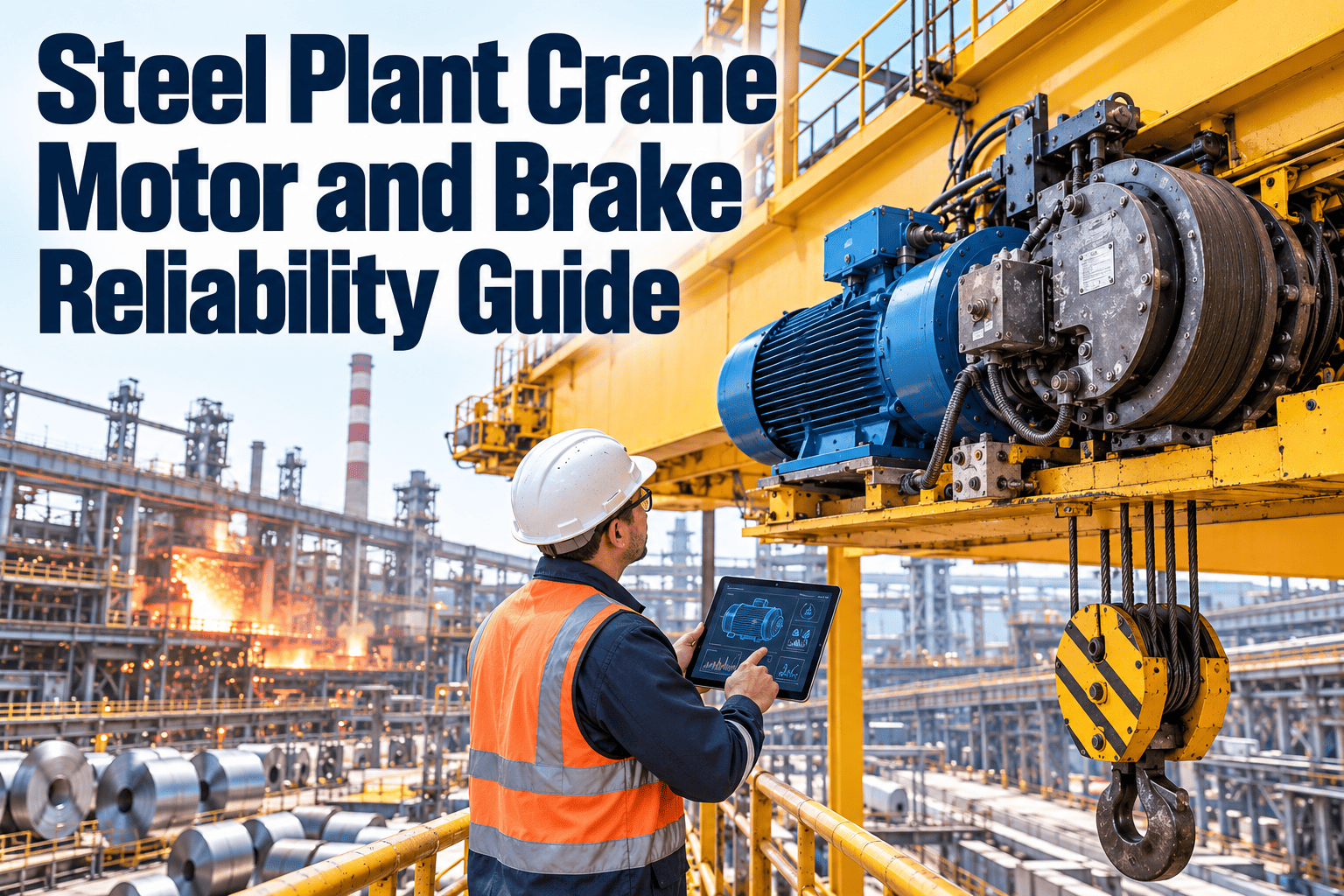
Crane brake systems operate under extreme conditions in steel mills: frequent high-heat duty cycles heating brake assemblies to 200-300°F, contamination from mill scale dust and hydraulic oil mist accumulating on brake surfaces, and vibration from load impacts loosening friction components. Brake failures manifest as gradual lining wear reducing braking torque until the crane can no longer hold rated load—an insidious failure mode because the crane continues to function until failure is catastrophic (load drift when brake fails to engage, or inability to stop during emergency descent). OSHA regulations and ANSI B30.16 standards require load-holding tests quarterly: the crane loads test weights at 125% rated capacity and parks without operator input—if the load drifts more than 1/4 inch in 5 minutes, brake torque is inadequate and repair is required. Steel plants implementing advanced brake management establish detailed lining wear tracking: lining thickness is measured quarterly using precision indicators, providing wear rate trending. A brake lining wearing 0.015 inches per quarter (normal rate) projected to need replacement in 20+ quarters; a brake wearing 0.040 inches per quarter needs replacement in 6 quarters (18 months). This trending enables planned brake replacement during scheduled maintenance rather than emergency repair. Parking brake springs degrade from thermal cycling and vibration—tension decreases gradually until holding capacity drops below standards. Facilities performing spring tension verification quarterly catch degradation before failure. Actuator seals degrade from thermal and mechanical stress, causing slow hydraulic fluid leakage that gradually reduces actuator pressure and braking force. Monthly visual inspection of actuators for weeping or dripping identifies seal degradation weeks before braking failure occurs. OxMaint's brake tracking system logs lining thickness measurements, documents load hold test results, records actuator seal inspections, and alerts when friction components approach replacement thresholds—preventing unplanned brake failures and load-holding emergencies.
Implementing Crane MTBF Improvement: Compliance, Documentation, and Predictive Transitions
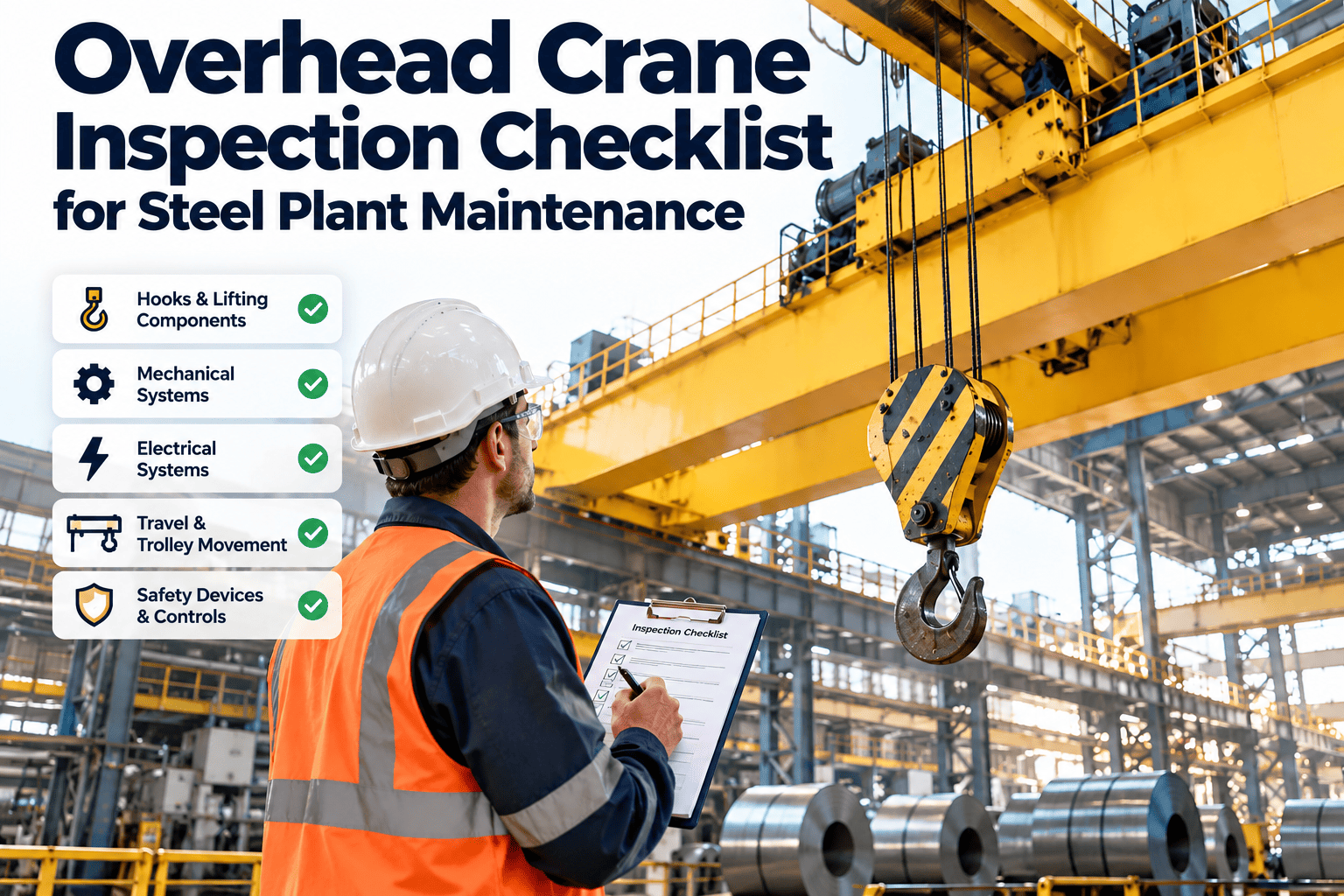
Crane maintenance program implementation begins with baseline compliance assessment: document which OSHA-mandated inspections are currently being performed, identify gaps where monthly or quarterly protocols are inconsistently executed, and establish responsibility assignments. Most U.S. steel mills employ certified crane operators and one-two dedicated maintenance technicians—assign maintenance responsibility clearly through written procedure specifying who performs each inspection, required documentation format, and escalation procedure for defects. Establish inspection templates: monthly rope inspection checklist, quarterly detailed rope measurement form, quarterly brake lining thickness log, semi-annual track alignment survey record. Digital documentation—whether through printed forms in binders or cloud-based CMMS platform—ensures consistent data capture and enables trending analysis. Second phase involves baseline documentation: for each crane, document wire rope specifications (size, core type, nominal diameter), installation date, original lining thickness, baseline rope diameter measurements, and historical repair records. This baseline becomes the reference point for all subsequent trending. Third phase implements condition-based analysis: as inspection data accumulates over 6-12 months, wear rates become measurable. A rope with 0.5% diameter loss per year is operating normally; a rope with 2% loss per year is experiencing accelerated corrosion and should be replaced within 12 months rather than waiting until visual degradation becomes obvious. Brake lining wear trending identifies replacement needs 12-18 months in advance, allowing planned brake rebuilds during scheduled maintenance rather than emergency repairs. OxMaint's crane compliance system maintains OSHA-required records, tracks inspection schedules, generates trending analysis, and alerts when components approach replacement thresholds—transforming crane maintenance from reactive emergency response to proactive asset management.
Case Study: MTBF Transformation at Multi-Crane Hot Steel Mill
A major U.S. steel mill in the Great Lakes region operated 18 bridge cranes across their hot mill, coil yard, and finishing line. Pre-program baseline (24-month period): 8 major crane failures with average repair cost $65,000 per event ($520,000 total), downtime averaging 36 hours per failure (288 hours annually = $432,000 lost production revenue based on $1.5M daily facility revenue). Total annual cost of reactive maintenance: $952,000. MTBF for the fleet averaged 6.5 months (approximately 3-4 major failures per crane annually). Implementation phase (months 1-6): Digitized all 18 cranes in CMMS system, trained 2 dedicated technicians on detailed rope inspection protocols, established monthly visual and quarterly detailed inspection schedules, implemented baseline wire rope diameter measurements on all cranes. Cost of training and system implementation: $45,000. Operational phase (months 6-24): Quarterly trending data accumulated. Month 9, detailed rope inspection identified accelerated diameter loss on coil yard Crane 7 (2.8% loss per quarter vs. 0.5% baseline)—projecting rope replacement need within 12 months. Planned rope replacement scheduled during next maintenance window, costing $8,000 in materials and 16 labor hours. Without trending, this rope would have failed catastrophically 6 months later during peak summer production, costing $75,000 in emergency repair plus $450,000 in lost production. Month 18, quarterly brake lining measurement on hot mill Crane 3 identified rapid wear (0.06 inches per quarter vs. 0.015 normal)—projected replacement need in 8 months. Planned brake rebuild executed during slow season, costing $12,000 vs. $85,000 emergency repair cost. Post-implementation results (24-month period following implementation): 2 major crane failures (down from 8), average repair cost $48,000 (down from $65,000 due to planned vs. emergency repair), total downtime 8 hours annually (down from 288 hours), annual financial benefit: $904,000 in combined avoided emergency repairs and production recovery. Implementation cost: $45,000. Net benefit year 1: $859,000. Fleet MTBF improved from 6.5 months to 18+ months (3x improvement). This facility now views systematic crane maintenance not as cost but as competitive advantage—their crane availability is now 98% vs. industry average of 85%.
Frequently Asked Questions — Steel Plant Crane MTBF Improvement
Maximize Crane Reliability and Extend MTBF with Systematic Maintenance
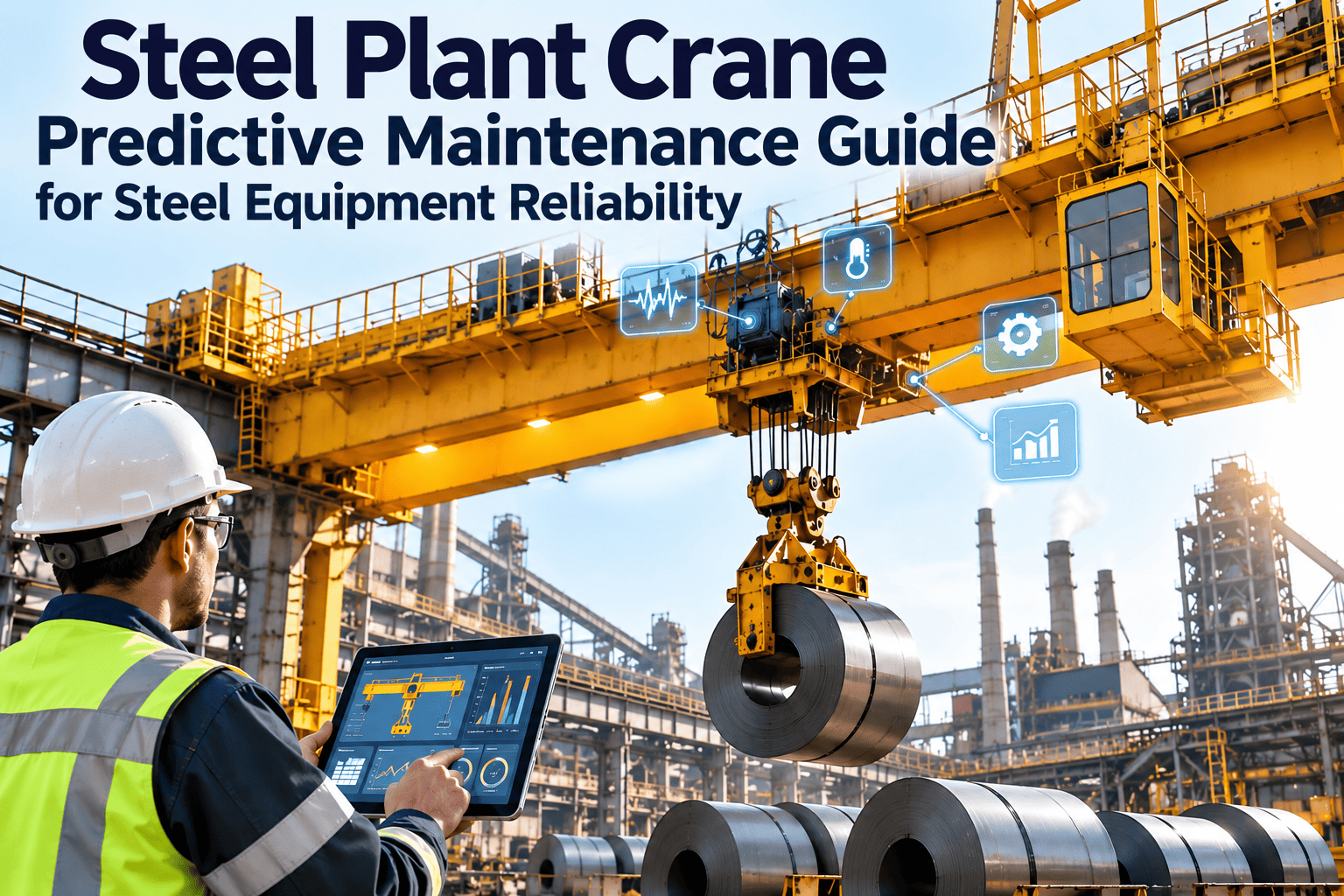
OxMaint's crane maintenance system maintains OSHA-required inspection records, tracks wire rope condition, monitors brake system wear, schedules load tests, and generates trending analysis—transforming crane maintenance from reactive emergency response to proactive asset protection. Establish baseline rope diameter and lining thickness measurements. Quarterly trending identifies components approaching replacement thresholds 12-18 months in advance. Prevent catastrophic failures, extend crane service life to 30-35+ years, and reduce annual maintenance costs by $200K-$500K at multi-crane facilities.