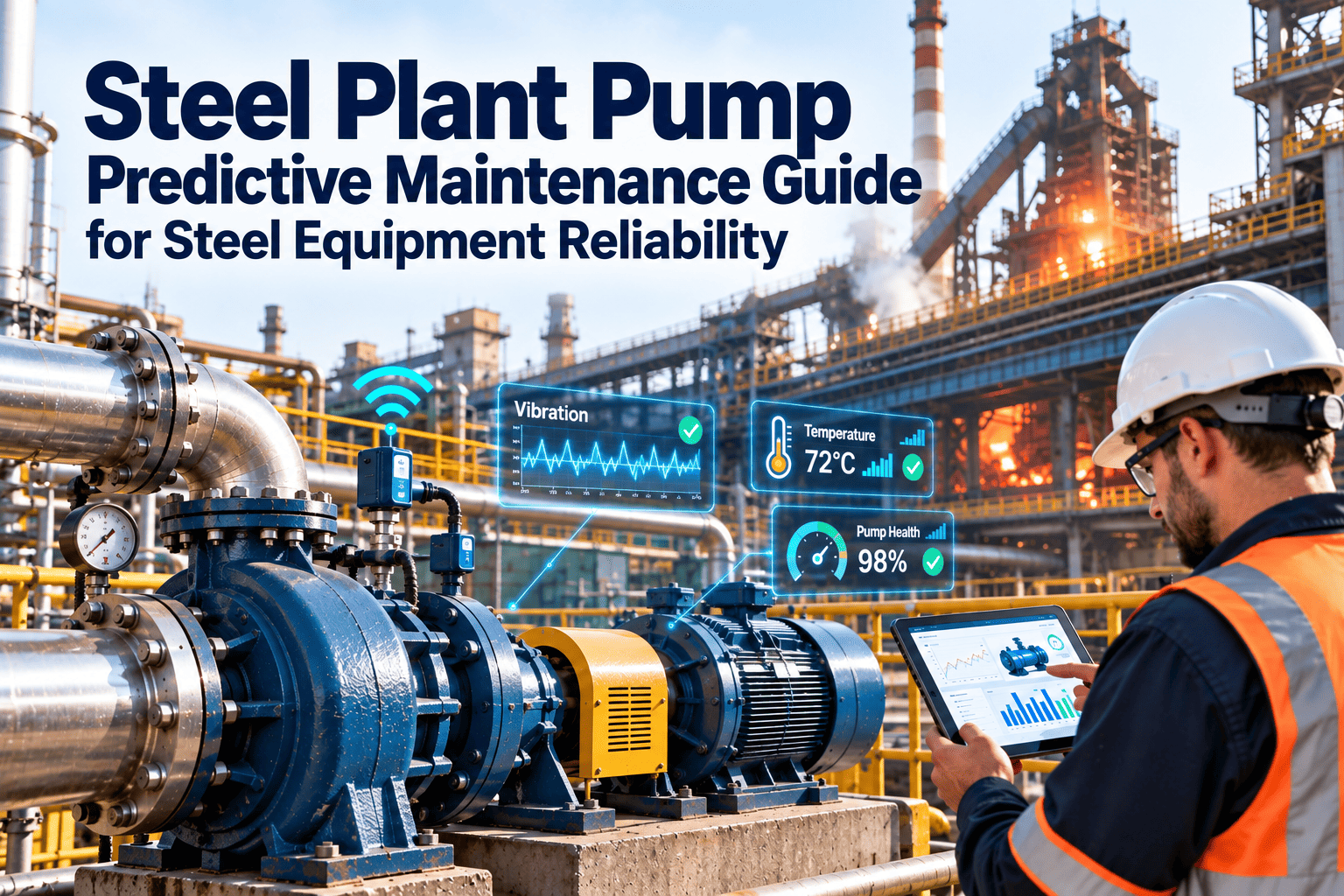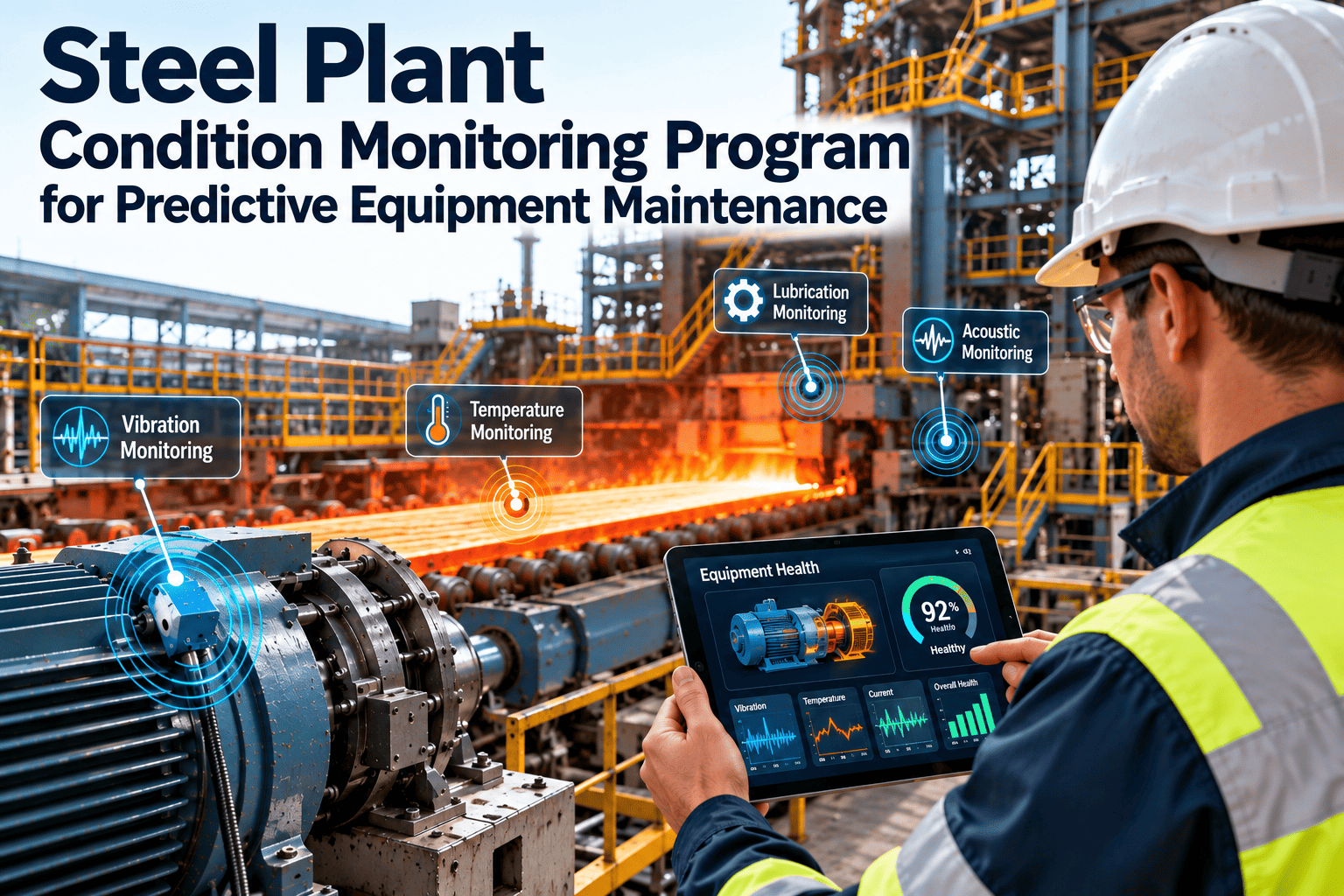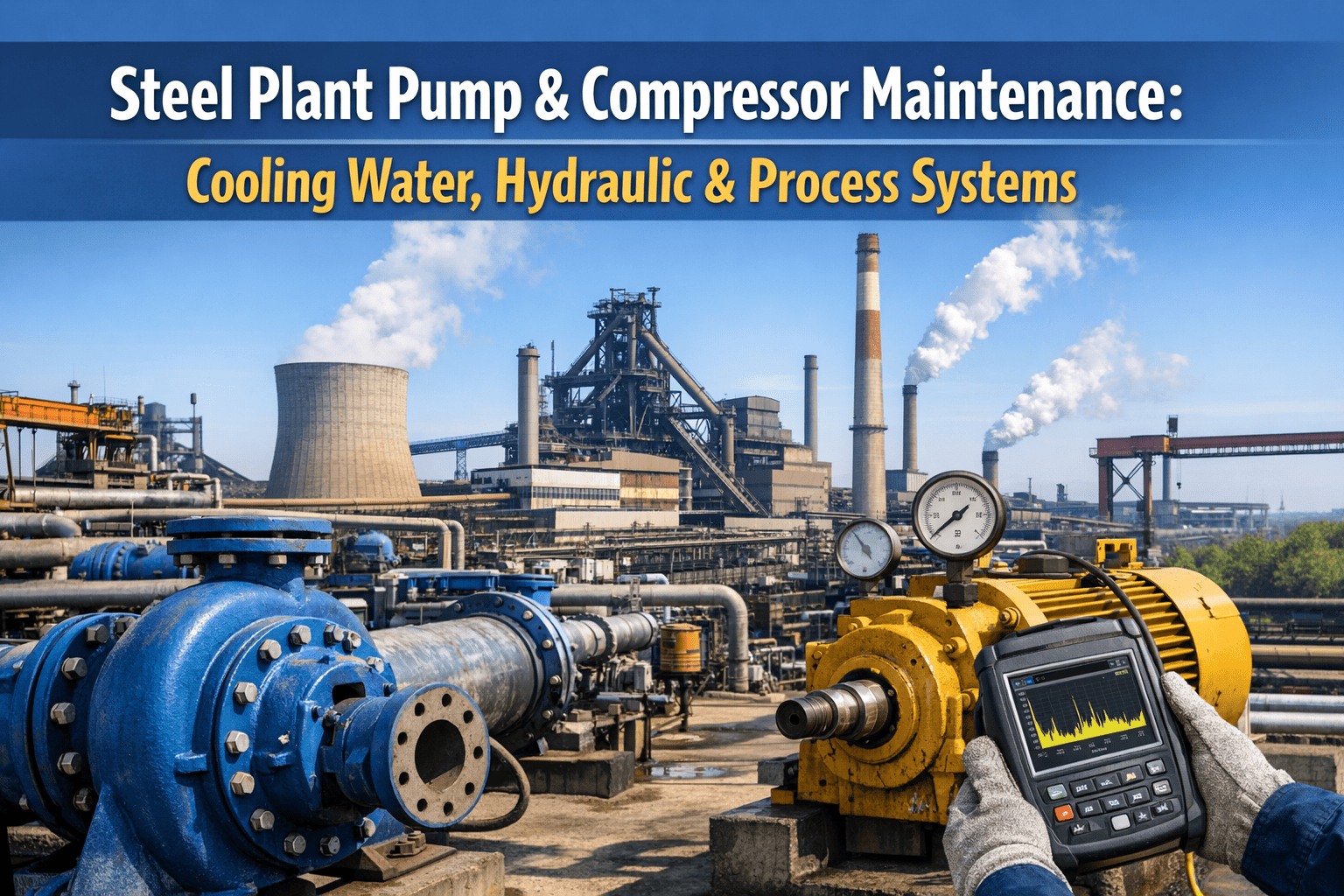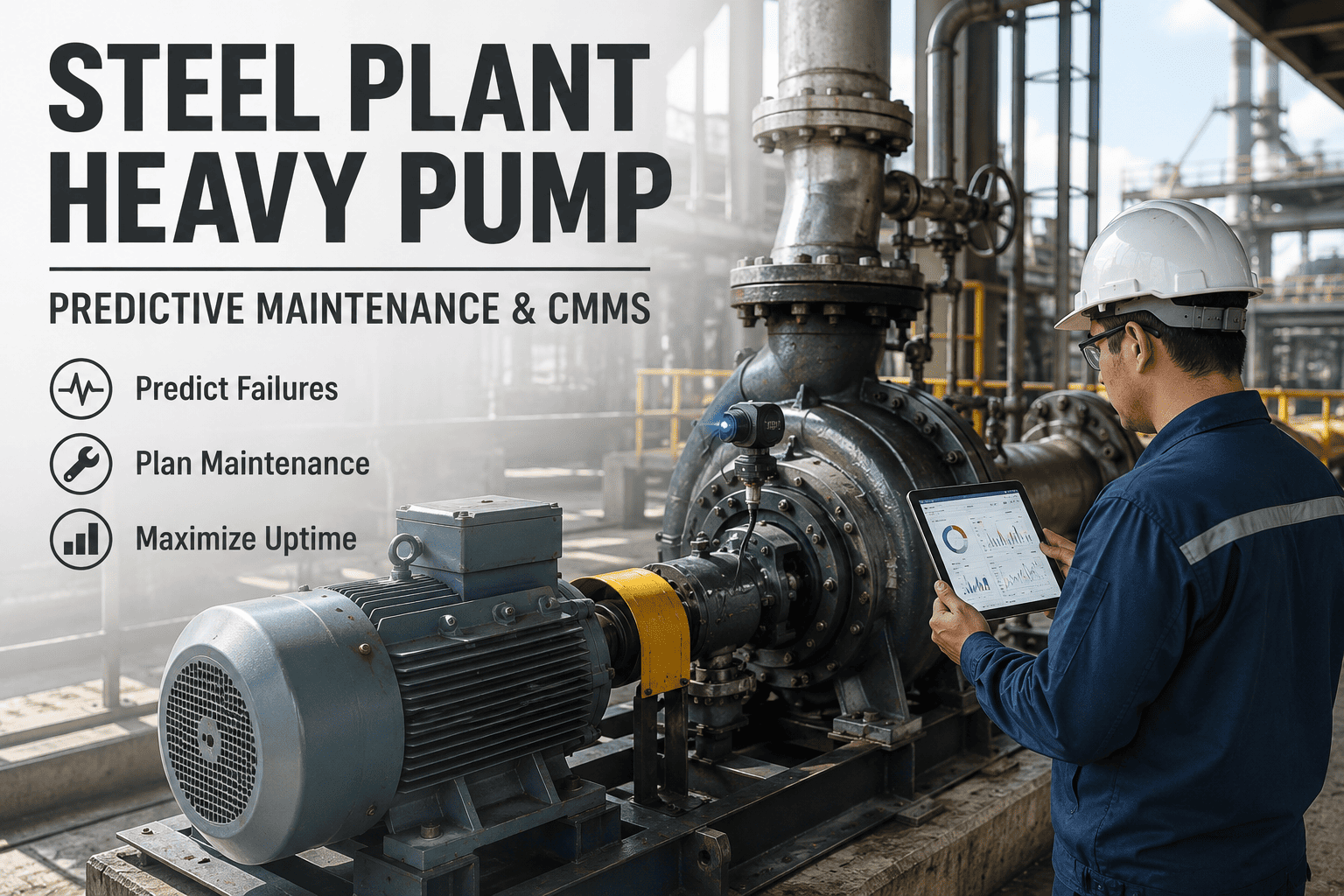
Steel plant heavy pump predictive maintenance is the difference between a reliable continuous-casting operation and a multi-million-dollar unplanned outage. In integrated steel mills, heavy-duty process pumps—cooling water, hydraulic, descale, slurry, and chemical injection—move enormous fluid volumes under extreme thermal and pressure loads, and when a single critical pump fails, the production cascade can halt an entire blast furnace or rolling mill within minutes. Modern CMMS platforms like OxMaint combine vibration signature analysis, motor current signature analysis (MCSA), and mechanical seal condition monitoring to detect bearing degradation, cavitation, and impeller wear weeks before catastrophic failure. Reliability teams using predictive pump strategies typically cut unplanned downtime by 30–50% and reduce emergency maintenance spend by thousands of dollars per incident. Start your Start Free Trial to see how OxMaint turns real-time pump sensor data into automated work orders.
PREDICTIVE MAINTENANCE FOR STEEL MILLS
What does a single heavy pump failure cost your steel plant per hour of lost production?
When a descale or cooling water pump trips mid-cast, the cascade hits furnaces, rollers, and slab output almost instantly. OxMaint's AI-powered CMMS catches bearing, seal, and cavitation signatures early—so you fix pumps on your schedule, not the pump's.
PUMP FAILURE MODES IN STEEL
Why steel plant heavy pumps fail—and how predictive maintenance catches it early
Heavy pumps in steel service face thermal shock, abrasive slurries, high-pressure hydraulic cycles, and continuous duty. Reactive maintenance leaves reliability teams firefighting; predictive maintenance shifts the curve left—identifying degradation 30–90 days before failure. Below are the four dominant failure modes OxMaint monitors across critical pump circuits.
Bearing & Shaft Degradation
Cooling water pumps running at 3,000+ RPM develop inner-race bearing defects detectable in high-frequency vibration signatures 6–12 weeks before seizure. OxMaint thresholds ISO 10816 velocity alarms automatically.
Mechanical Seal Wear
Descale pumps handling hot, abrasive water see seal face erosion accelerate rapidly once flush pressure drops. OxMaint tracks flush-flow and leakage sensors to flag seal failure 2–4 weeks early.
Impeller & Volute Erosion
NPSH-margin loss in slurry and chemical injection pumps causes cavitation that erodes impeller vanes in days. MCSA and discharge-pressure pulsation analytics detect onset before metal loss compounds.
Motor Current Signature Drift
Hydraulic pump motors under fluctuating load develop rotor bar and stator faults. OxMaint's motor current signature analysis (MCSA) identifies load-side anomalies and coupling misalignment remotely.
CONDITION MONITORING TECHNIQUES
Steel plant pump condition monitoring: vibration, MCSA, cavitation & seal integrity
A robust steel pump CMMS ingests data from tri-axial accelerometers, motor current transducers, pressure transmitters, and flow sensors—then applies AI pattern recognition to distinguish normal process variation from genuine fault signatures. Here is how each monitoring layer maps to a failure stage and recommended action.
| Monitoring Technique | Primary Sensor Input | Failure Stage Detected | Lead Time to Failure | OxMaint Automated Action |
|---|---|---|---|---|
| Vibration Signature Analysis | Tri-axial accelerometer (acceleration, velocity, displacement) | Bearing defect, misalignment, imbalance, looseness | 30–90 days | Auto-generate work order with fault frequency & severity |
| Motor Current Signature Analysis (MCSA) | Current transducers on motor phases | Rotor bar, stator winding, coupling wear, load oscillation | 21–60 days | Flag for electric motor reliability review & trend |
| Discharge Pressure Pulsation | Dynamic pressure transmitter at pump discharge | Cavitation onset, impeller erosion, blocked suction | 7–21 days | Critical alert + throttle/valve adjustment checklist |
| Seal Flush Flow & Leakage Monitoring | Flow meter on seal flush line, leak detection probe | Mechanical seal face wear, O-ring degradation | 14–30 days | Schedule seal replacement kit pull from inventory |
| Thermal Imaging (Motor & Bearing) | IR camera / thermocouple on bearing housing | Lubrication breakdown, overload, friction escalation | 10–25 days | Trigger lubrication route & grease type recommendation |
PREDICTIVE MAINTENANCE ROADMAP
How to implement pump predictive maintenance in a steel plant: a 6-month rollout
Moving from reactive to predictive pump maintenance does not require a plant-wide shutdown. A phased 6-month roadmap prioritizes the 5–10 most critical pumps first, proves ROI, then scales. Mills typically see full payback within 4–7 months.
Criticality Ranking & Asset Onboarding
Identify the top 10 critical pumps across cooling water, descale, hydraulic, and slurry circuits. Upload asset hierarchies, OEM pump curves, and historical work-order data into OxMaint. Benchmark current MTBF and OEE per pump.
Sensor & Data Channel Integration
Install or connect vibration accelerometers, motor current transducers, and pressure/flow sensors to OxMaint via OPC-UA, MQTT, or direct PLC integration. Configure sampling rates and baseline operating envelopes for each pump.
AI Baseline Training & Alarm Thresholds
OxMaint's AI engine learns normal vibration, current, and pressure signatures for each operating mode (startup, steady-state, cast-cycle, descale-burst). Set ISO 10816 vibration alarms, MCSA deviation bands, and cavitation pulsation limits.
Automated Work-Order Generation
When a predictive alarm triggers, OxMaint auto-generates a work order with fault type, severity, recommended repair procedure, required spare parts, and assigned technician. No manual data entry—reliability engineers review and approve.
Spare-Parts Inventory Alignment
Link predicted failures to Bills of Materials (BOM). OxMaint reserves mechanical seals, bearings, and impeller kits in advance, triggers min-max reorder points, and cuts emergency parts procurement by up to 60%.
Scale to Full Pump Fleet & Review ROI
Expand monitoring to secondary pump circuits. Review KPI dashboard: unplanned pump downtime reduction, MTBF improvement, emergency work-order ratio, and maintenance cost per ton of steel produced. Target 30–50% downtime cut.
REAL-WORLD IMPACT
The cost of inaction: a steel mill pump failure scenario
A mid-size integrated steel mill running a continuous caster relied on time-based preventive maintenance for its four 500 kW cooling water pumps. One pump developed an undetected inner-race bearing fault. Here is what happened.
Without Predictive Monitoring
Plus collateral damage to the mechanical seal and shaft coupling from the sudden seizure, extending repair from 8 hours to 26 hours.
With OxMaint Predictive CMMS
Zero production loss. Parts pulled from stock. Repair completed in 6 hours within a planned maintenance window. Net savings: $266K on a single pump.
OxMaint PLATFORM CAPABILITIES
How OxMaint helps: AI-powered steel pump CMMS capabilities
OxMaint unifies sensor data, work-order automation, asset history, and spare-parts inventory into one AI-driven platform built for steel plant reliability teams. Here are four capabilities mapped directly to heavy pump predictive maintenance outcomes.
AI Vibration & MCSA Analytics
OxMaint ingests tri-axial vibration and motor current data, applies ISO 10816 thresholds and AI pattern recognition to classify bearing faults, misalignment, cavitation, and rotor defects—auto-generating work orders with fault diagnosis and severity level.
Outcome: Detect 85% of pump failures 30+ days in advanceAutomated Predictive Work Orders
When a predictive alarm triggers, OxMaint creates a work order with repair procedure, required spare parts from the BOM, estimated labor hours, and assigned technician—routed for approval based on criticality and severity rules you configure.
Outcome: Cut emergency work orders by 40–60%Asset Registry & Pump Hierarchy
Maintain a complete digital twin of every pump—OEM curves, installation date, repair history, sensor tags, BOM, and operating context. Drill from plant to circuit to pump to bearing in seconds during root-cause analysis or audits.
Outcome: ISO 55000-aligned asset tracking, audit-ready in minutesMaintenance Analytics & KPI Dashboard
Live dashboards track MTBF, MTTR, OEE, PM compliance, and cost-per-ton across every pump circuit. Trend reliability scores month-over-month and justify maintenance spend with hard data your plant manager and reliability engineers trust.
Outcome: 30–50% reduction in unplanned pump downtime in 6 monthsSee OxMaint predict pump failures on your assets—book a 30-minute demo
Walk through a live steel plant pump monitoring dashboard, see how AI fault detection auto-generates work orders, and get a tailored ROI estimate for your mill's critical pump circuits.
FREQUENTLY ASKED QUESTIONS
Steel plant pump predictive maintenance: common questions
What is predictive maintenance for steel plant heavy pumps?
Predictive maintenance for steel plant heavy pumps uses condition-monitoring sensors—vibration accelerometers, motor current transducers, pressure and flow meters—to continuously assess pump health and detect bearing faults, cavitation, seal wear, and motor defects 30–90 days before catastrophic failure. Unlike time-based preventive maintenance, predictive strategies trigger repairs only when data shows degradation, maximizing remaining useful life and minimizing unnecessary downtime. OxMaint's AI-powered CMMS automates this by analyzing sensor signatures and auto-generating work orders when thresholds are breached.
How does vibration analysis detect pump bearing failures in steel mills?
Vibration analysis detects pump bearing failures by measuring acceleration, velocity, and displacement across frequency bands that correspond to specific bearing geometry (inner race, outer race, ball spin, cage frequency). When a bearing defect develops, it produces characteristic fault frequencies that intensify as damage progresses. OxMaint applies ISO 10816 alarm thresholds and AI pattern recognition to tri-axial accelerometer data, identifying the fault type and severity level—often providing 6–12 weeks of lead time before functional failure. You can see this in action by booking a demo at Book a Demo.
Which pumps in a steel plant should be monitored with predictive maintenance first?
Start with pumps whose failure causes the highest production loss: cooling water pumps on continuous casters and furnaces (failure halts casting within minutes), descale pumps on hot strip mills (failure damages strip surface quality), hydraulic power-pack pumps (failure drops rolling-mill pressure), and slurry pumps in water-treatment circuits. Rank by criticality score—production impact, redundancy, repair cost, and historical failure frequency. OxMaint helps you build this criticality ranking during onboarding, typically focusing on the top 5–10 pumps for the first 90 days.
How much does a CMMS for steel plant pump maintenance cost?
A CMMS for steel plant pump maintenance typically costs between $8,000 and $35,000 per year depending on the number of assets, sensor integration channels, and user seats—far less than the $250K+ cost of a single unplanned critical pump failure. OxMaint offers tiered pricing that scales with your pump fleet and includes AI predictive analytics, automated work orders, asset tracking, and inventory management. Most steel mills achieve full payback within 4–7 months through avoided downtime and reduced emergency maintenance spend. Start a Start Free Trial to evaluate the platform on your assets.
Can OxMaint integrate with existing SCADA and PLC systems in a steel plant?
Yes, OxMaint integrates with existing SCADA, PLC, and sensor infrastructure via standard industrial protocols including OPC-UA, MQTT, Modbus, and REST APIs. This means you can connect vibration sensors, motor current transducers, pressure transmitters, and flow meters already installed on your pumps without ripping out legacy systems. OxMaint also supports manual data entry and mobile inspections for pumps without sensor coverage, giving you a single CMMS platform for both monitored and unmonitored assets.
Stop reacting to pump failures. Start predicting them.
Join the steel mills using OxMaint to cut unplanned pump downtime by 30–50%, eliminate emergency work orders, and protect production targets with AI-driven predictive maintenance.
Free 14-day trial · No credit card