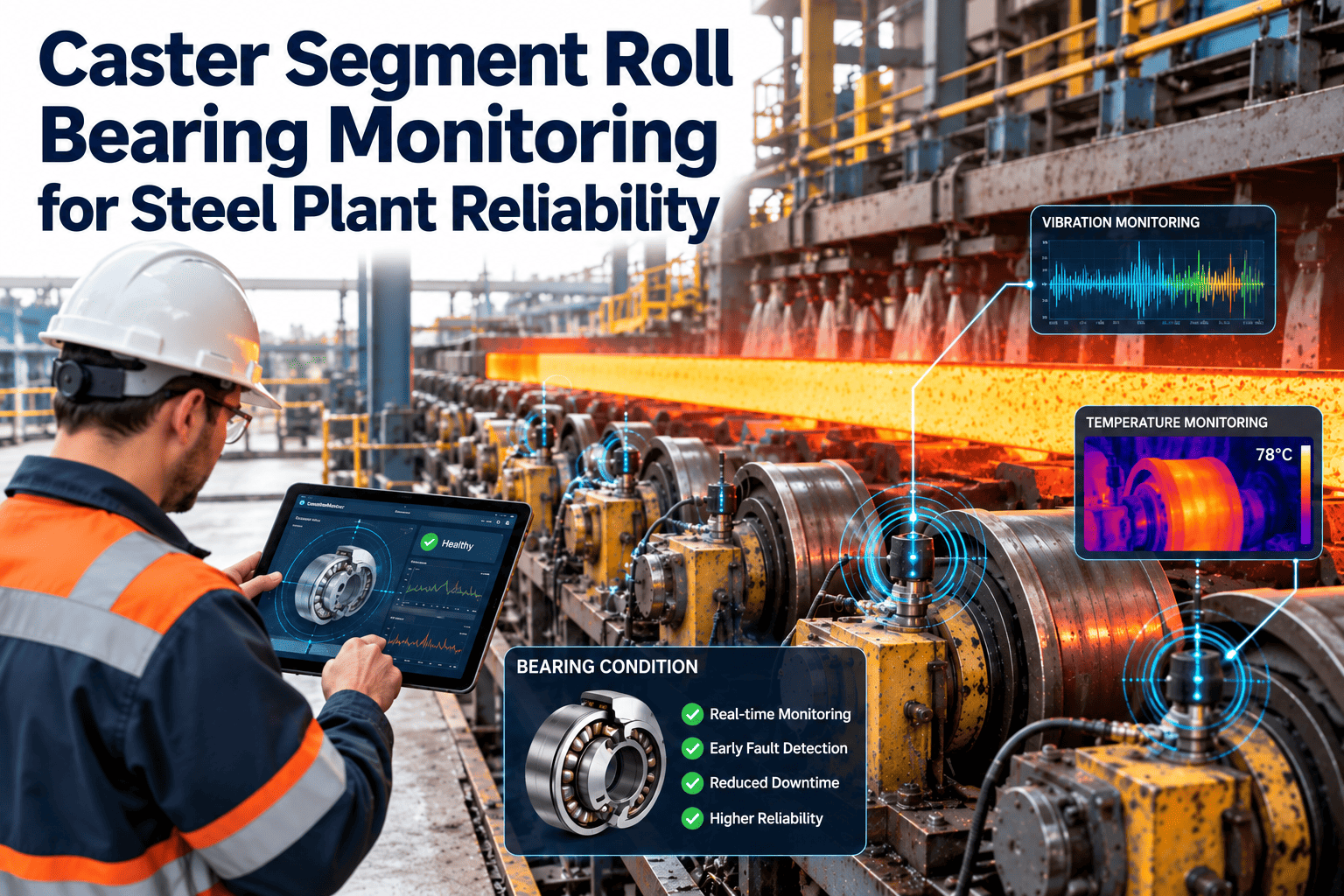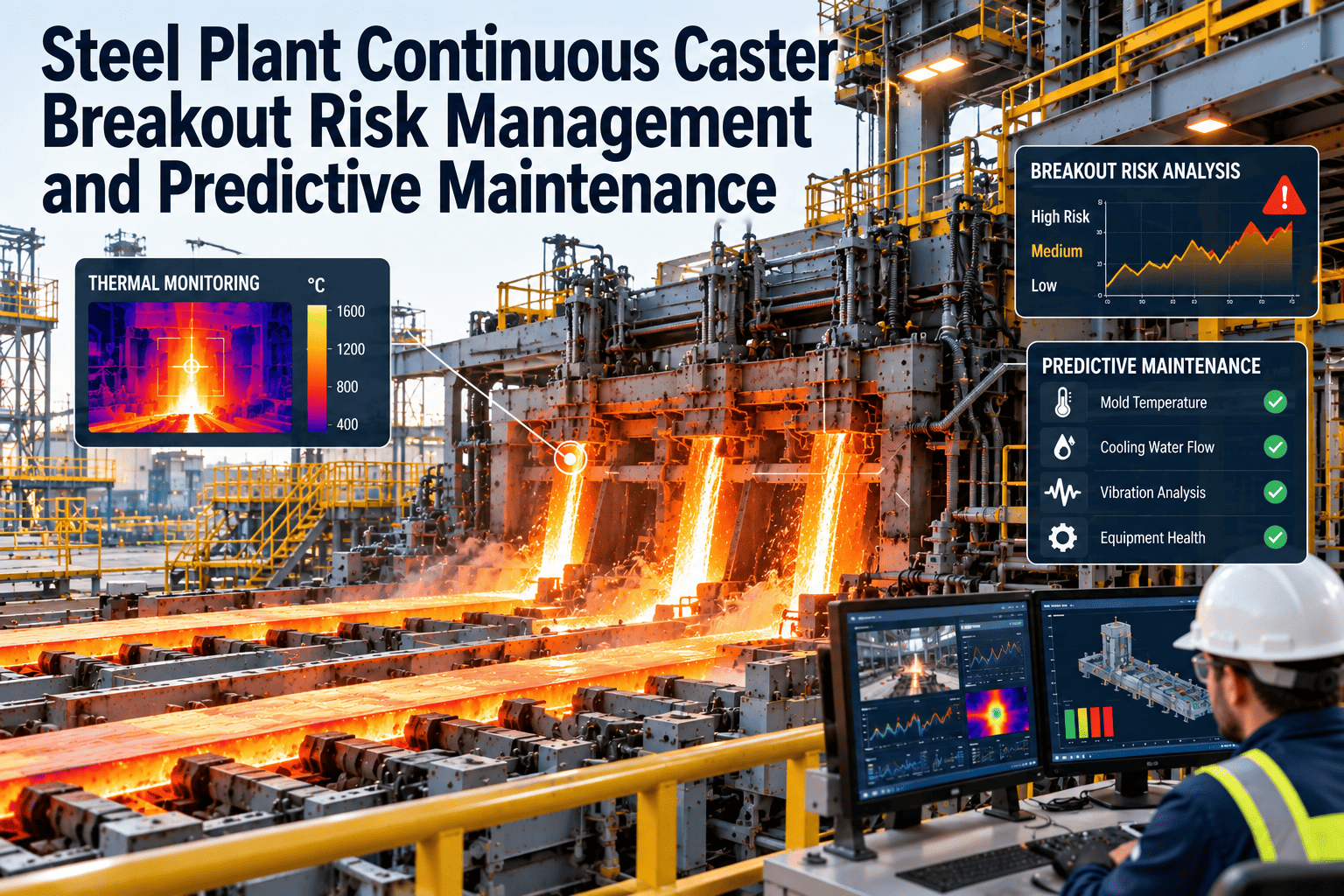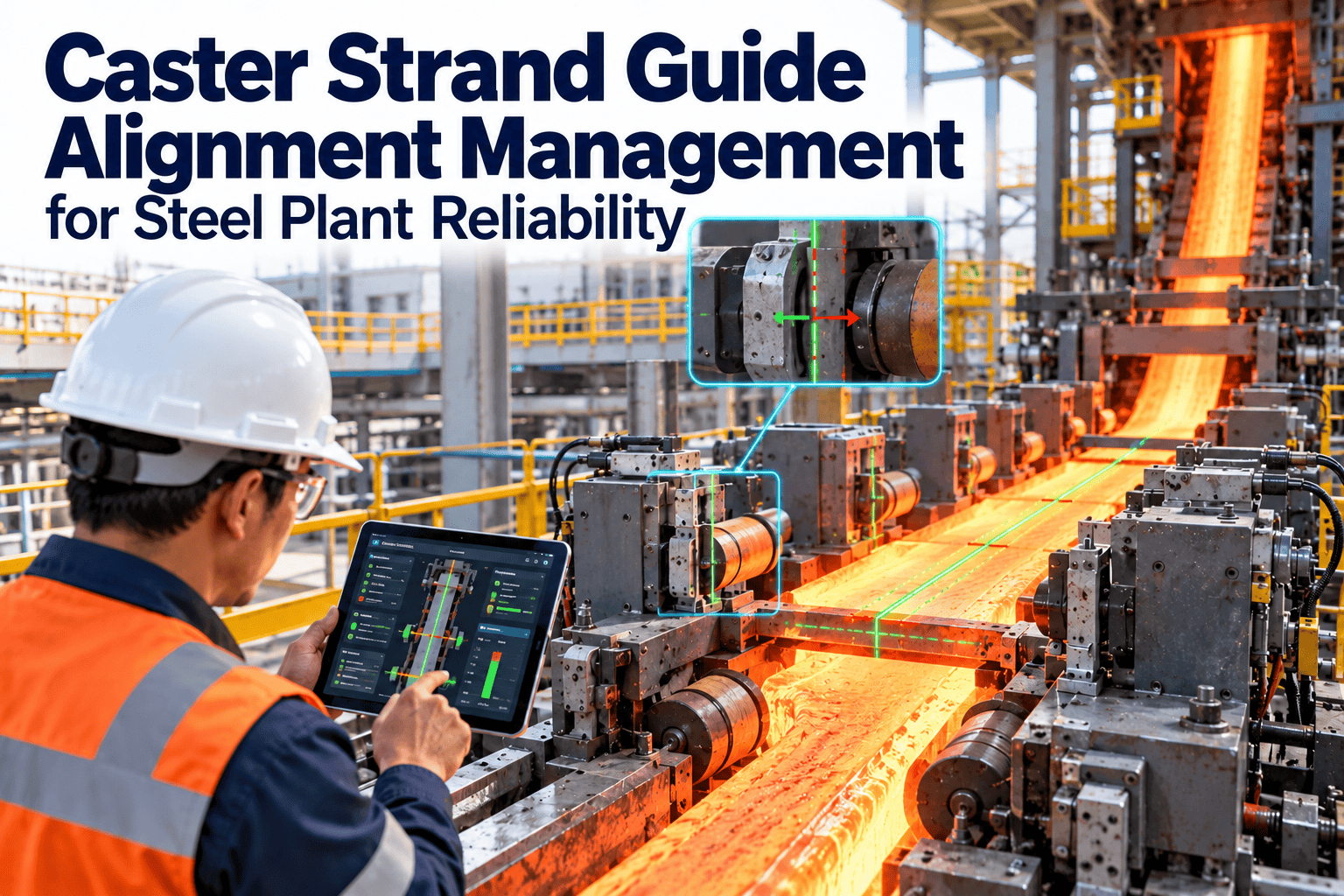
Continuous casting punishes small geometric errors. When strand guide rolls drift out of alignment, the shell is squeezed unevenly, bulging and internal stress rise, and defects that look like metallurgy problems can trace back to mechanical condition. Caster strand alignment management gives maintenance and process teams one disciplined way to measure, record and correct that drift before it reaches the slab. This guide covers where misalignment starts, how it shows up, and how to run the work in steel plant maintenance management software.
Caster Strand Guide Alignment Management for Steel Plant Reliability
Keep roll gaps, segment position and roll condition inside tolerance with scheduled checks, traceable segment history and fast corrective work orders, so alignment problems are found in the segment bay and not in the slab.
Reading the strand: quality symptoms that point back to alignment
Alignment problems rarely announce themselves. They appear as a pattern across heats, so the first job is to connect what quality sees with what maintenance can inspect.
What the plant sees
Internal cracks or mid-thickness crackingWhat maintenance checks
Roll gap profile through bending and unbending zones, gap taper, and bearing play on segments in the affected zone.What the plant sees
Slab bulging between rollsWhat maintenance checks
Roll pitch, roll sag, worn or bent rolls, loose segment clamping and frame deformation.What the plant sees
Off-corner or surface cracksWhat maintenance checks
Mold-to-first-segment alignment, foot roll position, spray nozzle pattern and edge roll wear.What the plant sees
Centerline segregation or porosityWhat maintenance checks
Gap setting accuracy in the soft reduction zone, drive consistency and segment calibration records.What the plant sees
Uneven roll wear and early bearing failuresWhat maintenance checks
Roll centerline offset, lubrication distribution, cooling flow and free roll rotation.What the plant sees
Sticker events or breakout alarmsWhat maintenance checks
Mold oscillation condition, level control hardware and mold support alignment. Process variables are the other half of the review.Root causes of strand guide misalignment
Most alignment loss is cumulative. Heat, water, load cycles and contamination change the segment slowly, which is why a fixed inspection routine beats reacting to quality complaints.
| Cause | How it develops | Early signal | Maintenance response |
|---|---|---|---|
| Roll wear and bending | Surface loss and sag under ferrostatic load and thermal cycling | Gap deviation at the same nominal setting | Inspect rolls by position, set wear limits, refurbish or replace on condition |
| Bearing deterioration | Contamination, water ingress, lubrication starvation | Stiff or noisy rotation, rising bearing temperature | Bearing inspection routes, lubrication tasks, condition checks |
| Frame and clamping distortion | Thermal fatigue, mechanical shock, loose fasteners | Side-to-side gap difference after seating | Frame geometry check, torque verification, repair or retire frame |
| Installation error | Incorrect seat, shims or connection after a segment change | Deviation right after reinstall | Install checklist, post-install gap verification, supervisor sign-off |
| Cooling and spray faults | Blocked nozzles, leaking water circuits | Uneven shell temperature, scale on rolls | Nozzle checks, water circuit preventive tasks |
| Mold and oscillator offset | Mechanism wear and mounting looseness | Irregular oscillation marks on the slab | Oscillator alignment check, mold seat inspection |
Where to focus first: a zone sensitivity matrix
Not every segment deserves the same inspection depth. Use this matrix as a starting point and adjust it to your caster design, steel grades and failure history.
| Caster zone | Sensitivity to gap error | Wear exposure | Suggested review rhythm |
|---|---|---|---|
| Mold and foot rolls | High | High | Every campaign and after any alarm event |
| Bender and curved zone | Medium | High | Each segment pull, with as-found gap record |
| Unbending zone | High | Medium | Each segment pull, with strain-related quality review |
| Soft reduction segments | High | Medium | Gap calibration check at every change |
| Straight zone and exit | Lower | Medium | Planned inspection on a longer interval |
A segment maintenance cycle in six steps
Alignment management is a closed loop. The data collected when a segment arrives in the bay decides how the next interval is planned.
Define the alignment standard
Record target gap, tolerance and wear limits for each segment position, based on OEM data and your own plant practice.Plan the pull
Trigger segment changes by heats, tonnage or campaign length, and reserve crane, crew and spare segment in the same plan.Measure as-found condition
Capture gap, roll rotation, bearing condition and frame seating before any repair, so drift is quantified.Repair and set
Replace rolls and bearings, correct the frame, and set the gap to the standard with calibrated tools.Verify as-left condition
Measure again, compare to tolerance, and obtain sign-off before the segment returns to service.Install and learn
Verify seating on the caster, log the segment position, and feed results into the next interval decision.
Put every segment pull on a controlled schedule
Set up segment assets, tonnage-based preventive tasks and as-found measurement checklists in Oxmaint, then see how your caster team can track alignment history in one place.
Alignment inspection checklist by stage
Use the same checklist wording every time so results can be compared across segments and campaigns.
Before the segment is pulled
- Review quality holds linked to the segment position
- Check last as-left gap and installation date
- Confirm spare segment status and readiness
- Note spray, cooling and lubrication alarms from the run
- Confirm isolation, lifting plan and permits
In the segment bay
- Record as-found gap at defined measuring points
- Turn each roll by hand and note resistance
- Inspect roll surface, scale build-up and cracks
- Check bearing seals, grease condition and housings
- Inspect frame, clamps, hoses and nozzles
Before and after reinstall
- Record as-left gap against tolerance
- Verify torque on fasteners and clamping devices
- Test water and lubrication connections
- Confirm seating on the caster and segment position
- Close the work order with measurements attached
Alignment control: unmanaged versus managed
Unmanaged alignment work
- Gap readings stored in personal notebooks or spreadsheets
- Segment changes triggered by breakdowns or quality complaints
- No link between slab defects and the segment in that position
- Roll and bearing spares discovered missing on the day of the pull
- Repeat repairs because earlier findings are not visible
Managed alignment workflow
- As-found and as-left measurements attached to each work order
- Segment pulls planned from heats, tonnage and condition
- Segment history searchable by position, date and defect
- Spares reserved against the planned job in inventory
- Recurring failures flagged for engineering review
Condition signals that support predictive caster maintenance
Predictive work does not require a complex model on day one. Start with the signals already available, and attach them to the right asset.
Gap and alignment readings
Trend as-found values by segment position. A segment that returns out of tolerance repeatedly needs a design or interval review, not another adjustment.Roll rotation and bearing condition
Hand-turn feel, bearing temperature, vibration route data and grease analysis show bearing decline before a roll seizes.Segment service history
Run length, repairs, replaced parts and reinstall position explain why one segment outlasts another.Quality feedback
Internal crack and surface defect findings linked by cast and strand help locate suspect positions faster.Process context
Casting speed, secondary cooling flow and steel grade explain why wear rates change between campaigns.Records, safety and traceability
Alignment work involves heavy lifts, hot equipment and pressurized water, so the record has to prove both technical and safe execution.
- Link every segment pull to lockout, hot work, lifting and confined-space permits where they apply.
- Keep calibration status for gap gauges and measuring instruments against each measurement taken.
- Store technician sign-off, supervisor approval and completion date on the work order.
- Keep segment identification and position history so quality investigations can reconstruct what ran in each position.
- Document tolerances and revisions so audits under quality and asset management systems can follow the decision trail.
Common mistakes in caster alignment programs
Plants with capable people still lose alignment control because of habits in how the work is recorded and scheduled. These are the patterns worth removing first.
Adjusting without recording the as-found value
If the segment is corrected before measurement, the plant loses the only evidence of how far it drifted. Interval decisions then rest on opinion.Treating every segment position the same
A foot roll section, an unbending segment and a straight-zone segment age differently. A single fixed interval wastes effort in some places and misses wear in others.Letting spares define the schedule
When the spare segment is not ready, the pull is delayed and the installed segment runs past its limit. Spare readiness belongs in the plan, not in the afterthought.Separating quality data from maintenance data
Internal crack findings and roll gap records are far more useful together. Keep a shared reference for strand, position and cast.Closing work orders without measurements
A work order that says "aligned" tells the next shift nothing. Require numeric values and instrument identification before closure.Running a shared review between maintenance, process and quality
Alignment is a mechanical condition with a metallurgical consequence, so the best reviews bring three groups to the same table with the same data.
Maintenance brings
- As-found and as-left gap trends by position
- Roll and bearing replacement counts
- Open corrective work and backlog on the caster
- Spare segment and component status
Process brings
- Casting speed and steel grade mix by campaign
- Secondary cooling settings and deviations
- Mold level and oscillation observations
- Alarm and breakout event summaries
Quality brings
- Internal and surface defect findings by cast
- Slab shape and dimensional feedback
- Downgrades or holds linked to strand
- Customer complaints traced to casting
Turning findings into actions that last
A review only pays off when each finding becomes a tracked action with an owner and a due date.
- If a position repeatedly returns out of tolerance, shorten its interval or open an engineering investigation into the frame, clamping or roll design.
- If a bearing type fails early in a certain zone, review lubrication routes, seal condition and cooling water exposure.
- If defects appear immediately after a segment change, audit the installation checklist and shimming practice.
- If quality holds cluster around one campaign, compare run length, speed and spray conditions against segment condition at pull.
- If spare segments are repeatedly late, adjust the refurbishment lead time and reorder points for rolls, bearings and nozzles.
KPIs that show whether alignment control is working
| KPI | What it shows | Data source |
|---|---|---|
| As-found out-of-tolerance rate | How much drift occurs between pulls | Segment bay measurement checklists |
| Planned versus unplanned segment changes | Whether interval planning is effective | Work order type and trigger |
| Mean run length per segment position | Which positions wear fastest | Segment history by position |
| Alignment-related quality holds | Cost of drift reaching the slab | Quality records linked to work orders |
| Caster preventive task compliance | Discipline of routine inspections | Preventive work order completion |
| Spare segment availability at pull time | Readiness of the segment pool | Inventory and reservation records |
How Oxmaint supports the alignment workflow
Oxmaint is maintenance management software, so it organizes the work around alignment rather than replacing measurement tools.
- Asset hierarchy from caster and strand down to segment, roll and bearing for clean history.
- Preventive schedules triggered by calendar, heats or tonnage counters.
- Mobile inspection checklists for as-found and as-left measurements, with notes and photos.
- Corrective work orders raised from alarms, quality findings or inspection results.
- Inventory for rolls, bearings, nozzles and seals, linked to planned jobs.
- Dashboards and reports on backlog, compliance and repeat failures.
How to start without disrupting the caster schedule
Build the strand asset tree
Register each strand, segment position and roll group with identifiers that match the plant floor.Standardize the checklist
Convert existing bay measurement sheets into one checklist with tolerances and required fields.Load the last known history
Enter recent segment pulls, failures and spare stock so the first interval review has context.Review monthly with quality
Compare defect trends and alignment findings, then adjust intervals and spares.
Building alignment skills across shifts
Consistent results depend on people measuring and recording in the same way, regardless of crew or shift.
- Train technicians on measuring point locations, instrument use and the meaning of each tolerance.
- Use photos in the checklist so everyone recognizes worn rolls, damaged seals and scale build-up the same way.
- Hold a short debrief after each segment pull to capture surprises and update the job plan.
- Give new staff a reference set of past as-found records so they learn what drift looks like in practice.
- Review instrument calibration and handling so measurements remain trustworthy.
Caster strand alignment FAQs
How often should segment alignment be checked?
Check at every segment pull, then adjust intervals using as-found drift, tonnage and defect history for each position.Can alignment problems cause internal cracks?
They can contribute, alongside cooling and steel grade. Review gap profile and process data together.Does Oxmaint measure roll gap?
No. It records measurements from your tools and ties them to work orders and asset history.What is as-found versus as-left data?
As-found is the state on arrival, and as-left is the state after repair. Both are needed to see drift.Can we start with one caster?
Yes. Pilot one strand, then book a demo to plan the wider rollout.Make alignment drift visible before it becomes slab defects
Give your caster maintenance team a single record of segment condition, measurements and planned interventions, and move from reacting to quality complaints to controlling the cause.