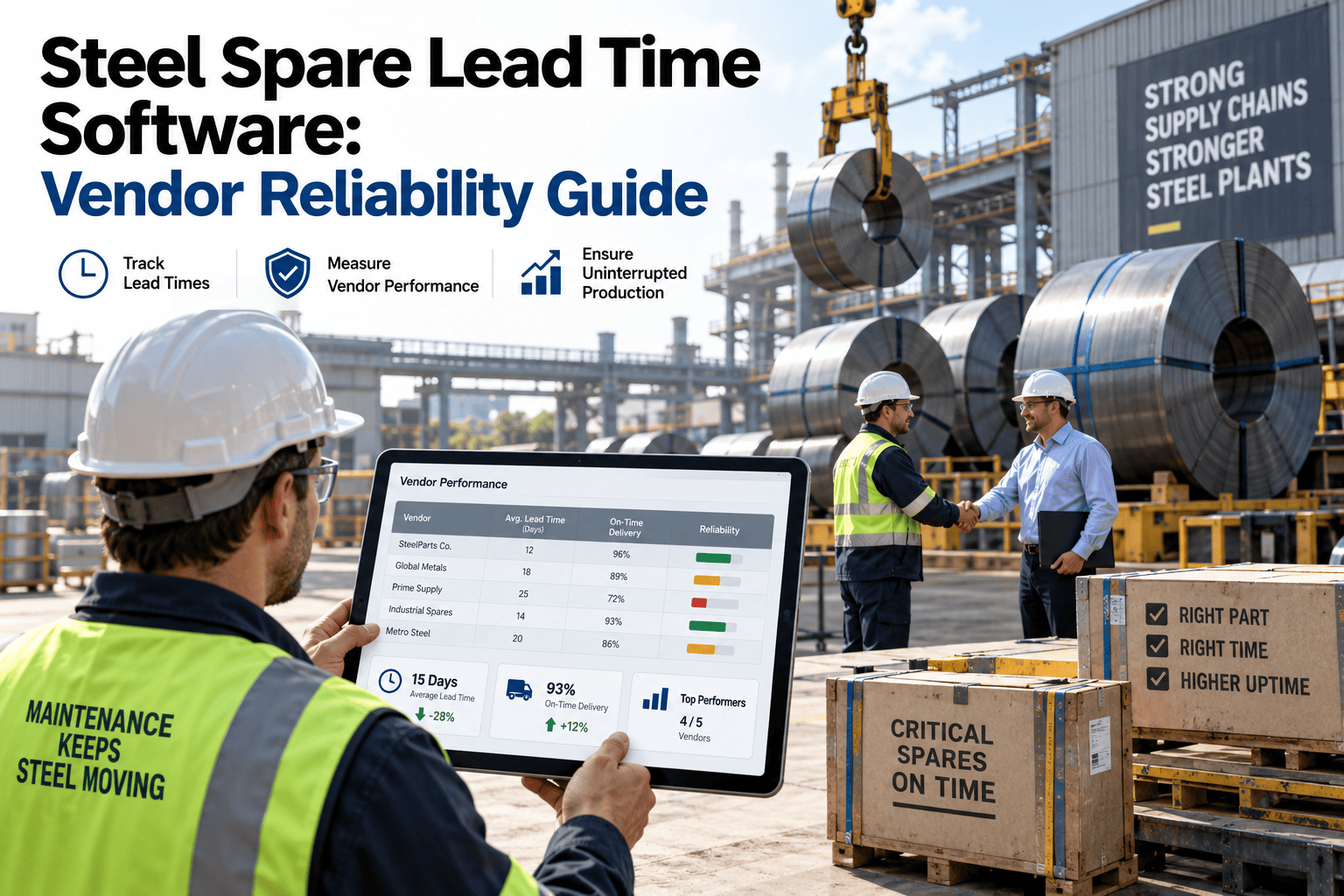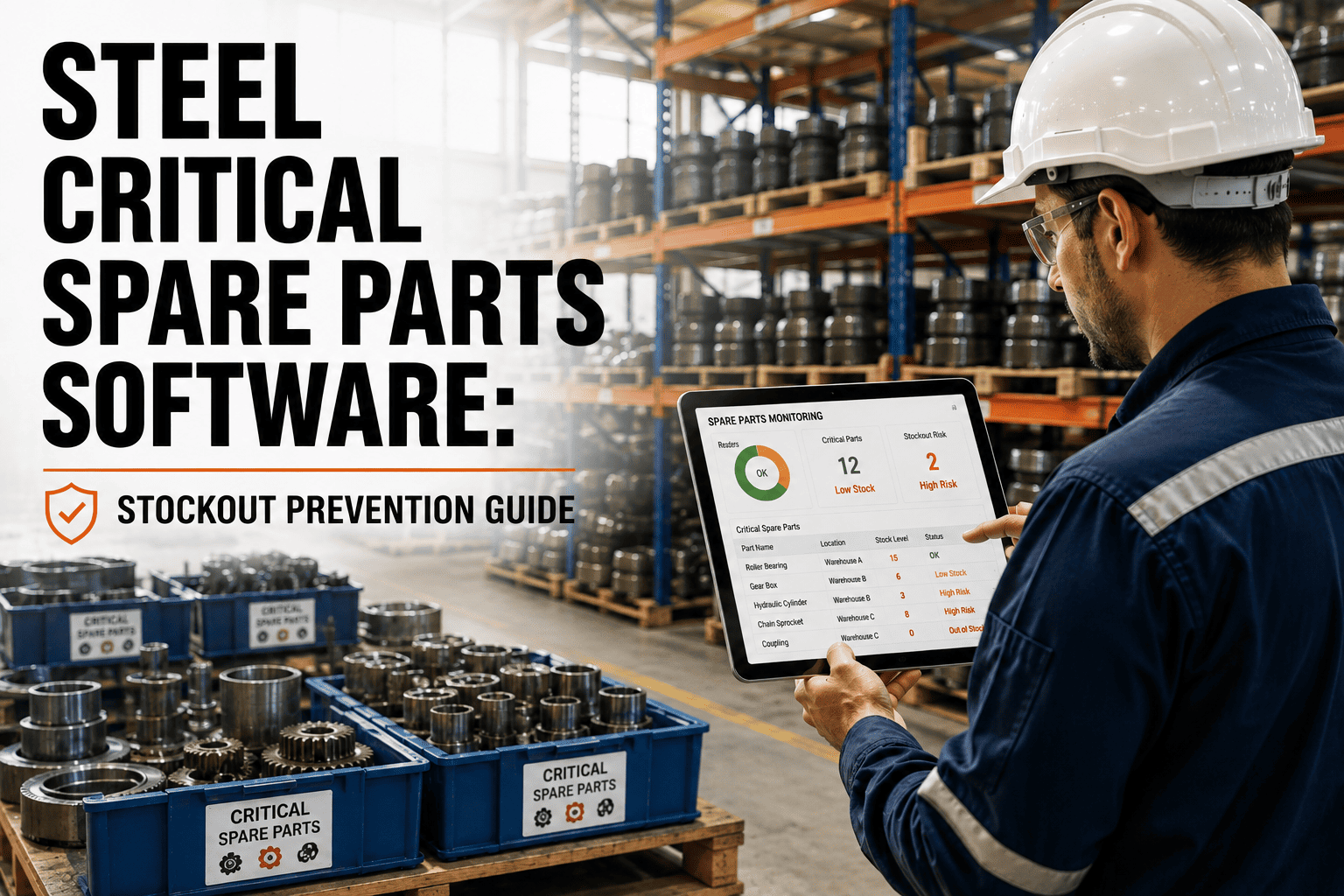
A stockout in a steel plant is rarely about a missing screw. It is about a gearbox bearing, a servo valve or a drive module that takes months to arrive, needed on a line that earns money every hour it runs. By the time the failure happens, the lead time is already lost and everyone pays emergency prices. Lead time should be a measured, variable input to every stocking decision. This guide shows how to measure and use it. To track parts and supplier history together, start with Oxmaint inventory.
Steel Plant Spare Parts Lead Time Management for Maintenance Procurement
Reduce stockouts and emergency buys by measuring real supplier lead times, linking them to reorder points, and protecting critical spares by consequence rather than by price.
Lead Time Is Six Delays, Not One Number
The quoted lead time covers only the supplier's part of the journey. Your own internal steps often add weeks that no one measures.
The Reorder Math, With a Worked Illustration
The standard reorder point is expected demand during lead time plus safety stock. The numbers below are illustrative only, and your own history should set real values.
Now suppose the supplier starts delivering in five months instead of three. Demand during lead time becomes 20, and the old reorder point of 16 would have been breached before the order even arrived. That is why lead time must be updated from receipts.
Which Parts Deserve a Lead Time Review First
Measure Supplier Lead Time From Receipts
| Measure | How to calculate | Why it matters |
|---|---|---|
| Actual lead time | Goods receipt date minus purchase order date, per part and supplier | Replaces the quoted figure as the planning input |
| Lead time variability | Spread of actual lead times across recent orders | Sets how much safety stock the uncertainty needs |
| On-time delivery | Orders received by the promised date divided by all orders | Shows which suppliers need a larger buffer or a backup |
| Internal approval time | Requisition date to purchase order date | Reveals delay that is entirely under your control |
| Inspection and putaway time | Receipt to available in stock | Catches parts that are in the building but not usable |
Put Real Lead Times Behind Every Reorder Point
Keep part records, supplier history and reorder rules together in Oxmaint, so critical spares are reviewed against what suppliers actually deliver.
Strategies for Long-Lead Critical Spares
Emergency Purchase Versus Planned Purchase
- Part needed after failure, with the line already stopped
- Premium freight and urgent supplier surcharges
- Limited choice of supplier or substitute
- Technicians and contractors waiting on site
- Approval bypassing normal controls
- Part ordered from the PM or condition signal, with weeks to spare
- Standard freight and negotiated terms
- Time to compare suppliers and check quality
- Job kitted and scheduled before the stop
- Normal approval path with budget visibility
Link Lead Time to the Maintenance Plan
Procurement should see the maintenance plan far enough ahead to act inside lead time.
Common Lead Time Mistakes in Steel Plant MRO
- Entering a lead time once at part creation and never updating it.
- Using the supplier's quote and ignoring internal approval and inspection time.
- Cutting stock value across the board and removing critical spares with the dead stock.
- Setting safety stock by price rather than by consequence of stockout.
- Ordering shutdown materials too late because scope was not frozen.
- Relying on the memory of long-serving staff to know which spares are critical.
KPIs for Lead Time and Availability
How Oxmaint Supports Parts and Procurement Workflow
Scoring Criticality Before You Stock
A reliable lead time is only useful when you know which parts it matters for. Score each spare on a small set of factors, and review the score with operations.
| Factor | Question to ask | Effect on stocking |
|---|---|---|
| Production consequence | Does failure stop the line, slow it or leave a workaround? | Higher consequence justifies more protection |
| Safety and environment | Could a failure create a safety or environmental incident? | May require stock regardless of cost |
| Lead time | How long does a replacement take to become usable? | Longer lead times push toward holding stock |
| Single source | Is there only one supplier, repairer or design? | Raises risk, so consider a second source |
| Failure likelihood | How often has this part failed, and is it condition-monitored? | Rare but severe failures need insurance spares |
| Repairability | Can the part be repaired, and how long does repair take? | Repairable parts may need fewer units but a managed loop |
Handling Lead Time Variability
Two suppliers can quote the same lead time and behave very differently. The spread of actual deliveries matters as much as the average.
- Use a recent window of actual receipts, such as the last several orders, to see the spread for each part and supplier.
- Give parts with wide spread a larger safety buffer, or look for a second supplier to reduce the risk.
- Review the supplier's own capacity signals, such as order books or raw material shortages.
- Separate quoted lead time from observed lead time in the part record, so the gap is visible.
- Flag parts where lead time is longer than the time between warning and failure on the asset.
A Supplier Scorecard for Critical Spares
| Measure | What it tells you | Typical action |
|---|---|---|
| On-time delivery | Whether promised dates are reliable | Raise safety stock or find a backup supplier |
| Quote-to-order time | How quickly the supplier responds to requests | Use agreements for items needed urgently |
| Quality at receipt | How often parts fail inspection or need rework | Tighten specifications or inspection |
| Emergency response | Whether the supplier can expedite when needed | Record contacts and terms in the part record |
| Repair turnaround | How long repairable units take to return | Plan the number of units in the loop |
Managing the Repairable Spare Loop
Storeroom Practices That Protect Availability
- Mark critical spares clearly in the system and in the storeroom, so they are not issued for convenience.
- Use cycle counts focused on critical and high-value items, not only an annual stock take.
- Store long-life items in conditions that match the manufacturer's guidance, and log inspections.
- Reserve parts against approved jobs, so a spare is not consumed by an unplanned request.
- Review slow-moving stock by consequence before disposal, and keep the critical ones explicitly.
Illustrative Critical Spare Groups by Plant Area
| Area | Typical groups to review | Why lead time matters |
|---|---|---|
| Rolling mill | Gearboxes, spindles, couplings, chocks, drive modules | Large components may be custom and slow to repair |
| Continuous casting | Segment rolls, oscillator parts, hydraulic valves, slide gate parts | A stop affects every downstream process |
| Melt shop | Transformer parts, electrodes, cooling components, furnace panels | Specialist parts with long manufacturing times |
| Blast furnace and stoves | Valves, blowers, cooling elements, burners | Outages are rare and expensive, so parts must be ready |
| Utilities | Compressors, large pumps, switchgear, fan rotors | Failures can affect several areas at once |
| Material handling | Belts, idlers, pulleys, crusher wear parts | Planned wear parts can be ordered from the plan |
Procurement Policy Rules Worth Writing Down
- State which part classes can be ordered by the storekeeper against a reorder point, and which need planner or manager approval.
- Set a time limit for approving requisitions on critical spares, so internal delay does not eat the supplier's lead time.
- Require a recorded reason for every urgent order, so emergency buying can be analyzed by cause.
- Define when a repair is preferred to replacement, with the measured repair turnaround as an input.
- Agree who may approve the use of an insurance spare, and how it is replaced afterward.
Kitting and Pre-Staging Parts for Planned Jobs
Lead time ends at the shelf, but delay can continue until the right parts reach the right crew. Kitting closes that last gap.
A Review Calendar for Lead Time Data
Frequently Asked Questions
Order Inside Lead Time, Not After the Failure
Connect spare parts, supplier history, preventive maintenance and work orders so critical parts are on the shelf when the job starts.