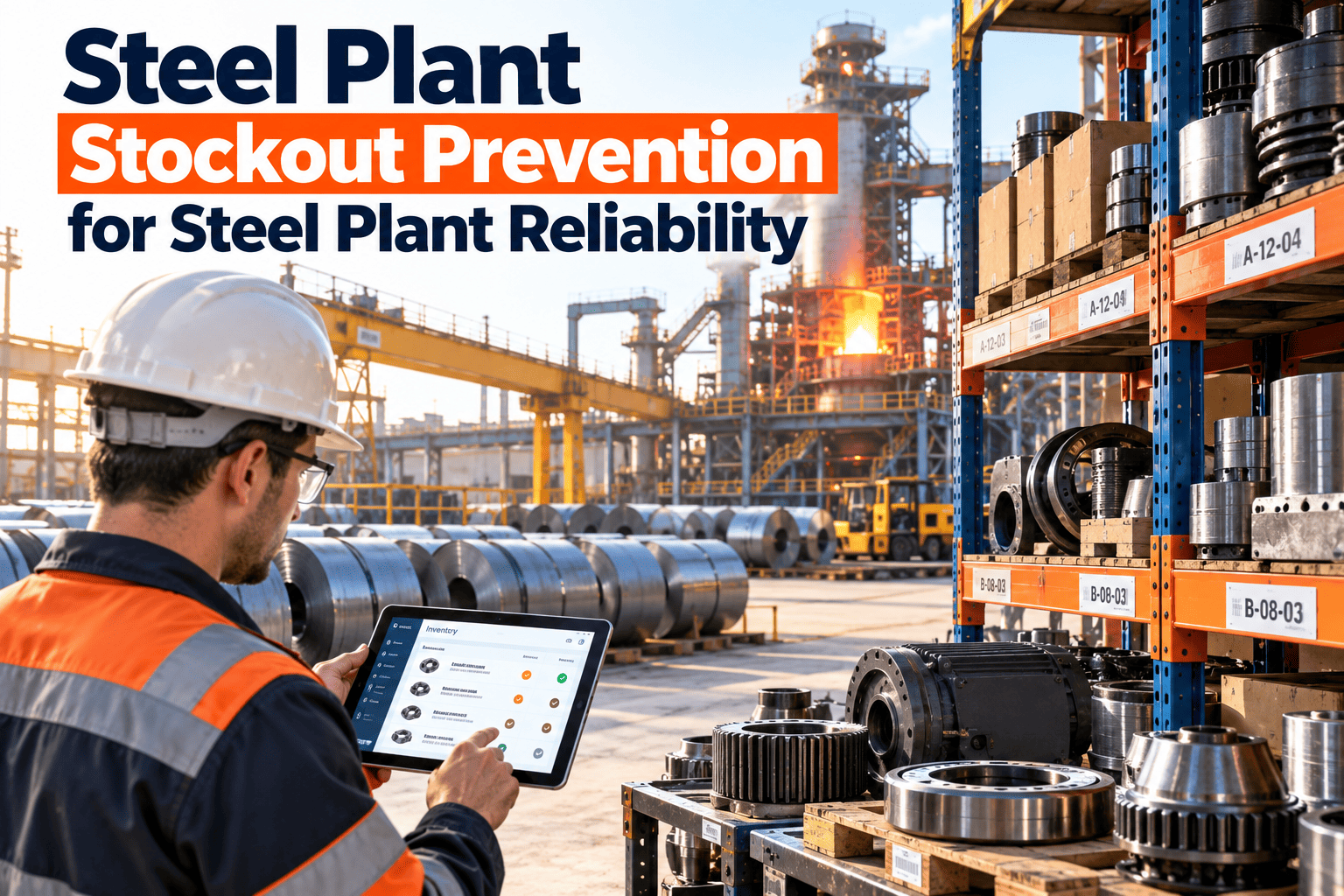
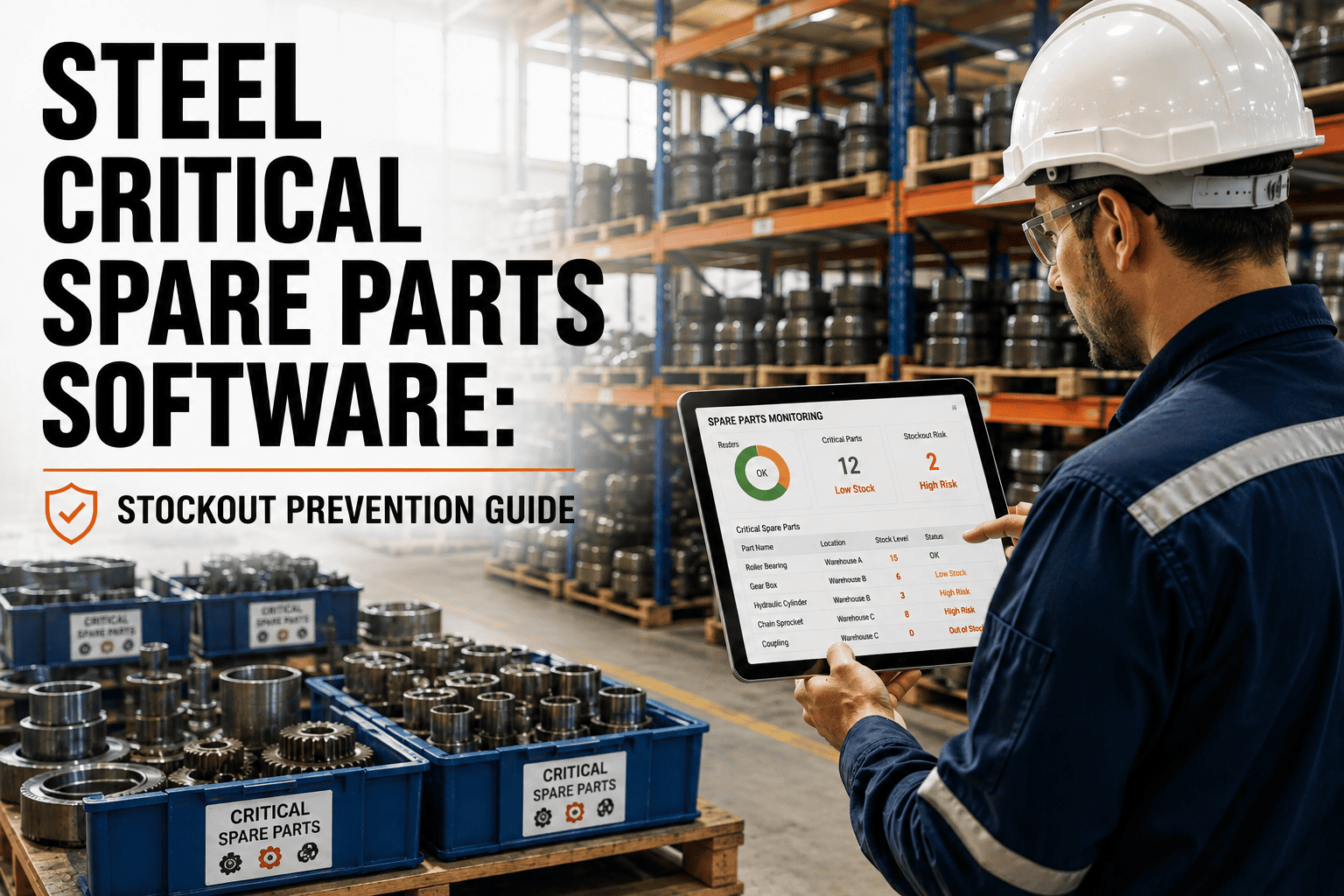
A single missing bearing seal. A refractory brick out of stock. A hydraulic valve not on the shelf. In a steel plant running 24/7 at full capacity, any of these becomes a production stoppage worth $40,000 or more per hour. Sign in to Oxmaint to see your plant's live stockout risk map — most facilities discover 12 to 18 critical parts already at risk before they even begin a formal audit. confirms that AI-driven demand forecasting improved forecast accuracy by up to 10% at major producers like Gerdau, directly cutting inventory holding costs while eliminating emergency procurement cycles that plague reactive operations.
$1T
Lost Annually to Stockouts
Worldwide across industries
20–50%
Forecast Error Reduction
With AI vs. traditional planning (McKinsey)
65%
Fewer Lost-Sale Events
Post AI forecasting deployment
23%
Plants Using AI Today
Early movers gain the edge
The Core Problem
Why Steel Plants Keep Running Out of Critical Parts
Traditional procurement in steel plants relies on fixed minimum stock levels set months or years ago, supplier lead times pulled from a quote rather than actual delivery history, and demand estimates based on last year's production schedule. None of these inputs update when conditions change — and in steel, conditions change constantly. Sign in to see how Oxmaint tracks your real consumption rates automatically, without manual counts.
01
Static Reorder Points
Fixed thresholds ignore production surges, campaign changes, and seasonal demand — leaving you exposed exactly when you need stock most.
02
Quoted vs. Actual Lead Times
Industrial suppliers deliver 34% later than quoted on average. Safety stock sized on the quoted lead time is structurally insufficient from day one.
03
No Supplier Reliability Data
Procurement teams place orders with underperforming vendors without visibility into past delivery failures, inflating stockout risk with every purchase order.
04
Detection at Point of Use
Most plants discover a stockout when a technician opens an empty bin — at which point the production line is already at risk and emergency procurement begins.
Real Impact
What a Single Stockout Actually Costs
Direct Downtime Loss
$40K–$120K/hr
Emergency Procurement Premium
2–4× list price
Expedited Freight Cost
+$800–$3,500
Contract Penalty Exposure
0.5–2% contract value
Technician Idle Time
4–16 hrs avg wait
Source: Industry averages compiled from Netstock 2025 Benchmark Report, McKinsey Supply Chain Analysis, and steel plant operational data.
Forecasting Science
How AI Calculates the Right Safety Stock for Your Plant
Safety stock is not a guess or a round number — it is a mathematically precise buffer calculated from demand variability, lead time variability, and your target service level. Sign in to Oxmaint to see this formula applied automatically to every SKU in your parts catalog, recalculated weekly as fresh data arrives.
A
Moving Average
Slow-moving stable parts
±25% accuracy
Baseline only
B
Exponential Smoothing
Seasonal-cycle parts
±15% accuracy
Secondary model
C
ARIMA / Time Series
High-usage MRO items
±12% accuracy
Active model
S
ML Gradient Boosting
All SKUs with sensor data
±6% accuracy
Oxmaint Primary
77% of steel plants have not yet adopted AI for inventory. Early movers gain a measurable procurement edge.
Data Comparison
AI Procurement vs. Traditional Procurement: Side by Side
How It Works
Oxmaint's 4-Layer Stockout Prevention System
1
DSF
Demand Signal Forecasting
Oxmaint reads equipment sensor data, work order history, and production schedules simultaneously. When a rolling mill bearing shows elevated vibration for three shifts, the system projects a replacement within 10–21 days and flags the part for a reorder check — before the work order is even filed.
Sign in to connect your sensors.
2
SRS
Supplier Reliability Scoring
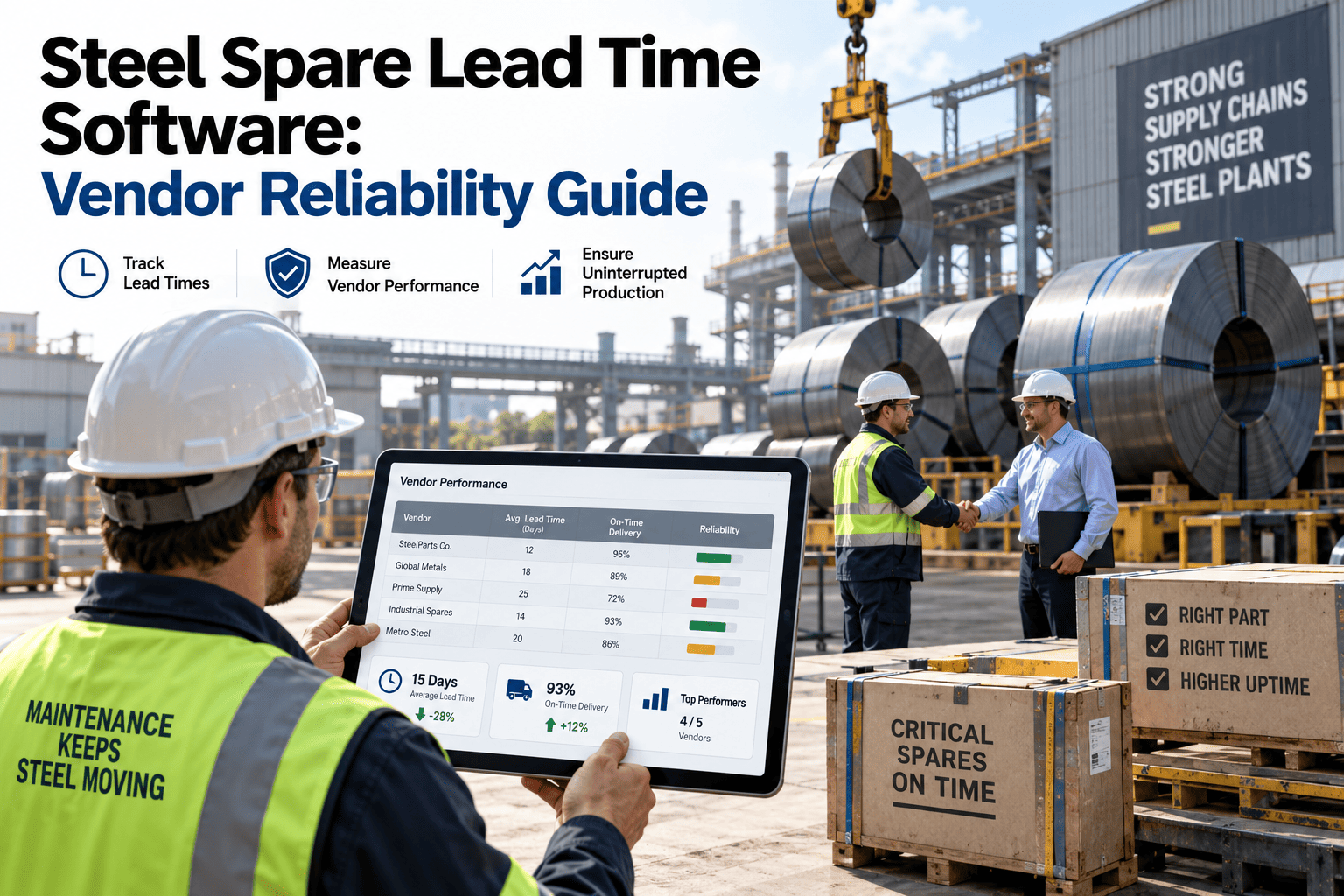
Every supplier receives a dynamic 0–100 score weighted by on-time delivery (50%), lead time accuracy (30%), and quality rejection rate (20%). When a supplier drops below 70, Oxmaint automatically inflates safety stock for parts sourced from that vendor by 15–25% — no manual intervention required.
3
ART
Automatic Reorder Triggers
Reorder points update weekly. When stock drops to the calculated threshold, a draft purchase order fires automatically — pre-filled with the preferred supplier, EOQ-based quantity, and the right approval chain. Emergency procurement cycles become a last resort, not a routine.
4
CPC
Critical Parts Classification
Parts are ranked into three tiers: mission-critical (plant-stopping), operational (production-slowing), and standard MRO. Safety stock, service level targets, and reorder logic differ by tier. Capital concentrates where failure is unacceptable — not spread uniformly across 10,000 SKUs.
Book a demo to see tier classification live.
"
We were sitting on 2.4 million dollars in spare parts inventory while still running emergency orders every month. The problem was never how much stock we held — it was that the wrong parts were overstocked and the right ones ran out. Oxmaint's demand forecasting flipped that ratio in eight months. Emergency procurement dropped from 23 orders a year to 4.
FAQ
Frequently Asked Questions
How does Oxmaint detect a stockout risk weeks before it happens?
Oxmaint combines three live data streams: real-time inventory levels updated from storeroom transactions, equipment sensor readings that signal upcoming part consumption (e.g., bearing vibration trends pointing to replacement), and historical demand patterns segmented by production schedule. When all three converge on a depletion window, the system generates a risk alert with a projected out-of-stock date.
Sign in to activate predictive stockout alerts for your plant — the initial data connection takes under 30 minutes for most facilities.
What data does Oxmaint need to start forecasting, and what if our storeroom records are incomplete?
Oxmaint can begin generating useful forecasts with as little as six months of consumption history and a current inventory snapshot. Incomplete records are handled through a guided data enrichment process where existing purchase orders and work order records are mapped to build the initial consumption dataset. The AI model improves in accuracy continuously as more data accumulates — it does not require perfect historical records to start delivering value.
Book a demo to see a sample data onboarding walkthrough.
How is the supplier reliability score calculated and what triggers a safety stock increase?
Each supplier receives a score from 0 to 100 based on three weighted factors updated after every closed purchase order: on-time delivery rate at 50% weight, lead time accuracy versus quoted at 30%, and quality rejection rate at 20%. When a supplier drops below 70, Oxmaint automatically increases safety stock for parts from that vendor by a calculated buffer — typically 15 to 25% — and holds the increase until the supplier score recovers across three consecutive on-time deliveries. No manual override is required from the procurement team.
Can Oxmaint manage parts shared across multiple steel plant locations?
Yes. Oxmaint's multi-site module aggregates demand signals across all connected facilities and identifies inter-plant transfer opportunities before triggering external purchase orders. If one site has excess stock of a part that another site is about to exhaust, the system flags a transfer first — cutting emergency procurement cost and delivery lead time significantly.
Sign in to connect your plant network and see cross-site inventory balancing in action.
How quickly do steel plants typically see results after deploying AI demand forecasting?
Most Oxmaint customers see their first risk alert within 72 hours of connecting storeroom or ERP data. Emergency order frequency typically falls 30 to 40 percent within the first 90 days as the AI learns actual consumption patterns. Full optimization — statistically sized safety stock, dynamic reorder points, and populated supplier scores — is typically reached by month four or five. Plants that also connect equipment sensor data reach optimized forecasting faster due to the additional consumption signal quality.
Your Next Stockout Is Predictable. Prevent It Now.
Oxmaint's AI forecasting engine is running for steel plants across South Asia, Southeast Asia, and the Middle East — calculating the right safety stock, tracking real lead times, and firing automatic reorders before bins run empty.