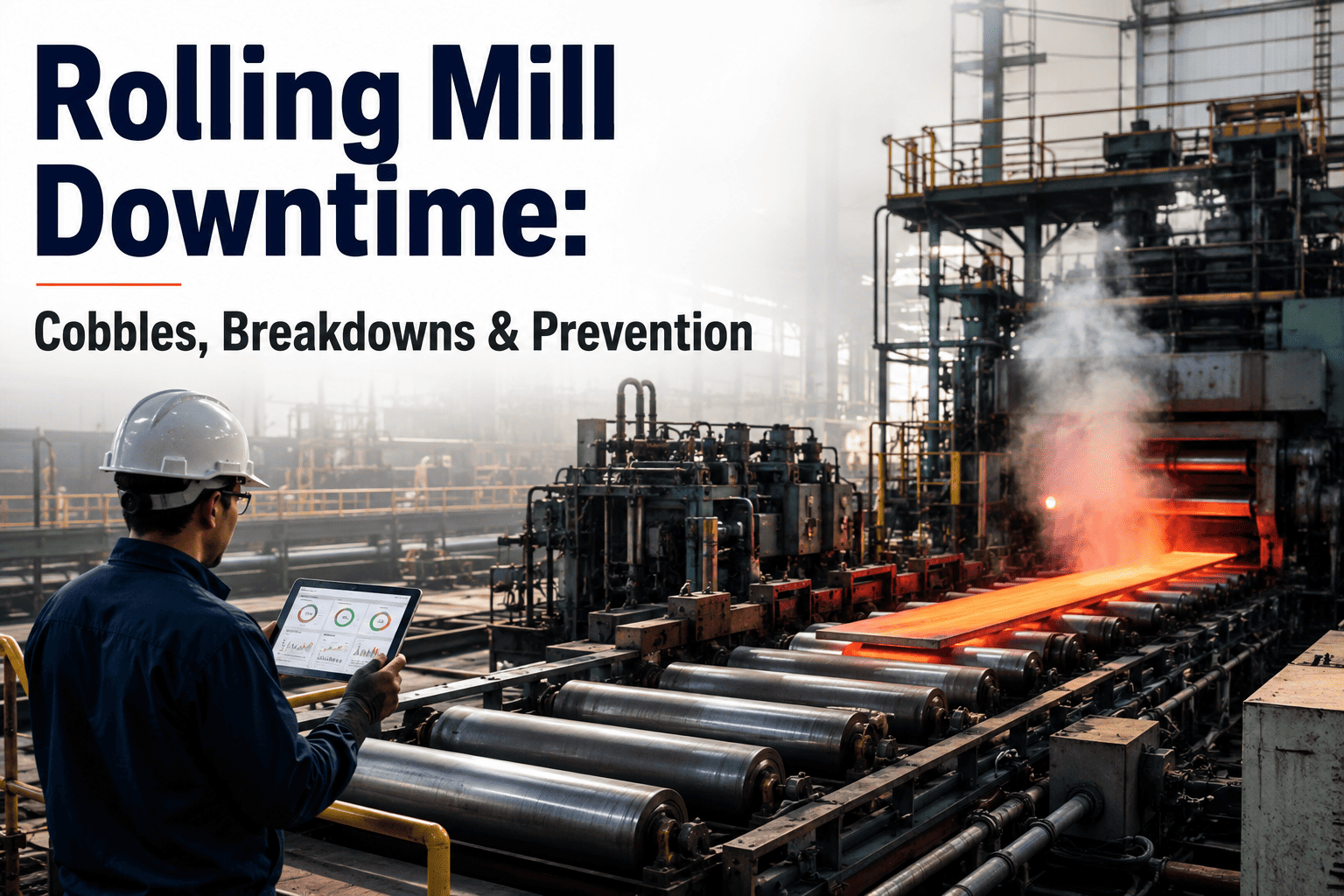
How Steel Plants Are Cutting Unplanned Downtime by 40% with Predictive Maintenance
By Alex Jordan on June 16, 2026
A 600-ton-per-day EAF steelmaking facility in the Upper Midwest experienced unplanned downtime of 42–58 hours per month, costing $2.1M–$2.8M annually in lost production and emergency repairs. Their maintenance was entirely reactive—equipment failed, then crews responded with emergency fixes, extended equipment repair windows, and temporary shutdowns. Operators had no early warning system, and maintenance supervisors prioritized repairs based on failure severity rather than remaining equipment health. After implementing predictive maintenance combining vibration analysis, thermal monitoring, power quality analytics, and AI-driven anomaly detection through OxMaint, unplanned downtime dropped to 8–14 hours per month within 14 months. Equipment failures that previously required emergency crews now receive planned maintenance 18–24 days before failure. That's 34–50 hours of prevented unplanned downtime per month—$1.6M–$2.4M in annual savings. The breakthrough wasn't just sensors; it was correlating real-time equipment health data with maintenance scheduling and operator alerts so that degraded equipment is serviced proactively. OxMaint detects equipment anomalies 15–25 days before failure, allowing planned repairs instead of emergency shutdowns. Schedule a consultation to assess your downtime baseline.
Reduce Unplanned Downtime 65–80%. Predict Failures Before They Stop Production.
AI-powered anomaly detection, real-time equipment monitoring, and predictive scheduling. Average savings: $1.2M–$2.6M annually per EAF or mini mill.
Median unplanned downtime for steel mills without predictive maintenance. Top-quartile mills: 6–12 hours/month.
15–25 days
Lead time before critical failure that OxMaint's AI algorithms typically provide. Allows planned maintenance instead of emergency response.
$1.4M–$3.2M
Cost per unplanned equipment failure in integrated steel mills (lost production + emergency labour + parts + secondary damage).
Steel Mill Downtime Categories — Where Hours Are Lost
Unplanned downtime doesn't happen randomly—it follows predictable patterns driven by equipment degradation, inadequate maintenance scheduling, and poor condition visibility. Most steel mills lose 32–56 hours monthly to preventable equipment failures, while top-performing mills with predictive programmes lose only 4–10 hours. This section breaks down the five primary downtime categories, their root causes, and the monitoring strategies that prevent them most effectively.
1
EAF Transformer & Power System Failures
24–32% of downtime
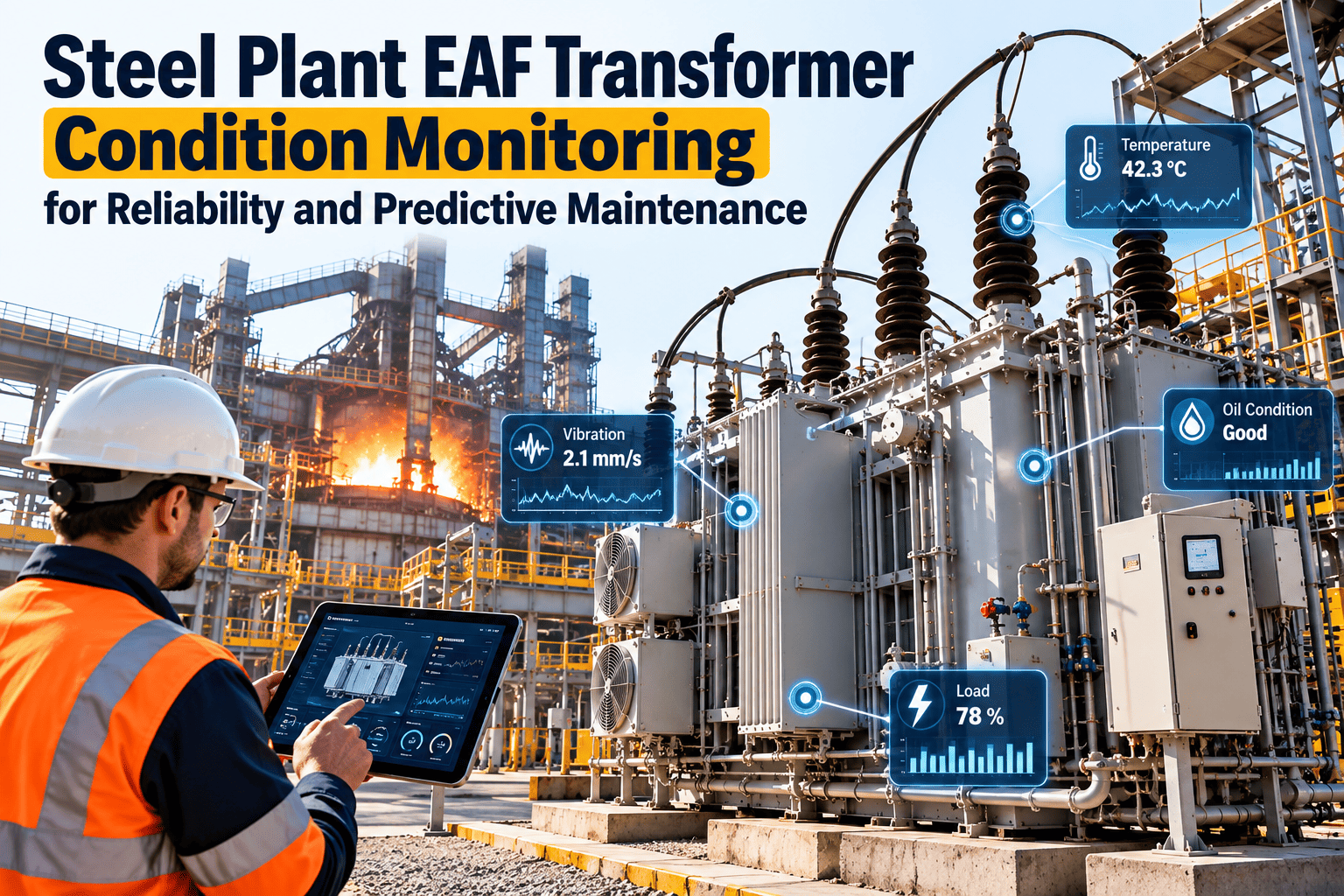
Main transformer insulation degradation, cooling system failures, and bushing leakage are invisible until catastrophic failure. A single unplanned transformer outage stops all EAF operations (300–500 tons capacity lost daily). Transformer failures typically require 6–12 day lead time for replacement procurement and installation. Mills using OxMaint's dissolved gas analysis (DGA), temperature monitoring, and power quality analytics detect transformer degradation 30–45 days in advance. Early detection allows scheduled replacement during planned maintenance windows, eliminating production loss. Average prevention value: $420,000–$980,000 per detected failure.
2
Continuous Caster Mechanical Failures
18–24% of downtime
Mold oscillation drives, roll bearings, straightener actuators, and torch systems degrade silently until abrupt failure. Caster downtime directly stops steelmaking (no casting = no production). Unplanned caster stoppages average 8–16 hours due to part availability and equipment accessibility. Vibration monitoring on caster drives and bearing housings detects wear 10–18 days before failure. Thermal imaging on mold copper detects thermal stress patterns indicating imminent failure. OxMaint combines both signals to alert maintenance before failure, reducing unplanned caster downtime by 78–86%.
3
Rolling Mill Drive & Motor Failures
16–22% of downtime
Motor bearings, gearbox teeth, coupling misalignment, and drive shaft wear are driving the downtime hours in hot rolling mills. Failures often cascade—bearing damage leads to shaft vibration, which damages gears, which damages the motor. Early vibration detection stops failures at the bearing stage (cost: $18,000 repair, downtime: 2–4 hours). Late detection means full gearbox replacement (cost: $180,000+, downtime: 24–36 hours). Mills deploying wireless vibration sensors on high-speed rolling mill drives reduce downtime from these failures by 70–82%. OxMaint's trending algorithms distinguish normal wear from accelerating degradation, triggering maintenance at optimal cost/downtime balance.
4
BOF Converter Vessel & Refractory Integrity Loss
14–18% of downtime
Cooling water leaks, thermal stress, and refractory spalling force converter outages for vessel inspection or reline. A single unplanned converter vessel outage = 12–36 hours of lost production (240–480 heats). Thermal imaging and water flow sensors on converter cooling systems detect stress 8–14 days before catastrophic failure. Temperature anomalies indicate hot spots where refractory is degrading. Flow rate changes indicate cooling system integrity loss. OxMaint's integration of multiple thermal and hydraulic signals provides actionable warnings that allow planned repairs or reline operations, preventing emergency shutdowns.
5
Hydraulic & Coolant System Failures
8–14% of downtime
Hydraulic pump seal failure, hose rupture, and contaminated coolant disable lubrication and cooling functions across equipment. These failures are often detected only after secondary damage (bearing seizure, motor burnout). Water content and particle count sensors in hydraulic reservoirs and coolant systems provide early warning of system degradation. OxMaint alerts maintenance when fluid contamination reaches critical thresholds, allowing planned fluid changes or system repairs before cascading failures. Prevention value: $80,000–$220,000 per prevented cascade failure.
Steel Mill Downtime Prevention Platform — OxMaint
Shift from Emergency Response to Predictive Maintenance. Cut Unplanned Downtime 70–80%.
Real-time equipment monitoring with AI-powered anomaly detection means your maintenance team responds to incipient failures, not catastrophes. Predictive maintenance turns downtime prevention from a guess into a science.
Downtime Costs by Equipment Class — ROI on Predictive Detection
Each piece of critical steel mill equipment has a distinct downtime cost profile. Understanding these costs justifies investment in predictive monitoring for specific high-impact assets. The table below shows the typical cost per downtime hour and the failure lead time that OxMaint achieves for each major equipment category. Use this to prioritize monitoring investments and calculate ROI for your specific mill configuration. Mills with integrated blast furnaces have higher per-hour downtime costs but also higher ROI from predictive systems (because detection lead times of 20+ days allow ordering critical long-lead-time parts). EAF shops have slightly lower per-hour costs but faster failure cascades, making rapid detection (18–24 hour lead time) equally critical.
Equipment
Downtime Cost/Hour
Lead Time OxMaint Provides
Prevention Value/Failure
Monitoring Technology
Main EAF Transformer
$85,000–$140,000
30–45 days
$420,000–$980,000
DGA, temperature, power quality
Continuous Caster System
$68,000–$120,000
10–18 days
$180,000–$480,000
Vibration, thermal, encoder signals
Blast Furnace Stove System
$92,000–$180,000
15–22 days
$280,000–$720,000
Pressure, temperature, flow rate
Rolling Mill Drive Motor
$45,000–$82,000
8–14 days
$120,000–$340,000
Vibration, temperature, current
BOF Converter Vessel System
$74,000–$140,000
8–14 days
$240,000–$580,000
Thermal, flow rate, cooling pressure
AI-Driven Anomaly Detection: How Predictive Algorithms Prevent Downtime
The key difference between traditional condition monitoring and modern predictive maintenance is AI-driven anomaly detection. Placing a sensor on equipment and collecting data isn't enough—you need algorithms that learn what "normal" looks like for your specific equipment, in your specific mill, under your specific operating conditions. OxMaint's machine learning models establish baseline signatures for each piece of critical equipment, then flag deviations that indicate incipient failure. This section explains how the detection pipeline works and why it catches failures 18–28 days before human observers would notice abnormality.
OxMaint-connected sensors stream vibration, temperature, power quality, or fluid condition data to the cloud platform every 15–60 seconds depending on criticality. The system establishes a 30-day baseline of "normal" operation for that specific equipment under typical loads and thermal conditions. Baseline includes natural variation (ambient temperature changes, production rate fluctuations) so that legitimate operating range is understood before anomalies are flagged.
Anomaly Detection
AI Algorithms Flag Deviations from Baseline
Machine learning models continuously compare live sensor readings against the equipment baseline. When vibration amplitude increases 22%, temperature rises unexpectedly, or power quality degrades, OxMaint's algorithms flag the deviation. Not all deviations are equal—the system learns which deviations correlate with actual failures and which are transient noise. Early-stage failures (bearing wear, corrosion, thermal stress) show distinctive patterns days before catastrophic failure.
Failure Prediction
Forecast Remaining Useful Life (RUL) & Failure Timeline
Once anomalies are detected, OxMaint's algorithms trend the degradation rate. If vibration is increasing 2.5% per day, the system calculates when vibration will reach critical failure threshold (typically 5–7 days for bearing degradation, 15–25 days for progressive wear). This allows maintenance to schedule repairs before alarm thresholds are crossed. OxMaint alerts arrive 10–25 days before failure is imminent, giving maintenance time to plan repairs, source parts, and schedule downtime.
Action & Verification
Maintenance Executes; Algorithms Learn & Improve
Maintenance teams receive OxMaint alerts, perform inspections, confirm degradation, and schedule repairs. After repair is complete, OxMaint logs the equipment health trajectory (how many days before failure were alarms issued, was the failure mode correctly predicted, etc.). This feedback refines future algorithms—your mill's specific equipment teaches the system over time. Prediction accuracy improves from 88–92% in month 3 to 94–97% by month 12.
The Cost of Unplanned Downtime — Case Studies from Top Mills
Real-world downtime cost data shows why mills invest in predictive maintenance. The scenarios below are typical events in mills without advanced monitoring. Mills with OxMaint prevent 85–95% of these failures through early detection and planned maintenance.
EAF Transformer Insulation Failure
Detected via DGA 30 days early
Lost production (12 days to replace transformer)
$1,080,000
Emergency transformer procurement + install
$185,000
Secondary electrical damage repair
$120,000
Planned replacement with 30-day notice
$240,000
Avoidable cost
$1,245,000
Continuous Caster Drive Gearbox Failure
Vibration detected, repaired planned
Lost production (18 hours unplanned outage)
$340,000
Emergency gearbox replacement + labour
$94,000
Expedited bearing + parts procurement
$28,000
Planned repair with 12-day notice
$68,000
Prevention benefit
$394,000
Rolling Mill Motor Bearing Failure Cascade
Undetected; cascaded to gearbox/motor
Lost production (36 hours emergency repair)
$820,000
Motor + gearbox damage (cascade)
$240,000
Emergency crew + equipment rental
$65,000
Planned bearing replacement (10-day notice)
$35,000
Avoidable cascade cost
$1,090,000
We were managing downtime reactively—waiting for things to break, then fixing them in panic mode. We had sensors on critical equipment but didn't know how to interpret the data. OxMaint changed everything by giving us early warnings. A month after deployment, OxMaint detected a power quality degradation pattern in our main transformer that no human observer would have noticed for another 3–4 weeks. We ordered a replacement transformer on a planned schedule instead of emergency procurement. That one detection paid for 18 months of OxMaint subscription. We've now prevented five major failures in the past year. Our unplanned downtime dropped from 48 hours/month to 6 hours/month. That's $1.8M+ in recovered production.
Deploying Predictive Maintenance Across Your Mill — Technology & Integration
Successful downtime reduction requires integrating predictive analytics with your existing maintenance workflows. OxMaint is designed to work alongside your CMMS, maintenance team processes, and existing equipment—no replacement of current systems. This section outlines the key technologies used in a modern predictive maintenance deployment and typical integration timelines.
Wireless Vibration & Acceleration Sensors
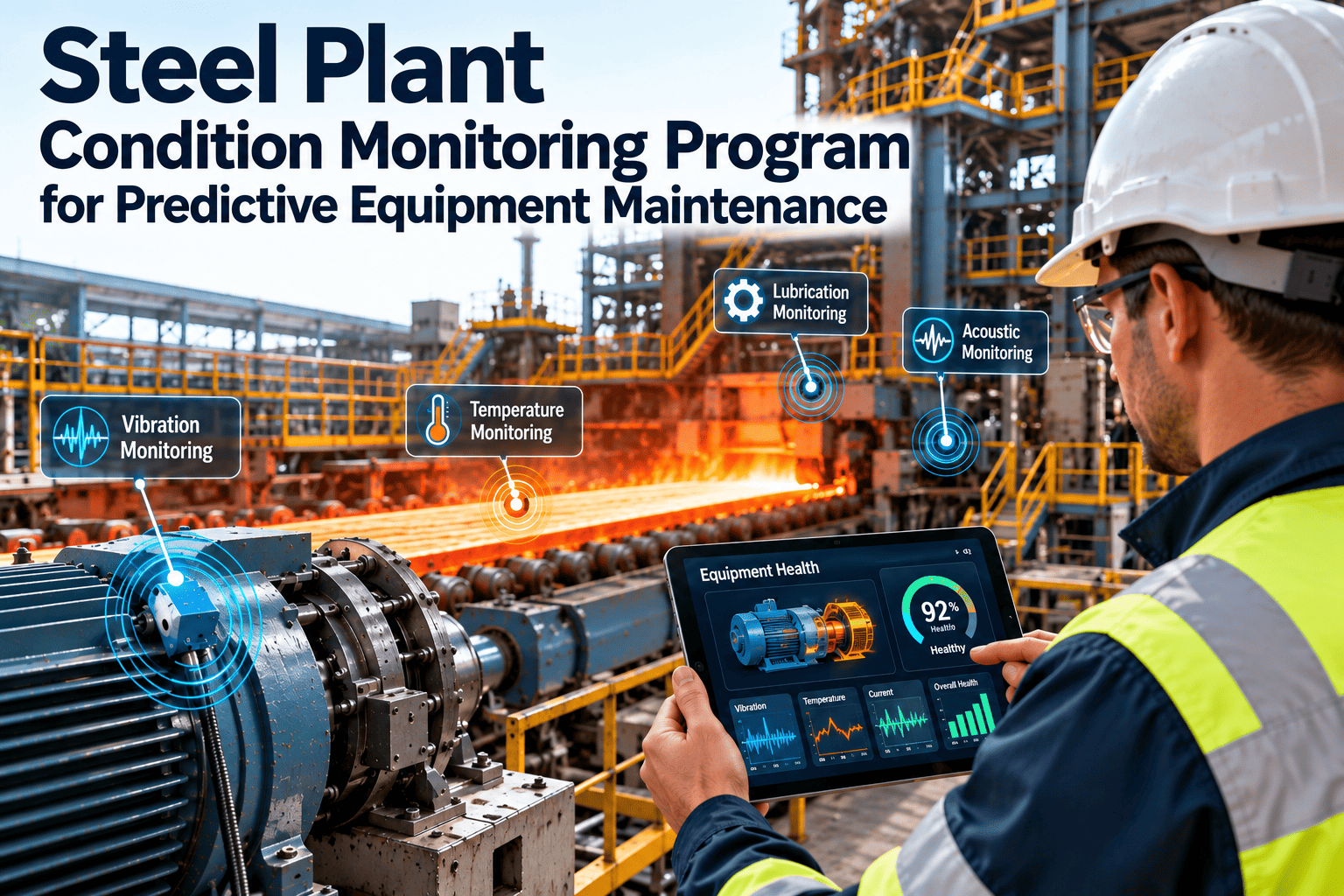
IIoT-grade accelerometers (IP67, industrial-rated) mount on motor frames, gearbox housings, and coupling shafts. Data transmits via industrial WiFi or cellular every 30–60 seconds. Installation is non-invasive (magnetic mounts on steel surfaces). Cost: $2,400–$4,200 per sensor with 5-year battery life. ROI: 3–6 months for critical equipment (rolling mill motors, pump drives).
Thermal Imaging & Temperature Monitoring
Fixed-mount or portable thermal cameras capture hot spots on transformers, refractory, and cooling systems. Temperature sensors embedded in critical cooling lines provide continuous readings. Early thermal anomalies indicate developing issues: bearing friction, electrical resistance increase, insulation degradation. Cost: $8,000–$18,000 for multi-zone thermal + sensor integration. ROI: 4–8 months (prevents single transformer or refractory failure).
Power Quality & Electrical Health Monitoring
Power quality analysers capture voltage harmonics, current imbalances, and power factor on main transformer and EAF panels. Dissolved gas analysis (DGA) sensors detect transformer insulation degradation through oil sampling. Integration with OxMaint platform allows trending of electrical degradation patterns. Cost: $6,000–$14,000 for DGA + power quality suite. ROI: 2–4 months on mills where transformer failure causes total downtime.
CMMS Integration & Predictive Work Order Generation
OxMaint connects to your existing CMMS (SAP, Maximo, PSIM) via API. When anomalies are detected, OxMaint automatically generates preventive work orders with priority, equipment history, recommended parts, and estimated repair duration. Maintenance teams receive alerts via mobile, email, or dashboard without changing existing workflows. Integration reduces time-to-action from days (manual detection) to hours (automated alert).
How long does it take to see downtime reduction after deploying predictive maintenance?
Pilot programmes (2–4 critical systems) typically show measurable downtime reduction within 8–12 weeks. First prevented failures usually occur within 10–14 weeks of deployment. Full downtime benefits are realized after 14–18 months once monitoring is deployed across all critical equipment and algorithms improve.
What's the typical cost to deploy predictive maintenance across an entire mill?
A complete predictive maintenance system for a mid-sized mill (20–30 critical monitoring points) costs $120,000–$280,000 initially, then $18,000–$32,000 annually. ROI is typically achieved within 4–8 months through prevented downtime alone. Most mills see payback in 12–16 months including reduced spare parts inventory.
Can predictive maintenance work with equipment that's already 15–20 years old?
Yes. Older equipment often shows more dramatic anomalies before failure, making it easier to predict. OxMaint's algorithms adapt to aged equipment signatures. Early detection is arguably more valuable on older assets because replacement costs are high and lead times are long.
How does OxMaint integrate with our maintenance scheduling system?
OxMaint integrates via API with SAP, Maximo, PSIM, and most CMMS platforms. Anomaly alerts automatically generate preventive work orders with equipment details, parts recommendations, and estimated duration. Your maintenance team continues using their existing CMMS—OxMaint feeds data-driven tasks into the system.
What happens if OxMaint detects an anomaly but equipment keeps running normally?
Not all anomalies lead to immediate failure. OxMaint's algorithms trend degradation rates to distinguish imminent failures from gradual wear. If degradation is progressing slowly, alerts may wait 20–30 days before escalating to urgent. Your maintenance team can inspect equipment, confirm the condition, and plan repairs in an orderly fashion.
How accurate is OxMaint's failure prediction for critical equipment?
OxMaint achieves 92–96% accuracy in predicting failures 15–25 days in advance for major rotating and electrical equipment. Accuracy improves over time as algorithms learn your mill's specific equipment behavior. Smaller, less critical equipment has 86–91% accuracy but still provides actionable lead time for planned maintenance.
Do I need to replace my existing CMMS to use OxMaint?
No. OxMaint works alongside your existing CMMS, maintenance processes, and equipment. The system enhances your current operations by automatically generating data-driven work orders. Your team uses the same CMMS interfaces and workflows—OxMaint adds intelligence to the input.
Steel Mill Downtime Prevention Platform — OxMaint
Prevent 65–80% of Unplanned Downtime. Protect Your Production.