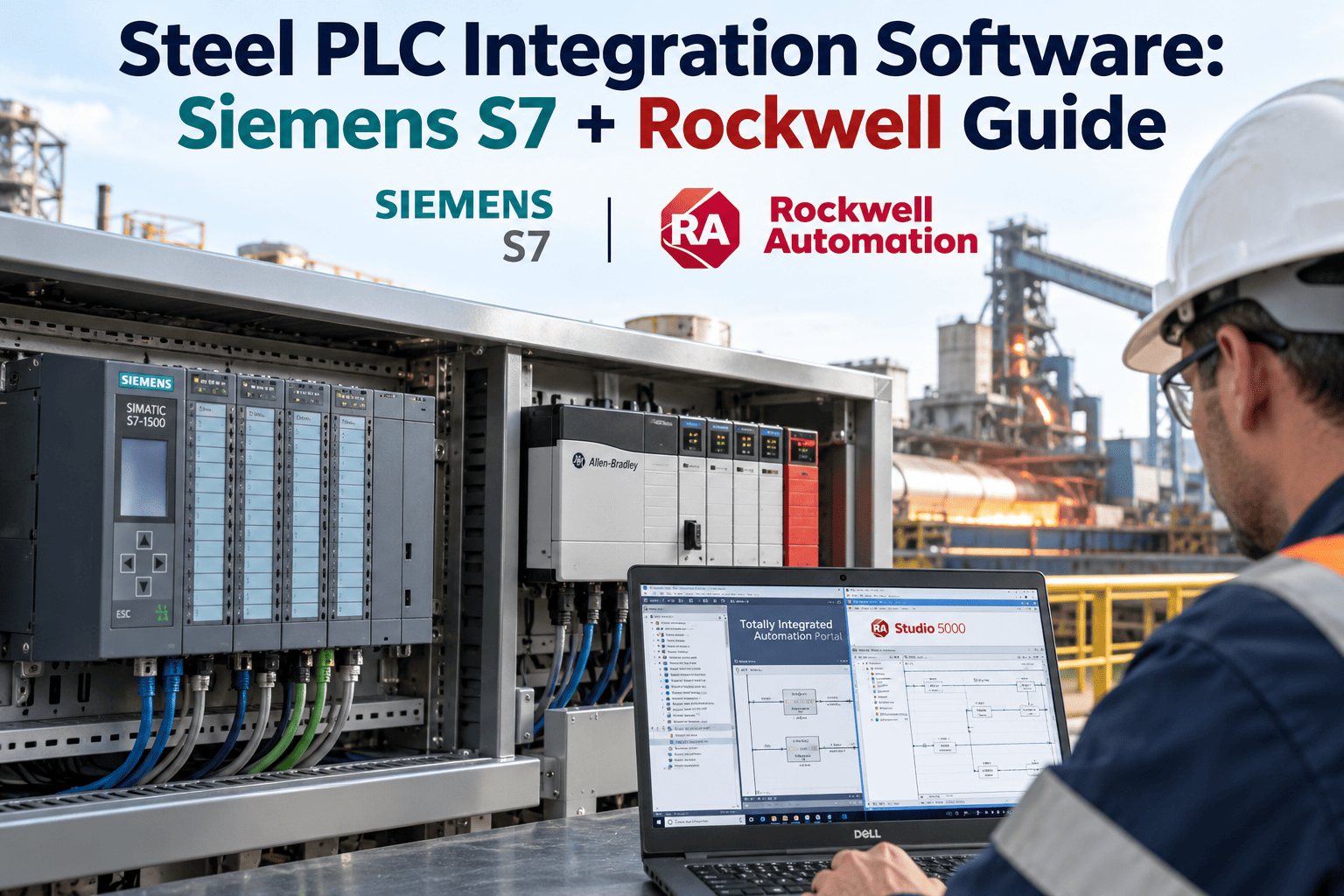
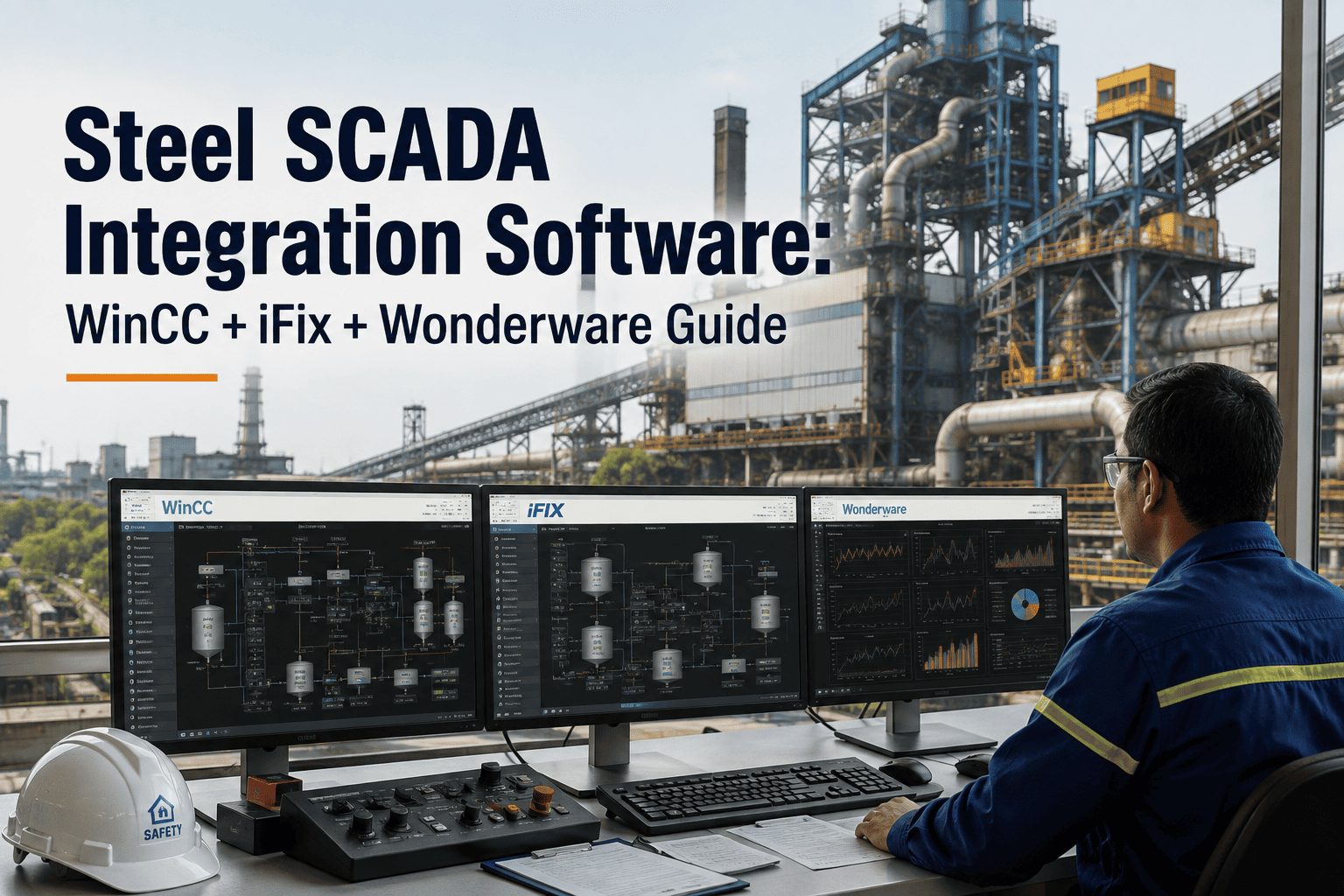
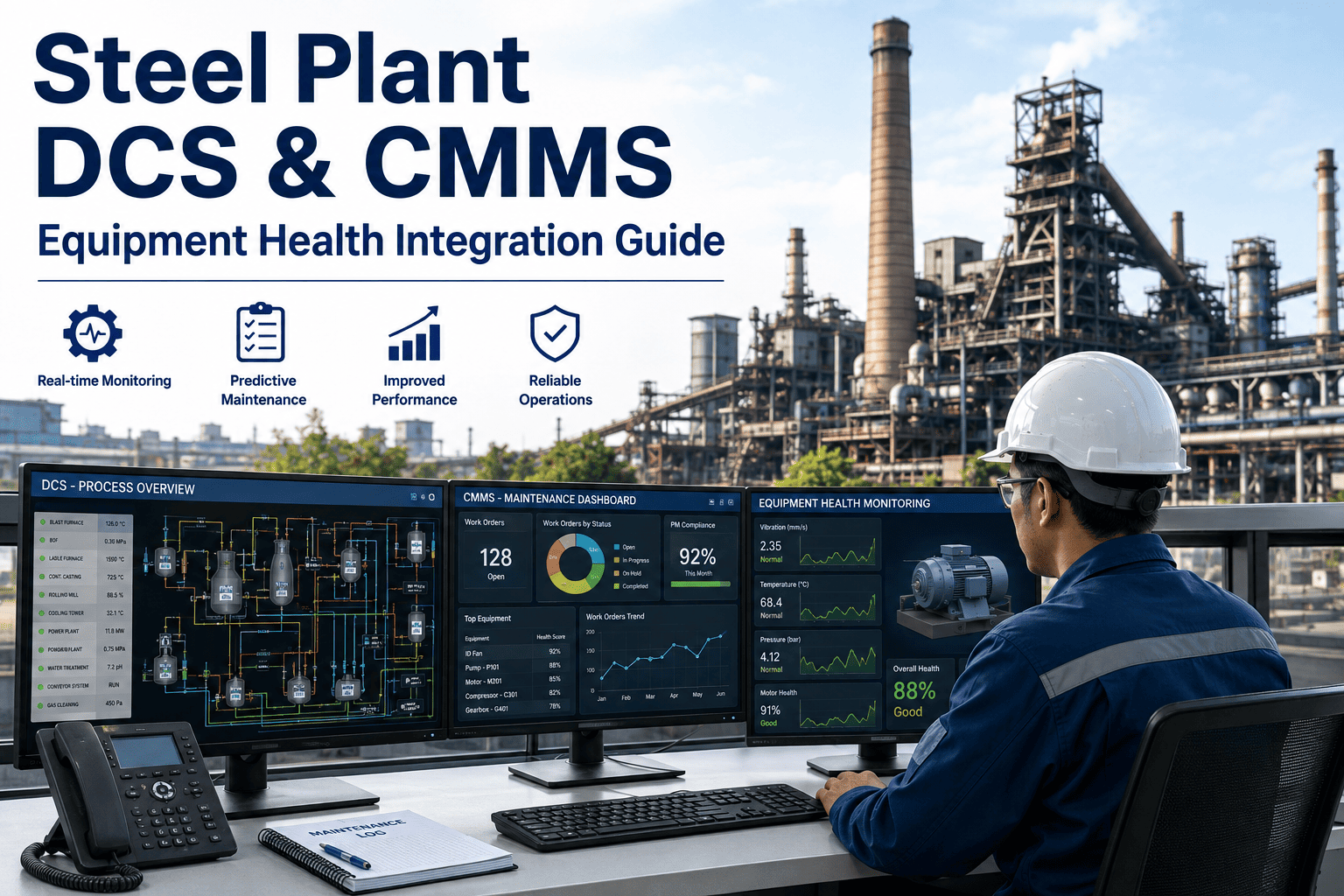
Every steel plant floor tells the same story: a Siemens S7 controller running the rolling mill, an Allen-Bradley ControlLogix driving the caster, and a Mitsubishi PLC tucked away on a decades-old annealing line — three vendors, three protocols, and zero shared visibility for the maintenance team. That fragmentation is exactly why steel plant PLC integration software has become the top digitalization priority for plant reliability leaders in 2026. This guide breaks down how Siemens S7, Rockwell/Allen-Bradley, and Mitsubishi PLC data can be unified into one maintenance system without touching a single wire on the panel. See how Oxmaint connects your existing PLCs in the sections below.
Why Steel Plants Are Drowning in Disconnected PLC Data
Steel production runs on some of the oldest and most reliable automation in heavy industry, and that is precisely the problem. Reliability teams are not short on data — every controller on the floor is already generating fault codes, cycle counts, and temperature readings every second. What they are short on is a single place where all of that data means the same thing, regardless of which panel it came from.
A single integrated steel plant typically operates four to seven different PLC vendors across twenty to forty years of capital cycles — Siemens S7 on the caster, Allen-Bradley ControlLogix on the hot strip mill, Mitsubishi Q-Series on auxiliary drives, and Schneider Modicon scattered through utilities. Every controller speaks a slightly different dialect of EtherNet/IP, PROFINET, or Modbus, and none of them were designed to talk to a maintenance system. The result is a plant where machines report perfect diagnostic data to their own local HMI, while the maintenance team is still walking the floor with a clipboard.
5+
PLC vendors per plant
Average mix of Siemens, Rockwell, Mitsubishi, and Schneider controllers on a single steel plant floor
78%
rank it the top ROI project
Share of manufacturers naming PLC-to-CMMS integration their highest-return digital initiative
38%
less unplanned downtime
Typical reduction in unplanned downtime once PLC tag data feeds automated work orders
None of this means the plant needs to rip out working automation. Modern integration platforms read directly from the tag database each PLC already exposes and translate it into condition data your CMMS understands. The real question is not whether to connect the shop floor to maintenance — it is which protocol strategy fits each vendor already installed at your plant.
A caster running on a Siemens S7-1500 might already stream diagnostic data over native OPC UA, while the hot strip mill's Allen-Bradley ControlLogix has never exposed a tag outside its own local network. Add a Mitsubishi Q-Series controller on the pickling line running MC protocol, and the plant now needs three different connectivity strategies just to see what is happening across one production sequence. Reliability teams that treat this as one integration project, rather than three separate ones, are the ones who get a unified asset view without a multi-year rollout.
Siemens S7, Rockwell, and Mitsubishi: How Each Platform Actually Connects
Every PLC vendor exposes data differently, and treating them all the same is where most integration projects stall. Here is how the three platforms most common on steel plant floors actually get their tag data into a maintenance system, and what that means for your rollout timeline.
Siemens S7
Native OPC UA on the S7-1500
Siemens S7-1500 controllers embed a fully functional OPC UA server and client natively, so no middleware is required for a direct connection. The older S7-1200 supports OPC UA server mode only from firmware 4.4 onward, which still allows read access without a client-side handshake, making it the simplest vendor to onboard first in a mixed fleet rollout.
Rockwell
Allen-Bradley Through a Gateway
Allen-Bradley ControlLogix and CompactLogix families lack a mature native OPC UA server, so a gateway such as Kepware or an Ignition-based server is typically the fastest path, translating EtherNet/IP tag data into a standard OPC UA or REST feed for the CMMS without touching the ladder logic already running the line.
Mitsubishi
Q-Series and MELSEC Bridging
Mitsubishi Q-Series and MELSEC controllers generally rely on MC protocol or Modbus TCP output, which a shared OPC gateway can normalize alongside Siemens and Rockwell tags so every controller, regardless of age or brand, lands in the exact same asset condition view inside the CMMS.
Architecture
Unified Namespace Design
A Unified Namespace uses a central MQTT broker where every PLC, sensor, and OT system publishes to one standardized topic hierarchy, replacing dozens of point-to-point integrations with a single connection per device and per application.
Security
IT/OT Boundary Protection
Data should move in one direction only, from Layer 1 controllers out through a DMZ or data diode, so IT never gains write access to the plant floor and OT controllers are never exposed directly to the wider network.
Automation
Tag Data to Work Orders
Once tag values reach the CMMS, condition thresholds on temperature, vibration, cycle counts, or fault codes can trigger automated work orders directly, closing the loop between the controller and the maintenance technician.
Stop maintaining a separate spreadsheet for every PLC vendor on your floor. Oxmaint reads Siemens, Rockwell, and Mitsubishi tag data into one asset record, automatically.
Four Mistakes That Delay Multi-Vendor PLC Projects
Most PLC integration projects do not stall because of the protocol — they stall because of planning gaps that only surface once the rollout is already underway. These are the four issues that show up most often on steel plant floors running a mixed Siemens, Rockwell, and Mitsubishi fleet.
A
No Shared Tag Naming Convention
A plant with eighty thousand PLC tags and no naming standard cannot map faults to assets consistently, so the same failure on two different lines shows up as two unrelated events in the CMMS.
B
Treating Every PLC the Same Way
Applying one connectivity method across Siemens, Rockwell, and Mitsubishi hardware ignores that only the newest S7-1500 units support native OPC UA, forcing costly rework on the other two vendors later.
C
Skipping the IT/OT Security Review
Without a DMZ or data diode planned in advance, IT will not allow the CMMS direct access to Layer 1 controllers, and OT will not allow those controllers to be exposed outward, stalling the project mid-rollout.
D
No Owner for Ongoing Tag Maintenance
Tag mappings drift as PLC programs are updated, so a project without a named owner for that upkeep quietly loses accuracy within a few months of going live.
Comparing Integration Approaches for a Multi-Vendor Steel Floor
Not every connectivity method scales the same way once you move past a single pilot line. The table below compares the integration approaches steel plants are actually running in 2026, weighed against the criteria that matter most for a mixed PLC fleet: setup effort, latency, and whether the output is CMMS-ready out of the box. A method that looks simple on one Siemens caster can become the most expensive option once it has to repeat across an Allen-Bradley mill and a Mitsubishi utility line, so weigh these columns against your full fleet, not just the easiest controller on the floor.
Integration Approach
Best Fit
Setup Effort
Data Latency
CMMS-Ready Output
Oxmaint Unified Layer
Mixed Siemens, Rockwell, Mitsubishi fleets
Low, guided setup
Near real time
Yes, native work orders
Native OPC UA (S7-1500)
Newer Siemens-only lines
Low on Siemens hardware
Real time
Needs separate CMMS link
Kepware / OPC Gateway
Legacy Allen-Bradley, mixed brands
Moderate, licensing required
Near real time
Needs separate CMMS link
MQTT Unified Namespace
Greenfield or large multi-plant sites
High, architecture project
Real time
Needs separate CMMS link
Point-to-Point Scripts
Single-line pilots only
Low upfront, high upkeep
Delayed, batch pulls
Manual mapping needed
Point-to-point scripts and single-vendor OPC UA links work fine for one pilot cell, but they multiply fast on a real steel floor with five or more controller types. Create a free Oxmaint account to map your own PLC fleet against these options before committing to an architecture.
Before and After: What Changes Once PLCs Talk to Your CMMS
The gap between a plant running isolated PLC dashboards and one running unified PLC-to-CMMS integration is not cosmetic — it changes how fast a fault turns into a completed repair, and how much of that response depends on one experienced operator noticing something on a screen at the right moment. Here is that shift in practice, side by side.
Disconnected PLC Data
Fault codes stay on the local HMI until an operator walks over and notices
Every PLC vendor needs its own spreadsheet, script, or engineer to interpret
Work orders are written from memory, hours after the fault actually occurred
No historical tag trend exists to justify replacing a component before it fails
Reactive, Fragmented Maintenance
Unified PLC-to-CMMS Data
Fault codes from Siemens, Rockwell, and Mitsubishi controllers auto-generate work orders
One asset record shows tag history regardless of which PLC vendor produced it
Technicians see the fault, the asset, and the repair history on one screen
Tag trends flag drifting cycle times or thermal loads before a breakdown
Predictive, Unified Maintenance
The Numbers Plant Managers Use to Justify PLC Integration
Capital committees do not approve integration projects on enthusiasm alone. These are the figures reliability leaders bring to the table when requesting budget for PLC-to-CMMS connectivity across a steel plant's controller fleet, and they hold up whether the fleet is two vendors or five.
78%
Rank It Top ROI
Manufacturers naming PLC-CMMS integration their best digital investment
38%
Downtime Reduced
Typical drop in unplanned stoppages after connecting PLC tags to work orders
9 mo
Average Payback
Typical payback window reported across integration case studies
100%
Vendor Coverage
Siemens, Rockwell, and Mitsubishi tags unified in one asset condition view
Bring every fault code on your floor into one system before your next planned outage window closes. Get your PLC fleet mapped in a single working session.
A 4-Step Path From Panel Wiring to Live Work Orders
Connecting a mixed PLC fleet to a CMMS is a sequencing problem more than a technical one. This is the order steel plants follow to go from a first inventory of controllers to fully automated work order generation.
1
Inventory the PLC Fleet
List every Siemens, Rockwell, and Mitsubishi controller on the floor along with firmware version, existing HMI, and whether native OPC UA is already active on each.
2
Match Each Vendor to a Protocol
Route Siemens S7-1500 units through native OPC UA, send Allen-Bradley and Mitsubishi tags through a shared gateway, and confirm the DMZ boundary before any data leaves Layer 1.
3
Standardize the Tag Naming
Map raw tag names from each PLC brand to a single asset naming convention so a fault on the caster and a fault on the mill both read the same way inside the CMMS.
4
Turn On Automated Work Orders
Set condition thresholds against the incoming tag data so fault codes, vibration spikes, and cycle-time drift generate a work order automatically instead of waiting on a floor walk. Schedule a walkthrough to see this step configured live.
We had a Siemens caster, an Allen-Bradley hot mill, and a Mitsubishi utility line, and three different ways of finding out something broke. Once the tag data from all three landed in one system, our technicians stopped guessing which controller to call about and started working from one screen.
Reliability Manager, Integrated Steel Plant
Frequently Asked Questions
Does connecting our PLCs to a CMMS require replacing the Siemens or Rockwell hardware?
No. Existing S7-1500, ControlLogix, and Mitsubishi Q-Series controllers keep running production exactly as configured. Oxmaint reads tag data through OPC UA or a gateway without modifying PLC logic or control programs.
What is the difference between native OPC UA and using a gateway like Kepware?
Native OPC UA runs directly on newer Siemens S7-1500 hardware with no extra device required. A gateway is needed for Allen-Bradley and older Mitsubishi controllers that lack a built-in OPC UA server, translating their protocol into a standard feed.
How does this integration stay on the right side of the IT/OT security boundary?
Data flows in one direction only, out of the PLC layer through a DMZ or data diode toward the CMMS. IT and cloud systems never gain write access back into the controllers, keeping Layer 1 isolated from outside traffic.
Can one plant really unify Siemens, Rockwell, and Mitsubishi data in a single view?
Yes. A shared gateway or Unified Namespace normalizes tags from all three vendors into one asset naming convention, so a fault from any controller shows up on the same maintenance record inside the CMMS.
How long does a typical multi-vendor PLC integration project take?
Most steel plants complete an initial rollout across their highest-priority lines within six to eight weeks, starting with fleet inventory and ending with live automated work orders. Book a demo for a timeline specific to your controller mix.
Unify Every PLC on Your Floor Into One Maintenance View
Stop switching between Siemens, Rockwell, and Mitsubishi dashboards to find out what broke. Oxmaint reads tag data from every controller on your floor and turns it into automated work orders your team can act on immediately.