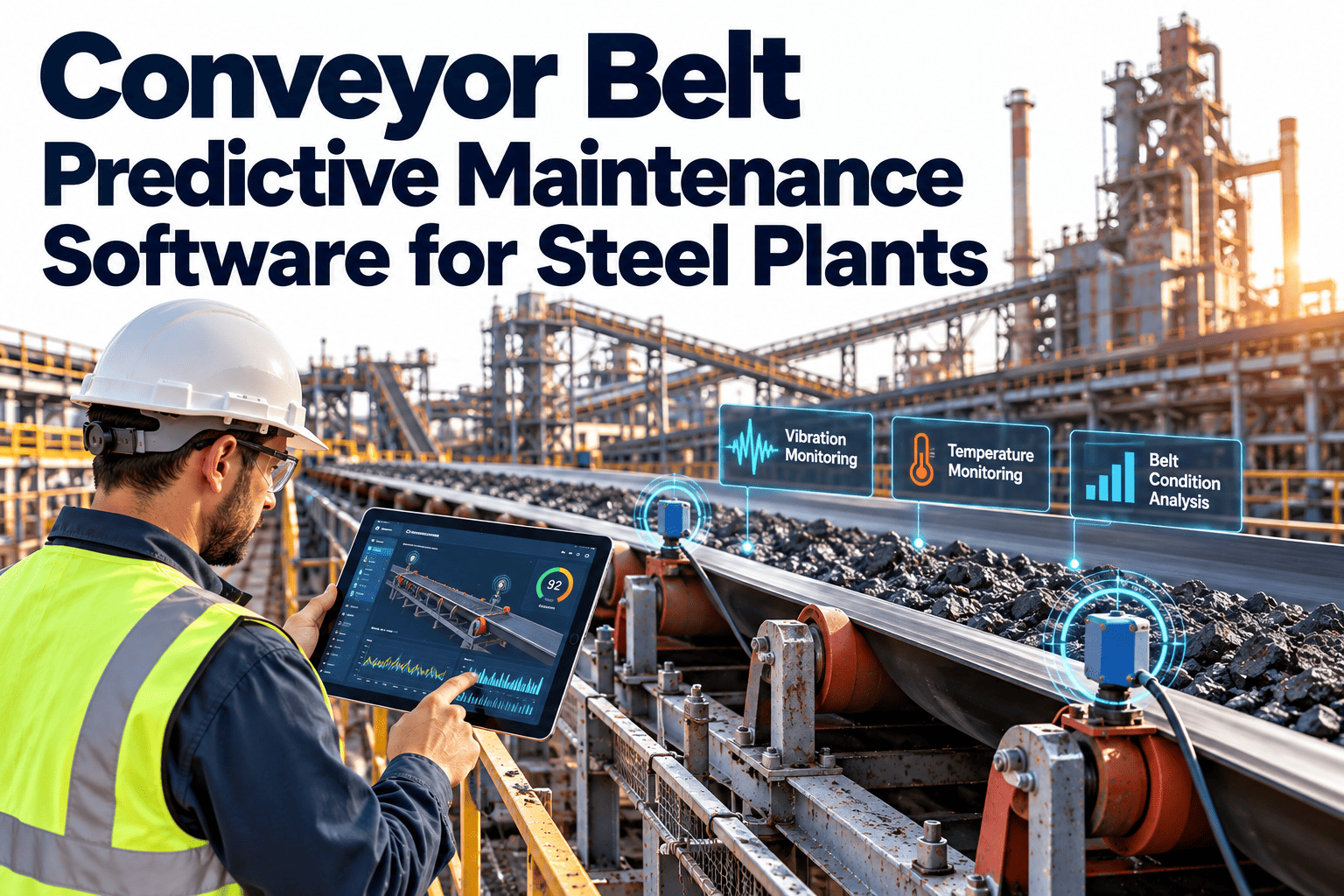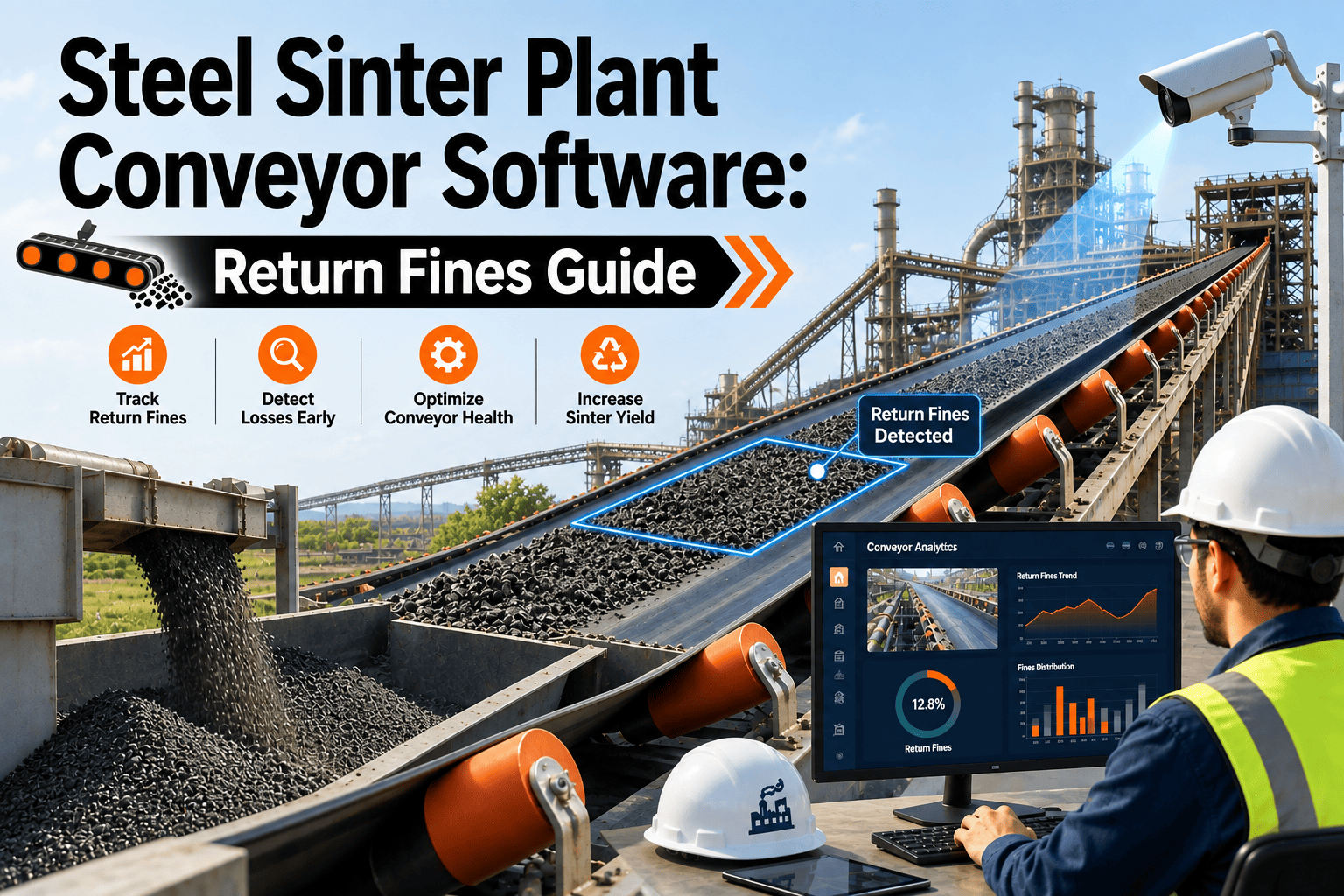
Every tonne of sinter that reaches the blast furnace has already made a dozen trips across belts most plant managers never think about until one fails. Raw mix conveyors feed iron ore fines, coke breeze, and flux into the mixing drum; strand belts carry the burning bed through ignition and cooling; and return fines conveyors haul the under-5mm reject back to the proportioning bins, sometimes several times over before that material finally sinters into blast-furnace-grade cake. These belts run hot, abrasive, and continuous, and a single blinded chute or torn cover can back up the entire strand within the hour. This guide breaks down where sinter plant conveyors actually fail, what to inspect and how often, and how a CMMS turns scattered PM sheets into a return-fines transport chain your team can rely on — starting with a Start Free Trial of Oxmaint.
What happens to blast furnace burden quality when a return fines belt blinds mid-shift?
Sinter transport belts carry abrasive, hot, moisture-laden material through seven distinct duty zones between the ore yard and the blast furnace stockhouse. When a return fines belt mistracks or a chute blinds, the strand loses feed consistency within minutes and burden quality drifts for hours afterward, long after the immediate stoppage is cleared. Most plants find out about a failing belt zone from the strand operator, not from a maintenance record, because inspection data lives on paper sheets scattered across shifts instead of a shared asset history. The breakdown below covers every belt in the chain, the failure mode specific to each, and the inspection cadence that keeps them running.
Seven belts, one strand: the sinter material flow
Sinter production is a closed loop, not a straight line. Return fines re-enter the mix at the head end, which means a problem on the last belt in the chain shows up as a feed problem on the first one within a single circulation cycle. Understanding this loop is what separates a maintenance plan built around the actual process from one built around a generic conveyor checklist. Each stage below carries a different material character, a different belt speed, and a different wear signature.
Iron ore fines, coke breeze, limestone, and dolomite move from stockpile or bunker onto weigh feeders, often over runs of several hundred metres in outdoor conditions. High abrasion, weather exposure, and long belt lengths make cover wear and idler seizure the dominant failure modes here. Because these belts sit furthest from the strand, problems here are the easiest to miss until throughput drops.
Short, precisely metered belts feed each raw material into the blending stream at a controlled ratio, usually within a percent or two of target. Belt slip or a drifting weigh cell here changes chemistry across the whole downstream bed, so tracking accuracy and calibration matter more than raw throughput. A feeder running slightly fast or slow for days can shift sinter basicity before anyone notices in the lab results.
Carries the granulated 5-7mm mix, now wetted to roughly 7-8% moisture, toward the strand charging system. Sticky material builds up on idlers and pulleys, driving mistracking, carryback, and eventual belt drift off the frame if left unaddressed for more than a few shifts.
Feeds the pallet cars at a controlled bed depth ahead of ignition, typically 400-700mm depending on plant design. Uneven loading here directly changes bed permeability and burn-through time down the length of the strand, which shows up later as inconsistent sinter strength and a higher return fines fraction.
Handles hot sinter cake at 300-500°C straight off the strand, ahead of crushing to size. Belt covers rated for sustained heat exposure are non-negotiable on this run, and standard cover compounds harden and crack within weeks if substituted here to save cost.
Separates product-grade sinter, typically 10-30mm, from under-5mm return fines after cooling. Screen blinding upstream directly overloads the return fines belt downstream within a single pass, since more material reports to reject than the belt and downstream bins were sized for.
Carries the rejected under-5mm fraction back to the raw mix bins to be re-blended. This belt runs the highest duty cycle in the plant, since every batch that fails size specification passes over it again, and in plants with poor granulation control that can mean 15-25% of total strand throughput recirculating continuously.
Where sinter conveyor belts actually fail
Sinter transport belts do not fail for one reason. Abrasive fines, cyclic heat, moisture, and constant recirculation compound on each other, and the failure that finally shuts down the strand is rarely the first problem that started the chain reaction. Recognizing the six patterns below is the difference between catching a developing issue at the weekly walkdown and discovering it as an unplanned stop.
Return fines and raw ore act as a continuous grinding medium against belt covers, idler shells, and chute liners. Cover thickness loss accelerates sharply once the top rubber layer breaches into the fabric or steel-cord carcass, and from that point a belt can go from serviceable to torn within days rather than months.
Breaker and discharge belts handling sinter above 150°C harden and crack the rubber cover over time, even with heat-resistant compounds rated for the duty. Cracked covers trap fines in the surface and accelerate exposure of the carcass underneath, compounding the abrasive wear already present on this run.
Moist mix and fine material stick to chute walls and belt surfaces past the discharge point, building up on return idlers and structure until flow restricts or a roller seizes entirely. Once a chute partially blinds, the effective opening narrows further with every pass, and the failure accelerates rather than staying stable.
Return fines belts start and stop repeatedly with screen output rather than running continuously, putting mechanical splices through constant flex cycles that steady-run belts never see. Splice inspection intervals matter more here than on any other belt in the chain, since a splice failure mid-shift takes the loop down entirely.
Fine dust works past seals on idlers exposed to raw mix and return fines, drying out grease and seizing bearings over a period of weeks. A seized idler flat-spots the belt within a single shift of continuous contact, creating a wear point that then propagates independently of the original cause.
Moisture from the mixing drum combines with fine dust to accelerate corrosion on stringers, walkways, and pulley shafts, especially on outdoor raw material handling runs exposed to weather. Left unchecked, corrosion eventually compromises the structural support the belt and idlers depend on for alignment.
Ready to put your sinter conveyor chain on a structured PM program?
Oxmaint gives steel plants a purpose-built CMMS for belt asset registries, wear inspection logging, and PM scheduling across the full sinter transport chain.
Duty and wear profile by transport zone
Not every belt on the sinter chain needs the same cover compound, speed, or inspection cadence, and treating them all identically wastes inspection effort on low-risk belts while under-inspecting the ones that fail first. Matching PM effort to actual duty is what keeps a maintenance budget focused on the zones that matter.
| Transport Zone | Material Handled | Dominant Wear Mode | Inspection Interval |
|---|---|---|---|
| Raw material reclaim | Ore fines, coke breeze, flux | Cover abrasion, idler wear | Weekly |
| Mixing drum discharge | Wetted 5-7mm mix | Carryback, mistracking | Weekly |
| Strand charging | Granulated mix | Load-depth drift | Weekly |
| Breaker infeed/discharge | Hot sinter, 300-500°C | Thermal cover cracking | Monthly |
| Screening decks | Sized and unsized sinter | Deck blinding, vibration wear | Monthly |
| Return fines loop | Under-5mm reject | Splice fatigue, abrasion | Weekly |
A single-strand plant tracking cover thickness only on the raw material belts kept missing recurring stoppages on its return fines loop roughly every five to six weeks. Once weekly logging was extended to that zone specifically, the pattern became clear: idler seizure at one recurring transfer point, driven by a skirting seal that had never been on any checklist. Adding that seal to the weekly walkdown and replacing it on a fixed interval eliminated the recurring stoppage entirely within the next quarter.
The sinter conveyor inspection cadence
A tiered inspection schedule catches wear before it reaches the point of belt tear or idler seizure, and spreads the workload so no single shift is left performing every check at once. Plants running this on a CMMS convert each row below into a recurring, auto-generated work order tied to the specific belt zone it applies to.
Belt tracking, cover surface condition, splice visibility, chute discharge flow, and idler noise checked on every belt in the return fines loop and strand charging system.
Ultrasonic or gauge thickness reading at known high-wear points on breaker infeed and return fines belts, logged against baseline for trending over successive readings.
Temperature and vibration spot checks across return-side idlers, prioritized on the fines loop where dust ingress rates and duty cycles both run highest in the plant.
Wear plate and liner thickness check at every transfer point, with replacement triggered before liner breach reaches the underlying steel chute wall structure.
Gearbox oil condition, motor temperature trend, and coupling alignment on breaker and strand charging drives, where load swings during cave-ins or blockages hit hardest.
Cover thickness trend review across every zone to project remaining belt life and schedule replacement ahead of the next planned strand shutdown window.
The sinter conveyor daily and weekly checklist
Sixteen checkpoints cover the minimum viable inspection across every belt in the sinter transport chain, grouped by the system each item protects so a technician can move through a zone in order without backtracking.
- Inspect belt cover surface for tears, gouges, or exposed carcass
- Check tracking against centerline markers at three points
- Verify splice condition on return fines and breaker belts
- Log cover thickness readings against baseline trend
- Listen for bearing noise on return-side idlers
- Check for seized or flat-spotted rollers
- Inspect stringers and walkways for corrosion
- Verify skirting seal at loading and transfer points
- Check chute liners for wear-through or buildup
- Verify scraper blade contact on discharge pulleys
- Inspect for material carryback on the return strand
- Confirm dust suppression is active at transfer points
- Record gearbox and motor temperature
- Verify pull-cord and belt-drift switches are functional
- Check coupling alignment and guard condition
- Confirm E-stop and lockout points are accessible
What a return fines stoppage actually costs
A blinded chute or seized idler on the return fines loop does not just stop one belt — it backs up screening, then the breaker, then the strand itself within a single shift, and the recovery time often outlasts the original stoppage by hours once material has to be cleared manually.
Sinter conveyor maintenance — common questions
Return fines are already the material that failed screening once, so they are finer and more abrasive per tonne than raw feed. This belt also runs the highest duty cycle in the plant, since rejected material recirculates through it repeatedly. You can log wear trends per belt zone by starting a Start Free Trial of Oxmaint.
Quarterly at minimum, with monthly checks at transfer points handling return fines or hot sinter discharge. Liner wear accelerates once the plate thins past half its original thickness, so trending matters more than any single reading.
Chute blinding and idler seizure account for the majority of forced stops, both driven by fine dust and moisture rather than sudden belt failure. Both give early warning signs that a structured inspection cadence reliably catches before a stoppage occurs.
Yes, primarily by keeping PM compliance high enough that wear-driven failures get caught during a scheduled check rather than a forced stop. To see the workflow on your own belt registry, Book a Demo with our team.
With regular cover thickness trending and prompt splice repair, return fines belts commonly reach three to five years despite their duty cycle, compared to under two years when wear is only caught after a visible tear appears.
From weekly sheet to work order
Most sinter plants already have the inspection knowledge in their maintenance team's heads — the question is whether that knowledge survives a shift change or a technician leaving. A paper walkdown sheet catches a wear point once; a CMMS asset registry remembers it, trends it, and flags it before the next reading crosses the threshold that matters.
Raw material reclaim, mixing discharge, strand charging, breaker, screening, and the return fines loop each get their own asset record with install date, cover specification, and duty notes, rather than one generic entry for the whole conveyor system.
Weekly walkdowns, monthly thickness checks, and quarterly liner inspections generate automatically on the schedule that matches each zone's actual duty, instead of a single blanket interval applied plant-wide.
Cover thickness and bearing temperature readings logged over successive checks build a trend line per asset, so a slow decline toward the replacement threshold is visible weeks before it becomes a forced stop.
Stop losing shifts to a blinded chute. Start tracking every belt in the chain.
Join the steel plants using Oxmaint to register sinter conveyor assets, schedule wear inspections, and keep the return fines loop running between planned shutdowns.
Free 14-day trial · No credit card