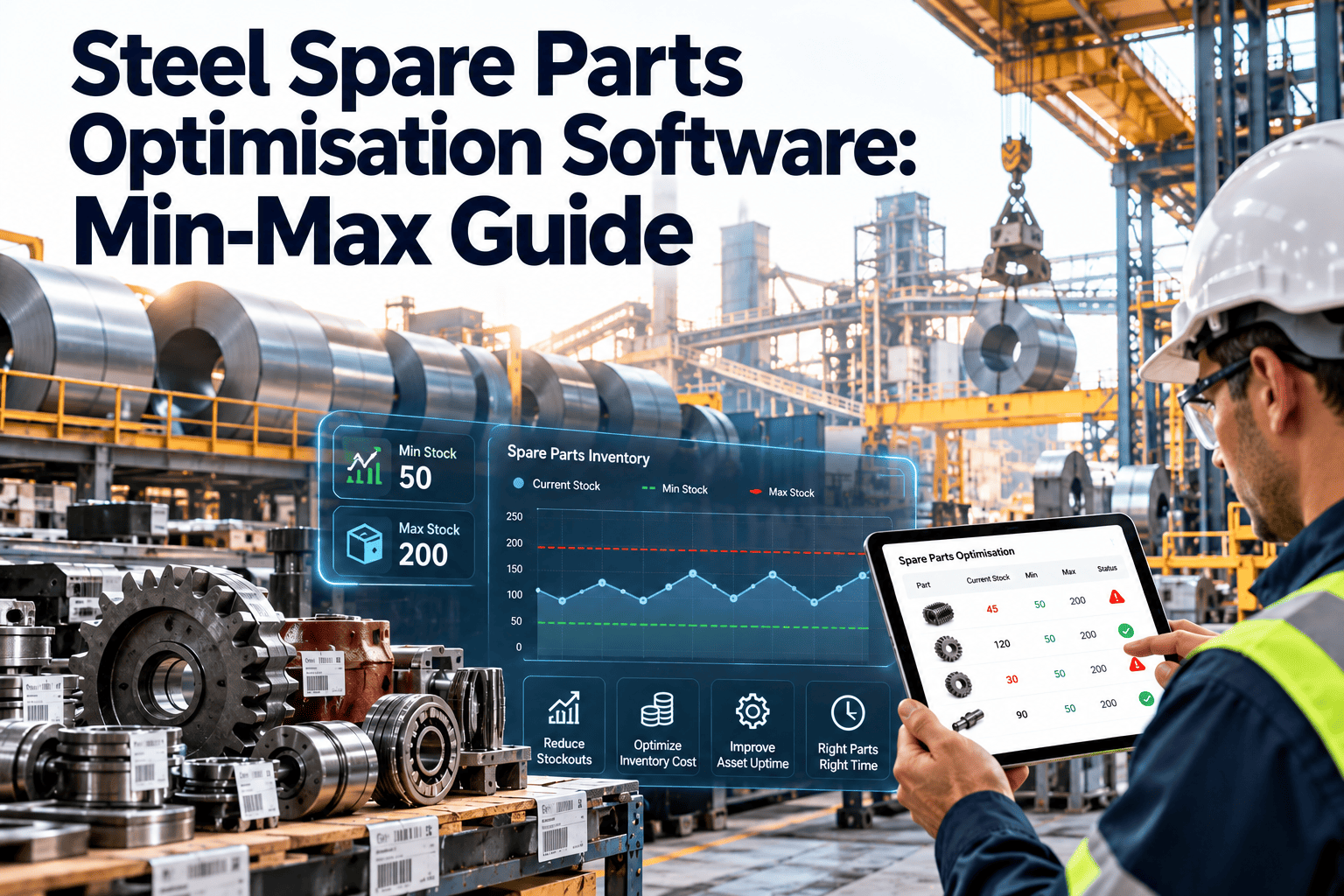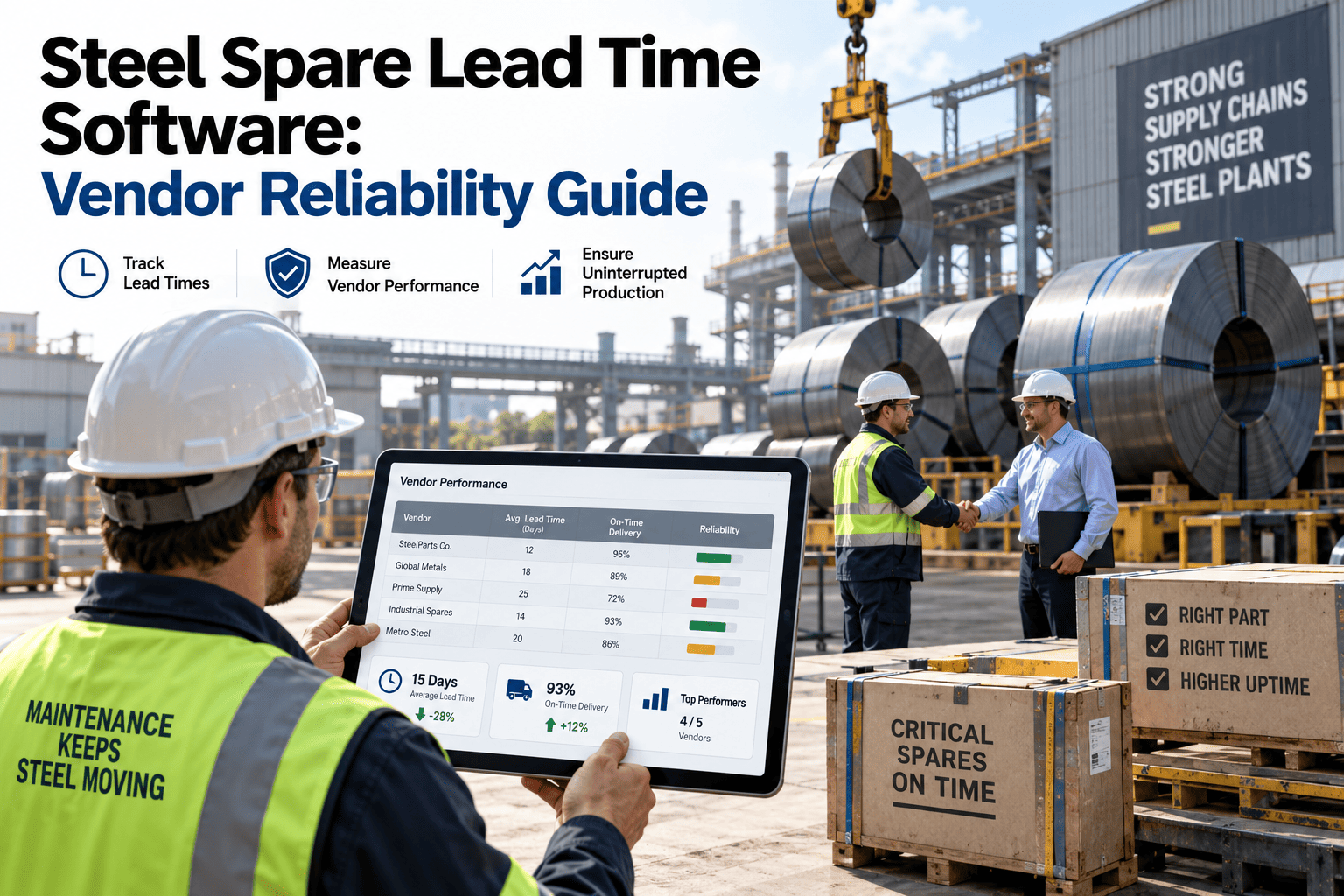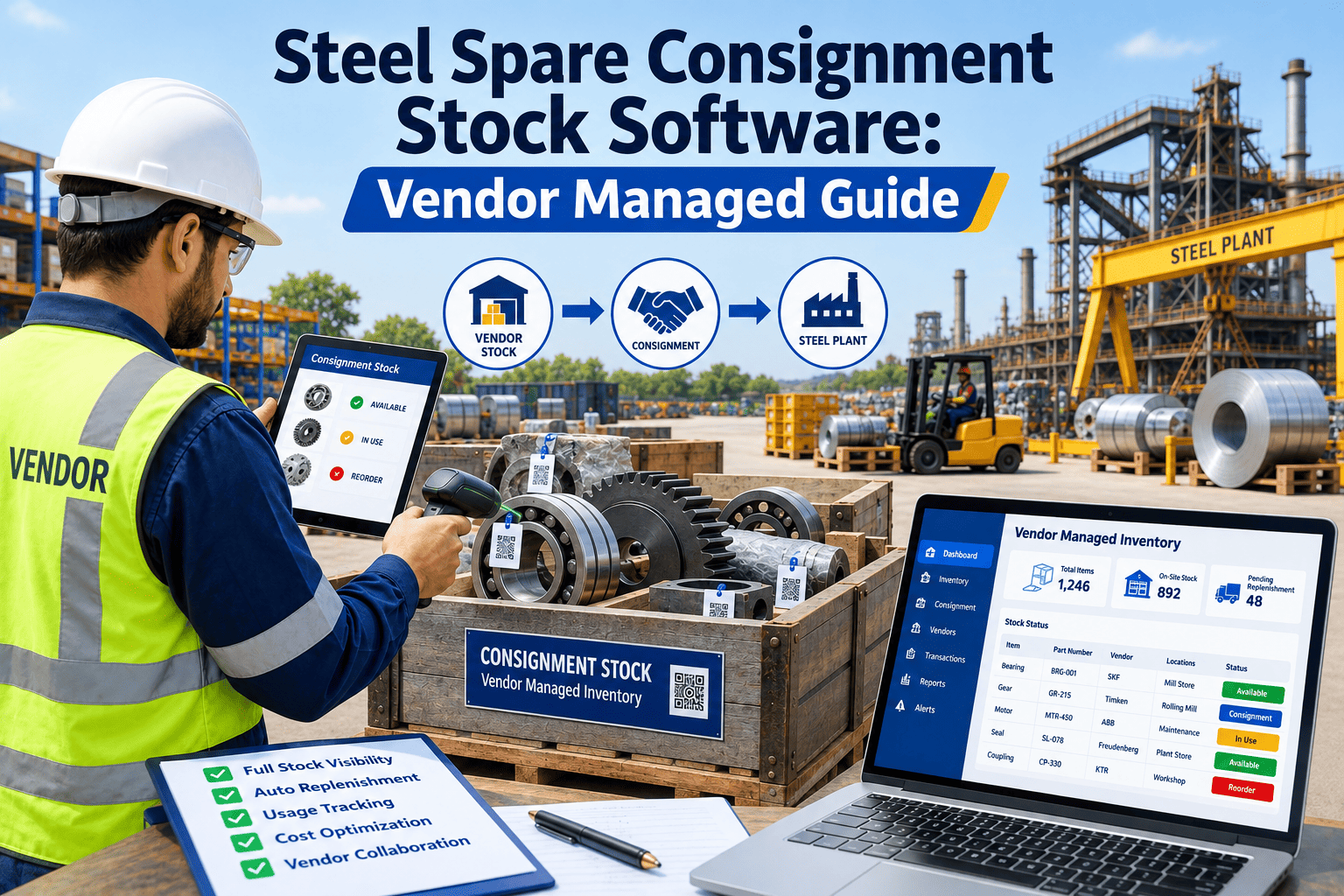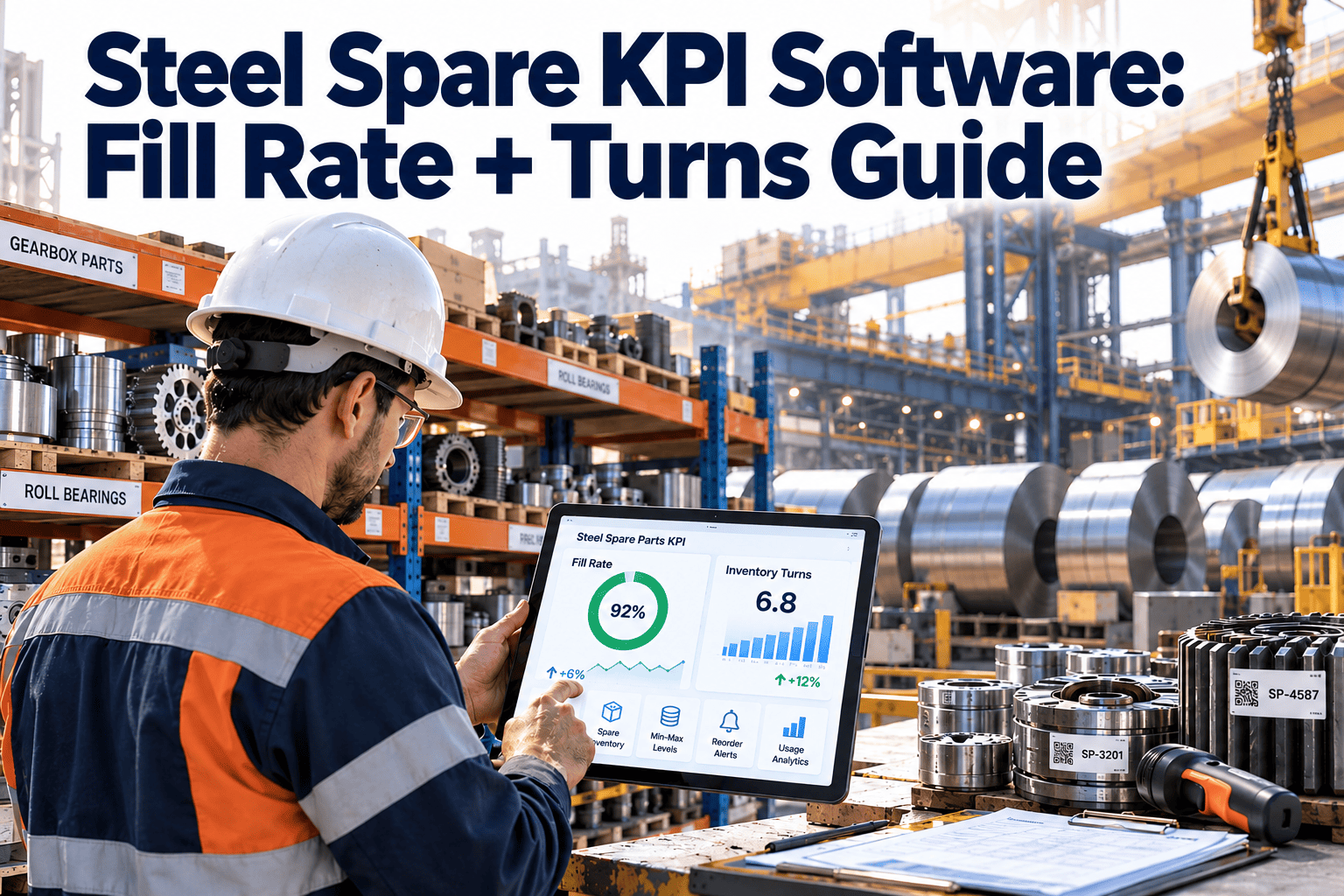
A steel plant can hold millions of dollars in spares and still stop for want of one bearing, coupling, or tuyere. The storeroom looks full, the finance team sees a large inventory balance, and the maintenance team still waits for parts. The gap between those views is measurable, and three numbers close most of it: fill rate, inventory turns, and stockout events. Used well, they show whether stores support uptime or just tie up cash, and a CMMS that calculates them from live transactions keeps the figures honest.
Steel Spare KPI Software: Fill Rate, Inventory Turns, and Stockout Tracking for Reliability and Finance Teams
Track service level on critical parts, interpret turns correctly for insurance spares, and log every stockout with its cost, so reliability and finance work from one spare parts scorecard.
Two Teams, Two Views of the Same Storeroom
Reliability wants parts available when a failure happens. Finance wants less cash tied up in inventory. Both are right, and a shared KPI set stops the argument.
What Reliability Asks
- Was the part there when the job needed it?
- How long did a crew wait for parts?
- Which critical spares have no cover?
- Did a stockout extend a stoppage?
What Finance Asks
- How much inventory is moving and how much is idle?
- What is obsolete or duplicated?
- How much was bought at emergency prices?
- Is the balance justified by risk?
Fill Rate: Was the Part There When the Job Needed It?
Fill rate, also called service level, measures how often a request for a part is met immediately from stock. A single plant-wide number hides the problem, so segment it.
| Segment | What It Covers | Why Measure Separately |
|---|---|---|
| Critical spares | Parts whose absence stops production or creates a safety risk | A high overall fill rate can hide missing critical parts while low-value items stay well stocked |
| Routine maintenance parts | Filters, seals, belts, bearings used in scheduled work | Shows whether preventive maintenance is being delayed by parts |
| Consumables | Fasteners, lubricants, gloves, small tools | Low impact per item, but frequent stockouts waste crew time |
| Shutdown kits | Parts reserved for planned outages | Kit completeness before the stoppage matters more than speed after it starts |
Setting Targets That Match Consequence
- Critical spares justify a very high fill rate target, even at higher carrying cost.
- Routine and consumable parts can run lower without raising downtime risk in a meaningful way.
- Review fill rate beside stockout rate and emergency purchases so one number never tells the whole story.
Inventory Turns: Useful Only on the Right Parts
Turns come from finished goods thinking, and they mislead in maintenance stores. A critical insurance spare is meant to sit unused, so low turns on that part is a sign of good cover, not waste.
Worked Example (Illustrative Figures)
How to Read Turns Correctly
- Measure turns on moving and consumable stock, and report insurance spares separately.
- Low turns on slow-moving, non-critical parts often point to over-ordering or obsolete stock.
- High turns on a critical part can be a warning that cover is too thin.
- Use the same period for issues and average inventory, so annual issues match annual average value.
Give Reliability and Finance One Spare Parts Scorecard
Oxmaint links parts issues to work orders and assets, so fill rate, turns, and stockouts come from real transactions instead of month-end spreadsheets.
Stockout Events: Count Them, Cost Them, Learn From Them
A stockout is a request that stores could not fill. The rate tells you how often it happens, but the event record tells you why and what it cost.
Stockout Causes and the Fix for Each
| Cause | Typical Signal | Corrective Direction |
|---|---|---|
| Part never stocked | Repeated emergency purchase of the same item | Review criticality and decide whether to stock |
| Reorder point too low | Stock hits zero between orders | Recalculate using real usage and supplier lead time |
| Lead time longer than assumed | Orders arrive after the planned date | Update lead times and raise cover on long-lead items |
| Inventory record wrong | System shows stock, shelf is empty | Cycle count and enforce issue discipline |
| Part not reserved for a planned job | Stock was consumed by another job | Reserve parts when the work order is planned |
Which KPI Matters Most for Which Class of Spare
Steel plants hold very different kinds of parts. Match the KPI emphasis to the part class instead of applying one rule across the catalogue.
Insurance Spares
Single-point, long-lead items such as large drive couplings, transformers, or caster components. Judge on availability and verified condition, not turns.
Repairable Spares
Motors, gearboxes, and pumps that cycle between plant and repair shop. Judge on pool availability and repair cycle time.
Planned Consumables
Rolls, bearings, refractory, and wear items with forecastable demand. Judge on fill rate and turns together.
General Stock
Fasteners, hoses, filters, and small tools. Judge on turns, accuracy, and carrying cost.
Companion KPIs That Keep the Main Three Credible
Fill rate and turns are only as reliable as the records behind them. These companion measures protect data quality and expose hidden waste.
-
Inventory record accuracy
Correct records divided by records checked, from regular cycle counts.
-
Emergency purchase share
Spend or order count placed outside normal replenishment.
-
Obsolete and inactive value
Value of stock with no movement over an agreed period.
-
Kit completeness
Share of planned job or shutdown kits fully available at the start date.
-
Carrying cost
Cost of holding inventory, including capital, storage, and deterioration.
-
Rotable repair cycle time
Days from removal to return for repairable spares.
A Monthly Spares Review That Ends in Decisions
Reports that are only read do not change stock levels. Run a short monthly review with a fixed agenda and named owners.
- Review fill rate by criticality class and list every critical stockout since the last meeting.
- Check each stockout record for cause, delay, and recovery cost, and assign corrective action.
- Compare turns on moving stock with the prior period and investigate large changes.
- Review obsolete and inactive stock and decide what to return, sell, or write off.
- Confirm reorder points and lead times for parts that caused repeat issues.
- Record decisions and owners, and report progress at the next meeting.
Spare KPI Mistakes in Steel Stores
- One fill rate for everything. A blended figure hides critical gaps behind routine successes.
- Chasing turns on insurance spares. Pushing turns up on critical cover creates stockout risk.
- Counting only system stockouts. A part found on the shelf after a long search is still a service failure.
- Ignoring stockout cost. Without delay and emergency spend, the case for stocking a part is hard to make.
- Stale lead times. Supplier lead times drift, and reorder points built on old data fail quietly.
Where Spare KPIs Behave Differently Across the Steel Plant
The same three KPIs read differently depending on the shop. Knowing what drives demand and lead time in each area stops you from applying a rule that fits one shop and fails another.
| Shop | Typical Spare Profile | KPI to Watch Closely | Common Failure of Cover |
|---|---|---|---|
| Blast furnace and stoves | Tuyeres, cooling plates, valve components, blower and pump parts with long recovery time after any stop | Critical fill rate and verified condition of insurance spares | Spare exists but has aged in storage and fails inspection when needed |
| Steel melt shop and caster | Mould components, segment rolls and bearings, ladle and crane parts, hydraulic items | Stockout rate on caster and crane parts | Rotable segments not returned from repair on time |
| Hot strip and cold rolling mills | Work and backup rolls, chocks, bearings, couplings, drive and hydraulic components | Kit completeness before roll campaigns and outages, plus turns on moving wear items | Long-lead rolls and spindles ordered too late for the planned stop |
| Utilities and services | Pump, compressor, fan, and electrical spares shared across shops | Inventory record accuracy and emergency purchase share | Shared parts charged to one shop, so nobody owns the reorder |
Why Shared Parts Need an Owner
- When two shops use the same motor or bearing, each assumes the other holds the cover.
- Assign one storeroom owner per shared part number, and let the CMMS show combined demand across shops.
- Report fill rate for shared parts against the plant, not against the shop that happened to raise the request.
Turning KPIs Into Reorder Points and Safety Stock
KPIs describe the past. Reorder settings decide the future. Use the KPI results to adjust stocking rules in a controlled way, one class of part at a time.
Cautions Before Applying a Statistical Formula
- Standard safety stock formulas assume steady, independent demand, which many steel spares do not show.
- For a unique critical part, the consequence of failure and the recovery option often matter more than demand statistics.
- Change one parameter at a time and watch fill rate and stockouts for a full cycle before changing it again.
Standing Up Spare KPIs in 90 Days
Spare KPIs fail when the data is unreliable. Start with record discipline, then add measures in order of how much they depend on clean data.
- Days 1 to 15: classify parts by criticality, starting with the highest-consequence items in each shop, and agree the class definitions with operations.
- Days 16 to 30: enforce a work order or asset reference on every stores issue, and begin cycle counts on critical and high-value items.
- Days 31 to 45: publish fill rate and stockout rate for critical parts, and start the stockout event record for every miss.
- Days 46 to 60: add turns for moving stock and obsolete value, reported separately from insurance spares.
- Days 61 to 75: review reorder points and lead times for the parts behind repeat stockouts.
- Days 76 to 90: run the first full monthly spares review with reliability and finance, and set targets by criticality class.
Presenting Spare KPIs to Finance Without Losing the Risk Story
- Show inventory value split into insurance spares, repairable spares, moving stock, and obsolete stock, so the balance has context.
- Pair every reduction target with its stockout rate, so cutting stock never hides rising risk.
- Report emergency purchase spend and stockout delay cost as the price of weak cover.
- Agree in advance which long-lead critical spares are held on purpose, and exclude them from turns targets.
How Oxmaint Supports Spare KPI Tracking
Oxmaint is a maintenance management platform, so spare KPIs are built on the same work order and asset records the plant already uses.
- Inventory records linked to assets, parts lists, and work orders for traceable consumption.
- Reorder points and stock levels that can be tuned by part and criticality.
- Parts reservation against planned work orders and shutdown jobs.
- Work order history that shows which parts each repair actually used.
- Dashboards and reports for service level, turns, and stockout activity.
- Mobile access so issues and counts are recorded at the storeroom counter or on the floor.
Steel Spare KPI Questions
What fill rate should a steel plant aim for?
Set it by criticality, with the highest target on critical spares. Avoid one uniform target across the whole catalogue.
Why are turns low on our critical spares?
That is often intended, since insurance spares should sit ready. Report them separately from moving stock.
How do we log stockouts consistently?
Use a standard record with cause, delay, and recovery action. Sign up to build it into your work order flow.
Can we calculate these KPIs from our current data?
Only if parts issues are tied to work orders and records are accurate. Book a demo to review your data readiness.
How often should spare KPIs be reviewed?
Review critical stockouts weekly and the full scorecard monthly, with decisions and owners recorded each time.
Measure Spares by What They Protect, Not Just What They Cost
Track fill rate, turns, and stockouts in Oxmaint and give reliability and finance the same view of your steel plant storeroom.