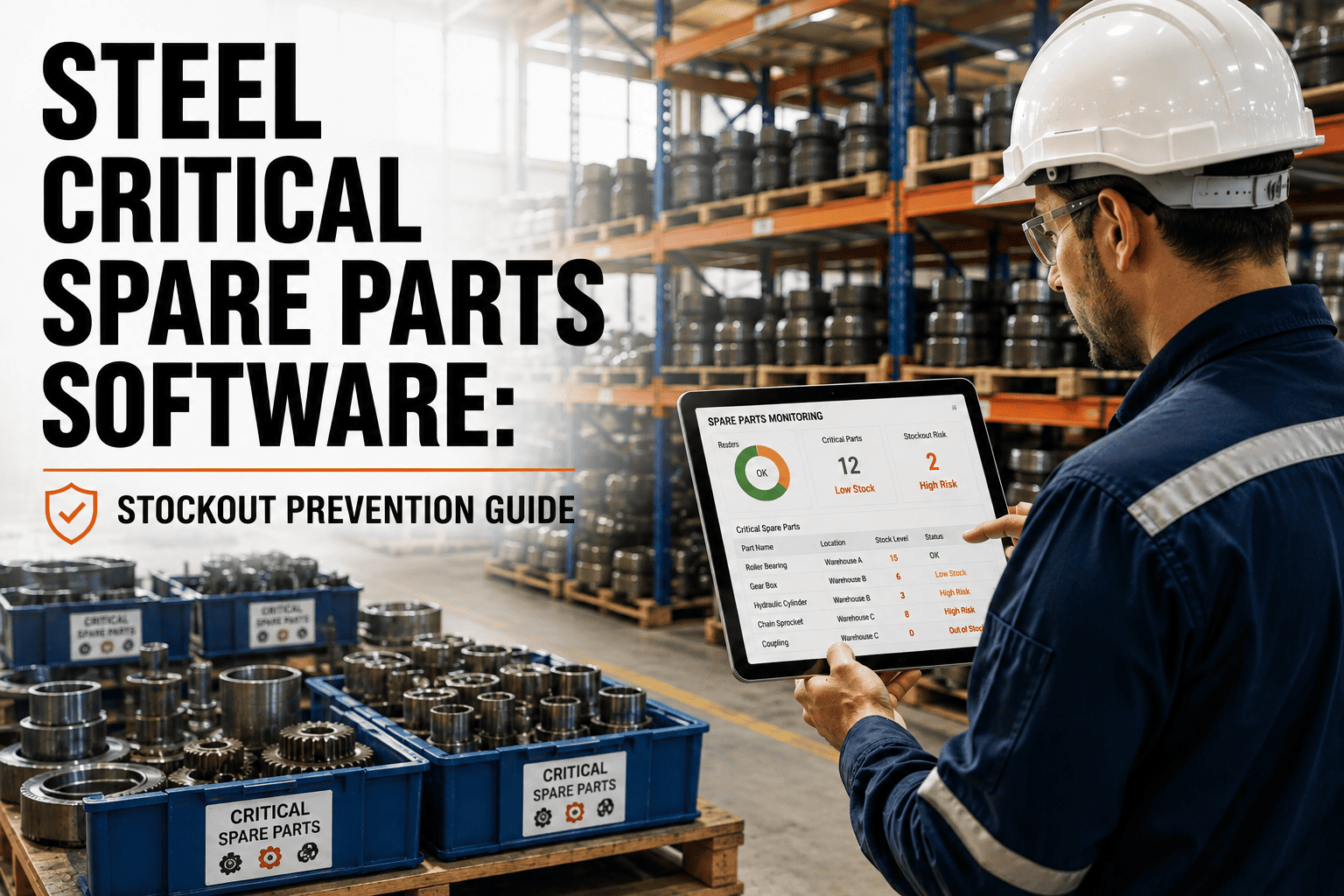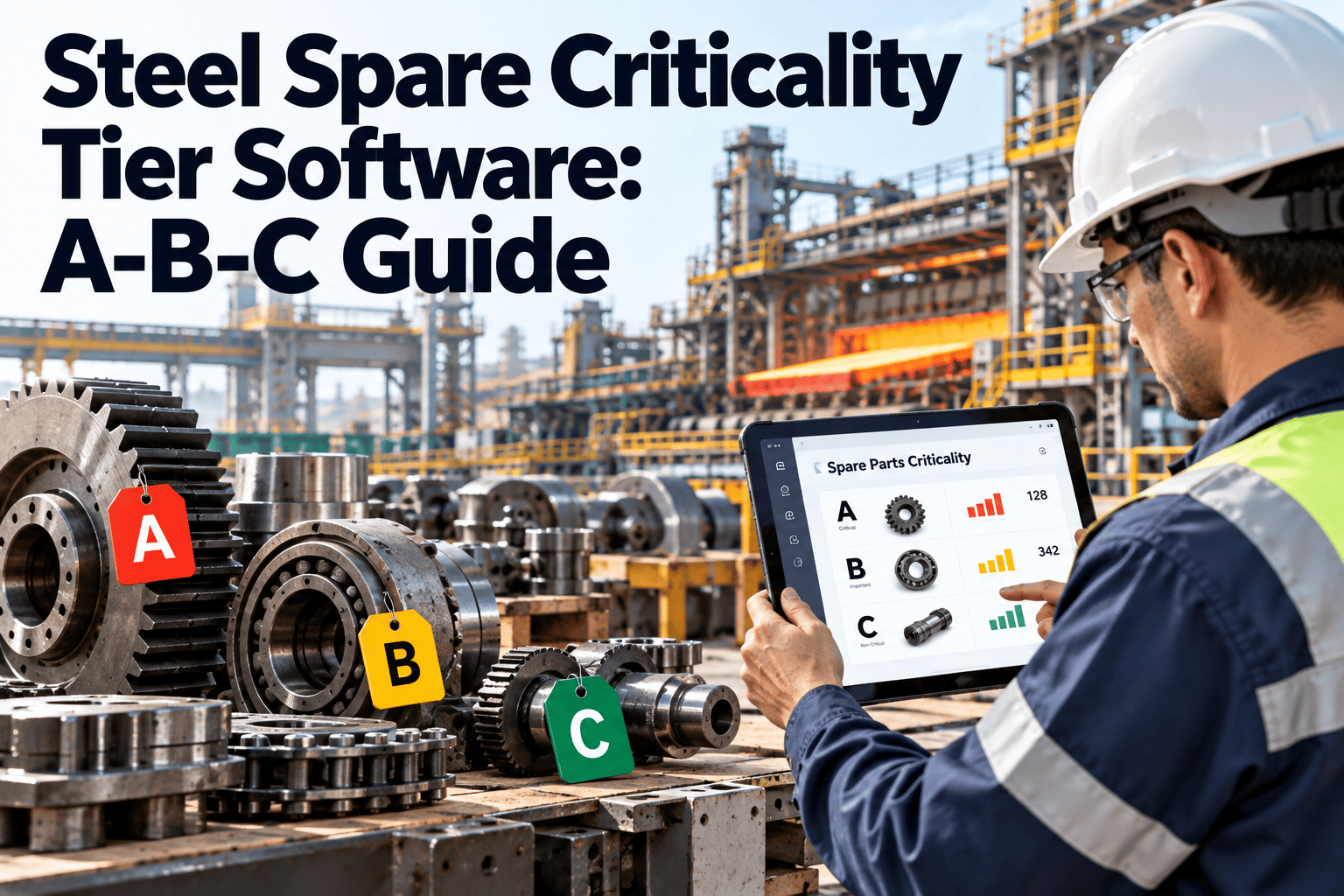
Most steel plant storerooms hold two kinds of risk at the same time: money tied up in parts that rarely move, and gaps where a missing part can stop a mill, furnace or caster. Spend-based ranking does not separate them, because a cheap sensor can be more critical than an expensive spare with an easy substitute. Criticality tiers fix this by ranking spares on what happens when the part is not available. This guide shows how to build A-B-C tiers in CMMS and inventory software from asset criticality and failure impact.
Steel Spare Criticality Tier Software: A-B-C Guide
Assign every spare to a tier based on asset criticality and failure impact, then set stocking rules that protect production without filling the warehouse.
Criticality tiers are not the same as value classes
Two different A-B-C systems are often confused in storerooms. Separating them is the first step to a sound spares policy.
Value-based A-B-C
- Ranks items by annual spend or stock value.
- Helps control purchasing and counting effort.
- Does not know whether the part stops a furnace.
Criticality-based A-B-C
- Ranks items by consequence of not having the part.
- Drives minimum stock, location and lead time rules.
- Works from asset criticality and failure impact.
Many plants use both. Criticality sets what must be on hand, and value analysis decides how tightly to manage the cost of holding it.
Why steel plants need tiered spares
From asset criticality to spare tier: the decision flow
A spare inherits much of its importance from the asset it serves. The steps below add the part-specific factors that refine the tier.
Rate the asset
Score each asset on safety, environment, production, quality and repair cost impact, then place it in a criticality class.
Link the part to its failure modes
Identify which failures need this part and how likely they are, using history, FMEA findings or condition data.
Check redundancy and substitutes
A standby unit, interchangeable part or on-site rebuild option lowers the tier compared with a single point of failure.
Add lead time and availability
Parts that take weeks or months to obtain, or have a single supplier, rank higher than parts sold locally.
Assign the tier and review
Record A, B or C against the item, with the reason, so reviewers can challenge the decision later.
Build your spare tiers from the asset register you already have
Link parts to assets, record the reason for each tier and let the system keep stock rules consistent.
Scoring matrix: criticality factors and weights
The weights below are an example to adapt. Each plant should agree its own scale with maintenance, operations, safety and purchasing.
| Factor | Question | Low score | High score |
|---|---|---|---|
| Safety and environment | Could failure harm people or breach emission controls? | No effect | Serious risk |
| Production impact | Does the unit stop, slow down or hold output? | Short or no effect | Full unit stop |
| Redundancy | Is there a standby or alternative route? | Standby ready | Single point |
| Lead time | How long to get the part? | Same day | Months |
| Repairability | Can it be rebuilt or sourced locally? | Easy local repair | Specialist only |
| Failure likelihood | How often does this part fail? | Rare | Frequent |
Add the scores, set threshold bands for A, B and C, and allow a documented override for special cases such as regulatory equipment.
What each tier means for stocking and handling
- Hold on site, with a defined minimum quantity.
- Consider insurance or rotable spares for long lead items.
- Control access and keep clear storage and condition records.
- Review quantities at least annually.
- Stock based on usage and lead time.
- Use min and max levels with reorder alerts.
- Arrange supplier agreements for quick delivery.
- Review when asset use changes.
- Keep lean stock or order on demand.
- Use consumable bins or vendor managed supply.
- Standardise to reduce part variants.
- Prune obsolete lines regularly.
Typical steel plant examples
These illustrations show how the same logic can place parts in different tiers. Your own tiers depend on redundancy, supplier and process conditions.
| Area | Spare | Likely tier | Reasoning |
|---|---|---|---|
| Rolling mill | Hydraulic servo valve for the gap control | A | Single point on product quality and mill running |
| Sinter plant | Cooler fan bearing set | A or B | Cooler stop affects the sinter line, depends on spare fan |
| Caster | Mould level sensor | A | Safety and quality impact, short repair window |
| Cranes | Hoist brake assembly | A | Safety and handling bottleneck |
| Utilities | Cooling water pump with standby | B | Redundancy reduces the immediate impact |
| General | Standard fasteners and filters | C | Low impact and readily available |
Before and after a tiering exercise
Before
- Stock levels set by habit or past breakdowns.
- Critical and non-critical parts mixed together in reports.
- Duplicate part numbers across stores.
- Urgent buying at premium cost during failures.
After
- Each part carries a tier and a documented reason.
- Stock rules differ by tier and lead time.
- Parts are linked to assets and failure modes.
- Planned buying replaces many emergency orders.
Insurance spares, rotables and the cost of holding them
Some Tier A items are expensive and rarely used, such as large motors, gearboxes, rolls or transformers. Holding them is a risk decision, not an inventory efficiency decision.
Parts held only to cover a low-probability, high-impact failure. Record the failure scenario they protect against and review it regularly.
Repairable units that cycle between service, repair and stock. Track location, repair history and condition so the spare is always ready.
Identical equipment across units allows one spare to cover several assets, if the standardisation is documented and checked.
A written reason for each insurance spare makes budget discussions easier. It also shows when a spare is no longer needed because the asset has been replaced or a standby installed.
Where tiers show up across the steel process
Common mistakes when tiering spares
| Mistake | What goes wrong | Better practice |
|---|---|---|
| Tiering by price only | Cheap but critical parts run out | Rank by consequence, then control cost |
| Ignoring redundancy | Too many A items for assets with a standby | Count the standby and test that it works |
| Setting tiers once | Plant changes make the tiers wrong | Review after modifications and failures |
| No link to assets | Nobody knows what a part protects | Attach every spare to one or more assets |
| Overstocking A items | Capital is tied up and parts age on the shelf | Base quantity on lead time, risk and use |
| Skipping store conditions | Bearings, seals and electronics degrade in storage | Define storage and shelf life checks |
Governance: who owns the tier decision
Reliability or maintenance engineering
Owns the criteria, scoring and technical reasoning behind each tier.
Operations
Confirms production impact and the real effect of a stop on the process.
Stores and purchasing
Provide lead time, supplier and price data, and apply the stock rules.
Safety and environment
Flag parts tied to protective systems and regulatory controls.
A short review meeting each quarter is usually enough to approve changes. The CMMS records who changed a tier and why.
Setting minimum stock for a Tier A spare
A simple reasoning path keeps the quantity defensible. It avoids both a stock-out and a shelf full of parts that never leave.
Inputs to collect
- Number of installed units using the part.
- Failure history and expected life.
- Supplier lead time and delivery reliability.
- Repair option and turnaround time.
- Cost of a stop for the supported asset.
Decisions to record
- Minimum quantity and storage location.
- Reorder trigger and who approves it.
- Whether a repaired unit counts as stock.
- Inspection interval for stored parts.
- Next review date and reviewer.
Keeping the tier data healthy over time
- Flag parts that have not moved in several years and ask whether they are still needed.
- Check that every Tier A part has a storage location, quantity and responsible owner.
- Compare the bill of materials on major assets with stock records after each overhaul.
- Capture lessons from every stock-out, including the cause and the corrective step.
- Retire parts for assets that have been decommissioned or replaced.
Clean data is what makes software useful here. Without accurate links between parts, assets and work history, any tier is only a guess.
Using breakdown history to challenge the tiers
- Review the last year of emergency work orders and list the parts that were missing or delayed.
- Check whether each missing part already had a tier, and whether that tier matched the real impact.
- Raise the tier of any part that caused a long stop because of lead time or lack of a substitute.
- Lower the tier of parts held for years without any demand once a standby or alternative exists.
- Share the results with operations so the next review starts from facts rather than opinions.
This feedback loop keeps the tier policy tied to what actually happens on site, which is what gives maintenance and finance teams confidence in it.
Linking spares to maintenance planning
- Preventive maintenance plans can reserve the parts they will consume before the job is scheduled.
- Work orders record which parts were used, so consumption history improves future stock levels.
- Inspection findings can trigger a purchase request for Tier A items before a planned shutdown.
- Shutdown scopes can be checked against stock to find shortages weeks in advance.
The tier is only useful if it is visible where decisions are made: on the part record, the work order and the purchasing request.
How Oxmaint supports spare criticality management
Asset management
Hold the asset hierarchy and criticality rating that spare tiers depend on, with parts linked to each asset.
Inventory control
Set minimum and maximum levels, reorder points and storage locations, with different rules for each tier.
Work orders
Record parts used on each job so consumption and failure history inform stock decisions.
Preventive maintenance
Attach required parts to recurring tasks so demand is known in advance.
Mobile workflows
Technicians and store staff can check availability, issue parts and log returns from a handheld device.
Reports and dashboards
Track Tier A stock coverage, stock-outs, turnover and parts without any linked asset.
KPIs to monitor your tier policy
Implementation checklist
- Agree criticality criteria with maintenance, operations, safety and purchasing.
- Clean the item master by merging duplicates and fixing descriptions.
- Link spares to the assets and failure modes they support.
- Score parts, set tier thresholds and record the reason for each result.
- Define stock rules by tier and set alerts for reorder and shortage.
- Pilot on one area, such as the rolling mill or a sinter plant, before the whole site.
- Review tiers after major failures, asset changes and shutdowns.
Start with the assets you already rank as critical. Their spares give the biggest return from the first round of tiering.
Frequently asked questions
What is a spare criticality tier?
It is a rank of A, B or C that reflects how damaging it is if a spare is unavailable when needed.
How is this different from ABC inventory analysis?
Value analysis ranks by spend, whereas criticality ranks by consequence of failure. You can manage both in Oxmaint.
How often should tiers be reviewed?
Review at least yearly, and after major failures, equipment changes or supplier changes.
Do we need failure data first?
No, start with asset criticality and judgement, then refine as work order history grows.
Can the tiers feed shutdown planning?
Yes, tiered stock checks highlight shortages early. For a walkthrough, book a demo.
Protect production with the right spare in the right place
Give every part a tier, a reason and a stocking rule, so the next critical failure meets a ready spare instead of a long wait.