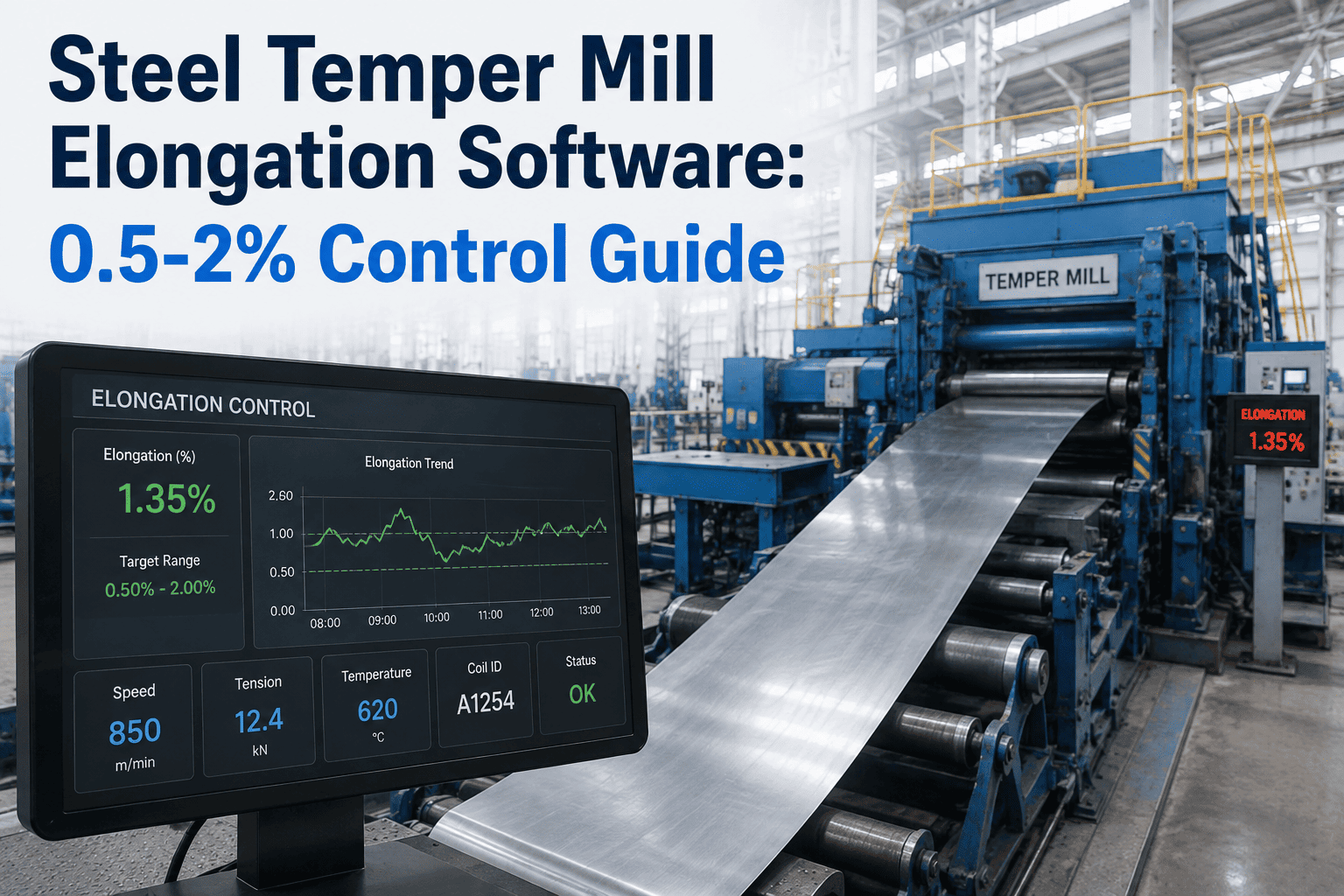
A temper mill applies somewhere between 0.5 and 2 percent elongation to a coil, and that number is one of the most consequential quantities in the entire cold mill — not because the reduction is large, it isn't, but because getting it wrong is the difference between a panel that stamps clean and one that shows Lüders lines the moment a body shop tries to form it. Most mills still set that elongation target once per product family and check it with an offline tensile test every ten to twenty coils, which means a roll that's quietly worn out of spec or a bridle that's started to slip can run for a full shift before anyone with a test result even suspects a problem. OxMaint ties the mechanical causes of elongation drift — roll wear, bearing clearance, bridle condition — to the same maintenance record so the drift gets caught before the tensile test does.
Coil-to-Coil Consistency
Catch Elongation Drift Before the Tensile Test Does
OxMaint tracks roll wear, bearing clearance, and bridle condition against your elongation target — so a temper mill drifting out of spec shows up as a maintenance trend, not a rejected coil ten shifts later.
What 0.5 to 2 Percent Elongation Is Actually Doing
Temper rolling looks like a trivial reduction next to the hot mill or the tandem cold mill upstream, but the elongation it applies is doing three separate jobs at once, and every one of them is judged by the customer, not the mill. The most critical is eliminating yield point elongation — without it, the steel retains a pronounced yield strength that shows up as Lüders lines, visible stretcher-strain marks that appear the instant a stamping press starts forming the panel, and there is no fixing a Lüders line after the fact. The second job is flatness correction, ironing out the shape defects that survived annealing and tension leveling upstream. The third is surface texture — the roll bite at the skin pass stand transfers a specific roughness profile onto the strip that determines how paint adheres and how light reflects off a finished automotive panel. All three targets are set by one elongation number, which is exactly why drifting even a few tenths of a percent off target doesn't fail quietly — it fails as a customer complaint on formed parts weeks after the coil left the mill, often on a stamping line a plant will never see directly, delivered back as a rejected shipment or a warranty claim with no obvious connection to a specific coil until someone traces it back through the order.
Yield Point Elimination
Removes the pronounced yield strength that causes Lüders lines during stamping. Fall below the minimum elongation and the defect returns, invisible until the press forms the part.
Flatness Correction
Irons out shape defects carried over from annealing and leveling. Uneven roll force across the strip width turns this correction into a new flatness problem instead of a fix.
Surface Texture Transfer
The roll bite imprints a controlled roughness onto the strip that governs paint adhesion and finish appearance — a job only the work roll's actual surface condition can deliver.
Why the Number Drifts, Coil to Coil
Elongation doesn't drift because the mill's control system stops working — it drifts because the mechanical inputs the control system relies on slowly change underneath it, and none of those changes trip an alarm on their own. A worn work roll still closes to the commanded gap; it just delivers a different surface and a different force response than the model assumed. A bridle that's begun to slip still pulls tension; it just pulls less of it than the setpoint calls for. The elongation control loop is only as accurate as the mechanical condition feeding it, and that condition erodes gradually enough that a single tensile test taken between drift events can look perfectly normal on both sides of a problem that was present the entire time. This is the core reason elongation problems feel intermittent even when the underlying cause is completely steady and progressive: the test is a snapshot, but the wear is a slope, and a snapshot taken at the right two moments can miss a slope entirely.
The Maintenance Checks That Actually Hold Elongation on Target
Each of the four drift causes above has a specific, well-understood maintenance fix, and none of them require exotic equipment — they require discipline and a place to track the results against the elongation trend instead of in a separate maintenance log nobody cross-references with quality data. Surface roughness variation traces back to work roll condition, so roll surface inspection at defined change intervals keeps the roughness transfer predictable coil to coil. Force oscillation traces back to bearing clearance, so scheduled bearing clearance checks catch the growth before it becomes a visible flatness defect. Elongation precision loss traces back to bridle condition, so bridle surface inspection on a fixed interval keeps tension delivery matched to what the control system assumes it's applying. And unstable force control traces back to the hydraulic automatic position control system, so seal and oil condition checks on the APC cylinders keep the roll gap holding steady across the full length of every coil, not just at the head and tail where operators are most likely to notice a problem visually.
Roll Surface Inspection
Checked at defined change intervals rather than run to failure, keeping roughness transfer inside Ra spec across the full campaign instead of drifting unnoticed toward the end of roll life.
Bearing Clearance Checks
Scheduled measurement catches clearance growth while it's still a maintenance item, before it becomes a flatness deviation a customer notices in a formed panel.
Bridle and APC Verification
Surface inspection on the bridle and seal and oil checks on the hydraulic APC system keep tension delivery and roll gap control matched to what the model assumes.
Root Cause, Not Just Symptom
Connect Every Elongation Deviation to Its Mechanical Cause
OxMaint logs roll changes, bearing checks, bridle inspections, and APC maintenance against the same mill and timeline as your elongation data — so a drift event points straight to the component behind it.
The Blind Spot Between Two Tensile Tests
Most temper mills confirm elongation the same way they have for decades: pull a coupon, run a tensile test, compare it against the target, move on. Tested once every ten to twenty coils, that approach catches a mill that has clearly drifted out of spec, but it says almost nothing about the eight or fifteen coils sitting between two passing test results. If elongation started sliding on coil three of a fifteen-coil run and only crossed the rejection threshold on coil fourteen, every coil from three through thirteen shipped with the same underlying problem and no test result that flagged it — because the test before and the test after both happened to fall on the right side of the line. This is the coil-to-coil consistency problem that a purely test-based quality system cannot solve on its own: the test tells you the mill failed, but only maintenance data tells you when it started failing and why, which is the only information that lets a plant go back and find every coil actually affected instead of guessing at a recall range. Guessing at a recall range is expensive in both directions — pull too few coils and a defective one ships anyway, pull too many and a plant is scrapping or re-inspecting perfectly good product out of an abundance of caution because there was no way to draw the line more precisely. The difference between those two outcomes is entirely a function of how good the record is between the two tensile tests, not how good the tests themselves are.
Why Automotive Grades Leave the Least Room for Drift
Not every product on a temper mill is judged with the same severity, and automotive outer panel grades sit at the strictest end of the range for a specific reason: the surface is the product. A tinplate can or an appliance wrapper has some tolerance for minor roughness variation because the surface disappears under paint or gets stamped into a shape where texture matters less. An automotive outer panel is inspected under raking light after paint, in a showroom, by a customer who will notice roll-bite texture inconsistency between two panels from the same vehicle. That tolerance gap means a deviation that would be a minor note on a tinplate order can be a full rejection on an automotive order, even though the underlying elongation drift on the mill was identical in both cases. It also means the coil-to-coil consistency problem hits automotive programs hardest, because the acceptable drift window before a defect becomes visible is simply narrower, and a mill running multiple product families through the same stand needs its tightest maintenance discipline reserved for whichever grades have the least tolerance for the same underlying mechanical wear.
We had a customer complaint on an automotive order and traced it back eleven coils before the tensile test that flagged the problem. Once we had roll change history and bridle inspection dates lined up against the elongation log, we found the exact coil the drift started on — not just the coil the test happened to catch it on.
Quality Manager — Cold rolling and finishing line, automotive-grade steel producer
Frequently Asked Questions
Why does temper mill elongation drift even when the roll gap setpoint doesn't change?
Because the mechanical condition behind the setpoint changes — roll surface, bearing clearance, bridle grip — even while the commanded gap stays exactly the same, so the same setpoint stops producing the same result even though nothing on the control screen looks any different.
What's the fastest way to catch elongation drift between tensile tests?
Track the mechanical inputs directly — roll change intervals, bearing inspection results, bridle slip checks — against a timeline, rather than waiting for the next scheduled test result. See how OxMaint builds that timeline automatically.
Does low elongation always mean Lüders lines will appear?
Falling below the minimum elongation for the grade significantly increases the risk of yield point elongation returning, though the exact threshold varies by steel chemistry, gauge, and the specific deep-drawing application the coil is destined for.
Can bearing clearance really affect strip flatness?
Yes. Growing bearing clearance lets roll force oscillate across the strip width during rolling, and that force variation shows up directly as a flatness deviation or shape defect in the finished coil, sometimes long before the clearance itself would be flagged on a routine visual check.
How do we find which coils were actually affected after a drift is confirmed?
Cross-reference the elongation trend against roll and bridle maintenance timestamps to find where the drift began, rather than assuming only the coil that failed the test was affected — the actual start point is often several coils earlier. Book a demo to see this against your own mill's history.
Close the Gap Between Rolls and Results
Tie Roll Wear, Bearing Health, and Bridle Condition to Every Elongation Number
OxMaint gives your temper mill one connected record for the mechanical causes behind elongation drift — so the next deviation gets caught on the maintenance floor, not the customer's stamping line.