SAP Integration for Chemical Plant Maintenance & Process Safety | PSM Guide
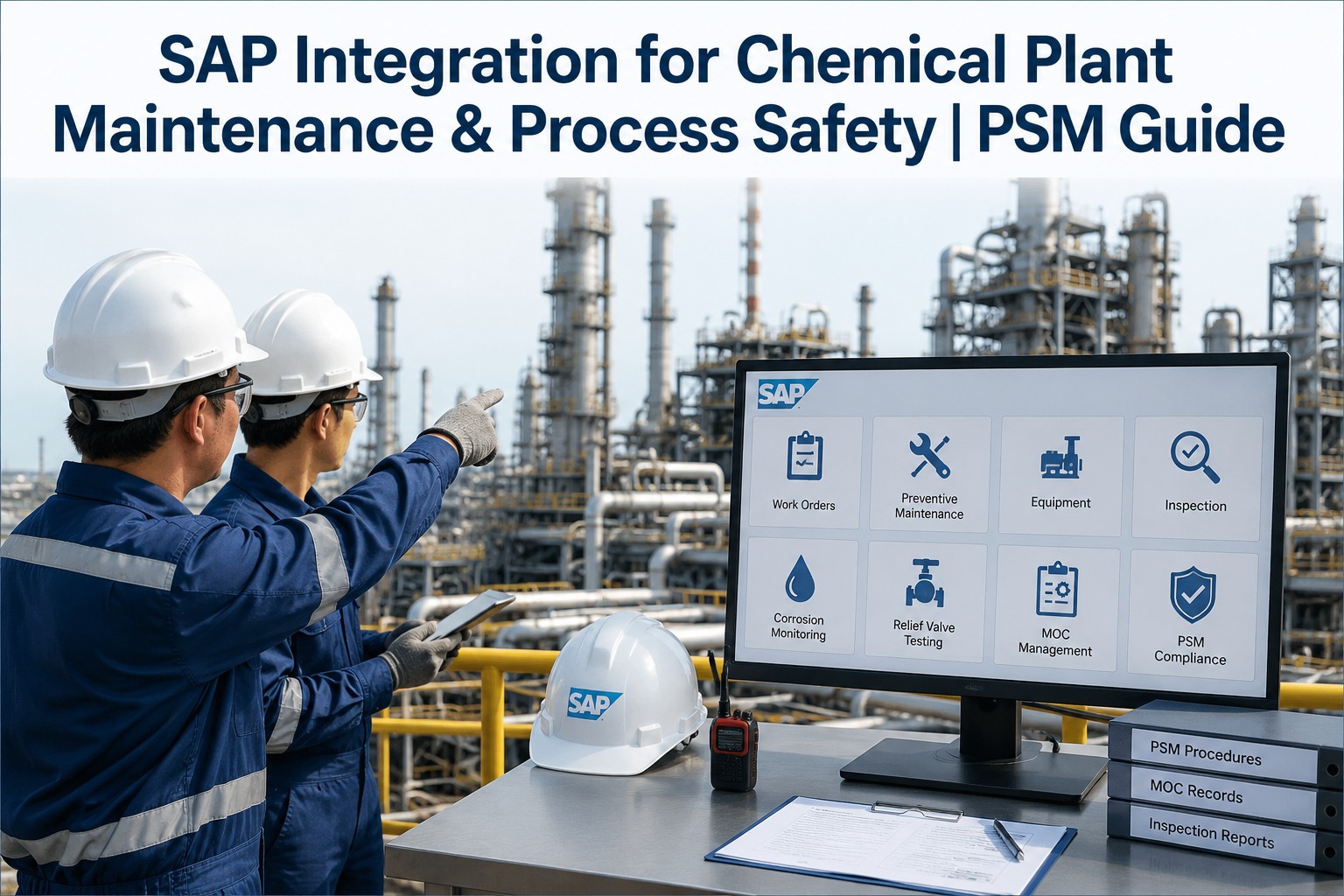
Chemical plant maintenance differs from every other industry in one critical way: a maintenance failure can produce a catastrophic release. Hot work without permit. PSV that wasn't tested. Pressure vessel with undetected corrosion. The consequences extend beyond production loss to fatalities, environmental damage, and regulatory crisis. OSHA Process Safety Management makes maintenance integral to plant safety—not just a reliability function. SAP-CMMS integration in chemical plants must serve PSM compliance, mechanical integrity discipline, and risk-based inspection simultaneously. This article maps how. Book a free demo to see PSM-aligned integration in action.
CHEMICAL PLANT REALITY
Mechanical Integrity Gaps Remain the #1 OSHA PSM Citation
14
PSM Elements (29 CFR 1910.119)
#1
MI Gaps Most-Cited PSM Deficiency
8
Maintenance-Critical Domains
RBI
Risk-Based Inspection (API 580)
Why Chemical Plant Maintenance Is Different From Other Industries
In most industries, equipment failure means lost production. In chemical processing, equipment failure can mean loss of containment—the release of toxic, flammable, or reactive materials with consequences ranging from environmental damage to catastrophic incidents. Maintenance isn't merely a cost or reliability function; it's a fundamental process safety control. The OSHA Process Safety Management standard (29 CFR 1910.119) codifies this reality through 14 mandatory elements, with mechanical integrity, management of change, and incident investigation directly governing how maintenance must operate.
The integration architecture that works in chemical plants must produce defensible evidence for every PSM element it touches. Inspection records that prove API code compliance. PSV test certificates with traceability. MOC documentation linking changes to authorized procedures. Without integrated systems, this evidence lives in spreadsheets, file cabinets, and tribal knowledge—which is exactly what OSHA inspectors cite. Plant leaders ready to assess PSM-aligned integration can Sign up free to assess PSM-aligned integration readiness.
The 14 PSM Elements: Where Maintenance Lives
OSHA 29 CFR 1910.119 defines 14 mandatory PSM elements. Five of those elements—Mechanical Integrity, Hot Work Permit, Management of Change, Pre-Startup Safety Review, and Incident Investigation—directly govern maintenance operations. Two others—Process Hazard Analysis and Operating Procedures—shape what maintenance must enable. When integration architecture serves these PSM elements directly, the maintenance program becomes the proof point of process safety. When it doesn't, the maintenance program becomes the place inspectors find compliance gaps.
The 8 PSM-Critical Maintenance Domains for SAP-CMMS Integration
The map below covers the eight maintenance domains where SAP-CMMS integration most directly affects PSM compliance and process safety. Each domain shows the relevant API or industry standard, the safety risk profile, the PSM requirement, the integration capability, and the evidence produced. Pressure relief devices anchor the framework because PSV failures produce the most catastrophic outcomes.
Proof testing of safety functions; SIL verification; partial stroke testing; bypass tracking
INTEGRATION DELIVERS
SIF testing schedules; SIL calculations; bypass authorization workflow; test result trending
EVIDENCE
SIF proof test records with SIL verification trail
07
Management of Change (MOC)
OSHA 1910.119(l)
RISK
8/10
PSM REQUIREMENT
Document changes to process, equipment, procedures; PSSR before startup; employee notification
INTEGRATION DELIVERS
MOC workflow from initiation to closure; PSSR checklist routing; linkage to work orders
EVIDENCE
MOC packages with full review and authorization chain
08
Incident Investigation & Learning
OSHA 1910.119(m)
RISK
7/10
PSM REQUIREMENT
Incidents resulting in or near-miss to catastrophic release investigated within 48 hours; RCA documented
INTEGRATION DELIVERS
Incident workflow with RCA tracking; corrective action assignment; lessons propagation to PM tasks
EVIDENCE
Investigation reports with closure tracking trail
3Static Equipment
3Safety-Critical Devices
2Management Systems
04PSV Anchor
The risk-score visualization is intentional: not every domain carries equal safety consequence. Pressure vessels and PSVs anchor the program because their failures produce the most severe outcomes. Integration architects ready to apply the domain framework can Sign up free to apply the 8-domain framework.
SEE IT IN PRACTICE
Walk Through PSM-Aligned Integration Live
30-minute walkthrough showing pressure vessel inspection scheduling, PSV testing workflow, MOC routing, and SIS proof testing—all running in an integrated SAP-CMMS architecture.
Risk-Based Inspection: From Calendar to Consequence-Driven
API 580/581 RBI methodology replaces calendar-based inspection with a risk-driven approach: inspect more where the risk is highest, less where it isn't. Integration with SAP-CMMS makes RBI operational—not just an engineering study sitting in a binder.
Probability of failure (corrosion rate, remaining life); consequence of failure (release size, area affected).
Prioritize
Position assets on risk matrix; high-consequence × high-probability assets get tightest inspection intervals.
Plan
Define inspection method (UT, RT, VT, IR); set interval; assign technician; feed back to PM plan in SAP.
RBI without integration stays academic. RBI integrated with the CMMS becomes the living strategy that actually drives where inspectors look and when. Plant leaders ready to formalize RBI workflows can Sign up free to operationalize RBI in integrated systems.
ROI of Integrated Process Safety Maintenance
Integrated PSM-aligned maintenance delivers ROI on dimensions general manufacturing integration doesn't measure: PSM citation reduction, audit defensibility, mechanical integrity coverage, and incident prevention.
AD-HOC vs PSM-ALIGNED INTEGRATION
Chemical Plant Safety & Compliance Delta
PSM Citation Risk
High
Low
−75%
PSV Test Compliance
~65%
99%+
+35 pts
RBI-Driven PM Coverage
~25%
85%+
+60 pts
MOC Cycle Time
30-60 d
7-14 d
−75%
Mechanical Integrity Gaps
Common
Rare
−80%
99%+
PSV test compliance with automated scheduling and tracking
85%+
RBI-driven PM coverage with integrated risk engine
The compounding effect: fewer citations reduce regulatory cost; tighter MOC reduces incident risk; better RBI directs limited inspection budget where consequences are highest. Plant leaders ready to model PSM-aligned ROI can Book a free demo to model PSM-aligned ROI.
Expert Perspective on Chemical Plant Integration
"
The chemical plant maintenance organizations I've watched mature in PSM execution share a property new plants rarely appreciate: they treat the mechanical integrity program as the safety program, not as a maintenance program with safety implications. The distinction is subtle but consequential. When mechanical integrity is "a maintenance program," budget cuts pressure it, schedule pressure relaxes inspection intervals, and PSV testing slips quietly into the next year. When mechanical integrity is "the safety program," budget protects it, schedule pressure can't relax it, and PSV testing happens on schedule because nothing else is acceptable. The integrated systems that work for chemical plants enforce the latter—not because they're strict, but because they make the deviations visible immediately rather than hiding them in spreadsheet rounding errors. Process safety is what integration is for in this industry.
01
MI Is the Safety Program
Mechanical integrity isn't a maintenance program with safety implications—it's the safety program. Budget and schedule must protect it absolutely.
02
PSV Slippage Is Existential
When PSV testing slips, the last line of defense weakens. No integration is acceptable that allows PSV testing to slip silently.
03
Make Deviations Visible
Integration's job isn't to be strict—it's to make deviations visible immediately so they can be addressed before they cascade.
90-Day PSM-Aligned Implementation Roadmap
The 90-day program below establishes PSM-aligned SAP-CMMS integration foundations: critical asset inventory, RBI integration, MOC workflow, and audit-ready evidence capture.
90-DAY PSM-ALIGNED ROADMAP
From Critical Asset Inventory to PSM-Ready Integration
DAYS 1–25
01
Critical Asset Inventory
Inventory PSM-covered equipment. Map pressure vessels, piping circuits, tanks, PSVs, SIS to SAP equipment master. Identify gaps.
DAYS 26–50
02
RBI Integration
Integrate RBI engine output with SAP PM plans. Configure inspection workflows per API 510/570/653. Validate intervals match risk assessments.
DAYS 51–75
03
MOC & PSV Workflows
Configure MOC workflow with PSSR. Set up PSV testing schedules and certificate management. Link to incident investigation workflow.
DAYS 76–90
04
Audit Readiness
Run PSM audit drill against integrated systems. Validate evidence trails for all 8 domains. Train operators and inspectors on workflows.
PROTECT PROCESS SAFETY
Make Your Chemical Plant Integration PSM-Ready
Eight domains mapped. API standards aligned. PSV testing protected. MOC workflows operational. The integration architecture that makes mechanical integrity programs survive OSHA inspection scrutiny.
Does our facility need PSM compliance even if we're not a refinery?
PSM applies to any facility handling highly hazardous chemicals above OSHA's threshold quantities listed in 29 CFR 1910.119 Appendix A. Covered processes include petroleum refining, petrochemical manufacturing, chemical processing, pharmaceutical manufacturing using HHCs, and ammonia refrigeration above the 10,000-pound threshold. Many facilities are surprised to discover their ammonia refrigeration, propane storage, or chlorine systems trigger PSM coverage even though the facility doesn't think of itself as "a chemical plant." When in doubt, run the threshold quantity test against your inventory. If you're subject to OSHA PSM, you're also likely subject to EPA RMP (40 CFR Part 68) since the two rules cover overlapping chemicals with different but related requirements.
What's the difference between PSM and EPA RMP?
OSHA PSM (29 CFR 1910.119) covers worker safety inside the facility. EPA RMP (40 CFR Part 68) covers off-site community impact from chemical releases. The two regulations cover overlapping chemicals and share most program elements by design, so most facilities run a single integrated program satisfying both. PSM has 14 elements; RMP has comparable requirements organized differently. The 2024 EPA Safer Communities by Chemical Accident Prevention rule expanded RMP requirements, particularly around root cause analysis, safer technologies and alternatives analysis, and employee participation. Facilities subject to both should ensure their SAP-CMMS integration produces evidence satisfying both reporting and inspection contexts.
How does Risk-Based Inspection (RBI) actually work in practice?
RBI follows API 580/581 methodology: identify assets and damage mechanisms, assess probability and consequence of failure, position assets on a risk matrix, and assign inspection intervals based on risk position. High-consequence, high-probability assets get tightest intervals; low-risk assets get extended intervals. The methodology replaces calendar-based inspection (everyone gets inspected on the same schedule) with risk-driven inspection (inspection effort follows risk). For SAP-CMMS integration, RBI output feeds PM plan generation: the RBI engine determines what to inspect when, and the CMMS executes the inspection workflow. Without integration, RBI stays as engineering studies that don't drive daily inspection planning.
How does MOC integrate with maintenance work orders?
MOC and maintenance work orders should be tightly linked. Any maintenance work that changes the process (replacing a control valve with different characteristics, modifying piping, adding instrumentation) must trigger MOC before the work order can be released. Conversely, MOC approval should generate the work orders needed to implement the change with PSSR verification before startup. The integration pattern that works: MOC workflow in one system, work order execution in another, with bidirectional linkage so neither side can proceed without the other's authorization. Work orders attempting to execute changes without authorized MOC must be blocked at the system level rather than relying on human discipline alone.
Should PSV testing data live in SAP or CMMS?
In most architectures, the PSV asset master lives in SAP (set pressure, manufacturer, location, equipment hierarchy linkage) while test records and certificates live in the CMMS with full lifecycle tracking. The integration synchronizes: SAP sees the next test due date and PSV status; CMMS captures test execution details, technician identity, set pressure verified, repair history, and certificate documents. Because PSV failures produce catastrophic consequences, both systems should reflect consistent PSV status at all times. Integration architecture for PSV management deserves more rigor than other equipment classes because the data integrity stakes are simply higher.