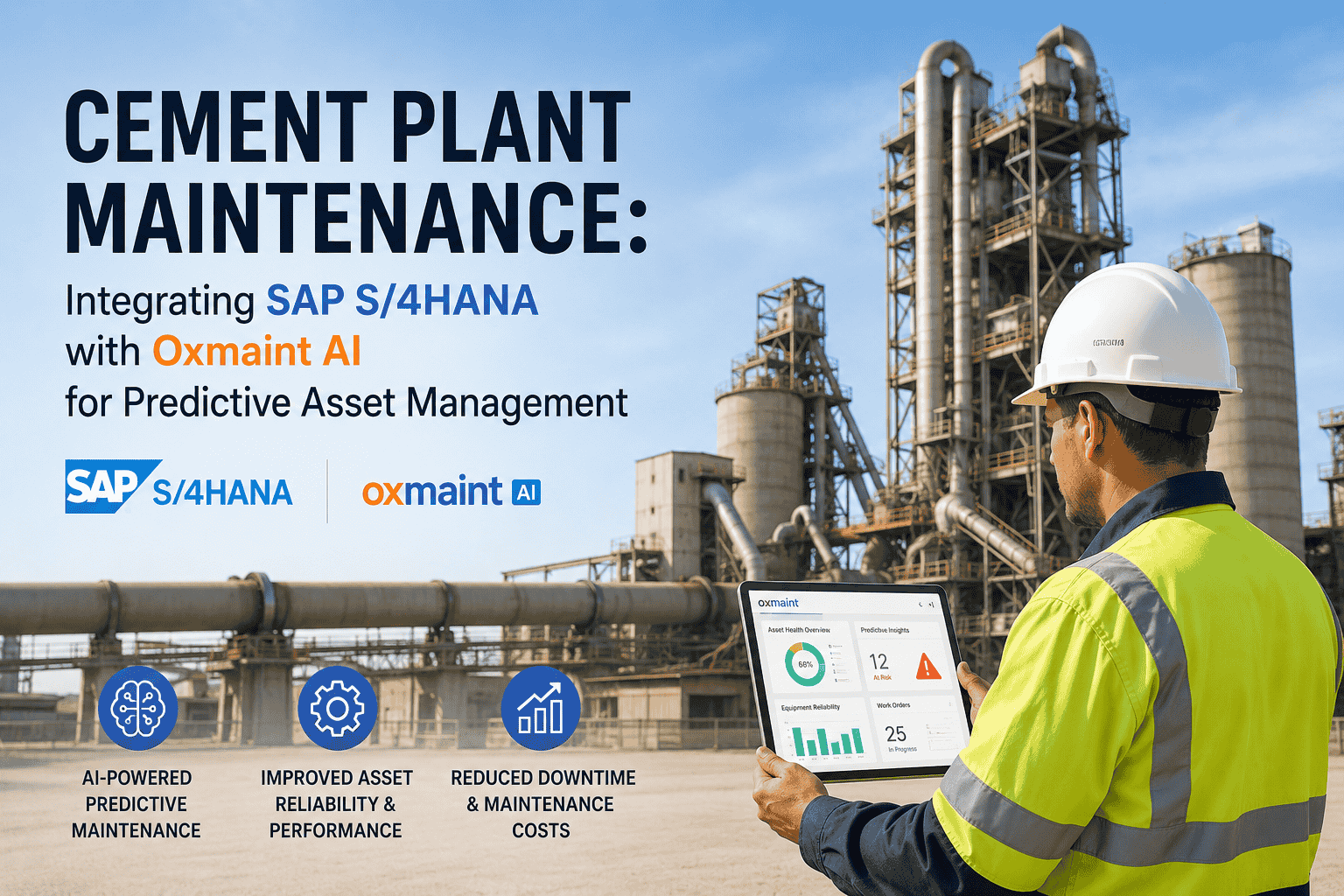
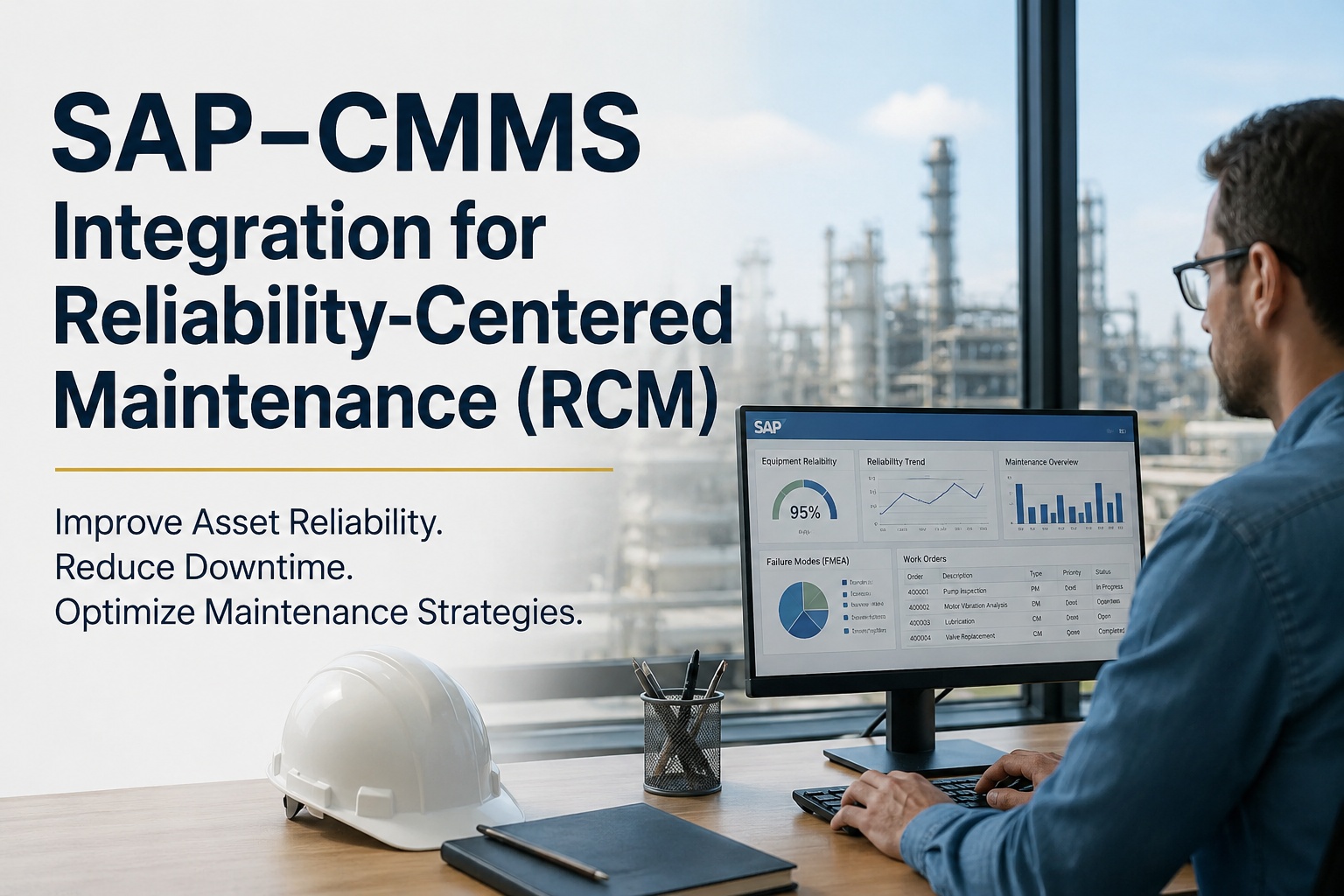
Cement Plant Maintenance: Integrating SAP S/4HANA with Oxmaint AI for Predictive Asset Management
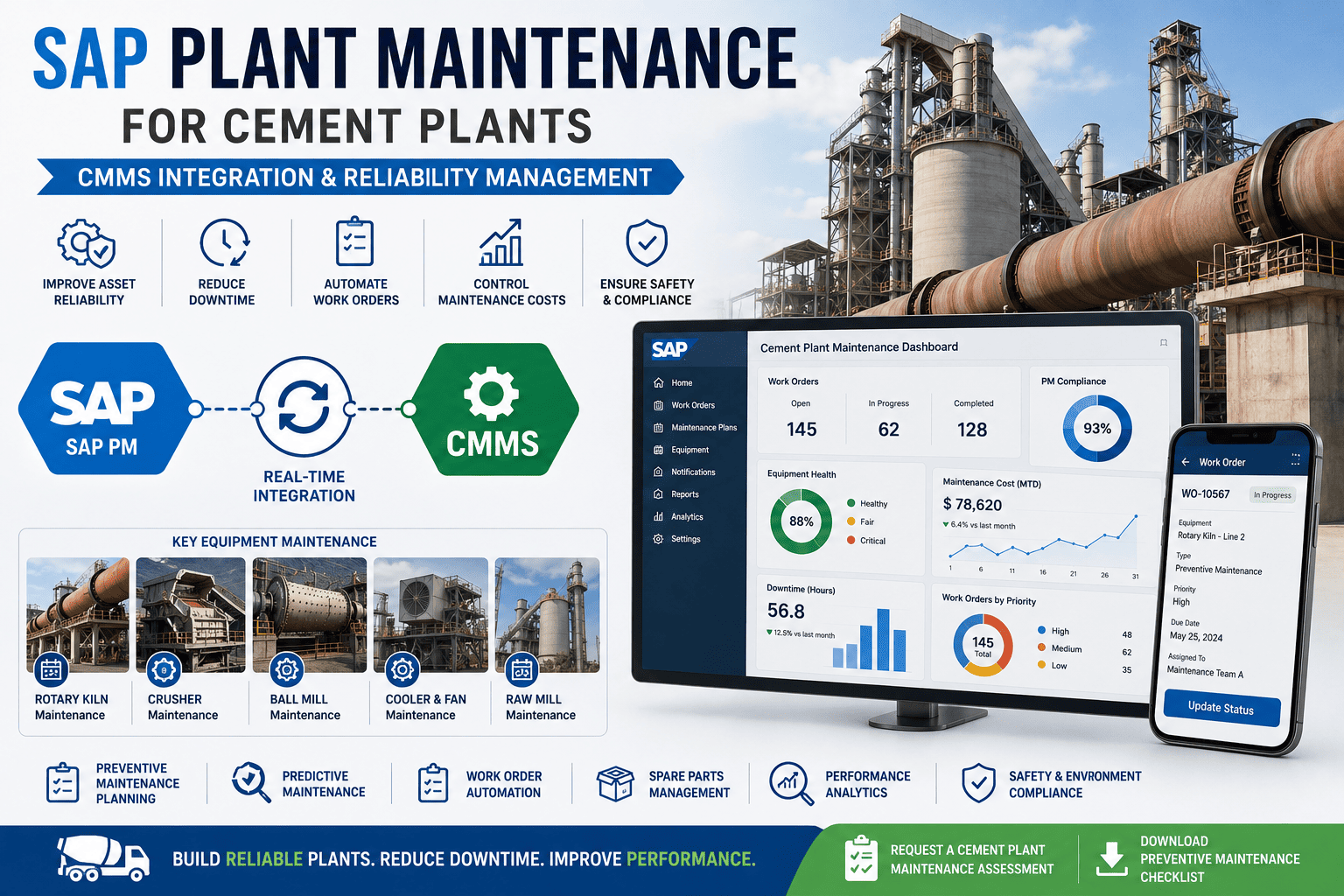
A cement plant runs six categories of critical equipment — rotary kiln, raw mill, coal mill, crushers, cement mill, and process fans — each with unique failure modes, each with different monitoring parameters, and each with a different cost per hour of unplanned downtime. SAP S/4HANA PM schedules the work orders, stores the asset hierarchy, and tracks the costs. What it does not do is listen to the kiln gearbox, watch the raw mill bearing temperature trend, detect the crusher eccentric bearing degradation, or predict the cement mill coupling failure 6-8 weeks before it halts production. OxMaint AI fills that gap — sitting alongside SAP PM, feeding predictive alerts directly into SAP work orders, and giving reliability engineers the failure-mode classification and remaining-useful-life estimate that SAP PM was never designed to calculate. US cement plants using OxMaint report $1.4M+ in avoided downtime costs in year one. Sign up free to connect OxMaint AI to your SAP PM asset register.
SAP S/4HANA PM + OXMAINT AI · CEMENT-SPECIFIC
SAP PM Schedules the Work Order. OxMaint AI Predicts the Failure That Creates It — 6 to 8 Weeks Earlier.
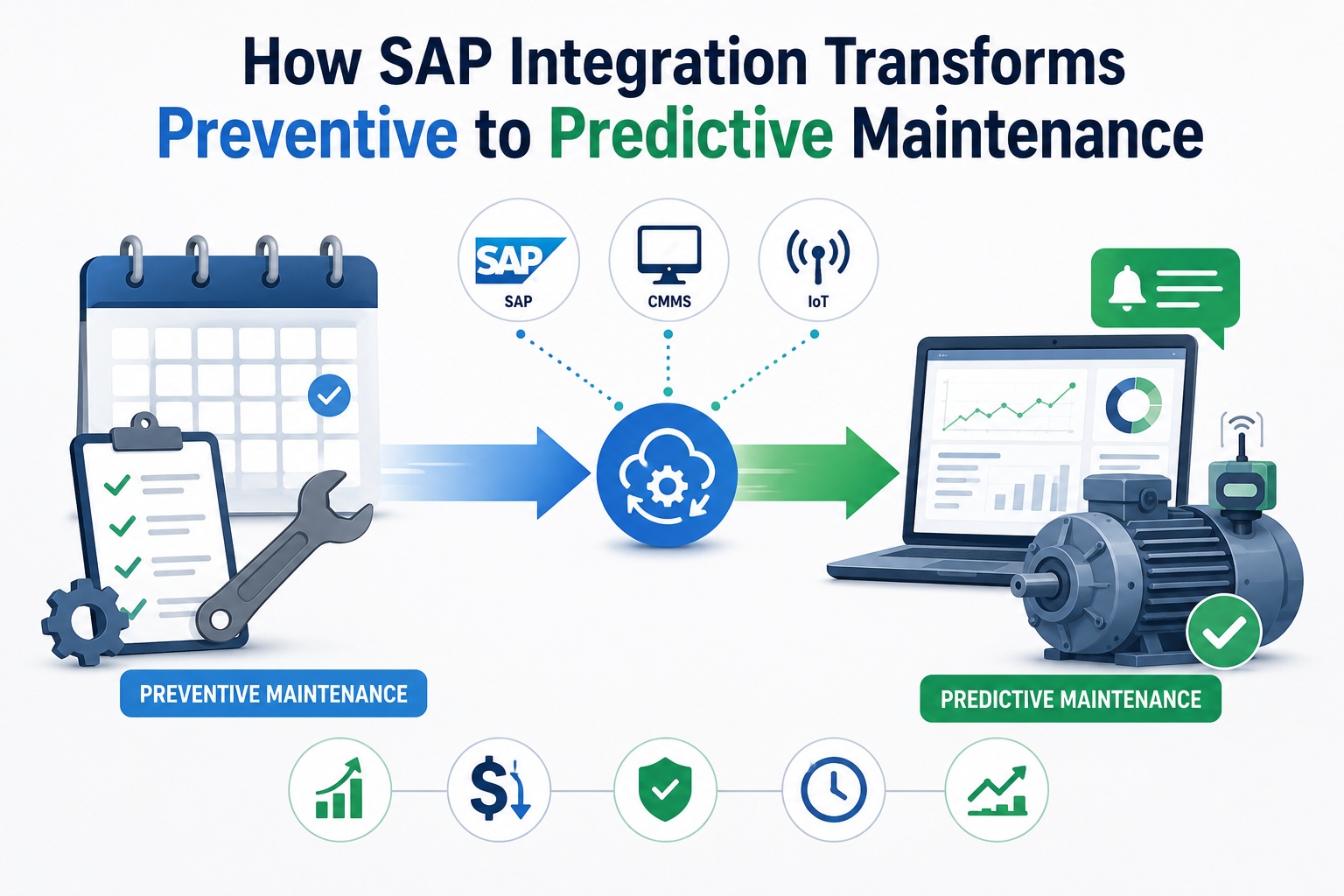
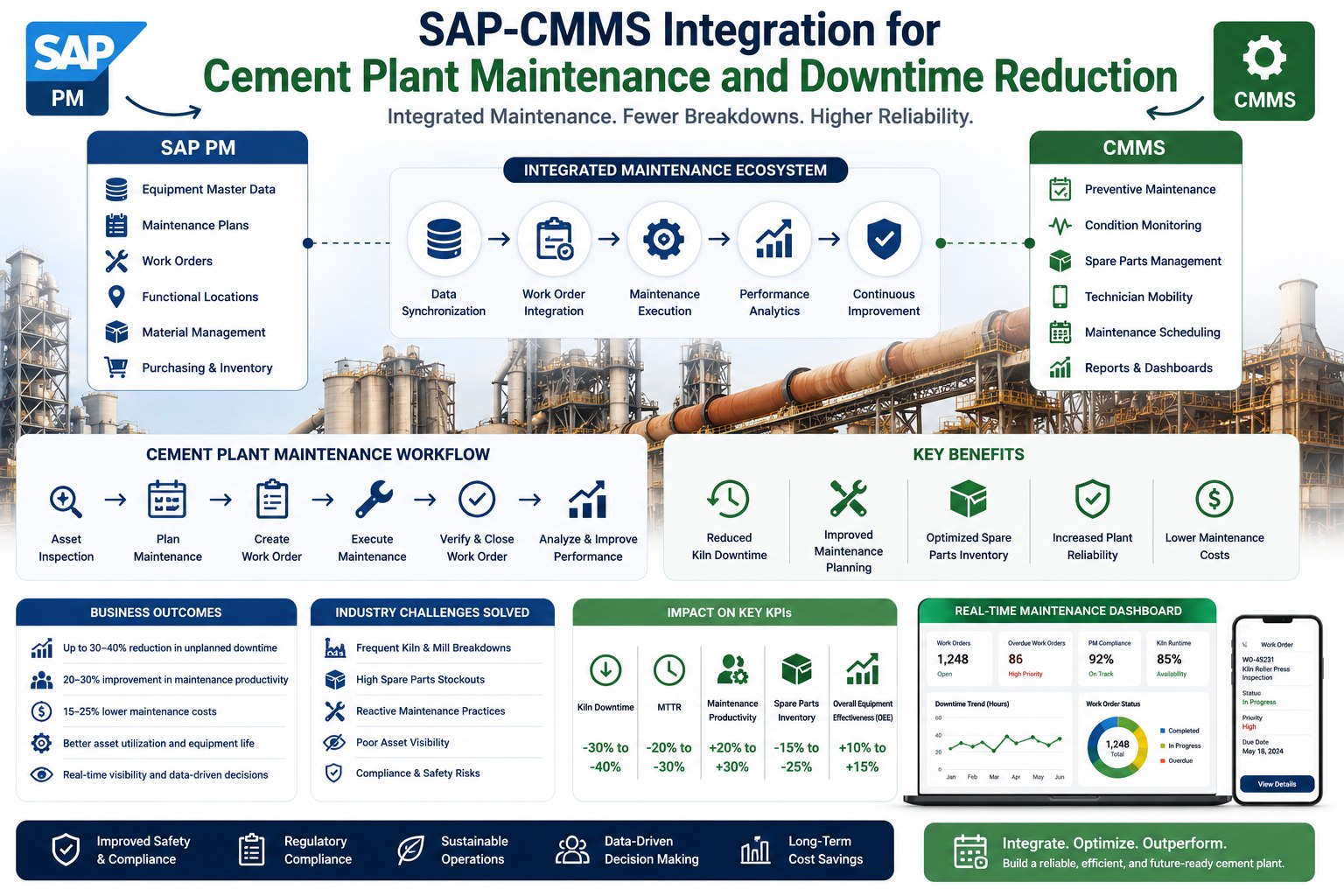
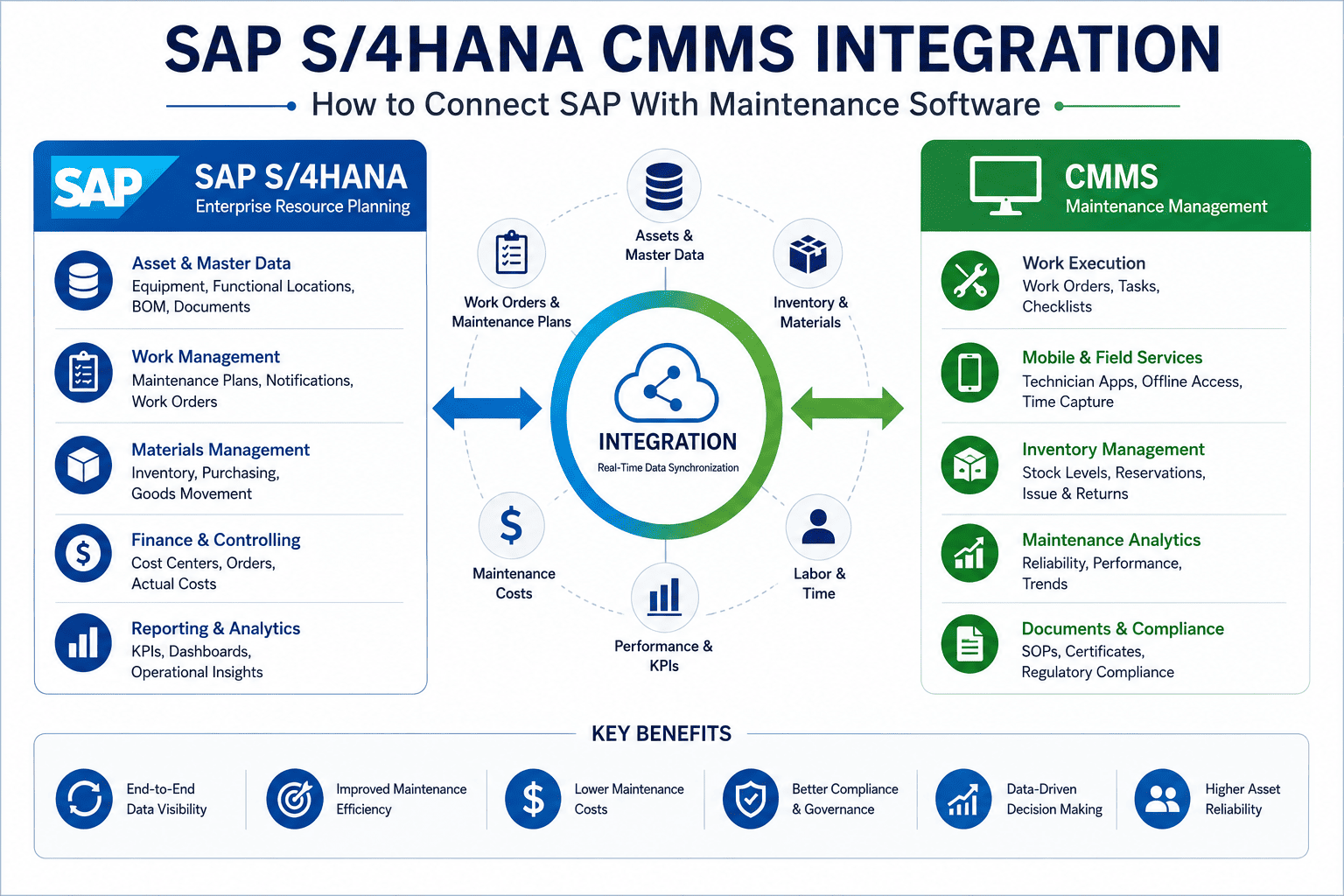
SAP S/4HANA PM is the system of record for asset hierarchy, maintenance planning, and cost tracking. OxMaint AI is the intelligence layer — vibration FFT, thermal imaging analytics, motor current signature analysis, and cement-specific failure-mode classification — that tells SAP PM which work order to create, when, and why. The integration is bidirectional: SAP PM sends the asset register and PM schedule to OxMaint; OxMaint sends predicted failures back as auto-generated SAP PM work orders with failure mode, remaining useful life, and recommended action attached.
The Six Critical Cement Assets · What SAP PM Misses and OxMaint AI Catches
SAP S/4HANA PM is the backbone for maintenance planning in cement — asset hierarchy, PM schedules, cost tracking, spare parts procurement. But SAP PM was designed as a planning system, not a prediction system. Here is what changes when OxMaint AI listens to each of the six critical cement assets and feeds predictions directly into SAP PM work orders. Sign up free to map your six asset categories to OxMaint AI.
ROTARY KILN
$260K/hr
SAP PMSchedules fixed-interval refractory inspection. Tracks kiln downtime costs and spare parts inventory.
OxMaint AIShell scanner detects refractory hot spots in real time. Tyre creep monitoring. Gearbox vibration FFT. Roller bearing temperature trending. Predicts failure 6-8 weeks ahead.
SAP PMTime-based PM schedule for bearing replacement and gearbox oil change.
OxMaint AI56 monitoring points digitized. Bearing temperature, motor current, gearbox vibration, and liner wear tracked continuously. Fan impeller dust imbalance detected before it causes 4-hour stops.
Bearing temp · motor current · gearbox vibration · liner wear · separator bearing spalling
COAL MILL
$10K/hr
SAP PMCalendar-based inspection schedule for rotary feeder and classifier.
OxMaint AI32 bearing locations monitored. Gearbox defects detected before they cause 56 hours of unplanned downtime. Seal air fan condition tracked for early intervention.
Rotary feeder wear · classifier faults · seal air fan bearings · gearbox degradation
CRUSHERS
$8K/hr
SAP PMFixed-interval jaw plate replacement. Crusher downtime logged after the fact.
OxMaint AIEccentric bearing condition monitored via vibration. Motor load profiling detects feed irregularities. Failures here starve the entire raw mill feed chain — early detection prevents cascade stops.
SAP PMPM schedule for coupling and bearing replacement based on operating hours.
OxMaint AI44+ bearing points per cement mill digitized. Coupling misalignment detected via 2× RPM vibration signature. Bearing and coupling failures can halt production for 72 hours — AI catches them 6 weeks early.
SAP PMScheduled bearing grease intervals and periodic balancing.
OxMaint AIVibration + motor current signature analysis catches impeller dust-coating imbalance and bearing wear. Fans are easy to overlook but cause raw mill stops when they fail. Detected before the 4-hour downtime event.
The integration pattern is the same for all six assets: OxMaint AI detects the degradation, classifies the failure mode with a confidence score, calculates remaining useful life, and auto-creates a SAP PM work order with the failure type, recommended action, and spare parts list attached. SAP PM handles scheduling, crew assignment, and cost tracking. Book a free demo to see the SAP PM integration live against your asset register.
"Our kiln gearbox failed on a Friday evening. The SAP PM schedule said the next inspection was 6 weeks out. Emergency replacement took 4 days — $4.2M in lost clinker production. How does OxMaint catch this?"
THE PROBLEM
5,000 TPD cement plant. Rotary kiln gearbox — SAP PM had a 12-week fixed-interval inspection cycle. Next scheduled inspection was 6 weeks away. On a Friday at 19:40 the gearbox seized. Emergency replacement sourced from overseas. Four days of kiln downtime at $260K/hour for the first 8 hours (full cascade), stabilizing to $180K/hour with partial bypass. Total cost: $4.2M in lost clinker production + $380K in emergency repair + $85K in air-freight for the replacement gearbox. Post-mortem showed bearing inner-race spalling that would have been visible in vibration FFT data 7 weeks before failure.
HOW OXMAINT AI + SAP PM SOLVES IT
Plant Floor Edge (Jetson)
Triaxial accelerometers on kiln gearbox at 25 kHz sampling. 2,048-line FFT every 60 seconds plus shell scanner thermal feed and roller bearing temperature. All captured on the edge box mounted at the kiln control room.
Predictive Engine (RTX)
Cement-specific failure library identifies inner-race spalling pattern in the FFT at week 2 of degradation. Classifies failure mode as "kiln gearbox bearing · inner race · BPFI." Calculates RUL at 49 days. Confidence score: 94%.
SAP PM Work Order
Auto-creates SAP PM notification + work order via BAPI with: failure mode, RUL, recommended action "replace bearing set during next planned kiln stop," and spare part number pre-linked. Maintenance planner schedules into the next clinker-cooler maintenance window — zero unplanned downtime.
THE RESULT
Failure caught 49 days before seizure. Bearing replaced during planned 8-hour kiln stop. $4.6M event avoided. SAP PM work order closed with full audit trail.
SCENARIO 02
"Our cement mill coupling failed and halted finish grinding for 72 hours. SAP PM showed the coupling was replaced 11 months ago — well within its 18-month service life. What went wrong?"
THE PROBLEM
Cement finish mill. Flexible coupling replaced 11 months earlier per SAP PM schedule (18-month interval). Coupling failed catastrophically — production stopped for 72 hours while the replacement was sourced and installed. Cost: $1.08M in lost cement production + $42K repair. Root cause: the coupling was installed with 0.3° angular misalignment that SAP PM's time-based schedule would never detect. The misalignment accelerated wear from 18-month life to 11 months. SAP PM saw the coupling as "healthy" because it was within its service interval.
HOW OXMAINT AI + SAP PM SOLVES IT
Plant Floor Edge (Jetson)
Vibration sensors on cement mill drive train capturing axial, radial, and tangential acceleration. FFT computed on the edge box continuously. Motor current signature analysis in parallel.
Predictive Engine (RTX)
Strong 2× RPM peak detected in the FFT within 72 hours of the coupling installation — classic misalignment signature. Alert issued immediately: "cement mill coupling angular misalignment · 0.3° · correct within 7 days to preserve coupling life." SAP PM work order created before the coupling had logged even one week of service.
Corrective Action in SAP
Alignment corrected in a 4-hour planned stop. Coupling life restored to 18+ months. SAP PM work order closed with FFT evidence attached — quality record for the next bearing audit.
THE RESULT
Misalignment caught 72 hours post-install — not 11 months later. $1.1M event avoided. Coupling life preserved. SAP PM record complete.
No — OxMaint AI sits alongside SAP PM as the predictive intelligence layer. SAP PM remains the system of record for asset hierarchy, maintenance planning, work order management, cost tracking, and spare parts procurement. OxMaint AI adds what SAP PM was never designed to do — vibration FFT, thermal imaging analytics, motor current signature analysis, failure-mode classification, and remaining-useful-life prediction. The integration is bidirectional: SAP PM sends the asset register and PM schedule; OxMaint sends predicted failures back as auto-generated SAP PM work orders via standard BAPI, RFC, or OData interfaces.
What cement-specific failure modes does OxMaint detect?
OxMaint's cement-specific failure library covers: kiln shell hot spots and refractory thinning, kiln tyre creep and roller bearing wear, kiln and mill gearbox bearing spalling (BPFO/BPFI/BSF/FTF), VRM separator bearing faults, crusher eccentric bearing degradation and toggle plate fatigue, cement mill coupling misalignment (2× RPM signature), coal mill rotary feeder wear, ID fan impeller imbalance from dust coating, bucket elevator belt condition, and compressor bearing health. Each failure mode has a cement-tuned detection threshold and RUL model trained on cement-plant failure data — not generic industrial baselines.
How does the SAP PM work order auto-creation work?
When OxMaint AI detects a degradation pattern that exceeds the alert threshold, it creates a SAP PM notification and work order via standard BAPI (BAPI_ALM_NOTIF_CREATE + BAPI_ALM_ORDER_MAINTAIN) or OData. The work order includes: failure mode classification with confidence score, remaining useful life in days, recommended corrective action, spare part number cross-referenced to SAP PM material master, and the FFT spectrum or thermal image as an attachment. The maintenance planner receives the work order in SAP PM and schedules it into the next planned stop — no manual data entry, no separate dashboard to monitor.
How long does the integration take to go live?
Eight to twelve weeks from contract signature. Weeks 1-2 — site survey, critical asset prioritization (typically kiln + raw mill + cement mill first), sensor placement review, SAP PM interface scope. Weeks 3-4 — Jetson edge boxes deployed near asset clusters, vibration sensors connected, DCS/SCADA tags mapped, baseline FFT spectra captured. Weeks 5-6 — RTX Predictive Engine live, cement failure-mode library loaded, first alerts flowing. Weeks 7-8 — SAP PM BAPI integration tested with real alert events, maintenance planner trained. Expansion to remaining assets runs 2-3 weeks per additional asset group.
What is the typical ROI timeline for a cement plant?
US cement plants using OxMaint report $1.4M+ in avoided downtime costs in year one. At $260K/hr for kiln downtime, preventing a single 8-hour unplanned kiln stop pays for the entire first-year investment. Beyond avoided downtime, plants see 18-25% maintenance cost reduction from right-time parts replacement (not too early, not too late), 50% reduction in unplanned downtime events, and 20-30% extension in equipment life through condition-based maintenance intervals replacing fixed-interval SAP PM schedules. Typical payback: 4-6 months.
Cement Edition · SAP PM Integration · 8-Week Pilot
Stop Scheduling Inspections. Start Predicting Failures — and Let SAP PM Do the Rest.
Book a 30-minute call with our cement deployment engineers. Walk through your kiln, raw mill, and cement mill asset register. See OxMaint AI feeding predicted failures directly into SAP PM work orders — live. Pilot in 8 weeks. Perpetual license, source code included, $0/mo.