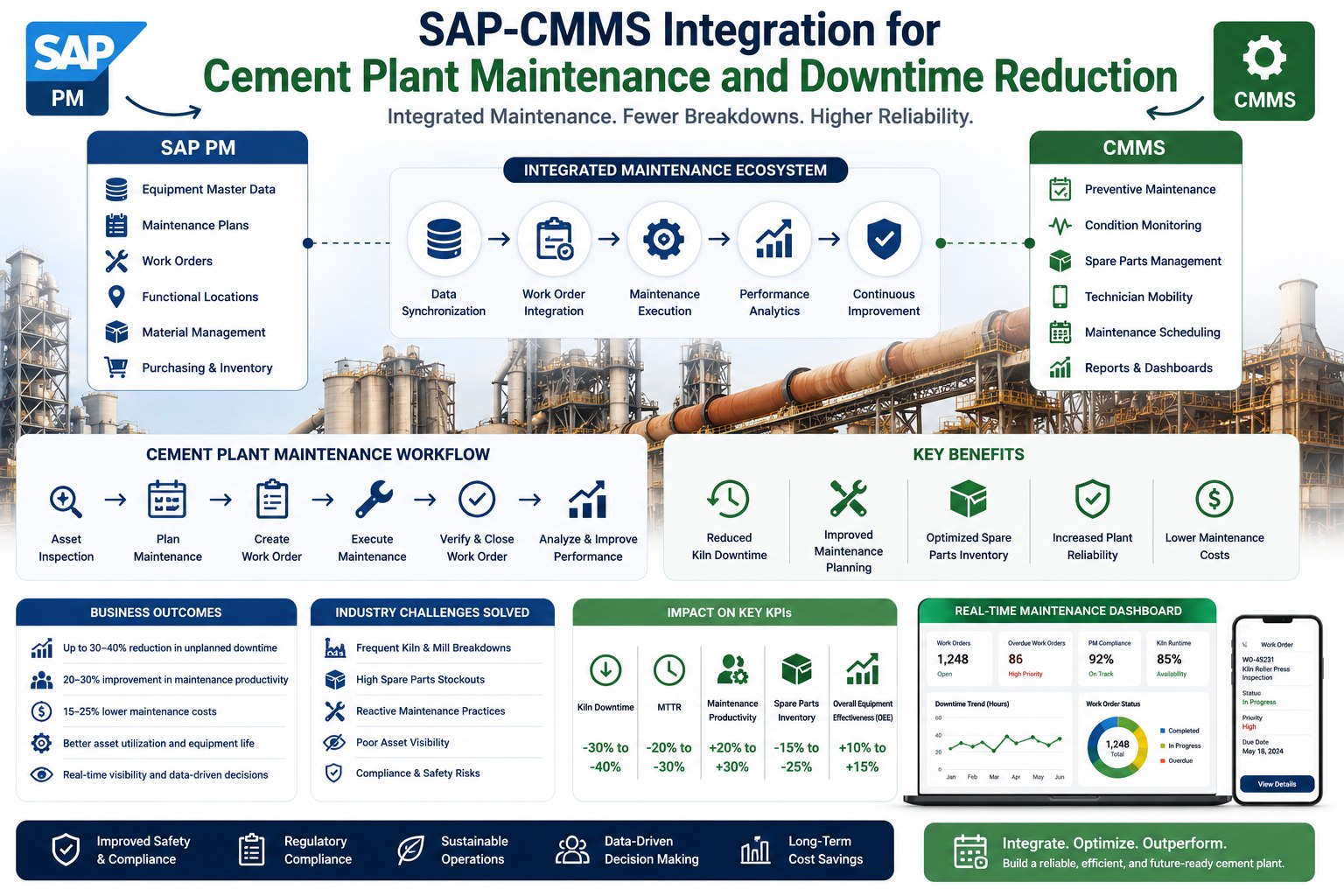
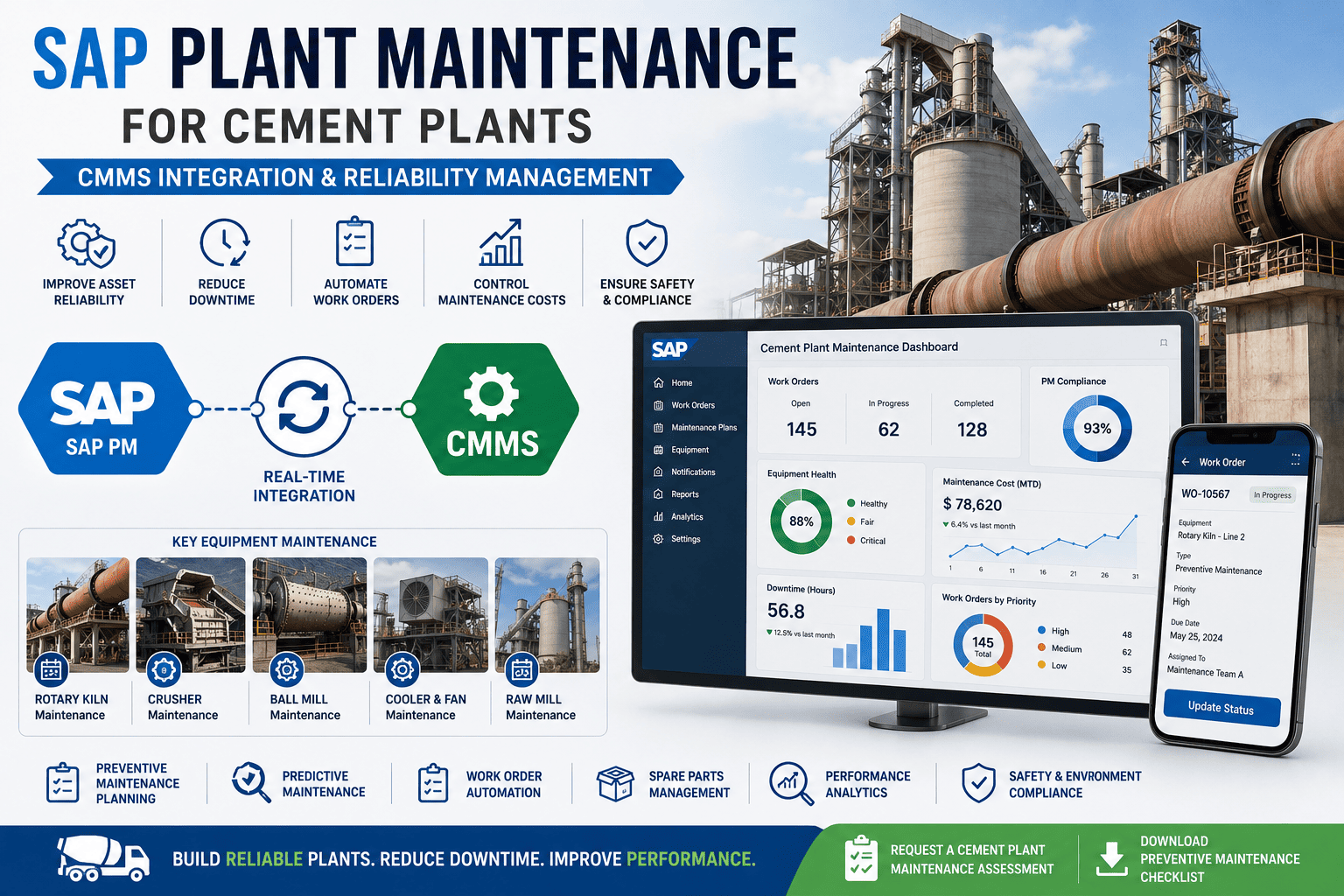
A cement kiln operates 24/7/365 at 1,450°C with materials moving continuously through 50-100 meters of rotating steel. When the kiln stops, the plant stops—and every hour of unplanned downtime costs $15,000 to $50,000 in lost production, refractory damage, restart energy, and supply chain disruption. The maintenance challenge isn't whether to invest in reliability; it's whether the SAP-CMMS integration architecture can keep pace with the plant's relentless production demands. This guide covers what the integration looks like for cement-specific equipment. Book a free demo to walk through cement plant integration.
CEMENT PLANT RELIABILITY REALITY
The Continuous-Process Discipline Cement Demands
85%+
Kiln Availability Target
200-400
Unplanned Hr / Year
Why Cement Plants Are Bound to Equipment Reliability
Cement manufacturing is the canonical continuous-process operation. Raw materials move from the quarry through crushing, grinding, preheating, kilning, cooling, finishing, and dispatch in an unbroken chain that runs 330-345 days per year. There are no buffers between stages large enough to absorb meaningful downtime. When the rotary kiln stops, the calciner stops feeding, the raw mill backs up, and the entire upstream chain has to be coordinated through a controlled shutdown.
The reliability discipline that distinguishes top-quartile cement operators isn't superior equipment—it's superior integration of maintenance data with operational data. Shell scanning patterns inform refractory lifecycle planning. Vibration trends on the kiln drive trigger inspection cycles weeks before failure. Cement leaders ready to begin a structured assessment can Sign up free to begin a cement plant reliability assessment.
The Critical Cost of Cement Plant Downtime
Downtime cost in cement manufacturing varies dramatically by which section of the plant has stopped. The cost breakdown below shows why the kiln area dominates reliability priorities.
Raw Materials
$5-10K
per hour
Crushing & raw mill — recoverable through buffer stocks
Preheater Tower
$20-30K
per hour
Cyclone build-up triggers kiln stop within hours
Rotary Kiln
$25-50K
per hour
The critical asset — restart alone is 24-48 hours
Cement Mill
$8-15K
per hour
Finishing — buffered but dispatch commitments at risk
The Cement Plant Production Architecture & Maintenance Integration Map
The map below shows the seven process stages of cement manufacturing, the critical equipment in each stage, the failure modes that drive unplanned downtime, and the SAP-CMMS integration touchpoint that addresses each. The kiln stage is the operational anchor.
7 STAGES · INTEGRATION FRAMEWORK
Cement Plant Architecture & Integration Map
PHASE A · Raw Materials
PHASE B · Pyroprocessing
PHASE C · Finishing
Quarry & Crushing
Raw Materials
Critical Equipment
Primary & secondary crushers · screens · stackers · conveyors · dust collectors
Failure Modes
Hammer wear · screen blockage · belt degradation · bearing failure
Integration Touchpoint
Vibration monitoring · real-time wear tracking · PdM scheduling
Raw Mill (VRM)
Raw Materials
Critical Equipment
Vertical roller mill · table & rollers · gear unit · static separator
Failure Modes
Roller & table wear · gearbox failure · hydraulic leaks · separator wear
Integration Touchpoint
Vibration analysis · oil analysis · roller lifecycle tracking
Preheater & Calciner
Pyroprocessing
Critical Equipment
4-6 stage cyclone tower · calciner · fuel injection · ID fan
Failure Modes
Cyclone blockage · refractory failure · fuel nozzle wear · fan vibration
Integration Touchpoint
Pressure differential monitoring · fan condition · refractory tracking
Rotary Kiln ANCHOR · $25-50K/HR
Pyroprocessing
Critical Equipment
Kiln shell · refractory lining · tires & rollers · main drive · burner · seals
Failure Modes
Refractory failure · tire/roller wear · drive failure · shell hot spots
Integration Touchpoint
Shell scanning · drive vibration · refractory lifecycle · burner monitoring
Clinker Cooler
Pyroprocessing
Critical Equipment
Grate plates · cooling fans · hydraulic drives · clinker breaker
Failure Modes
Grate plate wear · fan failures · hydraulic leaks · clinker fall-through
Integration Touchpoint
Grate temperature · fan condition · hydraulic system health
Critical Equipment
Ball mill or roller press · separator · gear unit · main bearings
Failure Modes
Liner wear · media wear · gearbox failure · bearing damage
Integration Touchpoint
Liner thickness · vibration analysis · oil analysis on gear unit
Packing & Dispatch
Finishing
Critical Equipment
Storage silos · packers · conveyors · truck loaders · bag filters
Failure Modes
Packer head wear · conveyor failure · silo flow issues · bag blockage
Integration Touchpoint
Throughput monitoring · packer condition · conveyor PdM
Standards Anchored Through Integration
ISO 14224ISO 50001GCCACEMBUREAUISA-95
The pivotal stage is Stage 04—Rotary Kiln—because every other stage's reliability decisions are coordinated against kiln availability. Refractory lifecycle drives the master maintenance calendar. Plant managers ready to score current kiln integration maturity can Sign up free to score kiln integration against the 7-stage framework.
From Kiln Event to Documented Response
The highest-stakes workflow in cement plant maintenance is the response to an emerging kiln integrity event. The pipeline below shows how integrated SAP-CMMS architecture turns each event into structured response and documentation.
KILN EVENT → COORDINATED RESPONSE
From Anomaly Detection to Production Restart
T+0Detection
01
Shell Scanner or Drive Anomaly Detected
Continuous shell scanner identifies emerging hot spot, drive torque exceeds baseline, or refractory thermocouple alarm triggers. Event auto-logged with position, severity, and baseline.
T+10 minAlert
02
Reliability Engineer & Operations Alert
Notification routed to kiln operations team and reliability engineering. Historical shell scan trends, refractory thickness, and recent maintenance history made immediately accessible.
T+30 minDecision
03
Continue / Cooldown Decision
Reliability engineer assesses trend severity, recent inspection findings, and operational impact. Decision: continue monitoring, schedule shutdown at next planned window, or initiate emergency cooldown.
T+HoursCoordinate
04
Plant-Wide Shutdown Coordination
Upstream stages sequenced through controlled stop. Coal mill shutdown. Cooling cycle begun. Maintenance crew briefed with scope, parts requirements, contractor coordination.
T+DaysRestart
05
Inspection, Repair & Production Restart
Kiln entered after cooldown. Refractory inspection by qualified specialist. Repair scope confirmed. Spare bricks pulled from inventory. Stable production restart with documented refractory update.
The differentiator from disconnected workflows isn't the speed of any single step—it's the continuity of data and decision context across the full event timeline.
SEE IT IN ACTION
Walk Through Cement Plant Integration on a Live Site
Kiln shell scanning, refractory lifecycle tracking, plant-wide coordination, and spare parts optimization on actual cement plant architecture.
ROI of Integrated Cement Plant Maintenance
The financial case for integrated cement maintenance sits on extended refractory campaigns, reduced unplanned downtime hours, and optimized spare parts inventory.
REACTIVE vs INTEGRATED SAP-CMMS
Annual Operating Performance Delta
Unplanned Downtime Hr / Yr
−66%
Refractory Campaign Length
+42%
6-9 mo
Typical payback at mid-size cement plant
$5-12M / yr
Recurring annual benefit from avoided downtime
The largest contributor to total ROI is refractory campaign extension. Moving from 12-month to 17-month average campaigns reduces frequency of major kiln stops and increases productive kiln-hours per year. Plant leaders ready to model refractory ROI can Book a free demo to model refractory campaign extension on current kiln baselines.
Expert Perspective: What Distinguishes Top-Quartile Cement Operators
"
The top-quartile cement operators I've worked with share a property that often surprises new plant managers: they treat refractory lifecycle as the maintenance program's master schedule, not as one project among many. The kiln stop calendar is set first; every other maintenance activity works around it. When refractory lifecycle drives the master schedule, everything else fits into place.
01
Refractory Drives Master Schedule
Kiln stop calendar set first; all other maintenance sequenced against it. Treating refractory as one project among many produces emergency reactivity.
02
Shell Scanning Is Leading Indicator
Continuous shell scanning with trended analysis catches refractory degradation weeks before failure. The historical pattern matters more than any single reading.
03
Plant-Wide Coordination Wins
A plant optimized section-by-section underperforms one coordinated holistically. Integration provides the visibility that turns local optimization into plant-wide reliability.
90-Day Path to Integrated Cement Plant Maintenance
Cement operators that successfully deploy integrated maintenance follow a consistent cadence. The roadmap below is what disciplined teams execute.
90-DAY DEPLOYMENT ROADMAP
From Kiln Asset Baseline to Plant-Wide Reliability
DAYS 1–20
01
Kiln-Anchored Asset Baseline
Inventory critical assets across 7 stages. Establish kiln-centric hierarchy. Document refractory campaign history. Baseline availability metrics.
DAYS 21–45
02
Condition Monitoring Integration
Integrate shell scanner, vibration, oil analysis, and thermocouple data streams. Establish baseline trending. Configure alert thresholds.
DAYS 46–70
03
Mobile Crews & Coordination
Deploy mobile work orders. Activate kiln event coordination workflow. Validate permit-to-work. Test cooldown coordination drill.
DAYS 71–90
04
Spare Parts & Campaign Planning
Optimize MRO inventory. Establish refractory lifecycle tracking and campaign planning. Plant management dashboard activated.
By day 90, the integration is operational across kiln-anchored equipment, condition monitoring feeds into work order workflows automatically, and refractory lifecycle planning extends 18-24 months forward. Operations leaders ready to start the baseline phase can Sign up free to begin the kiln-anchored asset baseline this week.
START THE TRANSFORMATION
Operate Your Kiln Like a Top-Quartile Cement Producer
Seven process stages integrated. Shell scanning trended. Refractory lifecycle planned. Plant-wide coordination operationalized.
Frequently Asked Questions
How does kiln shell scanning integrate with SAP PM?
Shell scanner data feeds into SAP PM through the CMMS layer rather than directly into the ERP. The continuous scan data is processed at the CMMS level for trending and pattern recognition, then anomalies trigger notifications routed into SAP PM as the system of record. Historical scan data is linked to specific kiln positions and refractory campaigns, supporting lifecycle analysis. Integration with refractory thickness measurements, thermocouple readings, and drive torque data provides the multi-variable view that catches degradation patterns invisible in any single data stream.
What's the typical refractory campaign extension achievable through integration?
Most cement operators moving from reactive to integrated maintenance see refractory campaign extension from 12 months baseline to 15-18 months over the first 2-3 campaigns. The improvement comes from earlier detection of localized degradation (allowing targeted patches rather than full reline), better operational discipline around kiln coating management, and improved coordination on temperature management. The plateau is typically around 18-22 months for highest-performing programs.
How does the system handle scheduled vs emergency kiln stops?
Both stop types follow similar coordination workflows but with different timing. Scheduled stops are planned 6-12 months in advance against the refractory campaign calendar. Emergency stops trigger the immediate coordination workflow but with the same workflow elements (upstream sequencing, cooldown coordination, contractor engagement, spare parts release). The discipline that distinguishes top operators is converting emergency stops into scheduled ones through better predictive monitoring.
Can integration scale across multiple cement plants in a portfolio?
Yes, and cement is one of the industries where multi-plant scaling delivers compounding value. Plant-level integration produces local reliability gains; multi-plant integration adds shared best practices, comparative benchmarking, spare parts optimization across the portfolio, and contractor coordination at scale. Most multi-plant operators deploy the first plant fully, validate the model, then scale the proven pattern to subsequent plants in 3-6 months each.
What about quarry equipment that operates outside the main plant?
Quarry equipment (large mobile equipment, primary crushers, conveyors) integrates through the same CMMS layer as plant equipment but with different criticality rankings and PM workflows. Mobile equipment uses OEM telematics integration (Caterpillar Vital, Komatsu KOMTRAX) feeding into the CMMS rather than direct sensor integration. MSHA compliance documentation also benefits from integration, since quarry operations have their own regulatory requirements separate from plant manufacturing.