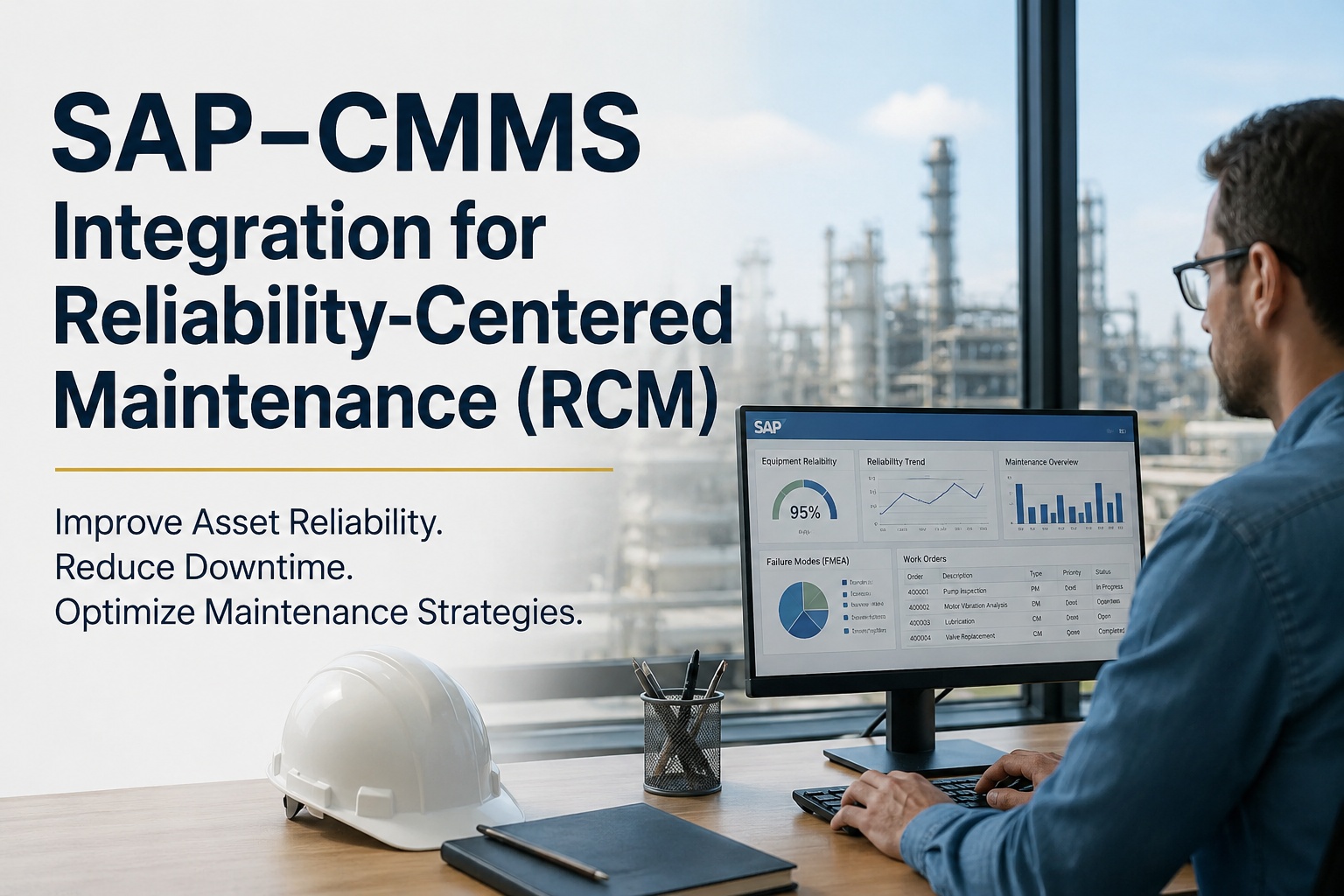
SAP–CMMS Integration for Reliability-Centered Maintenance (RCM) | Asset Reliability Guide
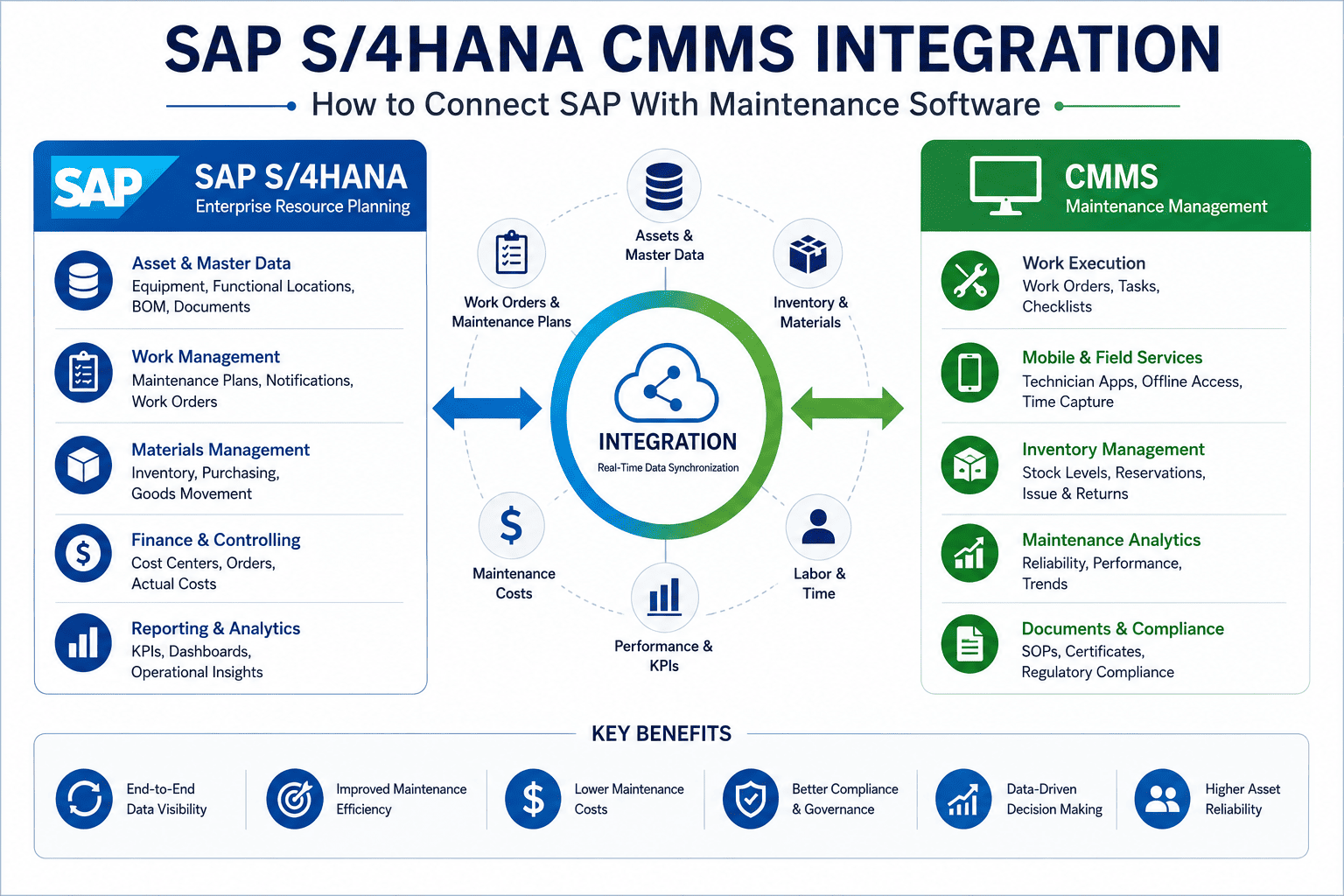
Reliability-Centered Maintenance answers a question maintenance organizations rarely ask explicitly: not "how do we maintain this equipment?" but "what maintenance does this equipment actually need to prevent failures that matter?" RCM emerged from aviation in the 1960s and revolutionized maintenance philosophy by anchoring strategy to function and failure consequence rather than calendar or hours. The methodology requires structured data—failure modes, effects, consequences, histories—exactly what SAP-CMMS integration provides at scale. This article maps how integration turns RCM from theoretical framework into operational practice. Book a free demo to see RCM integration.
RCM REALITY
Seven Questions Determine What Maintenance Strategy Actually Works
7
Classic RCM Questions
11%
Items With True Wear-Out Pattern
89%
Failures That Are Random
50-100%
MTBF Improvement Potential
Why RCM Without SAP-CMMS Integration Stays Theoretical
Most organizations that "do RCM" are really doing RCM workshops—week-long facilitated sessions producing detailed FMEA documents that get filed in a shared drive and rarely consulted again. The analysis is sound; the operationalization is missing. Without integration into the systems where maintenance actually happens (SAP for master data and work orders, CMMS for execution and history), RCM stays a periodic exercise rather than a living strategy.
The pattern that works inverts this. The RCM analysis lives inside the integrated maintenance system itself. Failure modes are linked to equipment in SAP. Tasks generated by RCM analysis create PM plans automatically. Execution history feeds back into the analysis for continuous refinement. The methodology stops being something you "do" periodically and becomes something the system continuously enforces. Reliability engineers ready to operationalize RCM can Sign up free to operationalize RCM in integrated systems.
The 7 RCM Questions Every Reliability Program Must Answer
John Moubray's RCM II established the seven sequential questions that any reliability analysis must answer. The questions look simple on paper. Answering them rigorously for every critical asset requires the structured data that SAP-CMMS integration provides—and the workflow that turns answers into operational maintenance strategy.
7 QUESTIONS · MOUBRAY RCM II FRAMEWORK
The Reliability-Centered Maintenance Question Map
PHASE A · Functions & Failures
PHASE B · Causes & Consequences
PHASE C · Maintenance Strategy
Q1
Function & Performance Standards ANCHOR · FOUNDATION
"What are the functions and associated performance standards of this asset in its present operating context?"
DATA SOURCE
SAP equipment master · design specifications · operating context records
INTEGRATION DELIVERS
Function library linked to equipment; measurable performance criteria captured
OUTPUT
Defined function statements with target values
Q2
Functional Failures
"In what ways can it fail to fulfill its functions?"
DATA SOURCE
SAP failure history · CMMS work orders · notification codes
INTEGRATION DELIVERS
Failure mode catalog linked to each function; historical pattern analysis
OUTPUT
Documented functional failure modes per asset
Q3
Failure Modes (Root Causes)
"What causes each functional failure?"
DATA SOURCE
CMMS root cause records · technician findings · cause/damage codes
INTEGRATION DELIVERS
FMEA worksheet integrated with work order history; cause-mode-effect hierarchy
OUTPUT
Validated failure mode list with cause hierarchy
Q4
Failure Effects
"What happens when each failure occurs?"
DATA SOURCE
Incident records · downtime logs · safety/environmental events
INTEGRATION DELIVERS
Effect documentation linked to failure modes; operational and safety impact
Each question must be answered for every critical asset—not once, but continuously as operating context, failure history, and consequence assessments evolve. Without integrated systems, this becomes prohibitive. With integration, it becomes the system's standard operating discipline. Reliability engineers ready to apply the question framework can Sign up free to apply the 7-question framework.
SEE IT IN PRACTICE
Walk Through RCM Operationalization Live
30-minute demo showing the 7 RCM questions answered against real SAP master data and CMMS history—with the FMEA, task library, and PM generation workflows running end-to-end.
Why Most Conventional Maintenance Wisdom Doesn't Match Reality
Before RCM existed, the conventional belief was that most equipment failures followed a predictable wear-out pattern—the assumption underlying most calendar-based PM programs. The Nowlan-Heap study commissioned by United Airlines in the late 1960s tested this assumption empirically across thousands of aircraft components and produced findings that shocked the maintenance community. The actual distribution of failure patterns looked nothing like the conventional wisdom. The discovery is what made RCM necessary—and it remains the empirical foundation that justifies abandoning calendar-based PM for failure modes that don't actually wear out.
The 6 Failure Patterns That Drive Maintenance Strategy
The seminal United Airlines/Nowlan-Heap study—the empirical foundation of modern RCM—found that only 11% of failures follow the wear-out pattern most calendar-based PM assumes. The other 89% follow random or infant-mortality patterns where time-based PM produces little benefit and often increases failure risk through unnecessary intervention.
A
Bathtub Curve
4%
Infant mortality + wear-out
B
Wear-Out
2%
Slow then rapid increase
C
Gradual Rise
5%
Steady increase over life
D
Initial Low / Constant
7%
Quick rise then plateau
E
Pure Random
14%
Constant failure probability
F
Infant Mortality
68%
High early failures then constant
The implication is profound: most equipment doesn't wear out predictably. Calendar-based PM works only for the 11% that does. For the other 89%, RCM-driven condition monitoring and run-to-failure (where consequences allow) produce better outcomes at lower cost. Reliability engineers ready to identify which pattern fits their critical assets can Sign up free to map your assets to failure patterns.
ROI of Integrated RCM Programs
Integrated RCM delivers ROI on dimensions calendar-based PM cannot match: failure modes addressed, maintenance task relevance, mean time between failures, and budget allocation efficiency. The performance delta below shows the operational and financial gains.
CALENDAR-BASED PM vs INTEGRATED RCM
Reliability Program Performance Delta
Failure Modes Addressed
0-20%
80%+
+60 pts
PM Tasks Matched to Real Modes
30%
90%+
+60 pts
Reactive Maintenance Share
60%
15%
−75%
Mean Time Between Failures
Baseline
+50-100%
+75%
Budget Allocation Efficiency
50%
90%+
+40 pts
12-18 mo
Typical payback period for integrated RCM program
50-100%
MTBF improvement from RCM-driven strategy refinement
The compounding value: each prevented failure feeds the FMEA refinement, which improves the next maintenance plan, which prevents the next failure. The cycle is what calendar-based PM can't produce. Reliability leaders ready to model RCM payback can Book a free demo to model RCM payback scenarios.
Expert Perspective on RCM Implementation
"
The RCM programs I've watched genuinely transform reliability share an unusual characteristic: they never finish. The teams I've seen succeed don't treat RCM as a project with a completion date; they treat it as the discipline by which the maintenance system continuously learns. Each work order completion feeds back into the FMEA. Each prevented failure validates the task selection. Each surprise failure triggers re-analysis. The integrated system is what makes this continuous learning possible—without integration, the feedback loop breaks at every handoff and the analysis stays static. The teams that fail at RCM typically treat it as a one-time exercise, complete the workshops, file the documents, and wonder six months later why reliability didn't improve. RCM is a way of operating, not a project deliverable.
01
RCM Is a Discipline, Not a Project
The analysis must update continuously as failure history and operating context evolve. Static RCM documents stop adding value within months.
02
Feedback Loops Drive Improvement
Every work order completion is data. Integrated systems close the loop automatically; non-integrated systems lose the data.
03
Start With Critical Assets Only
Full-scope RCM on every asset is impractical. Start with 5-10 critical assets and expand based on demonstrated value.
90-Day RCM Pilot Roadmap
The 90-day pilot below produces an operational RCM program on 5-10 critical assets, with the integration architecture and team discipline needed to scale beyond the pilot scope.
90-DAY RCM PILOT
From Asset Selection to Operational RCM
DAYS 1–25
01
Asset Selection & Function Definition
Select 5-10 critical assets. Define functions and performance standards (Q1). Establish operating context. Set up integration data flows.
DAYS 26–50
02
FMEA Workshops
Conduct failure mode and effects analysis (Q2-Q4). Use SAP history to ground the analysis. Document failures, effects, and consequences (Q5).
DAYS 51–75
03
Task Selection & Integration
Define proactive tasks (Q6) and default actions (Q7). Generate PM plans in SAP. Configure CMMS workflows to capture execution data.
DAYS 76–90
04
Pilot Operation & Learnings
Operate pilot with feedback loops active. Capture early lessons. Build scaling playbook. Plan wave 2 asset selection.
OPERATIONALIZE RCM
Turn Failure Mode Analysis Into Living Maintenance Strategy
Seven questions answered. Six failure patterns understood. Integration architecture that closes the feedback loop. The discipline that turns RCM from theory into reliability improvement.
No—and trying to do so is one of the most reliable ways to kill an RCM program. The 80/20 rule applies: focus RCM analysis on the 10-20% of assets that drive 80% of reliability risk or downtime cost. Critical equipment, single-points-of-failure, and assets with long replacement lead times deserve full RCM treatment. Lower-criticality assets can use simpler approaches: streamlined RCM (sometimes called RCM-Lite), template-based PM plans, or run-to-failure where consequences allow. Trying to apply full Moubray-style RCM across every asset consumes years of facilitator time and produces analysis paralysis. Start with critical assets, demonstrate value, then expand selectively.
Who should lead the RCM analysis?
RCM requires three roles working together: a trained facilitator who knows the methodology, the asset's operators who understand how it actually runs, and maintenance technicians who understand how it actually fails. The facilitator can be internal or external; the operational expertise must be internal. Reliability engineers typically own the program, but the analysis sessions need cross-functional participation. Programs that put RCM entirely on the reliability engineering team without operator and technician participation reliably produce theoretical analyses that don't match field reality. The cross-functional workshops aren't optional overhead—they're the mechanism that grounds the analysis in operational truth.
How long does an RCM analysis take per asset?
Full Moubray-style RCM on a single complex asset typically takes 3-5 days of facilitated workshops with cross-functional participation, followed by 1-2 weeks of documentation and refinement. Streamlined RCM (RCM-Lite or similar approaches) can compress this to 1-2 days per asset with somewhat less depth. The investment is significant but produces lasting value: an asset analyzed once stays analyzed (with continuous refinement via integration) for its entire operating life. Organizations that try to compress analysis below 1 day per critical asset typically produce surface-level FMEAs that miss the failure modes RCM is specifically designed to uncover.
How does RCM differ from regular preventive maintenance planning?
Conventional PM planning typically follows OEM recommendations and field experience to generate maintenance schedules. RCM inverts this: instead of asking "what does the manual say to do?", it asks "what are the failure modes and which ones can we actually prevent?" The result often looks different: tasks the OEM recommended may be eliminated as ineffective; tasks the OEM didn't mention may be added because failure data shows they matter; intervals may change based on actual failure patterns rather than calendar conventions. RCM is more rigorous than conventional PM planning and produces maintenance strategies that match actual equipment behavior rather than manufacturer assumptions.
Can RCM data feed into predictive maintenance programs?
RCM is the foundation predictive maintenance needs to work economically. The failure modes identified in RCM analysis tell you what sensor data matters; the consequence classification tells you which failures justify monitoring investment; the proactive task selection identifies where condition-based monitoring would replace time-based PM. Predictive maintenance programs without RCM grounding tend to monitor whatever is easy to monitor rather than what matters. Programs with RCM grounding target sensors at the specific failure modes RCM identified as worth detecting early. The two methodologies are complementary: RCM defines the strategy; predictive maintenance executes the condition-based portion of that strategy more effectively than periodic inspection alone.