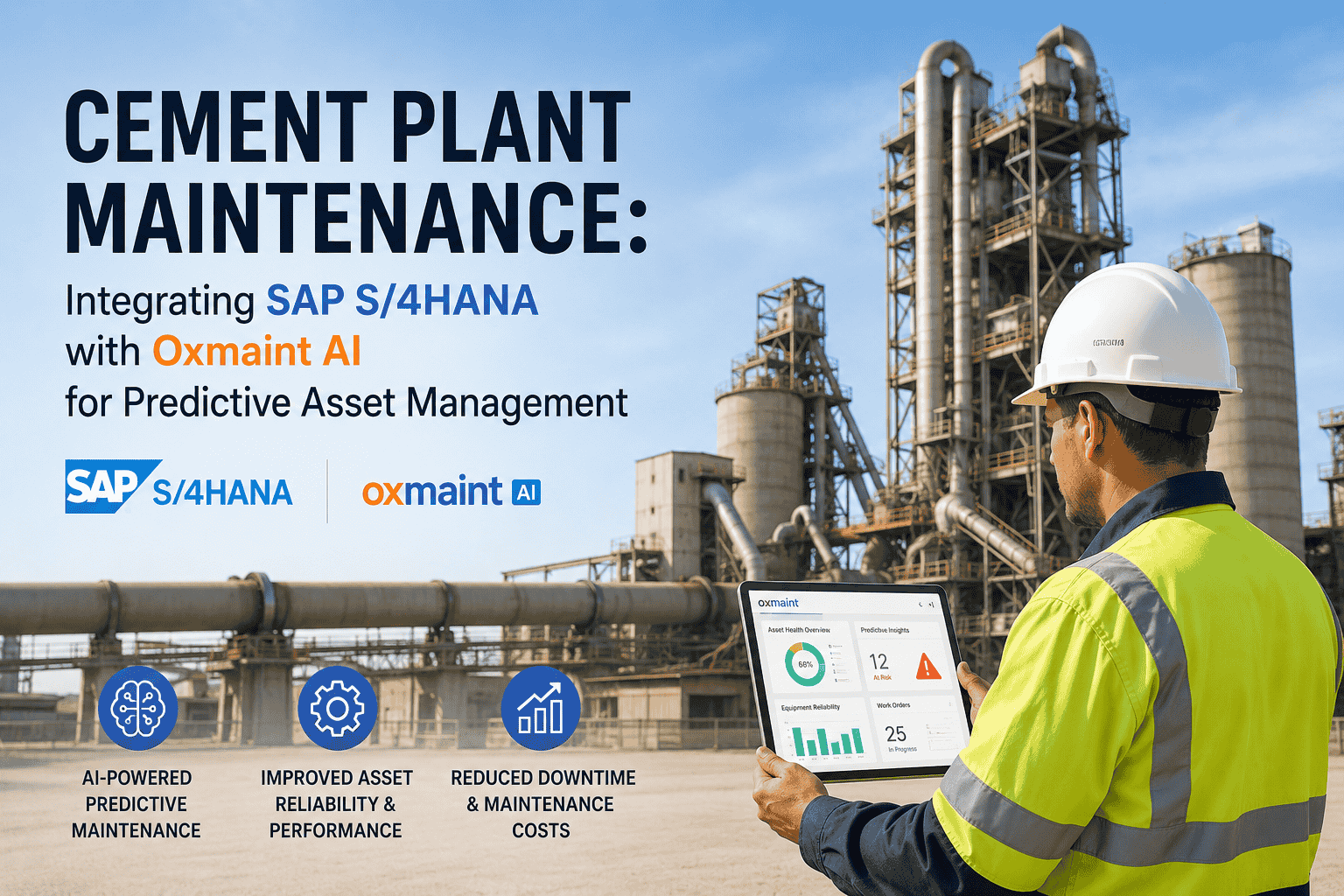
SAP Plant Maintenance for Cement Plants: CMMS Integration and Reliability Management
At 2:43 AM a rotary kiln bearing seizes, and within hours fourteen hours of clinker production are gone—over $280,000, plus thermal damage to the refractory lining. The cruel part? The bearing warned for weeks: vibration trended up, shell temperature widened—but nobody connected the data to a work order. That gap between what your plant senses and what your team acts on is exactly what SAP PM and CMMS integration closes. Book a free demo to see it on your kiln line.
The Real Cost of One Unplanned Kiln Stop
Why a single shutdown can exceed a plant's entire annual PM budget
$150K–$400K
Lost production per day of unplanned kiln downtime
5–10%
Of annual capacity lost to unplanned downtime industry-wide
68%
Of kiln shutdowns trace to missed PM on a schedule nobody checked
5–10x
Emergency repairs cost more than planned interventions
Sources: cement plant maintenance benchmarks (2025–2026), industry downtime studies
Why Cement Plants Are a Different Maintenance Problem
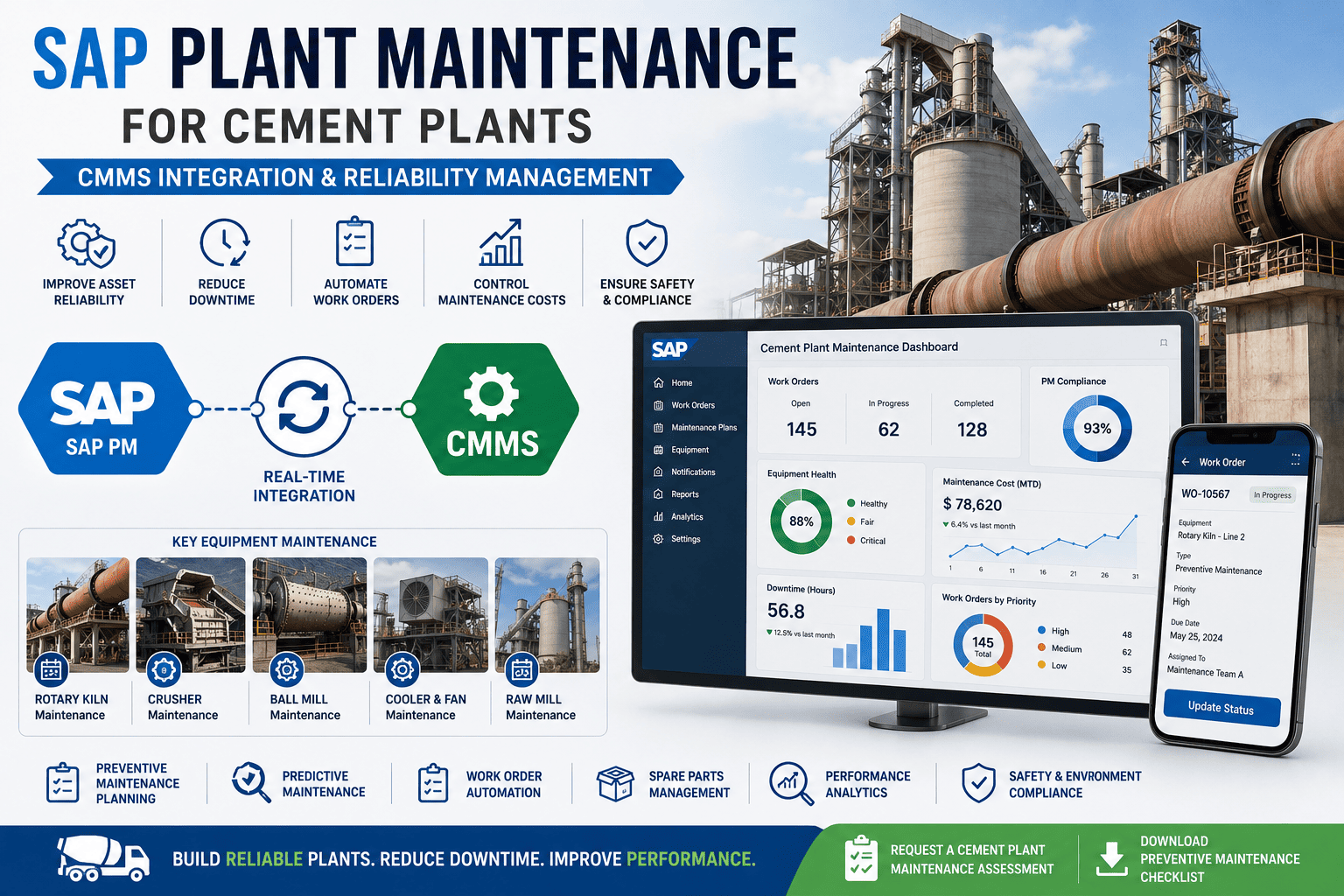
Cement manufacturing is one of the most mechanically intense industries on earth. Equipment wears with throughput, not with the calendar—so a kiln running at full feed ages faster than one in a cool month, and calendar-based PM misses it entirely. The assets are massive, the failure modes are thermal and rotational, and the cost of a wrong call is measured in hundreds of thousands per day. SAP PM is excellent at the enterprise layer—cost centers, procurement, asset accounting—but on its own it doesn't give planners the mobile work orders, condition-based triggers, or refractory-aware predictions the plant floor needs. The fix isn't choosing between them. It's connecting a purpose-built CMMS to SAP so each does what it does best.
Failure mode: belt tears, idler failure, cooler plate wear
Cascades into kiln & grinding stops
Usage-based PM beats calendar PM—cement equipment wears with tonnes, not days
How the SAP PM and CMMS Integration Works Together
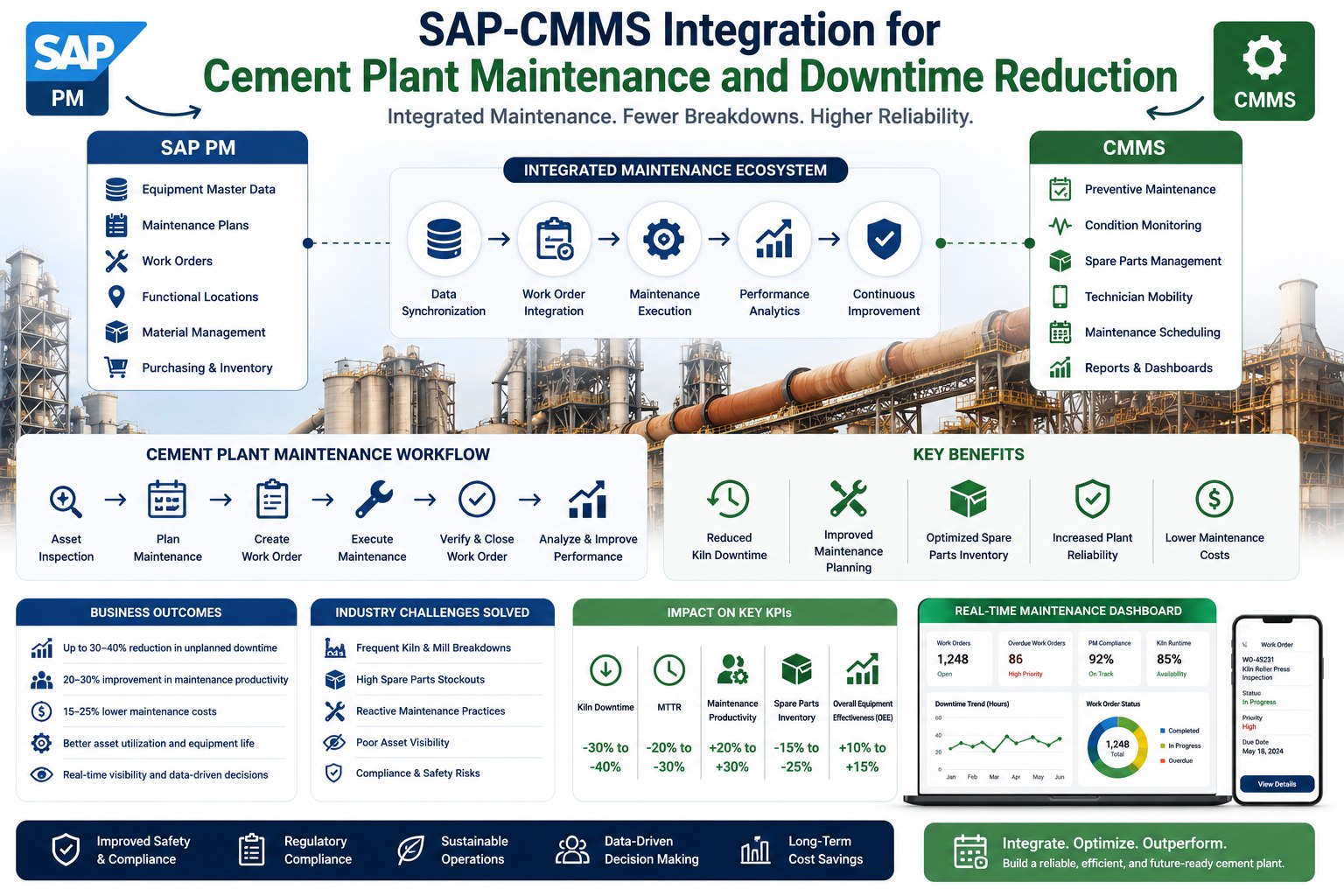
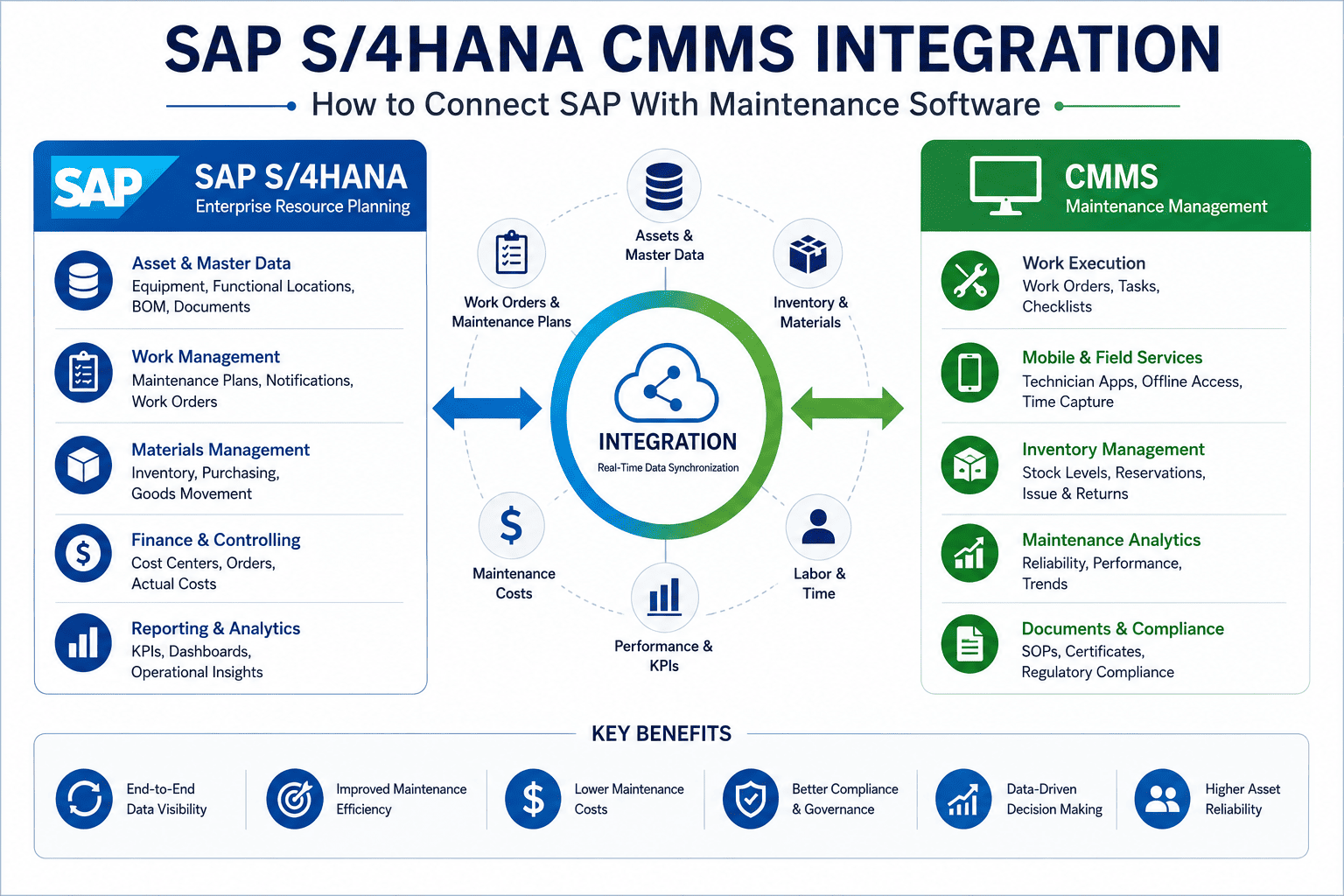
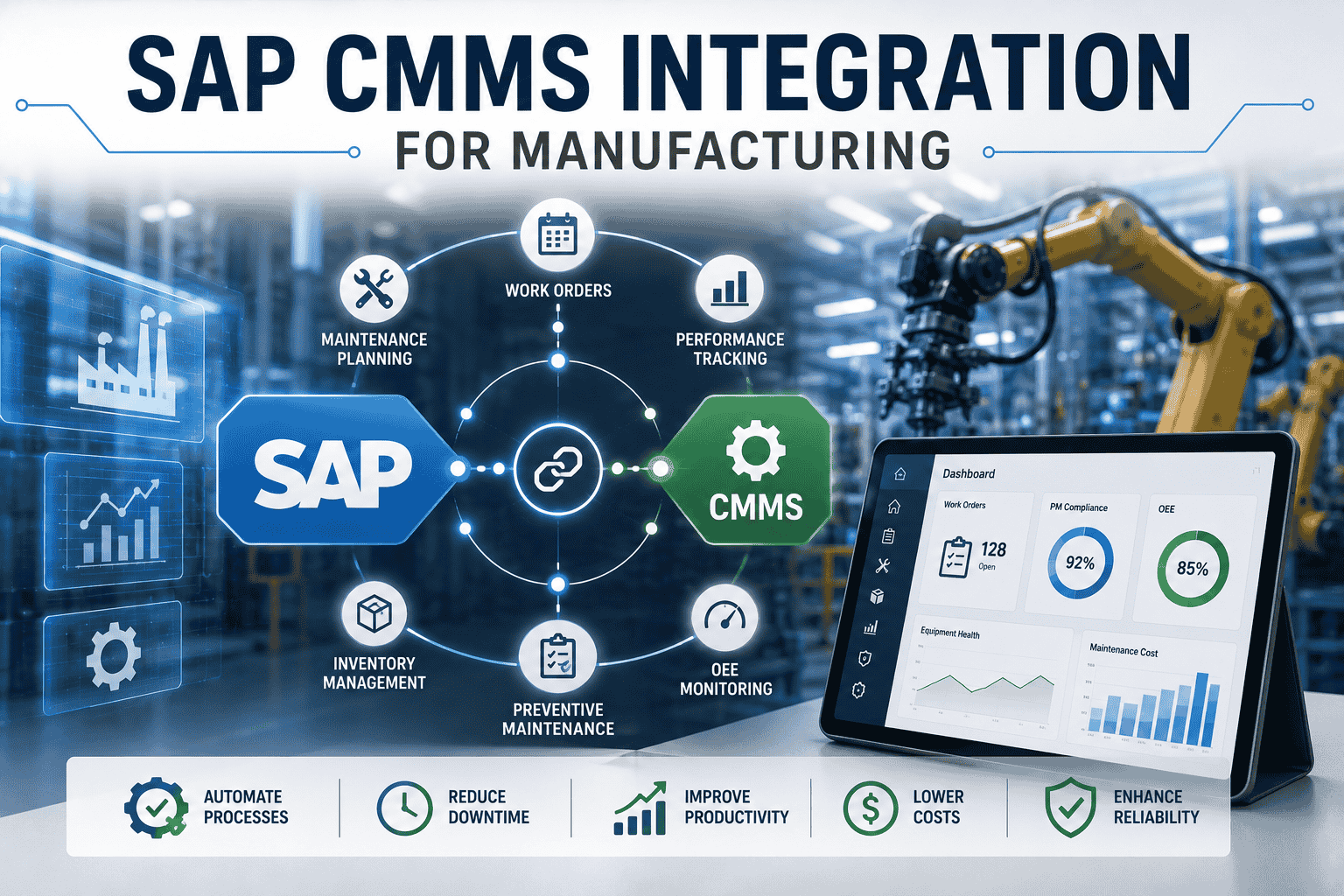
The integration is a bi-directional loop, not a one-way export. Asset hierarchy and parts data flow from SAP into the CMMS so planners work from accurate records. Condition data from the plant—vibration, shell temperature, motor current—feeds the CMMS through OPC-UA, MQTT, or REST connections to your DCS and historians. When a trend crosses a threshold, the CMMS generates a work order, then posts the labor and parts cost straight back into SAP. No double entry, no month-end reconciliation, no warning buried in a logbook.
Four Layers, One Connected System
From sensor signal to SAP cost posting
Layer 1
Sense
Vibration, shell temperature, current, and pressure data stream from kiln, mills, and crushers via DCS and process historians.
Layer 2
Predict
AI correlates the signals against failure history and refractory data—flagging hotspots and bearing failures days to weeks ahead.
Layer 3
Act (CMMS)
A mobile work order fires with the predicted failure mode, recommended parts, and lead time—assigned to the right technician automatically.
Layer 4
Reconcile (SAP)
Labor, parts, and procurement post back to SAP PM—cost centers and capital planning stay accurate in real time.
Standard SAP integrations configure in weeks, not months, and connect bi-directionally for work-order and procurement sync. Maintenance leaders ready to map this against their own SAP landscape can sign up free to model the integration before committing to a long implementation cycle.
From Warning to Work Order: The Refractory Story
Consider the kiln refractory lining—the single most expensive and dangerous failure point in the plant. Shell overheating from a thinning lining can force an emergency shutdown and a kiln restart that alone costs $200,000–$500,000 in fuel and thermal stress. An integrated system watches shell-temperature scanning data against refractory thickness and coating stability, predicting hot spots two to four weeks before they reach critical. That window is the entire difference between a planned, targeted brick replacement during a scheduled outage and a catastrophic 72-hour emergency.
Catching Failure in the Warning Window
Day 0
Shell temp differential begins widening—invisible to the shift
Day 8
AI flags a developing hotspot zone; CMMS opens an inspection work order
Day 14
Refractory thickness confirmed low; parts pre-staged via SAP procurement
Next Outage
Targeted brick replacement during planned downtime—zero emergency stop
See Your Kiln & Mill PM Configured Live
Watch how an integrated CMMS structures PM schedules for your specific kiln, mill, and crusher inventory—syncing predictions, work orders, and costs straight into SAP PM in a 30-minute walkthrough.
Moving from reactive firefighting to integrated, predictive maintenance isn't a soft benefit—it shows up on production tonnage and the maintenance budget. World-class cement plants plan over 85% of their work before the week starts; most plants still sit at 55–60% planned, meaning nearly half of all maintenance hours go to reactive work that costs four to six times more per event. The plants that close that gap see the difference in measured outcomes within the first year.
Documented Outcomes of CMMS-to-SAP Integration
52%
Reduction in unplanned kiln & mill downtime events
68%
Reduction in emergency repair costs within 18 months
89%
Reduction in critical spare-parts stockouts
$1.4M+
Avoided downtime costs reported in year one
A typical plant recovers its investment within 90–120 days—often from a single avoided shutdown
For a 1–3 MTPA plant with 50+ critical rotating assets, preventing even two unplanned events more than covers the annual platform cost. Plant managers evaluating the move can sign up free to run their own ROI against current downtime and emergency-repair spend.
Expert Perspective: What Separates Reliable Plants
The plants that stop losing money to downtime aren't the ones with the newest kilns—they're the ones where condition data finally reaches the work order. Every catastrophic failure I've investigated gave warning weeks in advance. The signal was always there. What was missing was a system that turned a vibration trend into a scheduled intervention before the bearing spalled. Integration is what converts data you already collect into reliability you can bank on.
Data Becomes Action
Sensor trends auto-generate work orders instead of dying in a logbook nobody reviews before the shift.
Outages Get Shorter
Pre-staged parts and sequenced tasks cut planned outage duration 15–25% by eliminating wait time.
Finance Stays Aligned
Costs post to SAP as work closes, so capital planning reflects real asset condition—not guesswork.
Getting Started Without a Two-Year Project
You don't need to boil the ocean. Start with your single most critical asset—almost always the kiln drive train—then add mills, crushers, coolers, and conveyors in monthly increments. Import the asset hierarchy, set criticality ratings, connect cost posting to SAP, and let early wins fund the next phase. Teams can sign up free to start with their most critical asset and expand from there. Plants that succeed treat integration as a staged rollout, not a big-bang go-live, reaching useful function in 60–90 days rather than waiting 12–18 months for perfect configuration.
The distance between what your plant already senses and what your team acts on is where reliability—and margin—leaks away. Closing that gap by connecting SAP PM to a purpose-built CMMS is one of the highest-return moves a cement operation can make, and every quarter of reactive firefighting makes the case stronger. Teams ready to see it working on real plant data can book a free demo for their specific asset mix.
Turn Sensor Data Into Reliability
Connect SAP PM cost truth with CMMS maintenance intelligence in one system. Predict kiln and mill failures, automate work orders, and protect every tonne of clinker production.
Do we need to replace SAP PM to add a cement plant CMMS?
No. The integration is designed to keep SAP PM doing what it does best—cost center accounting, procurement, and enterprise asset management—while a purpose-built CMMS handles the plant-floor layer: mobile work orders, condition-based triggers, refractory-aware predictions, and usage-based PM scheduling. The two connect bi-directionally so asset and parts data flow in and maintenance costs post back. You protect your SAP investment and add the cement-specific capabilities SAP PM wasn't built to deliver alone.
How long does SAP integration take, and is it disruptive?
Standard SAP integrations typically configure in two to four weeks, not months, and connect to your DCS and process historians through OPC-UA, MQTT, and REST API. The recommended approach is phased—start with the kiln drive train, then add mills, crushers, coolers, and conveyors in monthly increments. This keeps disruption minimal because you're proving value on one critical asset before expanding, and most plants reach useful function within 60 to 90 days.
Which cement plant assets deliver the most ROI from integration?
The rotary kiln is almost always first—its failure carries the highest cost, at $150,000 to $400,000 per day of lost production, and a single unplanned stop can exceed a plant's entire annual PM budget. Vertical roller and ball mills, crushers, conveyors, and clinker coolers follow. Because cement equipment wears with throughput rather than the calendar, usage-based PM on these rotating assets prevents the most downtime and energy waste per dollar invested.
How does the system handle noisy cement-plant sensor data?
Cement plants are among the noisiest industrial environments for data quality—vibration sensors drift, thermocouples fail, and network dropouts are common during kiln maintenance. A robust integration ingests your existing vibration, temperature, current, and pressure data and trains a plant-specific model on your own failure history, so it learns to distinguish genuine failure signatures from sensor noise and missing values rather than firing false alarms on every fluctuation.
What kind of payback should we expect?
Most cement plants recover their investment within 90 to 120 days, driven by avoided unplanned downtime alone—at roughly $20,000 or more per unplanned kiln hour, preventing two shutdown events more than covers annual platform cost. Documented outcomes within 18 months include a 52% reduction in unplanned downtime events, a 68% drop in emergency repair costs, and US plants reporting $1.4M or more in avoided downtime in year one.