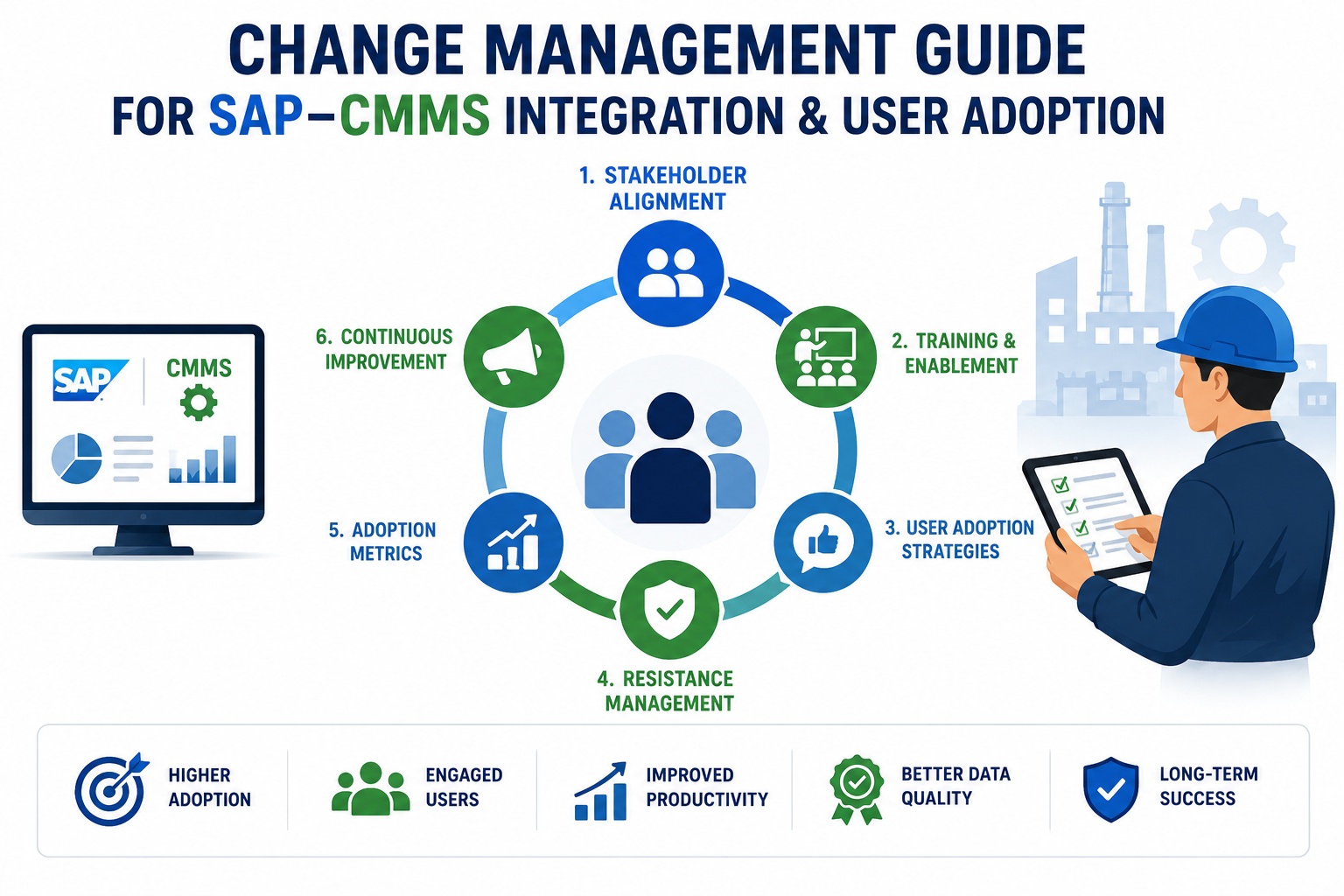
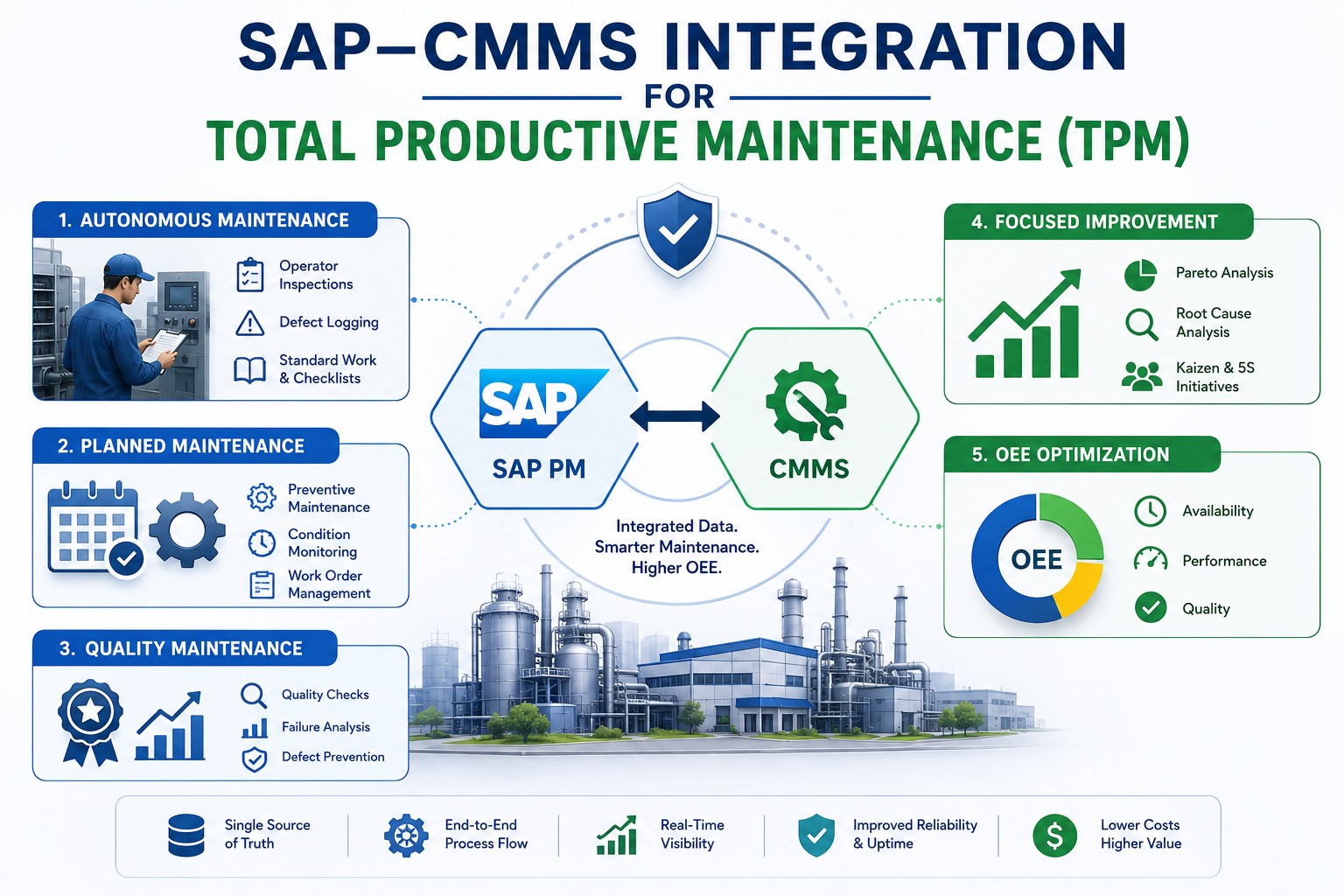
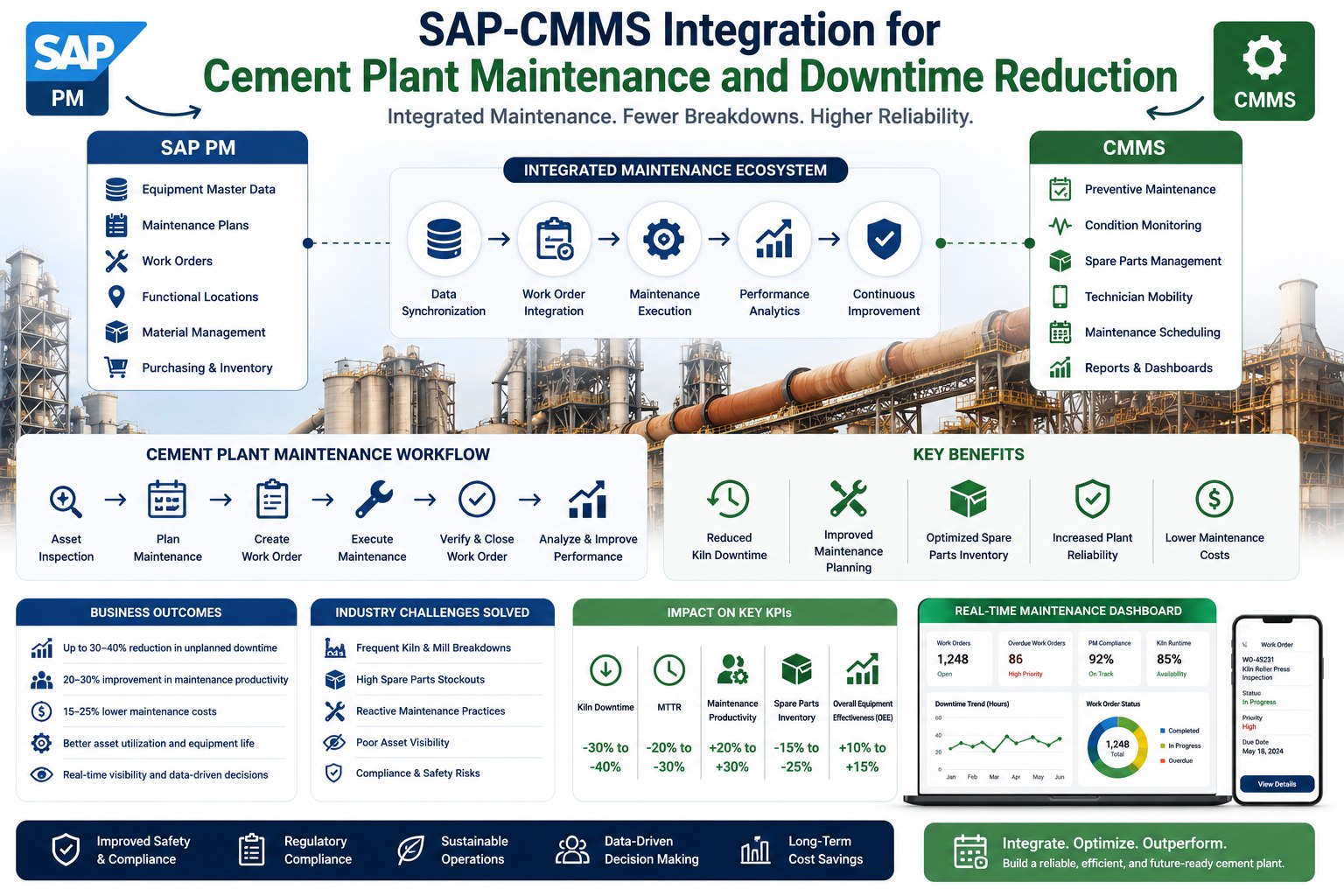
Change Management Guide for SAP–CMMS Integration & User Adoption
Your SAP-CMMS integration project has a 70% chance of disappointing someone in the next eighteen months. The technology will probably work. The data will likely flow. But somewhere between the go-live celebration and month twelve, technician usage will plateau below targets, planners will revert to spreadsheets, and someone will quietly ask whether the investment was worth it. The pattern is so common it's predictable—and entirely preventable when change management gets the same attention as system configuration. Book a free demo to see how adoption-focused implementations consistently outperform technology-first deployments.
The Six-Phase User Adoption Journey
How user sentiment and productivity move across an SAP-CMMS rollout
Why Most SAP-CMMS Integrations Fail on Adoption, Not Technology
Prosci's 2025 Best Practices in Change Management study found that projects with excellent change management are six times more likely to meet objectives than those with poor change management. For SAP-CMMS integrations specifically, the failure pattern is consistent: the system goes live on time, technical KPIs look healthy for the first 60 days, then technician engagement quietly slides. By month six, shadow spreadsheets reappear. By month twelve, the integration is considered "underperforming"—not because it doesn't work, but because people stopped using it as designed.
70%
of enterprise change initiatives fail to meet adoption targets within 18 months
6x
higher success rate when change management is funded from project start
$1.4M
average cost of low adoption per 100-user CMMS deployment over 3 years
The data tells a clear story: integration projects that allocate 15-20% of total budget to change management consistently outperform those that treat it as an afterthought. Sign up free to access adoption planning templates built from successful manufacturing implementations.
Stakeholder Alignment: Mapping Your Influencers and Resistors
Before designing training programs or rollout plans, map your stakeholder landscape. Not all stakeholders deserve equal attention—the matrix below positions every relevant person by their level of influence over peers and their current support for the change. Where someone lands determines how you engage them in the first 30 days of the program.
Stakeholder Engagement Matrix
Influence over peers (vertical) vs. current support for change (horizontal)
Influence ↑
Critical Resistors
High influence, low support—senior technicians, veteran planners
Engage urgently in design decisions
Champions
High influence, high support—reliability engineers, ops directors
Low influence, high support—early adopters, tech-curious staff
Equip with knowledge, grow their influence
Support →
Building a Technician Training Program That Actually Sticks
The most expensive training mistake is treating every user the same. Executives need 30 minutes of vision and KPI literacy. Planners need workflow design and exception handling. Technicians need mobile-first muscle memory built through repetition. Compress these into a single training session and adoption collapses. The pyramid below shows how high-adoption operations distribute training investment across organizational tiers.
12-20 hours over 4 weeksWorkflow design, exception handling, dashboard mastery
Technicians & Operators
20-40 hours of micro-sessionsMobile workflows, daily task patterns, shadow learning
See Adoption-First Implementation in Action
Watch how a mobile-first CMMS designed for technician adoption reduces training time by 60% while keeping data quality high. Live walkthrough with real workflows in 30 minutes.
Communication Cadence: Sustaining Engagement Through Rollout
Change communication isn't a one-time launch announcement—it's a sustained rhythm of audience-specific messaging that runs from project kickoff through month twelve post go-live. Effective programs maintain four distinct communication tracks simultaneously, each tuned to what that audience genuinely needs to hear. Executive updates focus on KPI progress and risk indicators. Manager briefings cover workflow changes and team-level metrics. Technician communications emphasize what's changing for them next week, with concrete examples. Feedback channels stay open continuously so concerns surface before they become resistance. Programs that compress all four tracks into a single monthly email consistently underperform—different audiences need different cadences, different formats, and different levels of detail to stay engaged.
Managing Resistance: The Three Archetypes You'll Encounter
Resistance isn't a single phenomenon—it shows up in three distinct patterns, each requiring different engagement. Recognizing which archetype you're talking to is half the work. The other half is responding with the right approach rather than the generic "training will solve it" response that fails for two of the three types.
A
The Veteran Skeptic
"We tried something like this in 2018. It didn't work then either."
Underneath
Has watched previous implementations fail and is protecting the team from another disappointment cycle
Engagement strategy
Share concrete success metrics from peer facilities. Acknowledge past failures explicitly. Involve them in design decisions.
B
The Optimized Operator
"My current spreadsheet workflow is already efficient. Why change it?"
Underneath
Has invested significant personal time building current workflow and fears losing personal productivity gains
Engagement strategy
Co-design future workflow with them. Position them as a power user. Map current efficiencies into new system explicitly.
C
The Pressed Worker
"I don't have time to learn new software on top of my workload."
Underneath
Genuinely overloaded and viewing training as additional burden rather than long-term time savings
Engagement strategy
Mobile-first micro-training in 15-minute sessions. Show immediate time savings on their specific tasks first.
Most implementation teams over-invest in mass training and under-invest in archetype-specific conversations. Sign up free to model resistance scenarios against your stakeholder map before go-live.
Adoption Metrics That Predict Long-Term Success
Login frequency tells you almost nothing useful. The metrics below predict whether your integration will still be delivering value at month eighteen. Track them weekly during the first six months, monthly thereafter, and tie them to named accountability—not just dashboards that nobody reviews.
Adoption Health Metrics & Healthy Thresholds
Metric
Healthy
Warning
Critical
Mobile Work Order Completion
> 85%
65-85%
< 65%
Data Quality Score
> 92%
80-92%
< 80%
Shadow Process Incidents
0-2/month
3-8/month
> 8/month
User-Initiated Workflows
> 70%
40-70%
< 40%
Champion Network Activity
Weekly
Monthly
None
Time-to-Completion Trend
Improving
Flat
Worsening
Each metric reflects a different dimension of adoption health, and weak performance on any single one signals a specific intervention. Sign up free to configure these adoption metrics as a live scorecard inside your CMMS.
Expert Perspective: Lessons From High-Adoption Implementations
The single biggest predictor of SAP-CMMS adoption isn't training quality or system design—it's whether technicians believe leadership actually cares about their input. Implementations where the plant manager sits through the same mobile training as the maintenance crew see adoption rates 40-50% higher than implementations where executives delegate the entire change effort. Visible accountability beats elaborate communication plans every time. People watch what leaders do, not what they say in launch emails.
Executive Presence Beats Communications
Leaders who attend training, visit the floor during rollout, and respond to feedback personally drive dramatically higher adoption than those running it through emails.
Quick Wins Compound
Deliver one tangible improvement in the first 30 days—a process that saves 20 minutes, a report that took hours to build—and let users tell each other about it.
Sustain Beyond Go-Live
Adoption work doesn't end at go-live—month four through nine is where most implementations quietly fail. Maintain weekly check-ins through month twelve.
Teams ready to design adoption-first implementations can request a working session with our change management specialists. Book a free demo to map your adoption strategy against successful peer implementations.
Build Adoption Into Your Implementation From Day One
Most CMMS platforms ignore the human side of integration. Oxmaint is designed for adoption first—mobile-native, technician-friendly, and proven across hundreds of manufacturing facilities.
How much of an SAP-CMMS integration budget should go to change management?
Prosci and McKinsey both recommend 15-20% of total project budget for change management activities on enterprise software implementations. For SAP-CMMS specifically, with high technician-user counts and significant workflow disruption, the upper end of that range is more reliable. Underinvesting below 10% correlates strongly with adoption failures at month nine to twelve. The investment includes communications, training development, champion programs, dedicated change resources, and post-go-live sustainment activities.
When should change management activities actually start?
Change management should begin during business case development—at least 60 days before vendor selection. Stakeholder mapping, executive alignment, and current-state workflow analysis all happen pre-contract. Starting change management at project kickoff is already late. Starting at go-live is essentially crisis management. The earliest cost is also the lowest cost: addressing concerns during planning is far cheaper than rebuilding trust after go-live missteps.
How do you handle a critical resistor who refuses to engage?
First, verify it's actually resistance and not legitimate concern—critical resistors often have valid technical or operational objections that get dismissed. Second, involve them in design decisions where their expertise matters; resistors often become champions when they own part of the solution. Third, if engagement attempts genuinely fail, escalate clearly: a high-influence resistor who won't engage will silently sabotage adoption, and leadership must address that directly rather than working around it.
What's the most common adoption mistake at the six-month mark?
Declaring victory too early. By month six, technical KPIs typically look good, the project team is being reassigned, and executive attention is shifting elsewhere. This is exactly when shadow processes start reemerging—the original technicians revert to spreadsheets for "just this one thing," exceptions accumulate, and adoption metrics quietly degrade. Sustaining change management investment through month twelve is the difference between durable adoption and slow-motion failure.
Can you measure ROI on change management investment specifically?
Yes, though it requires deliberate measurement design. Compare adoption rates, time-to-proficiency, productivity recovery curves, and shadow-process incident counts against industry benchmarks or prior implementations. Prosci data shows projects with excellent change management deliver 143% of expected ROI versus 35% for poor change management—a measurable 4x difference. Documenting these gaps quantitatively also makes the business case for change management funding on future programs significantly easier.