SAP–CMMS Integration for Total Productive Maintenance (TPM)
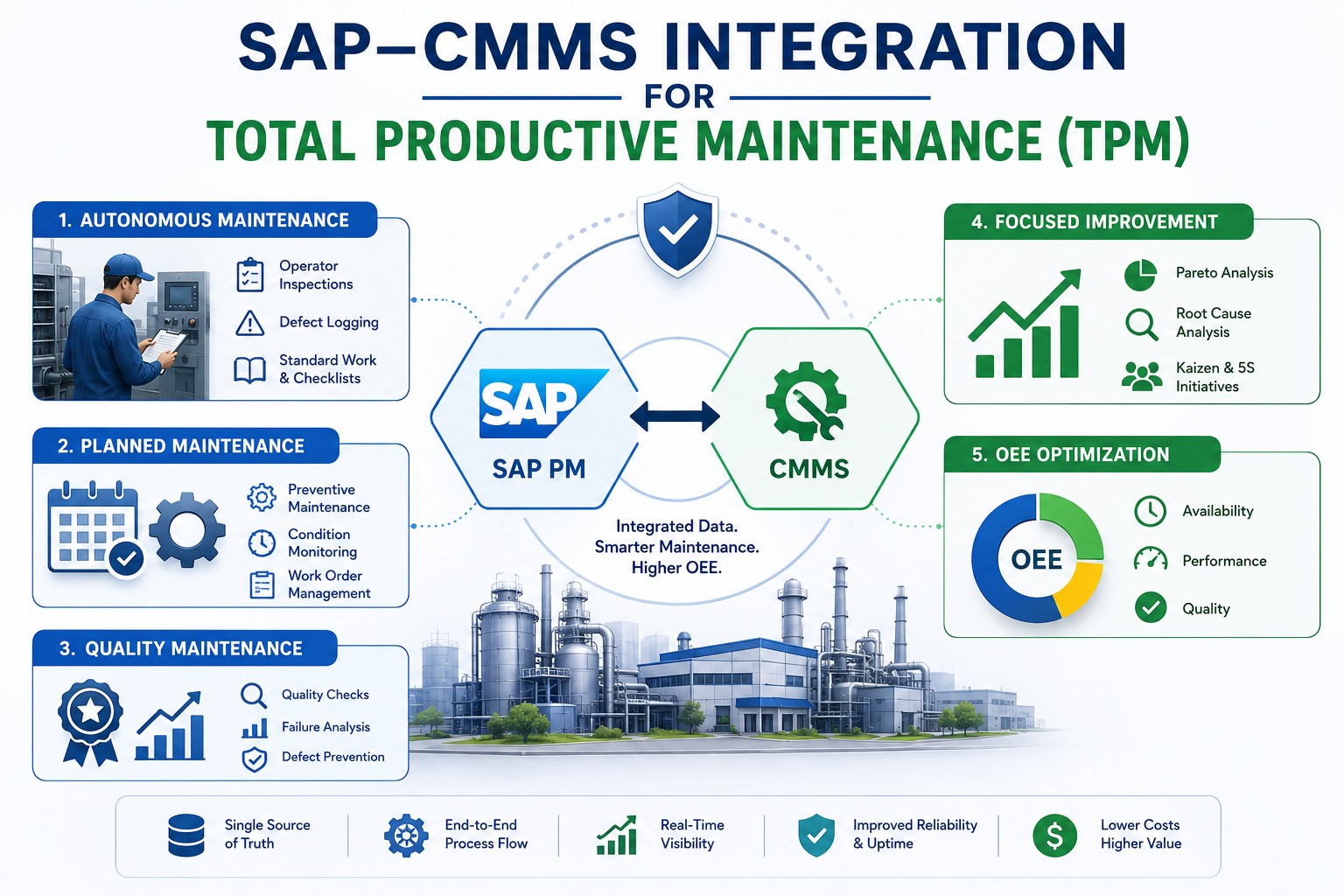
Every plant talks about TPM. Few plants actually do TPM. The gap between TPM aspiration and TPM execution is rarely about philosophy or buy-in—it's about infrastructure. The eight TPM pillars demand systematic execution discipline: operators capturing inspection findings, maintenance triggering planned work, engineers tracking failure modes, leadership reviewing OEE trends. Without integration tying all this together, TPM becomes the breakroom wall poster. With it, TPM becomes how the plant runs. This guide maps how SAP-CMMS integration enables each pillar in practice. Book a free demo to see TPM integration.
TPM EXECUTION REALITY
TPM Pillars Work Only When Integration Carries Them
8
TPM Pillars + 5S Foundation
85%+
World-Class OEE Target
6
Big Losses TPM Eliminates
JIPM
Japan Institute of Plant Maintenance
Why TPM Requires SAP-CMMS Integration to Scale Beyond Theory
TPM (Total Productive Maintenance) emerged in 1971 from Nippondenso, codified by JIPM, and now powers reliability programs at world-class plants from Toyota to Coca-Cola to ArcelorMittal. The methodology works—but only at plants where execution discipline matches philosophical buy-in. The plants that struggle aren't lacking conviction; they're lacking the systems that make the discipline sustainable. Operators willing to perform autonomous maintenance can't sustain it if they have no way to capture findings. Maintenance teams committed to planned maintenance can't execute it if work orders aren't scheduled to equipment usage. Engineers tracking the 6 Big Losses can't act on data they have to manually compile.
SAP-CMMS integration provides the infrastructure each TPM pillar requires. Mobile inspection capture for autonomous maintenance. Counter-driven scheduling for planned maintenance. Loss tracking for focused improvement. Quality linkage for quality maintenance. Without integration, every pillar requires manual administration that doesn't scale. With integration, the pillars become self-sustaining operational disciplines. Reliability leaders ready to assess their TPM readiness can Sign up free to assess your TPM readiness.
The 8 TPM Pillars Mapped to SAP-CMMS Integration
The framework below covers the eight TPM pillars defined by JIPM. Each row shows which OEE component the pillar primarily affects, the functional focus area, and the three-part structure (pillar purpose, typical activities, integration role). Quality Maintenance anchors as the gold pillar because it's typically the hardest to operationalize—linking equipment condition to product quality requires the deepest integration discipline.
8 PILLARS · OEE COMPONENT · FOCUS AREA · INTEGRATION
Permit-to-work workflows; safety incident tracking; SHE evidence capture for audits
08
Office TPM (Administrative)
SUPPORT
ADMIN
PILLAR PURPOSE
Apply TPM principles to administrative processes: procurement, planning, scheduling efficiency
TYPICAL ACTIVITIES
Process mapping; workflow optimization; eliminating administrative waste; supplier scorecards
INTEGRATION ROLE
End-to-end process visibility; administrative KPI tracking; automated approval workflows
3Core Operational
2Quality & Lifecycle
3Foundation & Support
04Quality Maintenance Anchor
The OEE component badges reveal the strategic story: pillars 1-2 drive Availability, pillar 4 drives Quality, pillar 3 attacks all components. Without integration linking these pillars, each operates in isolation and the OEE ceiling stays around 65%. With integration, world-class 85%+ becomes achievable. Reliability leaders ready to map their pillar gaps can Sign up free to map your pillar maturity gaps.
SEE IT IN PRACTICE
Walk Through TPM Integration Live
30-minute walkthrough showing how integration enables each TPM pillar—autonomous maintenance capture, planned maintenance scheduling, loss tracking, quality correlation—running in real plant workflow.
OEE (Overall Equipment Effectiveness) is the north-star metric TPM optimizes. The formula multiplies three components: Availability × Performance × Quality. World-class plants achieve 85%+ OEE; typical plants operate at 60-65%. The gap is driven by 6 Big Losses TPM systematically eliminates.
Availability
Uptime ÷ Planned production time. Affected by breakdowns and setup/adjustment losses. Pillars 1-2.
Performance
Actual rate ÷ Ideal rate. Affected by minor stops and reduced speed losses. Pillar 3 focused improvement.
Quality
Good units ÷ Total units. Affected by defects and startup losses. Pillar 4 quality maintenance.
OEE Result
A × P × Q. World-class threshold is 85%+. Typical plants operate at 60-65% with significant room for improvement.
The 6 Big Losses map precisely to OEE components: Breakdowns (Availability), Setup/Adjustments (Availability), Minor Stops (Performance), Reduced Speed (Performance), Defects (Quality), Startup Losses (Quality). Reliability leaders ready to attack the 6 Big Losses can Sign up free to attack the 6 Big Losses.
Common TPM Implementation Mistakes That Stall Progress
TPM implementation failures share predictable patterns. Launching all 8 pillars simultaneously and producing chaos across all of them instead of progress on any. Treating TPM as a maintenance department initiative rather than a plant-wide system, which alienates operators who should be central. Compressing the timeline to 6-12 months and abandoning the program when fatigue sets in before maturity. Tracking OEE without tracking the contributing pillar metrics that explain OEE movement, leaving leadership unable to act on trend data. Skipping the 5S foundation and trying to build autonomous maintenance on cluttered, unstable workplaces. Each mistake sounds preventable in retrospect; each one explains why most TPM programs deliver partial results despite full investment. The discipline that prevents these failures is patient, sequenced execution with infrastructure that sustains effort across years rather than depending on heroic individual commitment.
ROI of TPM-Aligned Integration
TPM-aligned integration ROI shows up in metrics that matter to plant managers and reliability leaders: OEE improvement, operator engagement, planned-vs-reactive ratio, MTBF improvement, and continuous improvement velocity.
PRE-TPM vs INTEGRATED TPM
Plant Performance Delta
Overall Equipment Effectiveness
60-65%
85%+
+22 pts
Operator-Detected Issues
0%
30-40%
+40 pts
Planned vs Reactive Ratio
30/70
80/20
+50 pts
Mean Time Between Failures
Baseline
2-3x
+150%
Continuous Improvement Velocity
Slow
Fast
+55 pts
85%+
World-class OEE achievable with integrated TPM discipline
80/20
Planned vs reactive maintenance ratio (inverted from baseline)
The compounding effect: better pillar 1 execution catches more issues early; pillar 2 efficiency improves; pillar 3 has cleaner data to analyze. Each pillar amplifies the others when integration carries them. Plant leaders ready to model TPM ROI can Book a free demo to model TPM ROI scenarios.
Expert Perspective on TPM Implementation
"
The TPM implementations I've watched succeed share a property that initially feels unrelated to TPM philosophy: they treated the program as a 3-5 year transformation, not a 6-month project. JIPM's research shows the typical path: 12-18 months establishing Pillar 1 (autonomous maintenance), 18-24 months reaching Pillar 4 (quality maintenance), 36+ months reaching all 8 pillars at meaningful maturity. The plants that try to compress this timeline experience the same pattern: initial enthusiasm, mid-program fatigue, late-program abandonment, then quiet acknowledgment that TPM "didn't work here." TPM works at every plant that runs it as a sustained discipline. TPM fails at every plant that runs it as a temporary initiative. The infrastructure decision—whether integration carries the discipline or whether people carry it manually—determines whether the plant can sustain the multi-year commitment that TPM actually requires.
01
Multi-Year Transformation
TPM is a 3-5 year sustained discipline, not a 6-month initiative. Plan and resource accordingly.
02
Sequence Pillars Strategically
Pillar 1 (Autonomous) builds the foundation. Pillar 2 (Planned) amplifies it. Pillar 4 (Quality) emerges from both.
03
Integration Carries Discipline
Manual TPM doesn't scale beyond pilot. Integration makes pillar discipline sustainable across years.
90-Day TPM Integration Foundation Roadmap
The 90-day program below establishes the integration foundation that makes multi-year TPM sustainable—maturity assessment, foundation pillar build, loss elimination, and KPI dashboards.
90-DAY TPM FOUNDATION
From TPM Assessment to Operational Foundation
DAYS 1–25
01
TPM Maturity Assessment
Assess current state across all 8 pillars. Identify foundation gaps. Baseline OEE per asset. Define multi-year vision.
DAYS 26–50
02
Pillar Foundation Build
Configure Pillar 1 (Autonomous) mobile workflows. Configure Pillar 2 (Planned) scheduling. Train operators and technicians.
DAYS 51–75
03
Loss Elimination Workflows
Configure 6 Big Loss tracking. Pillar 3 Kaizen project tracking. OEE component dashboards live for daily review.
DAYS 76–90
04
KPI Dashboards & Sustainment
Real-time TPM KPI dashboards across all pillars. Weekly review cadence. Continuous improvement targets set.
MULTI-YEAR DISCIPLINE
Make Your TPM Program Sustainable for the Long Haul
Eight pillars enabled. Foundation built. Loss elimination active. The TPM integration that makes 85%+ OEE achievable and the discipline sustainable across the multi-year journey.
TPM is a multi-year transformation, not a short-term project. JIPM benchmarks: 12-18 months to establish Pillar 1 (Autonomous Maintenance) meaningfully, 18-24 months to reach Pillar 4 (Quality Maintenance), 36+ months to mature across all 8 pillars. The TPM Award levels reflect this timeline: Award for TPM Excellence (3+ years), Award for Excellence in Consistent TPM Commitment (5+ years), Special Award for TPM Achievement (8+ years). Plants attempting compressed timelines (6-12 month programs) typically experience initial gains followed by regression as the discipline isn't yet sustainable. Plan TPM as a 5-year strategic transformation with the first 6 months focused on infrastructure and pilot success.
What's the difference between TPM and standard preventive maintenance?
Standard PM is a maintenance team activity: technicians follow schedules, perform tasks, document completion. TPM is a plant-wide system involving operators, maintenance, engineering, and management together across 8 pillars. Operators perform autonomous maintenance on equipment they run. Maintenance focuses on tasks operators can't do. Engineering eliminates failure modes through equipment improvements. Management protects time and budget for TPM execution. The metrics also differ: standard PM measures schedule compliance; TPM measures OEE and the 6 Big Losses. The systemic, cross-functional view is what produces TPM's distinctive results—standard PM optimizes maintenance department efficiency; TPM optimizes plant-wide effectiveness.
How do we measure TPM success?
Primary TPM KPI is OEE (Overall Equipment Effectiveness) with world-class threshold of 85%+ and component breakdown into Availability, Performance, Quality. Secondary KPIs vary by pillar: Pillar 1 tracks operator engagement, OPL count, autonomous step progression; Pillar 2 tracks PM compliance, MTBF, MTTR; Pillar 3 tracks Kaizen project count and loss reduction; Pillar 4 tracks FTQ (First-Time Quality) and defect-to-equipment correlations. Tertiary KPIs include skill matrix completeness (Pillar 6), safety incident rate (Pillar 7), and administrative cycle times (Pillar 8). Strong TPM programs track all three layers; weak programs track only OEE without the contributing pillar metrics that explain OEE movement.
Which pillar should we start with?
Start with Pillar 1 (Autonomous Maintenance) and Pillar 2 (Planned Maintenance) in parallel. Pillar 1 builds the foundation: operators take ownership of equipment, capture findings, and surface issues early. Pillar 2 ensures the maintenance team responds systematically to those findings with planned work rather than reactive scrambles. These two pillars together generate the data that other pillars (3-Focused Improvement, 4-Quality Maintenance) need to function. Starting with Pillar 4 before Pillars 1-2 are operational typically fails because there's no foundation of clean equipment condition data to correlate with quality. Sequence matters: Foundation first (1-2), then improvement loops (3), then quality linkage (4), then lifecycle and support (5-8).
How does TPM relate to lean manufacturing?
TPM and lean manufacturing share philosophical roots in Toyota Production System (TPS) and are highly complementary. TPM focuses on equipment reliability and OEE optimization; lean focuses on waste elimination and flow optimization. Both use PDCA cycles, Kaizen events, A3 problem solving, and visual management. Both emphasize operator engagement and continuous improvement. The integration shows up in shared infrastructure: value stream maps from lean inform TPM focus areas; OEE data from TPM informs lean improvement projects. Many world-class plants run both programs simultaneously under different names with shared resources. Where they differ: lean attacks 7-8 wastes (muda); TPM attacks the 6 Big Losses. The mental models are different but the disciplines are compatible.