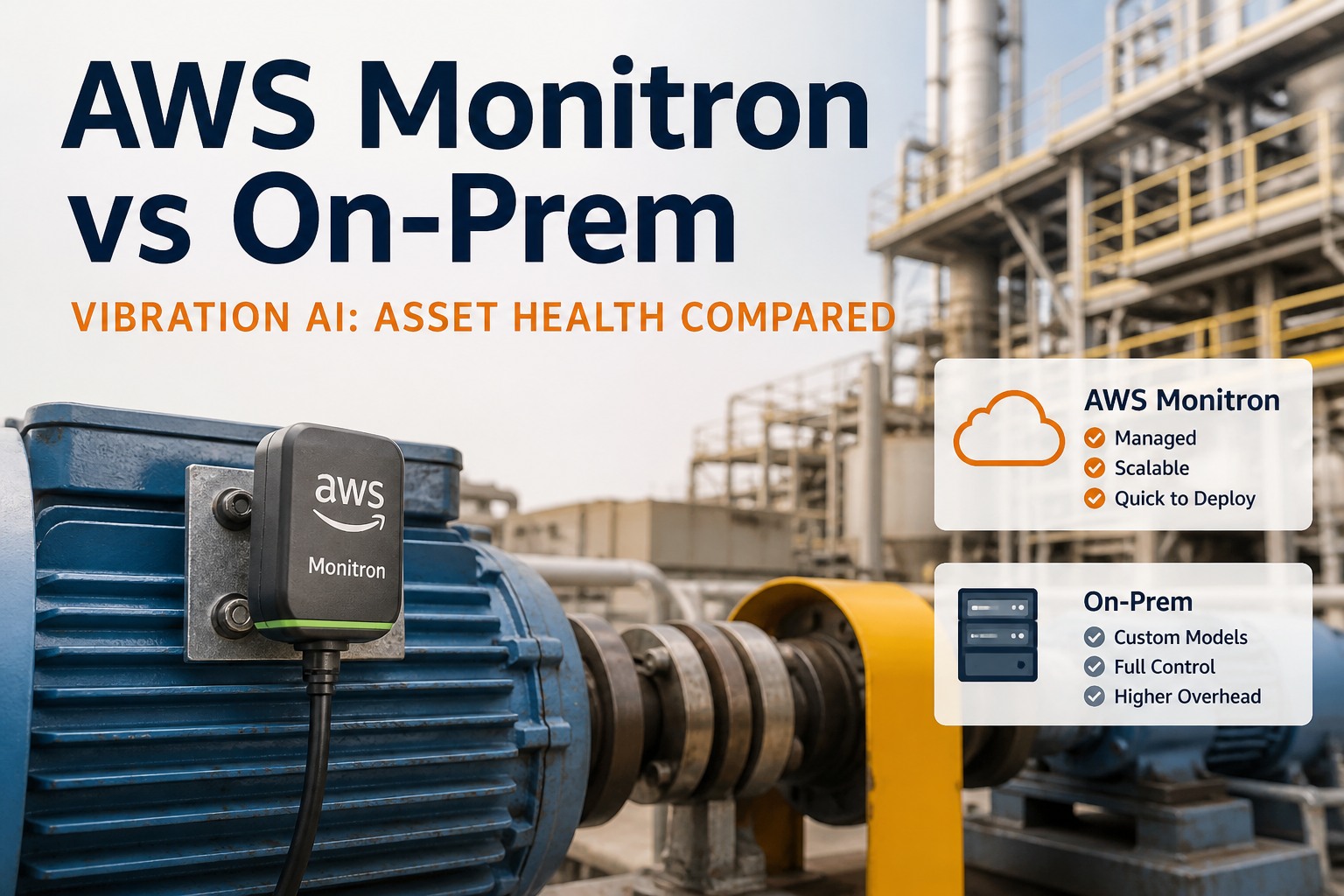
AWS Monitron vs On-Prem Vibration AI: Asset Health Compared
By Riley Quinn on May 1, 2026
Your pump has been vibrating at 4.2 mm/s for the last six weeks. A bearing failure is forming. In 30 days, it will cost you $40,000 in emergency repairs and two days of line shutdown. You just don't know it yet — because your maintenance team is still relying on monthly manual checks and gut feel. That's the problem vibration AI was built to solve. The question isn't whether to adopt it. The question is which architecture fits your plant: AWS Monitron's managed cloud approach — or a custom on-premises vibration AI model running at the edge? See how OxMaint turns vibration data into zero-downtime operations — start free.
MAY 12, 2026 5:30 pm est, orlando
Upcoming Oxmaint AI Live Webinar — Map Your AWS vs On-Prem Vibration AI Path Live
Join the OxMaint team at SAP Sapphire Orlando to model your exact vibration AI architecture — AWS Monitron alternatives, on-prem edge AI, or hybrid routed by asset type. Walk in with your sensor inventory; walk out with a costed, defensible plan.
Important Update: Amazon Monitron closed to new customers as of October 31, 2024. Existing customers retain access and device warranties through 2029. This comparison still matters — understanding its architecture helps you choose the right successor or alternative.
What Is AWS Monitron — And What Changed?
AWS Monitron launched in 2020 as Amazon's answer to the complexity of industrial predictive maintenance. The pitch was compelling: wireless sensors, a gateway, automatic ML, and a mobile app — no data scientists required. GE Gas Power was an early customer, using it to retrofit vibration monitoring across tumblers and motors without building custom IT/OT network infrastructure. Then, on October 1, 2024, AWS announced it would close Monitron to new customers. No new features. Devices sold only until July 2025. What remains is a clear signal: even AWS couldn't make the "pure cloud, managed ML" model scale commercially for the full diversity of industrial environments.
How AWS Monitron Actually Works
End-to-end architecture — sensor to alert
Wireless Sensor
3-axis MEMS
±16g, up to 6kHz
BLE 5 · IP69 · 5yr battery
Bluetooth LE
Bluetooth LE
Gateway
WiFi / Ethernet
Up to 20 sensors
30m BLE range
HTTPS to AWS
HTTPS to AWS
AWS ML Engine
ISO 20816 standards
Anomaly detection
Self-improving model
Push notification
Push notification
Mobile / Web App
Alerts · Dashboards
Feedback loop
No ML skills needed
Data capture: once per hour (default) · Manual on-demand via NFC tap · No third-party sensors supported
The Core Trade-Off: Plug-and-Play vs. Precision Control
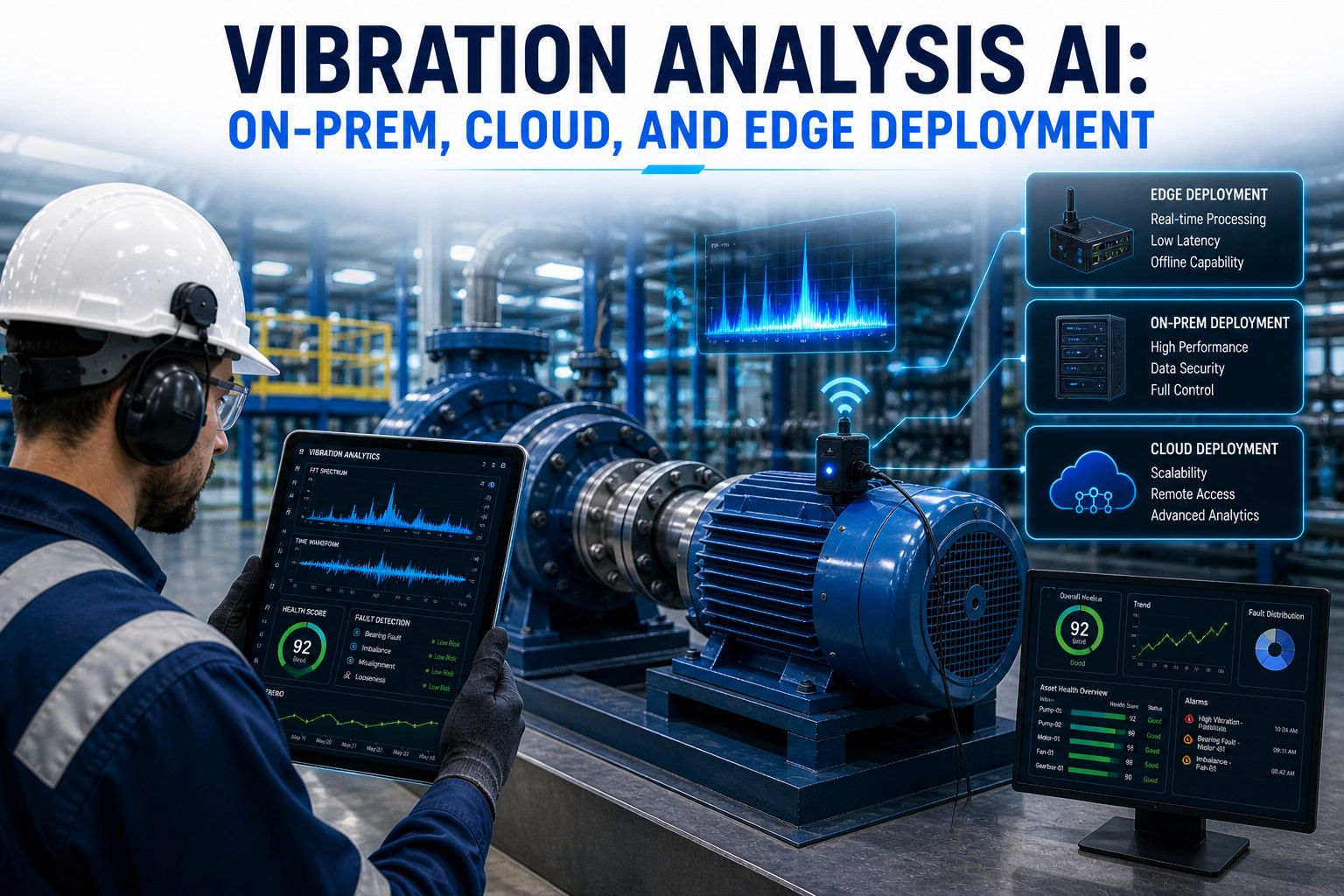
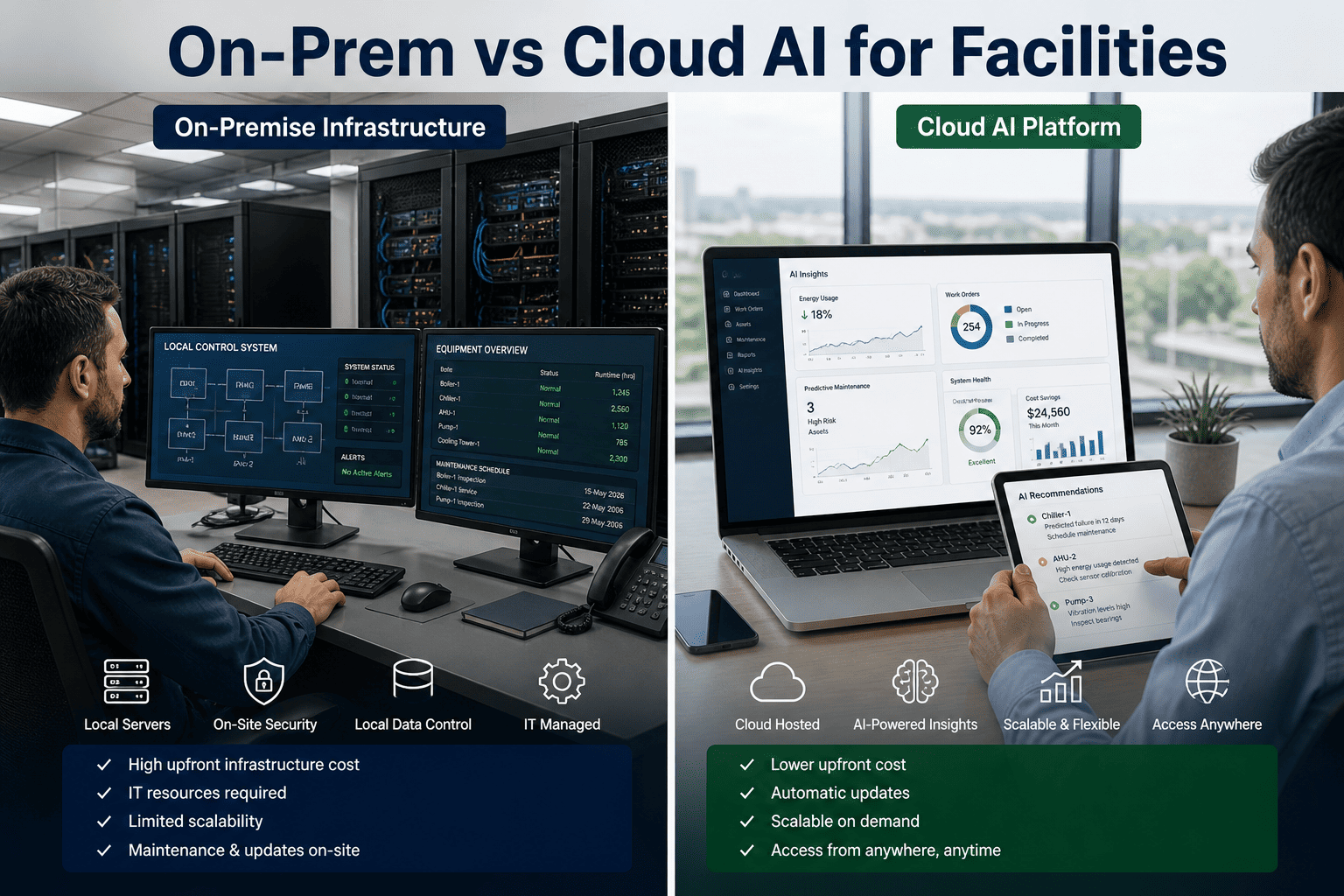
The debate between Monitron-style managed cloud and on-premises vibration AI isn't about which technology is better. It's about which constraints your plant actually has. A mid-size food manufacturer with 40 motors, limited IT staff, and no data science team gets enormous value from a managed cloud approach. A heavy-process refinery running 600 RPM slow-speed gearboxes on a restricted OT network needs something fundamentally different. Not sure which model fits your facility? Try OxMaint's condition monitoring free.
AWS Monitron vs On-Prem Vibration AI
Side-by-side on the dimensions that matter most to plant engineers
Dimension
AWS Monitron (Cloud)
On-Prem Vibration AI
Setup Time
Minutes — sensor sticks on, app connects
Weeks to months — hardware, model training, integration
ML Expertise Required
None — fully managed, no code
Data scientists or reliability engineers needed
Sensor Flexibility
Proprietary only — no third-party sensors
Hardware-agnostic — any sensor brand, any frequency
Data Capture Frequency
1x/hour (fixed) — NFC manual override only
Continuous, configurable — sub-second if needed
Network Dependency
Requires internet — cloud outage = no alerts
Air-gapped operation — full function offline
Slow-Speed Equipment
Limited — optimized for standard rotating speeds
Custom models for <100 RPM assets
Model Customization
Black box — no access to underlying model
Full control — train on your specific failure modes
Data Sovereignty
Data leaves plant — AWS cloud storage
All data stays on-site — no external transfer
Ongoing Cost Model
Per-sensor subscription — predictable SaaS
Higher upfront CAPEX, lower long-term OPEX
Alert Latency
Minutes to hours — cloud roundtrip delay
Milliseconds — edge inference, no cloud hop
CMMS Integration
Limited — mobile app only, no native CMMS link
Full API integration — auto work orders in CMMS
When AWS Monitron Wins: The Right Fit Scenarios
Despite its discontinuation for new customers, the Monitron architecture represents a valid — and often superior — approach for specific plant profiles. Understanding when managed cloud vibration monitoring is the right call helps you evaluate its successors and alternatives using the same lens.
Cloud Wins
SMB with No In-House ML Team
You have 20–80 motors, pumps, and fans. No data scientist. No OT/IT integration budget. Managed cloud gets you from zero to predictive maintenance in a day — not a quarter.
Cloud Wins
Standard Rotating Equipment at Normal Speeds
Pumps, motors, compressors, fans running at typical industrial speeds. ISO 20816 ML baselines work well. No specialized failure mode training needed for commodity rotating assets.
Cloud Wins
Pilot Program or Proof of Concept
Testing predictive maintenance ROI before a larger rollout. Low upfront cost, fast deployment, and visible alerts let you prove the business case without a six-month implementation project.
On-Prem Wins
Air-Gapped or Restricted OT Networks
Regulated industries (defense, pharma, nuclear) or plants with strict OT/IT separation policies cannot route operational data to cloud. On-prem is the only viable architecture.
On-Prem Wins
Safety-Critical High-Speed Lines
When a bearing failure on a high-speed press means a safety incident, the minutes of cloud latency are unacceptable. Edge AI with millisecond response is required for controlled shutdowns.
On-Prem Wins
Complex Multi-Asset Correlation
When you need to correlate vibration from 50 assets simultaneously with process variables, OEE data, and maintenance history — the black-box AWS model can't deliver that cross-context reasoning.
Not Sure Which Approach Fits Your Plant?
OxMaint works across both architectures — cloud-connected condition monitoring or on-prem edge analytics. Our team will map your asset inventory and network constraints to the right model in a 30-minute session.
The Hidden Cost of Monitron's 1-Hour Data Capture Limit
One of the least-discussed constraints in the AWS Monitron architecture is its fixed data capture frequency: one snapshot per hour. For motors running at 3,000 RPM, a bearing failure can progress from early-stage vibration anomaly to catastrophic seizure in under two hours during a thermal event. Hourly polling isn't predictive maintenance — it's slow reactive detection. On-premises vibration AI systems run at continuous high-frequency sampling (up to 26.7kHz raw data), giving reliability engineers the spectral resolution to catch bearing defect frequencies, gear mesh anomalies, and imbalance signatures weeks before overall vibration levels cross any threshold.
Failure Detection Window: Cloud (1hr) vs On-Prem (Continuous)
Week 1
Bearing Defect Frequency Emerges
On-Prem detects
Week 3–4
ISO 20816 Threshold Crossed
Monitron detects
Week 5–6
Audible / Physical Symptom
Manual check detects
Week 7–8
Catastrophic Failure
Failure
On-Prem AI (continuous)
AWS Monitron (1hr polling)
Manual inspection
Failure event
Expert Perspective: The Architecture Decision That Defines Your ROI
The question I get from plant engineers isn't "does vibration AI work" — they know it does. The question is "why did our first implementation fail?" Nine times out of ten, the answer is architecture mismatch. A food plant with 30 assets and no reliability engineer should not be building on-prem ML models. A refinery with 600 assets, classified zones, and microsecond safety requirements should not be routing sensor data to a cloud vendor they don't control. The technology is mature. The deployment decision is where the ROI lives.
Predictive AI Needs Feedback Loops
Monitron's self-improving model requires technician feedback entered in the app to improve accuracy. Without disciplined feedback entry, models drift. On-prem systems trained on historical failure data from your own assets start more accurate and improve faster.
The Data-Action Gap Is the Real Problem
Both architectures produce alerts. The failure point is what happens next. Without CMMS integration, an alert is just a notification. Connecting vibration AI output to automatic work order creation is where unplanned downtime actually gets eliminated.
Monitron's Sunset Is a Market Signal
AWS closing Monitron to new customers reflects the reality that pure-cloud, proprietary-sensor architectures have structural limits in industrial environments. The market is moving toward hybrid edge-cloud systems with open sensor standards — not vendor lock-in.
Your Decision Framework: 5 Questions to Choose the Right Architecture
AI-driven predictive maintenance market in 2025 — projected to reach $25.84B by 2034
CAGR: 11.5%
52.7%
Cloud-based deployment share in 2025 — but edge AI is the fastest-growing segment at 14.8% CAGR
Edge share: 15.9%
$500B
Annual cost of unplanned equipment downtime for global manufacturers alone in 2025
Source: Industry analysts
30–90 days
Advance failure prediction window from AI models at up to 97% accuracy in 2025–2026 deployments
Accuracy: up to 97%
Conclusion: The Architecture Decision Is Yours — The Action Layer Matters More
AWS Monitron proved that managed cloud vibration AI could work — and AWS's decision to sunset it proved it couldn't work for everyone. The right architecture depends on your OT network, your asset profile, your team's technical depth, and your latency requirements. But here's what both architectures share: the gap between an alert and a fixed machine is always filled by a work order. Book a demo to see how OxMaint connects vibration AI — cloud or on-prem — to automatic work order execution. The market for predictive maintenance is growing at 11.5% annually because the math is undeniable: every dollar invested in condition monitoring returns seven. Whether you're evaluating Monitron alternatives, planning an on-prem deployment, or connecting existing sensors to a CMMS — the time to act is before the bearing fails, not after. Start your free OxMaint account and connect your first assets today.
Turn Vibration Data Into Auto-Generated Work Orders
Whether you're running cloud sensors, on-prem edge AI, or building the business case from scratch — OxMaint connects condition monitoring alerts to your maintenance workflow automatically. No more alerts that go nowhere.
AWS Monitron closed to new customers on October 31, 2024. Existing customers can continue using the service and purchasing devices until July 2025, with 5-year device warranties honored. AWS continues to maintain security, availability, and performance for existing deployments but has confirmed no new features will be added. For new deployments, AWS recommends alternatives through its partner network including Tactical Edge, IndustrAI, and Factory AI.
What are the main limitations of AWS Monitron compared to on-prem vibration AI?
Three limitations matter most to plant engineers. First, the fixed 1-hour data capture frequency misses rapid failure progression events. Second, Monitron does not support third-party sensors — you're locked into proprietary hardware. Third, the ML model is a black box with no customization for specialized failure modes, slow-speed assets, or plant-specific operating conditions. On-premises systems overcome all three by running continuous high-frequency sampling, accepting any sensor input, and allowing fully custom model training on your specific asset failure history.
What is on-premises vibration AI and how does it differ architecturally?
On-premises vibration AI runs ML inference locally — either on edge hardware at the machine or on an on-site server — without routing data to an external cloud. Data capture is continuous and configurable (versus Monitron's fixed 1-hour polling). Models are trained on your plant's specific assets and failure history, giving far higher accuracy for non-standard equipment. Alert latency drops to milliseconds versus minutes. The tradeoff is higher upfront cost and the need for technical staff to configure and maintain the models.
What should I use instead of AWS Monitron for new deployments?
The right Monitron alternative depends on your requirements. For plug-and-play simplicity with wireless sensors and no ML expertise required, AWS-recommended partners like Factory AI or Tractian are strong options. For full on-prem control with custom model training, solutions like Nanoprecise or custom deployments on edge hardware are appropriate. Critically, any alternative should connect condition monitoring alerts directly to your CMMS to auto-generate work orders — otherwise you're paying for alerts without reducing downtime.
How does CMMS integration change the ROI of vibration AI?
CMMS integration is the single largest variable in predictive maintenance ROI. A vibration alert that requires a technician to manually log into a separate system, create a work order, assign a technician, and order parts typically sees 60–80% of its value lost to friction. When vibration AI connects directly to a CMMS platform like OxMaint, alerts automatically generate work orders with the right parts, procedures, and technician assignment. This closes the data-action gap that causes most predictive maintenance programs to underperform. Industry data suggests full ROI confirmation within 12 months when the sensor-to-work-order loop is automated.