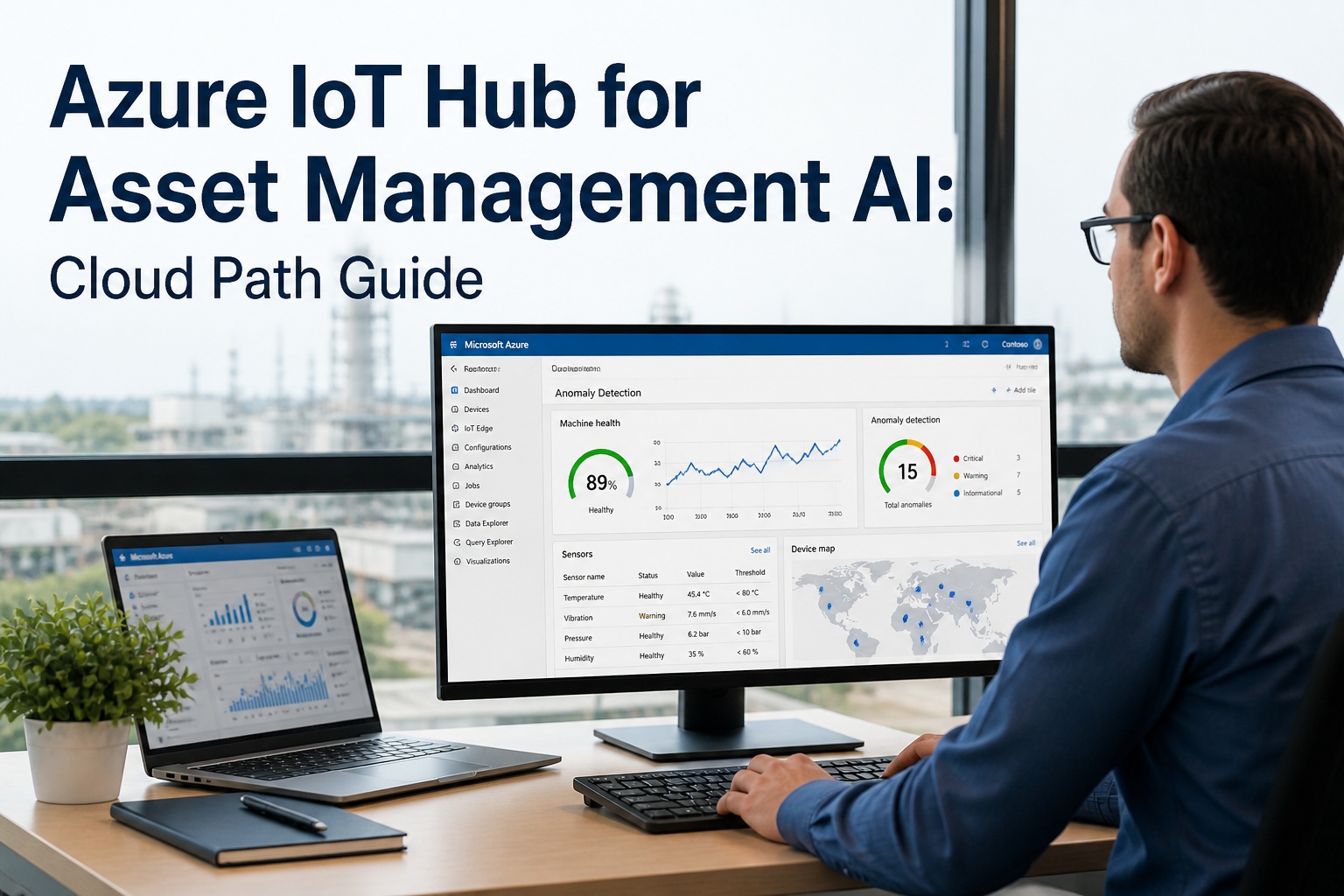
Azure IoT Hub for Asset Management AI: Cloud Path Guide
By Riley Quinn on May 1, 2026
Azure IoT Hub is not a maintenance platform — it's the data highway your AI maintenance platform runs on. U.S. manufacturers spending $200K+ on Azure IoT infrastructure and still getting surprised by equipment failures usually have the same problem: they built the pipeline but skipped the AI layer that turns sensor data into work orders. This guide maps exactly how Azure IoT Hub, Anomaly Detector and Stream Analytics fit together for asset management AI — and where that stack beats on-prem, where it doesn't, and how OxMaint closes the last mile from Azure alert to fixed machine. Connect your Azure-monitored assets to OxMaint's AI maintenance loop — free account, no setup required.
MAY 12, 2026 5:30 pm est, orlando
Upcoming Oxmaint AI Live Webinar — See Azure IoT + AI Maintenance Live
Join us in Orlando to see how Azure IoT Hub integrates with OxMaint's AI maintenance layer — from sensor ingestion to auto-generated work orders. Bring your architecture questions; leave with a costed integration plan.
The Azure IoT Reality Check: Azure IoT Hub handles up to 300 million device-to-cloud messages per day — but most manufacturing plants use less than 2% of that capacity while paying for the full architecture. The gap isn't in Azure's capabilities; it's in the AI layer that should sit on top. This guide shows you exactly what to build.
What the Azure IoT Asset Management Stack Actually Is
Azure IoT Hub is not one product — it's a layered stack that requires intentional assembly for asset management AI. See how OxMaint layers predictive maintenance AI on top of existing IoT infrastructure — try free. Most manufacturers either overbuild this stack with services they don't need, or underbuild it and wonder why their "AI monitoring" is just a dashboard with lag. Here is the actual architecture that works.
Azure IoT Asset Management — Full Stack Architecture
Layer 5
Action Layer
CMMS Auto Work Orders · Parts Pre-ordering · Maintenance Dispatch
Most Azure IoT deployments in manufacturing are strong at Layers 1–3 and weak at Layers 4–5. That's where asset health deteriorates into unplanned downtime.
The Three Azure Services That Actually Drive Asset AI
Azure has over 200 services. For manufacturing asset management AI, three do 90% of the work. Understanding what each does — and doesn't do — prevents expensive architecture mistakes.
Azure IoT Hub
The Message Broker
What it does: Bidirectional device-to-cloud communication. Handles device authentication, message routing, and device twin state management for millions of connected assets.
Max messages/day300M (S3 tier)
Latency~100–500ms
ProtocolsMQTT, AMQP, HTTPS
Starting price$10/month (F1 free)
What it doesn't do: No built-in anomaly detection. No work order generation. No failure prediction. It is a pipe, not a brain.
Azure Anomaly Detector
The Pattern Spotter
What it does: REST API that applies multivariate and univariate anomaly detection to time-series sensor data. Identifies spikes, dips, and trend shifts in vibration, temperature, pressure, and current signals.
Model typeUnsupervised ML
Training data neededMin. 12 data points
Multivariate supportUp to 300 variables
PricingPer 1K transactions
What it doesn't do: No asset-specific failure mode knowledge. No CMMS integration. No RUL (remaining useful life) estimation without custom model training on top.
Azure Stream Analytics
The Real-Time Processor
What it does: SQL-like query engine for real-time IoT data streams. Filters, aggregates, and routes sensor telemetry — thresholds, windowed averages, and alert triggers — before data reaches storage.
Processing latency< 1 second
Throughput1MB/s per SU
OutputsBlob, SQL, Power BI, Event Hub
Pricing~$80/month per SU
What it doesn't do: No native ML inference. No predictive capability without a connected ML endpoint. It processes what's already there; it doesn't predict what's coming.
OT/IT Integration Patterns: The Part Azure Docs Skip
OT/IT Integration Patterns for Azure IoT in Manufacturing
Pattern A
Direct Cloud Connect
SensorIoT HubAzure Cloud
Best for: New plants or greenfield deployments where IP network connectivity exists at the sensor level. Modern PLCs with MQTT support (Siemens S7-1500, Allen-Bradley Logix 5000 with Add-On Instructions).
Lowest costSimplest architectureRequires OT firewall changes
Pattern B
Edge Gateway Buffered
Legacy PLCIoT EdgeAzure Cloud
Best for: Plants with legacy equipment (pre-2015 PLCs), OPC-UA historians (OSIsoft PI, Kepware), intermittent WAN connectivity, or OT networks that prohibit direct cloud access. IoT Edge runs inference locally during outages.
Best for: Plants with existing OSIsoft PI or Inductive Automation Ignition historians containing years of asset data. Azure Data Explorer's ADX Connector ingests historical time-series data without replacing existing infrastructure.
Uses existing dataNo PLC changesBatch latency only
Azure IoT Cloud vs. On-Premises: When the Stack Actually Wins
Azure IoT Hub is not the right answer for every manufacturing plant. Here is the honest comparison matrix — built for reliability engineers, not Azure sales presentations.
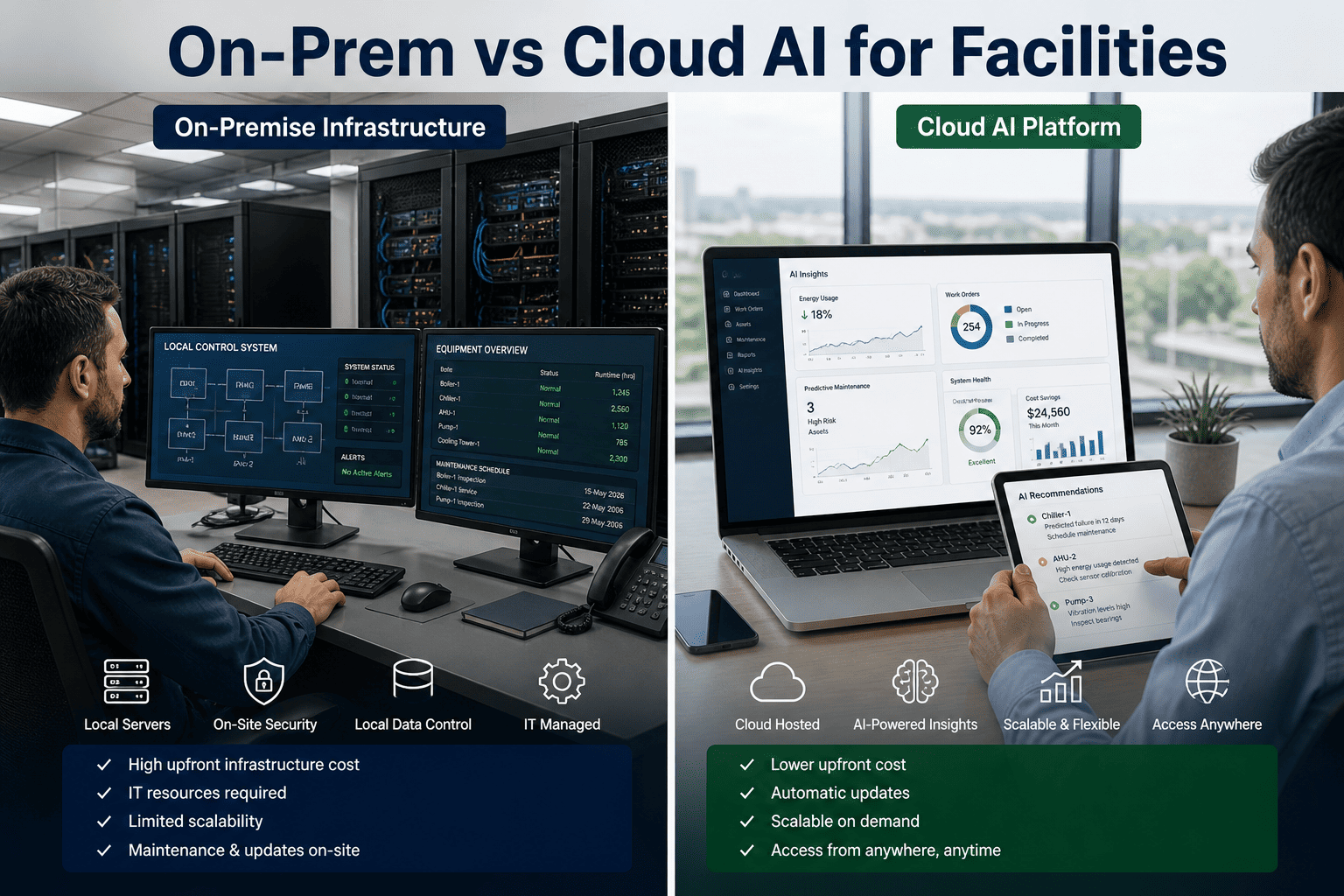
Azure IoT Cloud vs. On-Premises Asset Monitoring
For U.S. manufacturing plants — 2026 current pricing and capabilities
Decision Factor
Azure IoT Cloud
On-Premises / Edge
Winner At Scale
Setup Time
Hours to days
6–18 months
Azure
Upfront CAPEX
Near zero
$250K–$1M+
Azure
5-Year OPEX (150 assets)
$1.2M–$1.6M
$1.1M–$1.4M
On-Prem
Alert Latency
1–5 seconds (cloud roundtrip)
Milliseconds (edge inference)
On-Prem
Data Sovereignty
Data exits plant network
100% on-site
On-Prem
Scaling to 500+ Assets
Elastic — no hardware changes
Requires hardware investment
Azure
ML Team Required
No (managed APIs)
Yes (2–4 FTE)
Azure
Custom Failure Models
Possible via Azure ML
Full control
On-Prem
Offline / Air-Gap Support
Requires IoT Edge addon
Native
On-Prem
CMMS Integration
API-based (custom dev)
Custom build
Neither — needs middleware
The CMMS gap is the critical finding: neither Azure cloud nor on-prem gives you native work order generation. That last mile requires a dedicated maintenance platform layer — which is exactly what OxMaint provides on top of either architecture.
Already Running Azure IoT Hub? Close the Gap to Your CMMS.
OxMaint integrates with Azure IoT Hub to turn anomaly alerts into auto-generated work orders — without replacing your existing infrastructure. Connect in days, not quarters.
Evaluate hybrid at Year 2 — repatriation math starts working
Large Plant
400 Assets · 20 sensors each
~240M messages/month
IoT Hub (S3 tier)$2,500
Stream Analytics (8 SU)$640
Anomaly Detector$680
Azure Data Explorer$1,200
Storage + networking$380
~$5,400/month
On-prem or hybrid architecture typically wins at this volume
Figures are estimates based on Azure public pricing as of Q1 2026. Actual costs vary by region, reserved instance discounts, and data egress volume. Enterprise agreements typically reduce by 20–40%.
2026 Azure IoT in Manufacturing: What the Data Shows
$87B
Projected industrial IoT market size in 2026 — Azure holds approximately 30% of cloud IoT infrastructure share
IDC Industrial IoT 2026
68%
Of manufacturers using Azure IoT Hub report that CMMS integration is their biggest unresolved gap in their AI maintenance stack
Gartner Manufacturing IoT Survey 2025
4.2x
Faster time-to-first-alert for cloud IoT stacks vs. on-premises deployments — the speed advantage is real in Year 1
Microsoft Azure Manufacturing Benchmark
$7:1
ROI ratio for condition monitoring AI — every dollar invested returns seven in prevented downtime, regardless of cloud or on-prem architecture
Industry Week Maintenance Report 2026
Expert Perspective: What Azure IoT Gets Right — and Where It Stops Short
Azure IoT Hub is genuinely excellent infrastructure for manufacturing. The message throughput, device management, and integration with the rest of the Azure ecosystem are real competitive advantages. Where I see plants go wrong is treating Azure as a maintenance platform rather than an IoT data platform. They build the pipeline, see data flowing into Stream Analytics, and assume the AI work is done. It's not. Anomaly Detector will find statistical outliers in your vibration data — but a statistical outlier is not a maintenance action. It's a signal that someone needs to interpret, validate, and route into a work order. Without that last mile — from Azure alert to technician with the right parts — the platform delivers dashboards, not uptime. The second issue I see is OT/IT integration being treated as a technical problem when it's actually a people and process problem. The IT team owns the Azure subscription. The OT team owns the SCADA. They often don't talk to each other. No amount of IoT Edge configuration fixes that.
Azure Excels at Scale
For plants with 200+ assets and existing Azure enterprise agreements, IoT Hub's elastic scaling and managed services genuinely beat the CAPEX and talent cost of building equivalent on-prem infrastructure.
The Last Mile Is the Whole Game
An Azure anomaly alert that requires manual CMMS entry captures maybe 20% of its potential ROI. Auto-generated work orders close the loop. That's where the 7:1 ROI ratio actually comes from — not from better anomaly detection.
Digital Twins Are Worth the Investment
Azure Digital Twins, layered on top of IoT Hub, creates the asset context layer that turns raw telemetry into equipment health scores. For complex multi-component assets (turbines, compressors, press lines), Digital Twins is the architecture that makes AI maintenance economically defensible.
Turn Your Azure IoT Alerts Into Closed Work Orders — Automatically
OxMaint connects to Azure IoT Hub, reads your anomaly signals, and auto-generates CMMS work orders — so your maintenance team acts on every alert, not just the ones they notice. Live in days, no rearchitecting required.
Conclusion: Azure IoT Hub Is the Pipeline — AI Maintenance Is the Destination
Azure IoT Hub, Stream Analytics, and Anomaly Detector give U.S. manufacturers a world-class data infrastructure. But infrastructure is not outcomes. The plants achieving 25–35% downtime reduction from their Azure IoT investments are not the ones with the most sophisticated Stream Analytics queries — they're the ones who closed the alert-to-work-order loop. For plants under 150 assets, the Azure cloud stack is cost-effective and fast to deploy. For plants above 300 assets or with data sovereignty requirements, a hybrid architecture — Azure IoT Edge on-site, cloud processing for non-critical analytics — gives you the best of both worlds. In either case, the missing piece is always the same: a maintenance platform that sits between your Azure anomaly alerts and your CMMS. See how OxMaint bridges Azure IoT Hub and your CMMS — book your architecture walkthrough. The Azure IoT investment you've already made is 70% of the answer. Don't let the last 30% — the action layer — be the reason your assets still fail unexpectedly. Start your free OxMaint account and connect your first Azure-monitored assets today.
Frequently Asked Questions
How does Azure IoT Hub connect to a CMMS for automatic work order generation?
Azure IoT Hub does not natively generate CMMS work orders — it requires a middleware or maintenance platform layer. The standard integration pattern is: Azure IoT Hub ingests sensor data → Stream Analytics filters and routes anomaly-threshold breaches → Azure Logic Apps or a dedicated maintenance platform (like OxMaint) receives the event → the platform calls the CMMS API to create, assign, and prioritize a work order. Plants using OxMaint on top of Azure IoT Hub achieve this integration in days rather than months, without custom Logic Apps development. Native CMMS connectors for SAP PM, IBM Maximo, and Infor EAM are the fastest path to the closed loop.
What is the difference between Azure IoT Hub and Azure IoT Edge for manufacturing asset monitoring?
Azure IoT Hub is a cloud-hosted message broker — all data processing happens in Microsoft's Azure data centers. Azure IoT Edge is software you deploy on an on-premises gateway device that runs IoT Hub modules locally. For manufacturing asset monitoring, IoT Edge is critical when: your OT network cannot send data to the cloud continuously (air-gapped or bandwidth-limited sites), you need sub-second alert latency for safety-critical equipment, or you have regulatory requirements that prohibit raw sensor data leaving the plant network. Most mid-size manufacturing plants use a hybrid: IoT Edge gateways on the plant floor for real-time local processing, with aggregated data syncing to Azure cloud for long-term analytics and ML model management.
How accurate is Azure Anomaly Detector for predicting manufacturing equipment failures?
Azure Anomaly Detector's accuracy for equipment failure prediction depends heavily on the quality and history of your sensor data, not the service itself. In controlled benchmarks, multivariate Anomaly Detector achieves 80–92% precision on clean vibration and temperature data with 6+ months of historical patterns. In real manufacturing environments with noisy sensors, process variation, and limited failure history, false positive rates of 15–30% are common without tuning. The practical path: use Anomaly Detector as an initial signal layer, then apply asset-specific rules and OxMaint's maintenance context (is this asset due for PM? has it had this pattern before?) to filter and validate before generating work orders. Generic anomaly detection without asset context is a high-noise environment.
How does Azure IoT Hub pricing work at manufacturing scale, and when does on-premises become cheaper?
Azure IoT Hub pricing is tier-based by daily message volume: Free (8,000 messages/day), S1 ($25/month, 400K messages/day), S2 ($250/month, 6M messages/day), S3 ($2,500/month, 300M messages/day). For a 150-asset plant sampling at 1Hz per sensor with 10 sensors per asset, you generate approximately 130M messages per month — putting you in S3 tier. Combined with Stream Analytics, Anomaly Detector, and storage, full-stack Azure IoT costs approximately $1,200–$1,500/month at this scale. On-premises becomes cheaper at the total-cost level (hardware amortization + staff) around Year 3–4 for most plants above 200 assets. The 60-70% repatriation rule applies: when cloud costs reach 60-70% of equivalent on-prem costs, evaluate moving high-frequency workloads in-house while keeping lower-frequency analytics in Azure.
What OT/IT integration challenges should manufacturers expect when deploying Azure IoT Hub in brownfield plants?
Brownfield Azure IoT deployments in manufacturing consistently encounter four challenges. First, protocol translation: legacy PLCs speak Modbus, Profibus, or proprietary OEM protocols that do not map natively to MQTT/AMQP — you need an OPC-UA server or protocol gateway (Kepware, Ignition) between the PLC and IoT Edge. Second, firewall policy: most OT networks use unidirectional or strict whitelist-only egress policies; getting IT security to approve outbound HTTPS to Azure IoT Hub endpoints often requires months of review. Third, data quality: historian data from legacy plants contains gaps, unit inconsistencies, and tag naming that must be cleaned before Anomaly Detector produces usable signals — plan 4–8 weeks for data normalization. Fourth, organizational alignment: the IT team managing Azure and the OT team managing the plant floor often have separate reporting chains, budgets, and priorities. Establishing a joint governance model before the technical implementation is the highest-ROI investment you can make before starting an Azure IoT project.