Thermal Imaging AI for Predictive Maintenance: Setup Guide
By Riley Quinn on May 1, 2026
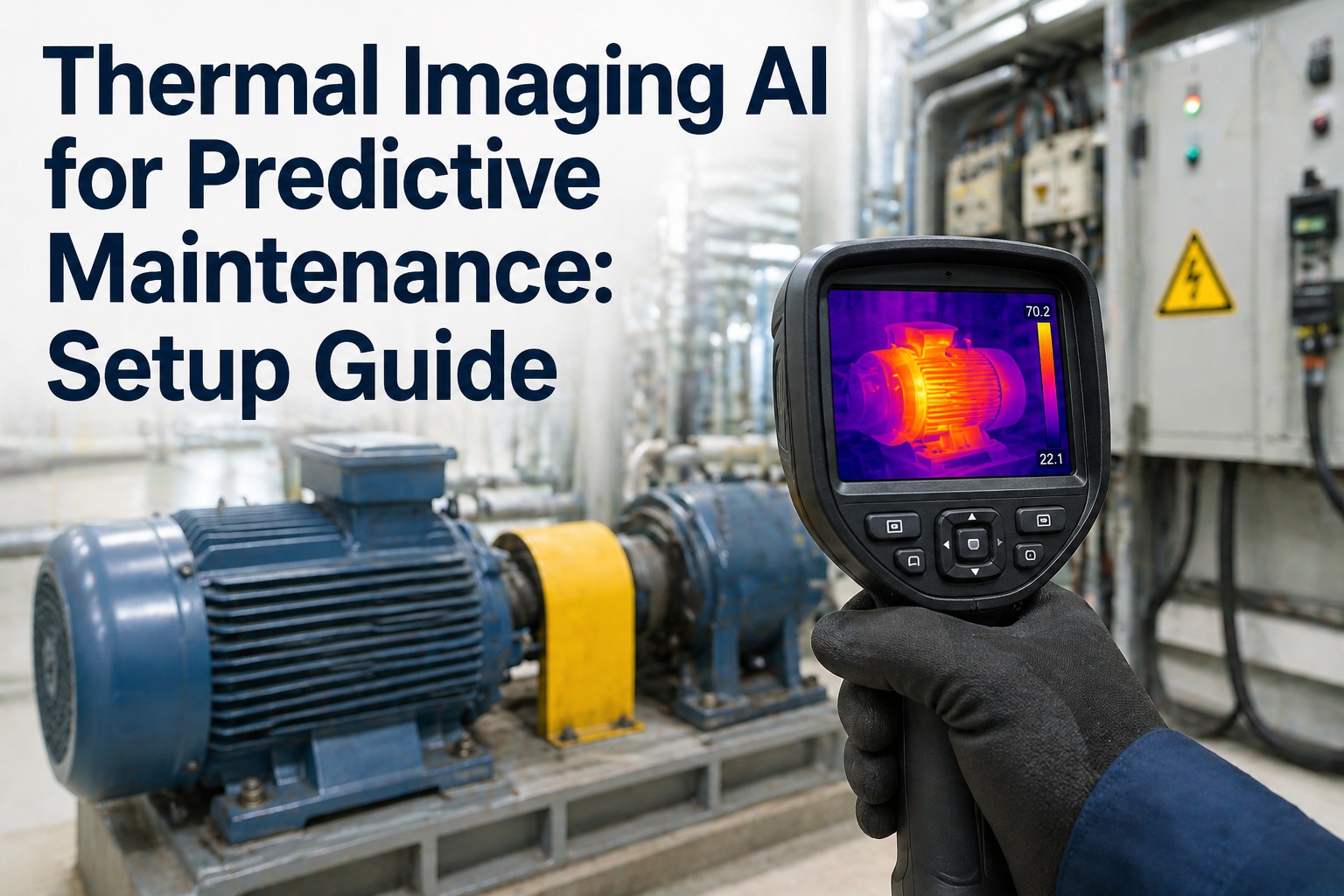
Your motor's bearing is running at 78°C right now. Normal is 55°C. The difference is invisible to your eyes, inaudible to your ears, and completely undetectable by your scheduled monthly walkthrough — which happens to be three weeks away. In three weeks, that bearing seizes. You lose two production days and spend $38,000 on emergency repair. Thermal imaging AI catches it today, automatically, without a technician leaving the control room. That's not a future capability — it's what OxMaint's condition monitoring platform does right now — start free. The AI-powered thermal camera market is already valued at $2.23 billion in 2025, growing to $4.77 billion by 2034. Here's exactly how to deploy it in your plant.
MAY 12, 2026 5:30pm est, orlando
Upcoming Oxmaint AI Live Webinar — Build Your Thermal AI Monitoring Architecture Live
Join the OxMaint team at SAP Sapphire Orlando to map your exact thermal AI deployment — fixed camera placement, edge vs cloud inference, or hybrid by asset class. Walk in with your asset inventory; walk out with a costed, defensible plan.
The Thermal AI Opportunity — 2025–2026 Market Snapshot
$2.23B
AI-powered thermal camera market in 2025 — reaching $4.77B by 2034
11.6%
CAGR for AI thermal cameras — fastest-growing segment in condition monitoring
65%
Of U.S. industrial facilities have integrated thermal imaging for predictive maintenance
85–90%
Of electrical faults detected by thermal AI before failure — vs 10–15% with periodic inspections
Downtime reduction with thermal AI
30–50%
Maintenance cost savings
20–40%
Faults caught that manual surveys miss
70% more
First-year ROI typical range
>300%
Why Periodic IR Surveys Leave You Blind
The traditional approach — a certified thermographer walks your plant quarterly with a handheld FLIR camera — covers your critical assets for roughly 2 hours out of every 2,190 operating hours. That's a 0.09% coverage rate. A motor that overheats only during peak load at 2 AM on a Tuesday is invisible to a 9 AM quarterly inspection. Continuous AI-powered thermal monitoring eliminates this blind spot by running detection on every frame, 24 hours a day, comparing readings against asset-specific baselines rather than generic temperature thresholds. The AI doesn't just see that something is hot — it understands whether that heat pattern is normal for that specific asset under those specific load conditions. Connect your thermal sensors to OxMaint's AI engine — start free, no hardware lock-in.
What Thermal AI Actually Detects: Asset-by-Asset Breakdown
Different assets produce different thermal fault signatures. Training your AI on the right patterns for each asset class is what separates genuine predictive intelligence from expensive false-alarm generators.
Electric Motors
Bearing overheating
+15–25°C above baseline
4–8 weeks lead
Winding insulation degradation
Asymmetric hotspot
3–6 weeks lead
Cooling system failure
+10°C casing rise
2–4 weeks lead
Rotor misalignment
Asymmetric end-bell pattern
4–12 weeks lead
AI detects winding vs bearing vs cooling — separate failure modes
Switchgear & Panels
Loose / corroded connection
+20–40°C at terminal
2–6 weeks lead
Overloaded circuit breaker
Uniform panel hotspot
1–3 weeks lead
Phase imbalance
One phase 10°C+ hotter
3–8 weeks lead
Insulation breakdown
Diffuse heat signature
4–10 weeks lead
85–90% of electrical faults are thermal-detectable
Bearings & Rotating Assemblies
Lubrication failure
+10–20°C bearing housing
3–6 weeks lead
Spalling / pitting
Localized race hotspot
2–5 weeks lead
Over-lubrication
Churning heat pattern
1–2 weeks lead
Misalignment loading
Asymmetric housing heat
4–12 weeks lead
AI distinguishes gradual wear from acute failure events
Transformers & Cables
Hot-spot in winding
Pinpoint +30°C+ rise
6–12 weeks lead
Core insulation degradation
Diffuse core heating
8–16 weeks lead
Bushing overheating
High-resistance contact heat
3–6 weeks lead
Cable tray hotspot
Localised cable heat
2–4 weeks lead
Longest advance warning of any thermal fault class
AI SEVERITY MATRIX
AI Severity Classification: From Raw Heat to Prioritized Action
Raw temperature readings don't tell you what to do next. AI does — by classifying every detected anomaly into a severity tier that drives the right maintenance response. The key insight is that AI compares heat against the baseline for that specific asset, not a generic threshold. A 75°C reading on a motor that normally runs at 70°C is an alert. The same 75°C on a motor that normally runs at 55°C is a critical emergency. See how OxMaint automatically classifies thermal alerts and generates work orders — book a demo.
Thermal Anomaly Severity Matrix
How AI turns temperature data into maintenance priority
MONITOR
+5–10°C above asset baseline · Gradual trend over days/weeks
Log to dashboard · Schedule next PM inspection · No immediate work order
4–12 weeks to failure
ALERT
+10–20°C above baseline · Rate of rise accelerating
Auto work order in CMMS · Assign technician within 72hrs · Parts pre-ordered
Immediate alert to operator · High-priority work order · Consider controlled shutdown
<1 week to failure
AI false alarm rate drops below 2% when thermal data is fused with vibration — vs 15–20% with temperature threshold-only systems
CTA 1
Ready to Deploy Thermal AI on Your Critical Assets?
OxMaint integrates with FLIR, ONVIF, and third-party thermal cameras — classifying every anomaly by severity and auto-generating work orders in your CMMS. No data science team required.
Thermal Camera Spec Guide for Predictive Maintenance
Specification
Entry-Level
Mid-Range
Industrial Pro
Thermal Resolution
160×120
320×240
640×480+
NETD Sensitivity
<100 mK
<50 mK
<30 mK
Temp Range
−20 to 150°C
−40 to 550°C
−40 to 1,500°C
Edge AI
No
Partial
On-device
Best For
Electrical panels, fixed monitoring
Motors, bearings, rotating assets
High-speed lines, furnaces, precision assets
Approx. Cost
$300–$1,500
$1,500–$8,000
$8,000–$40,000+
Key Brands
FLIR ONE, Seek
FLIR E-series, Fluke
Teledyne FLIR, InfraTec, Optris
For most plant applications: 320×240 with <50 mK NETD is the minimum for reliable AI anomaly classification. Going lower risks false negatives on early-stage faults.
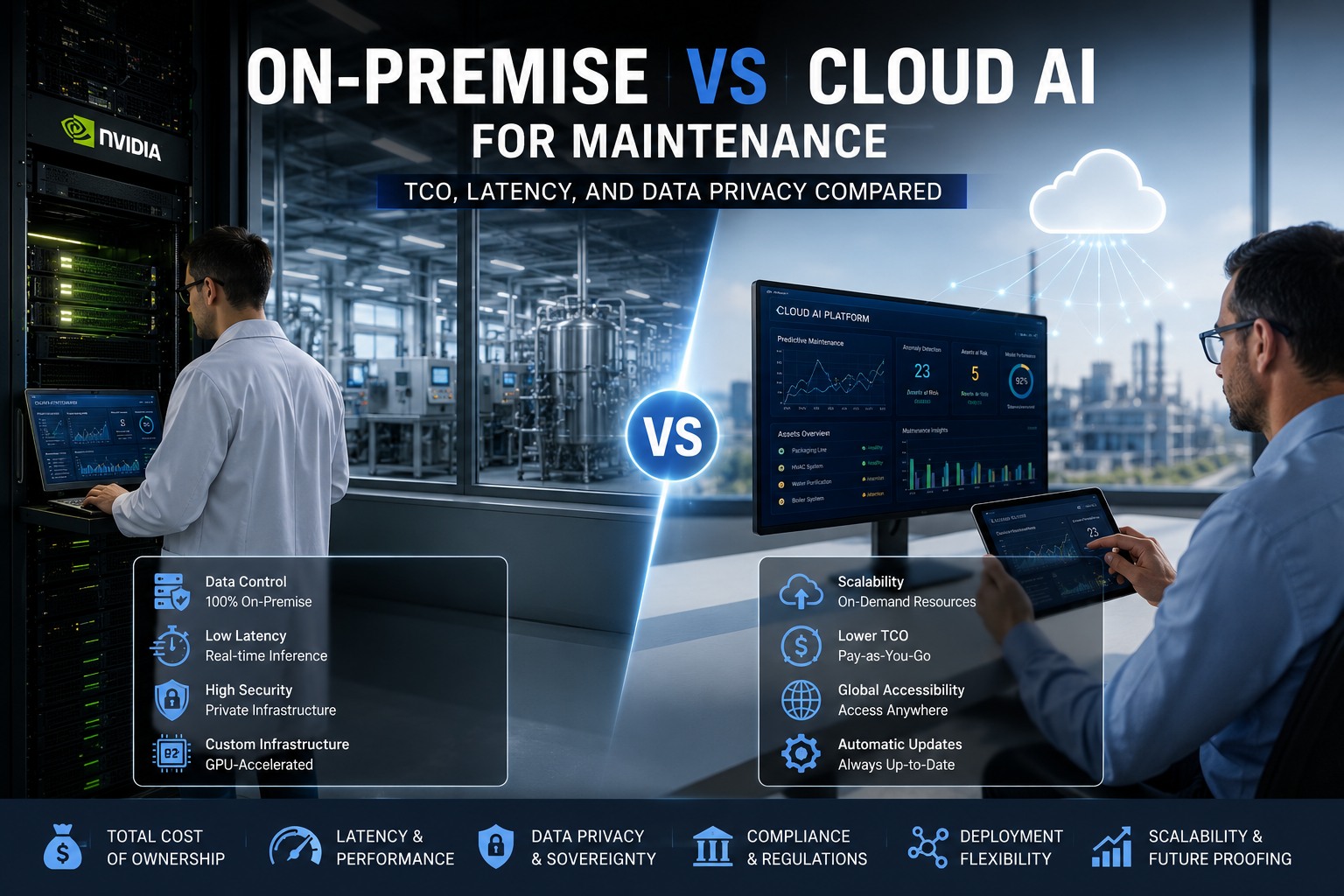
Deployment Architecture: Cloud vs Edge for Thermal AI
Where your thermal AI model runs — on-device at the camera, on an edge gateway at the plant, or in the cloud — determines your detection latency, data sovereignty, and what happens during a network outage. Most plants need a hybrid approach.
Thermal AI Deployment Architecture
Three layers — each with a specific role
01
Layer 1 — Camera / Sensor
Raw Radiometric Capture
Fixed LWIR thermal cameras stream per-pixel temperature data continuously. Industrial units with on-device AI run basic anomaly detection locally — enabling sub-second shutdown signals independent of network.
An on-premises edge server runs the classification model — comparing thermal frames against asset-specific baselines, fusing with vibration data, and triggering severity-graded alerts. Works fully offline. Processes multiple cameras simultaneously.
Confirmed anomalies sync to the cloud for model retraining on your specific asset population. Every classified fault automatically generates a work order in your CMMS — pre-filled with thermal image, severity, component ID, and recommended action. Audit trail maintained.
Auto work ordersModel improves over timeFull audit trail
EXPERT SECTION
Expert Perspective: Where Thermal AI Programs Fail
The first 90 days of any thermal AI deployment consistently reveal 15–25 electrical hotspots that previous handheld surveys had missed entirely. That's not because the surveys were done badly — it's because periodic snapshots at 0.09% coverage are structurally incapable of catching intermittent thermal faults. The technology is mature. The failure point is always the same: teams deploy cameras, see alerts, and then manually log them into a separate maintenance system. The data-action gap kills the ROI. The only programs that sustain results are the ones where every thermal alert automatically generates a prioritized work order in the CMMS within 60 seconds of confirmation.
Train on Your Assets, Not Generic Data
A model trained on generic motor data will generate false alarms on your specific asset population. Baseline each asset individually during normal operation before anomaly detection goes live. Give the model 2–4 weeks of normal data first.
Fuse Thermal With Vibration for Confidence
A bearing at 75°C is ambiguous. A bearing at 75°C with rising vibration amplitude at the defect frequency is a confirmed fault. Cross-sensor fusion drops false alarm rates below 2% — making maintenance teams trust and act on alerts.
Close the Data-Action Gap Immediately
Every confirmed thermal anomaly must automatically create a work order — not just a notification. Programs that require a technician to manually log alerts before work begins lose 60–80% of their potential downtime reduction to process friction.
CTA 2
Every Thermal Alert Should Become a Work Order — Automatically
OxMaint connects your thermal cameras to a CMMS that closes the data-action gap. Detected hotspot → severity classification → work order in 60 seconds. No manual logging. No missed repairs.
4-Step Setup Guide: From Camera to Continuous Monitoring
Deploying thermal AI doesn't require a data science team or a six-month integration project. Here's the exact path from hardware to running predictions — most plants are generating their first anomaly alerts within two weeks of sensor installation. Start your OxMaint free trial and connect your thermal sensors today.
01
Asset Survey & Camera Placement
Map your critical assets — motors, switchgear, bearings, transformers — by failure consequence and inspection accessibility. Fixed cameras go on the highest-consequence, hardest-to-inspect assets first. For electrical panels: one camera per room. For motor rows: one camera per 3–5 motors depending on sightlines. ATEX-rated cameras required for Zone 1/2 classified areas.
Prioritize by failure costATEX in hazardous zones1–2 day installation
02
Baseline Learning Period (2–4 Weeks)
AI models must learn what "normal" looks like for each specific asset under your operating conditions — load cycles, ambient temperature variation, seasonal changes. Do not activate anomaly alerting during this period. Let the model build component-specific thermal fingerprints. The more varied operating conditions captured during baseline, the fewer false alarms after go-live.
Asset-specific baselinesNo alerts during learningCapture load variation
03
Model Training & Threshold Calibration
Feed baseline data into the ML model (CNN-based architectures perform best for thermal image classification). Set severity thresholds per asset class — not a single plant-wide temperature limit. Integrate vibration data streams where available to enable multi-sensor fault confirmation. Run the model in shadow mode for 1 week before live alerting — compare AI detections against any known faults to validate accuracy before full deployment.
Connect your thermal AI output to your CMMS via API. Every confirmed anomaly should auto-generate a work order pre-populated with: thermal image attachment, GPS/asset location, severity classification, component ID, and recommended corrective action. This closes the data-action gap that kills ROI in most thermal monitoring programs. Technician feedback on completed work orders feeds back into the model to continuously improve accuracy.
Auto work orders in CMMS60-second alert-to-WO timeFeedback loop improves model
Frequently Asked Questions
What types of equipment benefit most from thermal imaging AI in predictive maintenance?
Electric motors, switchgear and electrical panels, rotating bearings, transformers, and cable trays deliver the highest ROI from thermal AI monitoring. Electrical faults are thermal-detectable in 85–90% of cases. Motors show bearing and winding faults 2–8 weeks before failure. Electrical panels reveal loose connections, phase imbalance, and overloaded circuits through characteristic heat patterns that AI classifies with high precision. Any asset where an unplanned failure costs more than the monitoring system — typically any asset above $10,000 replacement cost or causing more than 2 hours of production downtime — is a candidate.
How accurate is thermal AI in detecting faults vs traditional threshold-based alerts?
AI-based thermal anomaly detection achieves 80–97% accuracy in fault prediction when models are trained on asset-specific baseline data. Traditional threshold-only systems generate false alarm rates of 15–20% because they can't distinguish normal operational heat variation from genuine fault signatures. When thermal AI is fused with vibration data, false alarm rates drop below 2%. The critical difference is that AI compares temperature against each asset's individual baseline under current load conditions — not against a fixed plant-wide threshold that ignores context.
What thermal camera specifications are needed for AI-based predictive maintenance?
For reliable AI anomaly classification, the minimum effective specification is 320×240 resolution with a thermal sensitivity (NETD) of less than 50 millikelvin. Lower resolution cameras miss early-stage fault signatures that appear as subtle temperature gradients across small component areas. For high-value assets like large transformers or precision rotating equipment, 640×480 resolution with under 30 mK sensitivity provides the spatial resolution needed to distinguish between adjacent components. Temperature range should cover at minimum −40°C to 550°C for most industrial applications. ATEX or IECEx certification is required for cameras installed in classified hazardous areas.
Should thermal AI run on the edge or in the cloud?
Most industrial plants need a hybrid architecture. Edge processing at the camera or on-site gateway handles real-time anomaly detection and safety-critical responses — operating fully offline if network connectivity fails. Cloud processing handles model training and retraining on expanded datasets, multi-site analytics, and integration with CMMS work order systems. Edge-only deployments miss the cross-site pattern learning that makes models smarter over time. Cloud-only deployments introduce latency incompatible with safety shutdown requirements and create data sovereignty risks for regulated environments. The hybrid model is now the industry standard.
How long does it take to deploy thermal AI predictive maintenance and see ROI?
Physical camera installation on a typical manufacturing plant takes 1–2 days. The baseline learning period is 2–4 weeks before anomaly alerting goes live. Most deployments generate their first confirmed fault detections within the first 90 days — and in documented case studies, the first 90 days typically reveal 15–25 electrical hotspots that previous periodic inspections had missed. ROI exceeding 300% in year one is consistently documented across industrial deployments, with the primary value driver being prevention of two or three major unplanned downtime events that each cost $25,000–$500,000 depending on industry.