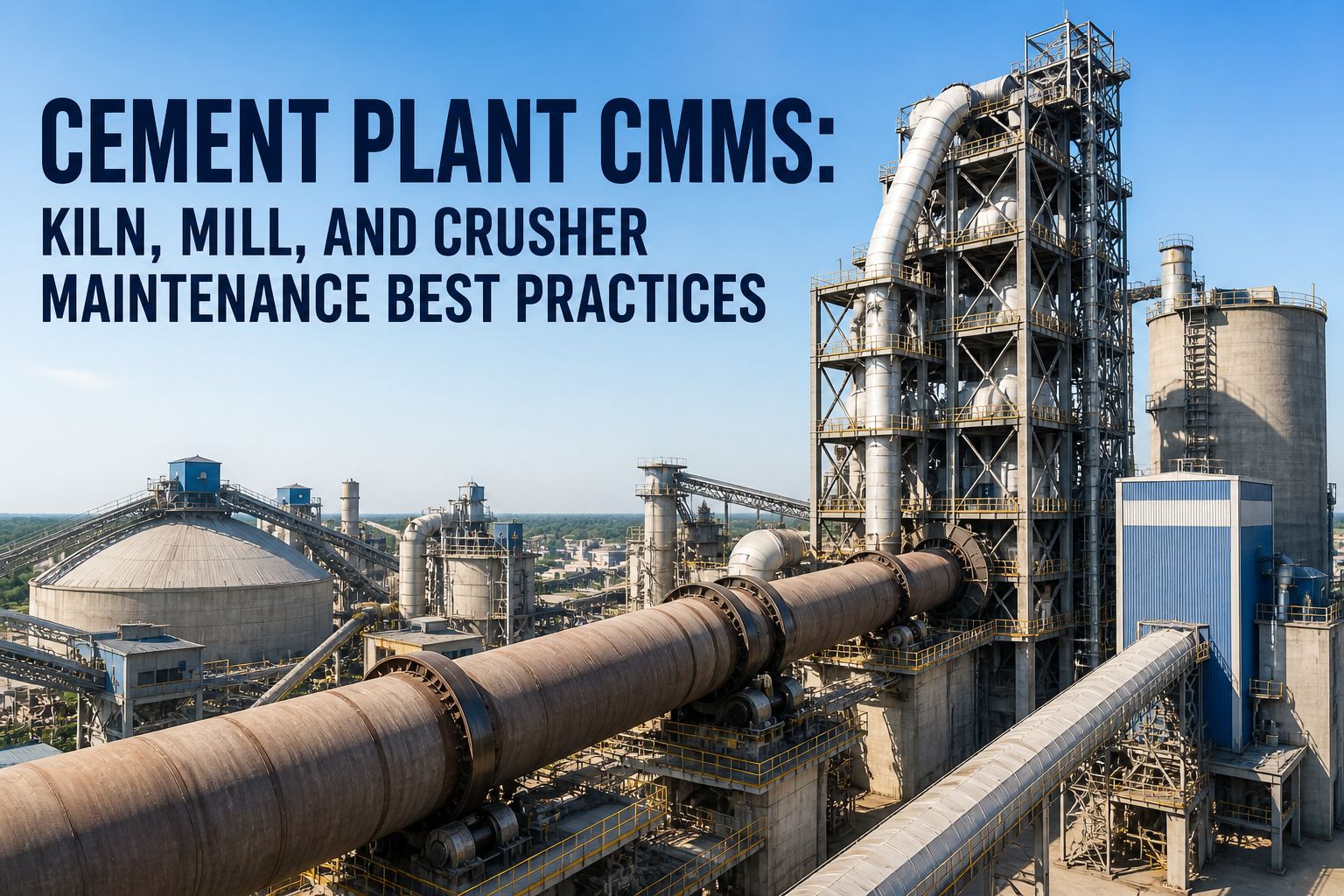
Cement Plant CMMS: Kiln, Mill, and Crusher Maintenance Best Practices
By Riley Quinn on May 2, 2026
A cement plant is the most punishing environment in heavy industry. Your rotary kiln runs at 1,450°C — twenty-four hours a day, seven days a week — with a 200-ton steel shell rotating on trunnion bearings while everything around it gets coated in abrasive dust. Your ball mill grinds clinker with 300 tons of steel media at vibration levels 10–30× higher than typical industrial equipment. Your jaw crusher absorbs 50g impact shocks every shift. And every one of these assets is a single point of failure: drop the kiln, and the entire plant stops. Drop the primary mill, and clinker piles up. Drop the crusher, and the kiln starves. The numbers are brutal — 82% of cement plants experience unplanned downtime within any 3-year window, a single kiln shutdown costs $100,000 to $500,000 per day, and most plants are still managing all of this with paper logs and reactive repair. The plants pulling ahead in 2026 aren't running better equipment. They're running a CMMS that knows the difference between a kiln, a mill, and a crusher — and applies the right monitoring strategy to each. See how Oxmaint's cement-specific CMMS lifts plant availability above 92% — start your free trial.
MAY 12, 2026 5:30 PM EST , Orlando
Upcoming Oxmaint AI Live Webinar— Build Your Cement Plant CMMS Strategy in One Session
Join the OxMaint team in Orlando to design a cement-specific maintenance strategy — kiln shell monitoring, vertical mill PM, crusher wear tracking, and conveyor reliability — mapped to your asset register on a unified CMMS platform.
The Cement Production Flow — And Where Each Asset Fails
To maintain a cement plant well, you need to think the way the production flows: from quarry to crusher to raw mill to kiln to finish mill to silo. Each stage has different failure modes, different operating temperatures, and different maintenance priorities. Here's the full production map with the critical assets and their dominant failure signatures called out.
Rotary kiln · Primary crusher · Main raw mill · Finish mill · Main ID fans
Strategy: Real-time vibration, thermal, and motor current monitoring. AI anomaly detection. Auto-generated work orders. Sub-100ms alert routing. 70–80% of unplanned downtime sits in this tier.
$100K–$500K/day downtime cost102+ monitoring points on kiln
Strategy: Route-based vibration walkdowns weekly. Oil analysis monthly. Thermal scans quarterly. CMMS-driven inspection routes with mobile data capture. Failures here cause 12–48 hour disruptions.
Strategy: Time-based PM schedules in CMMS. Visual inspection routes monthly. Wear-part replacement at calendar intervals or condemn thickness. Failures cause minor disruption with redundancy backup.
Redundancy availableStandard parts inventory
The Top 3 Failure Modes — And What They Cost
Decades of cement plant failure data point to a clear pattern: three failure modes account for the majority of catastrophic downtime events. Each one is detectable weeks in advance with the right CMMS strategy.
#1
Bearing & Coupling Faults in Cement Mill Gearbox
3 days production halt · $300K–$1.5M loss
Bearing and coupling faults in the cement mill gearbox can halt the entire plant for up to 3 days. Cause: extreme vibration loading combined with abrasive dust ingress wears bearings 4× faster than typical industrial environments.
Refractory erosion creates localized hotspots on the kiln shell. If unchecked, the shell can warp or crack, causing emergency cooling and full kiln rebuild. The single highest-cost failure mode in cement manufacturing.
Detection: Continuous shell scanner (IR thermography). AI flags hotspot growth above 250–400°C threshold. Catches failure 4–6 weeks ahead.
#3
Coal Mill Bearing & Gearbox Defects
56 hours downtime · $150K–$300K loss
Coal mill bearing and gearbox defects can result in up to 56 hours of unplanned production downtime. The coal mill is single-point-of-failure for kiln fueling — it cannot be bypassed.
Detection: Vibration on 32 bearing locations. Motor current signature analysis. Catches developing fault 4–6 weeks ahead.
Lift Cement Plant Availability Above 92% — Without Replacing Equipment
Oxmaint's cement-specific CMMS unifies kiln, mill, crusher, and conveyor reliability into one platform — with high-temperature-rated sensor support, AI anomaly detection, and CMMS-driven wear-part procurement built for cement plant conditions.
The MTBF Equation — And Why a Small Improvement Means Big Money
Mean Time Between Failures is the single most important number on a cement plant maintenance dashboard. It answers the question: how many hours does your equipment actually run before something breaks? The math compounds rapidly — even small MTBF improvements deliver outsized availability gains.
Availability=
MTBF
MTBF + MTTR
×100
Reactive Plant
MTBF:1,500 hrs
MTTR:8 hrs
99.47%availability
+33% MTBF
RCM Plant
MTBF:2,000 hrs
MTTR:8 hrs
99.60%availability
That 0.13% gap = 11+ extra production hours per year per kiln, worth $1.1M–$5.5M annually on a single line.
Expert Review — Why Most Cement CMMS Deployments Fail
The pattern I see in cement plant after cement plant is the same: someone buys a generic industrial CMMS, then tries to bolt cement-specific logic onto it for the next two years. It never works. A kiln is not a pump. A vertical roller mill is not a CNC machine. The failure modes, the operating temperatures, the wear-part procurement lead times — every one of these is fundamentally different in cement, and a CMMS that doesn't understand that distinction will surface alerts your team learns to ignore. The plants that succeed pick a CMMS that's been built for cement from day one — one that knows the wear rate of a jaw plate per tonne of limestone, that fires the procurement order at 80 mm thickness automatically because the lead time is 3–4 weeks, that distinguishes between a kiln support roller bearing rising 15°C and the same temperature rise on a conveyor idler. Generic platforms will get you to 85% availability. Cement-specific platforms with proper criticality tiering will get you above 92%.
RCM Lifts Kiln MTBF by 40%
Plants implementing Reliability-Centered Maintenance saw rotary kiln MTBF increase by 40% and ball mill MTBF improve by 33%, with maintenance costs dropping 30%. The ROI on disciplined RCM is some of the strongest in heavy industry.
82% of Plants Hit Unplanned Downtime in 3 Years
Industry data shows 82% of cement plants experience unplanned downtime within any 3-year window. Most of these events trace to gradually-worsening conditions detectable 4–8 weeks in advance with proper monitoring infrastructure.
200–400% First-Year ROI
A properly designed cement plant predictive maintenance program typically delivers 200–400% first-year ROI. Preventing one 3-day kiln emergency shutdown ($300K–$1.5M) typically pays for the entire CMMS investment.
Your 90-Day Cement CMMS Rollout Plan
The good news: a structured 90-day program covers Tier 1 assets responsible for 70–80% of unplanned downtime, deploys with under $8,000 in starter sensor hardware, and delivers measurable MTBF improvement inside the first quarter. Here's the rollout sequence.
Days 1–30
Foundation & Asset Register
List every rotating and process asset — kiln, mills, crushers, coolers, conveyors, fans
Score each asset on production impact (1–5), replacement cost (1–5), and spare parts lead time (1–5)
Assign Tier 1 / 2 / 3 designation; document failure history for all Tier 1 assets in CMMS
Outcome: Complete asset criticality matrix; reactive work drops 20–30% from documentation discipline alone
Days 31–60
Sensor Deployment & Baselines
Deploy 8–14 wireless vibration sensors on Tier 1 assets — kiln support rollers, mill drives, crusher bearings
Use cement-rated sensors (150–200°C, IP67+) — standard industrial accelerometers fail in months
Outcome: Live data streaming into CMMS; first condition-driven alerts begin appearing
Days 61–90
AI Alerting & Wear-Part Automation
Configure alert thresholds: Advisory at +20% above baseline, Critical at +50%
Activate auto-procurement triggers: jaw plate at 80 mm thickness, liner at minimum, gearbox oil contamination
First MTBF baseline established; outage prevention events documented
Outcome: First prevented forced shutdown typically logged in this window — recovers full program cost
Run Your Cement Plant Like a Top-Quartile Producer
Oxmaint's cement-specific CMMS deploys with no external consultants, integrates with your DCS via OPC-UA, and runs cement-trained AI models for kiln shell ovality, mill bearing degradation, and crusher wear tracking. Live in 90 days.
What makes cement plant maintenance different from general industrial maintenance?
Cement plants combine three structural conditions you almost never see together in other industries. First, extreme heat — rotary kilns operate at 1,450°C with shell surface temperatures reaching 250–400°C, while preheater towers sustain 80°C ambient continuously. Standard industrial accelerometers (rated to 85°C) fail within months in these conditions. Second, extreme vibration — ball mills generate 15–50 mm/s RMS vibration, 10–30× higher than typical industrial equipment, with crushers producing 50g impact shocks. Standard sensor mounts fatigue-crack and connectors vibrate loose. Third, abrasive dust environments — cement dust penetrates moving parts, bearings, and electrical enclosures, accelerating wear on every rotating component. A cement-specific CMMS understands these conditions, supports high-temperature-rated sensors, and applies maintenance logic calibrated for cement-typical wear rates rather than generic industrial benchmarks.
Which cement plant assets should be monitored continuously vs periodically?
Apply a 3-tier criticality framework. Tier 1 — Continuous Monitoring: rotary kiln, primary crusher, main raw mill, finish mill, and main ID fans. These assets carry $100K–$500K per day downtime cost and account for 70–80% of unplanned production loss. Real-time vibration, thermal, and motor current monitoring with AI anomaly detection is justified. Tier 2 — Periodic Condition Monitoring: clinker cooler, coal mill, secondary fans, bucket elevators, and main gearboxes. Failures here cause 12–48 hour disruptions at $30K–$80K per day. Route-based vibration walkdowns weekly, oil analysis monthly, and thermal scans quarterly are typically sufficient. Tier 3 — Standard Calendar PM: conveyor belts, auxiliary pumps, lighting, HVAC, and air compressors with redundancy backup. Time-based PM schedules in CMMS with monthly visual inspection routes cover this tier adequately. Most plants overspend on Tier 3 monitoring while underspending on Tier 1 — the right tiering reverses that imbalance.
How much does it cost to implement a cement plant CMMS with predictive maintenance?
A Tier 1 starter deployment for a single kiln line plant typically requires 8–14 wireless vibration sensors covering kiln support rollers, mill main drive, and primary crusher bearings, plus a 4G gateway and monthly oil sampling on two gearboxes. Hardware cost runs under $8,000 for a starter kit covering the assets responsible for 70–80% of unplanned downtime. CMMS software typically runs on a per-user or per-asset subscription model. A complete cement plant predictive maintenance investment — full sensor coverage, AI-enabled CMMS, integration with DCS — typically falls in the $500K–$1.5M range for a comprehensive deployment. With kiln downtime at $100K–$500K per day, preventing a single 3-day emergency shutdown saves $300K–$1.5M, putting payback inside 6–18 months. First-year ROI of 200–400% is documented across multiple cement industry deployments.
How does CMMS automate wear-part procurement for cement plant crushers and mills?
Most catastrophic crusher and mill failures aren't actually unpredictable — they're predictable wear events that turn into emergencies because procurement wasn't triggered in time. A cement-specific CMMS automates this by tracking wear-part dimensions against configured thresholds. Example: jaw plate wear is fully predictable — wear rate per tonne of limestone is essentially constant for a given rock hardness. The CMMS logs weekly thickness measurements, calculates the wear rate, and fires a procurement order automatically when measured thickness reaches the configured order threshold (typically 80 mm) — leaving the 3–4 week lead-time gap between order trigger and condemn limit (50 mm). Similar automation applies to mill liners, crusher blow bars, conveyor belts, and slew rings on stacker-reclaimers. The result: emergency procurement at 2.5× normal cost is eliminated for predictable wear events, and parts are always available when scheduled replacement is needed.
What MTBF improvement is realistic for a cement plant moving to predictive maintenance?
Documented results across cement industry deployments show meaningful MTBF improvement within the first year of disciplined Reliability-Centered Maintenance. Rotary kiln MTBF typically improves by 40%, ball mill MTBF improves by 33%, and overall maintenance costs drop by approximately 30%. The translation to availability is significant. A kiln with 1,500-hour MTBF and 8-hour MTTR delivers 99.47% availability. Improving MTBF to 2,000 hours with the same MTTR raises availability to 99.60% — which translates to roughly 11 additional production hours per year per kiln, worth $1.1M–$5.5M annually depending on plant capacity. The compounding benefit comes from MTTR reduction in parallel: when a CMMS pre-stages parts, schedules technicians, and pre-populates work order documentation, repairs that took 12 hours often complete in 6, doubling the availability gain. Plants achieving the 92%+ availability benchmark are running disciplined cement-specific CMMS programs with proper criticality tiering and condition-based maintenance on their Tier 1 assets.