LLMs for Maintenance: How Local Language Models Beat Cloud GPTs for Plants
By Riley Quinn on May 7, 2026
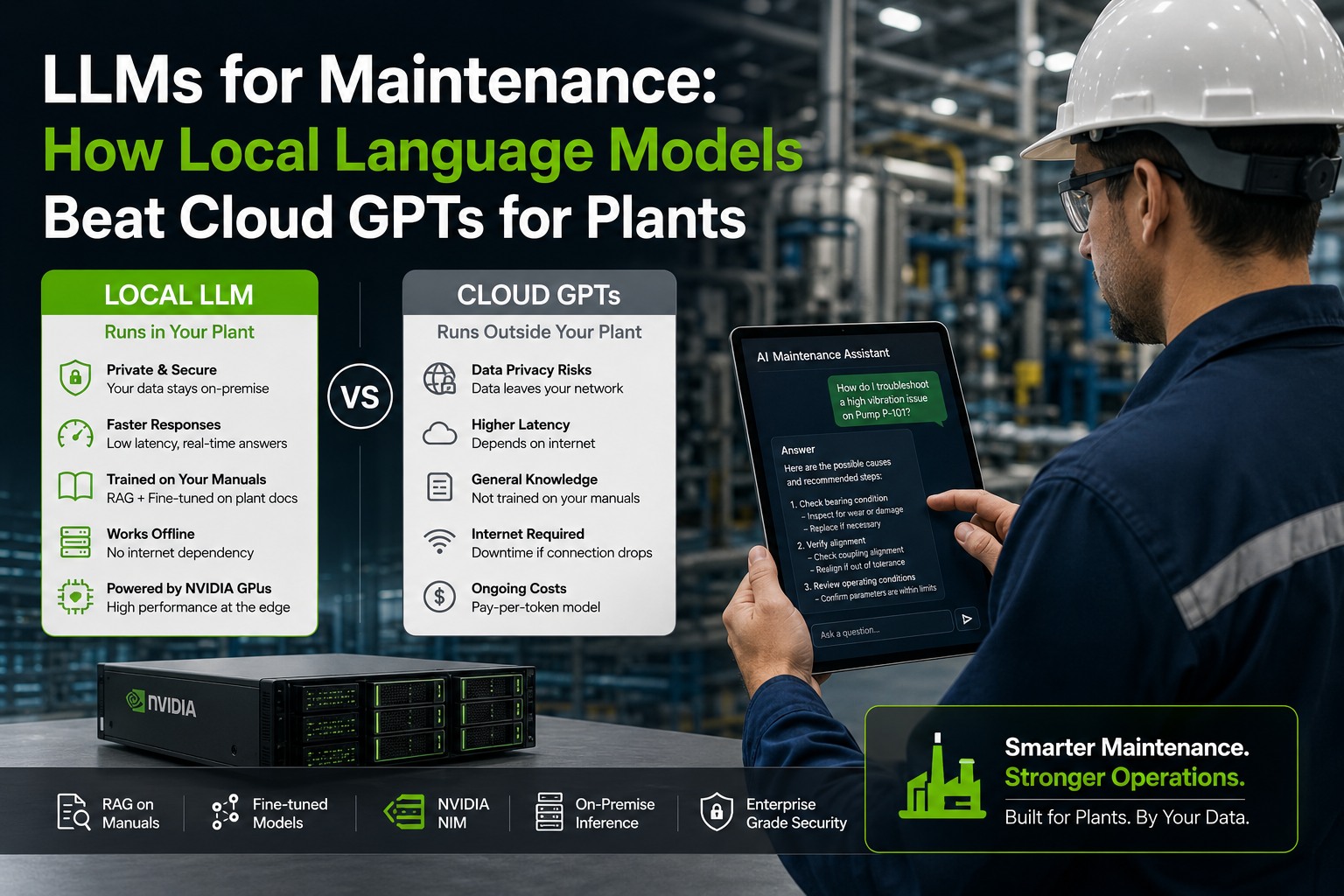
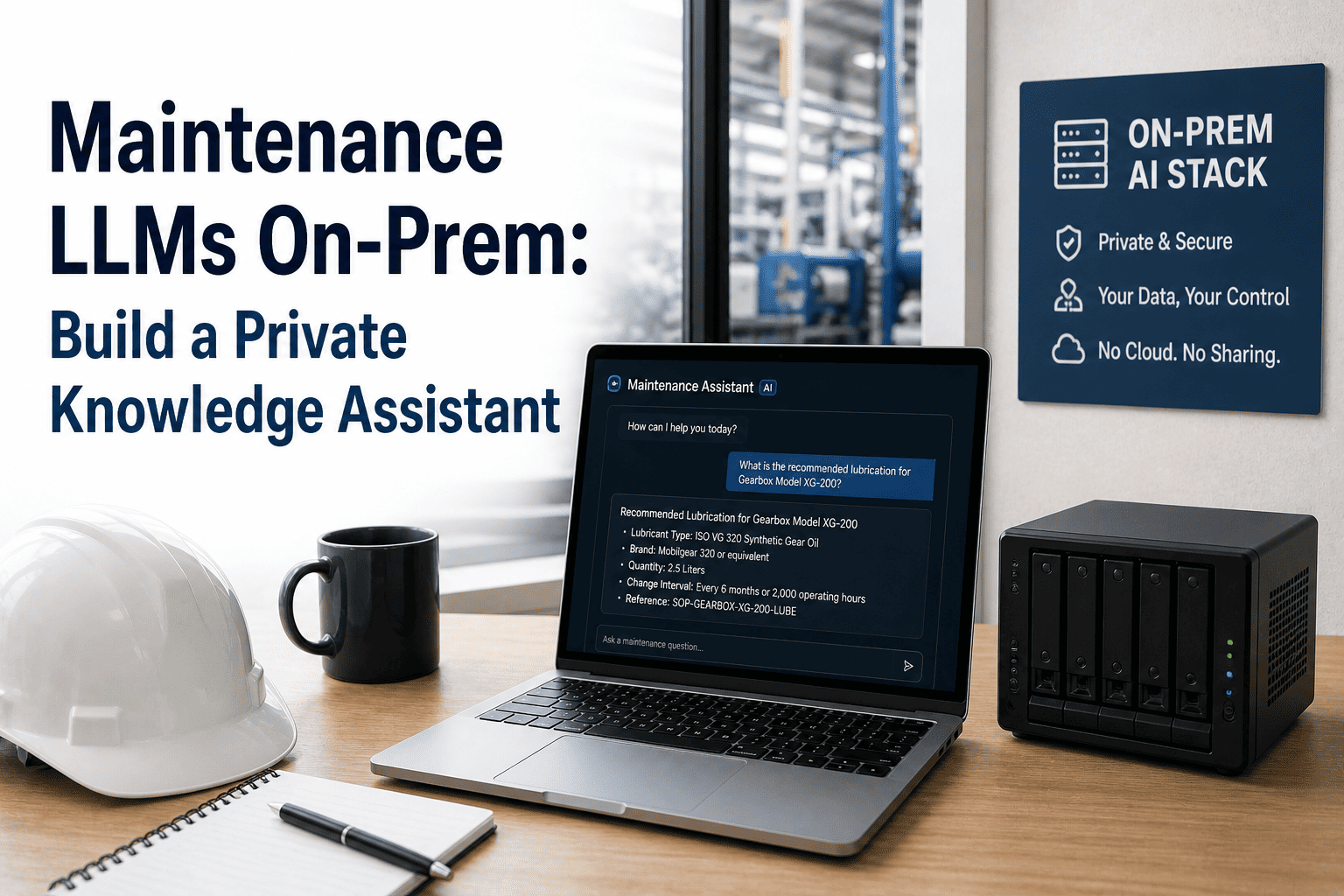
The past 18 months turned every plant manager into someone with an opinion on ChatGPT. The question for maintenance teams isn't whether large language models are useful — they obviously are — it's where the model should run. Cloud GPTs (ChatGPT, Claude, Gemini) are general-purpose, brilliant at open-domain reasoning, and a privacy nightmare for industrial maintenance work. Every prompt sends your equipment manuals, work order history, fault descriptions, and proprietary PLC code to a third-party server. Local LLMs running inside the plant on NVIDIA GPUs flip the equation: smaller models, but trained on YOUR manuals, with retrieval-augmented generation grounding every answer in your asset library — at sub-second response times, zero data egress, and zero per-token billing. Recent peer-reviewed work from IEEE Senior Members showed that ChatGPT-class LLMs paired with a local knowledge base "significantly improve performance" for industrial prognostics and health management. This guide walks through what local LLMs can do for maintenance, where they beat cloud GPTs, which open models run on which hardware tier, and how the OxMaint deployment ships a pre-trained, RAG-enabled industrial copilot in 6–12 weeks. Sign up free to see a local LLM running on your maintenance manuals.
MAY 12, 2026 5:30 PM EST , Orlando
Upcoming OxMaint AI Live Webinar — LLMs for Maintenance: Local Models Beat Cloud GPTs
Live session for maintenance directors, plant CIOs, reliability engineers, and IT security leaders evaluating LLM-powered industrial copilots. We'll walk through head-to-head benchmarks of cloud GPTs versus local LLMs for maintenance Q&A, demonstrate live RAG retrieval over equipment manuals and work order history, show which open models run on which hardware tier, and walk through the OxMaint deployment that ships pre-trained on industrial corpora and ready to run in 6–12 weeks.
Cloud GPT vs Local LLM — The Eight-Dimension Verdict
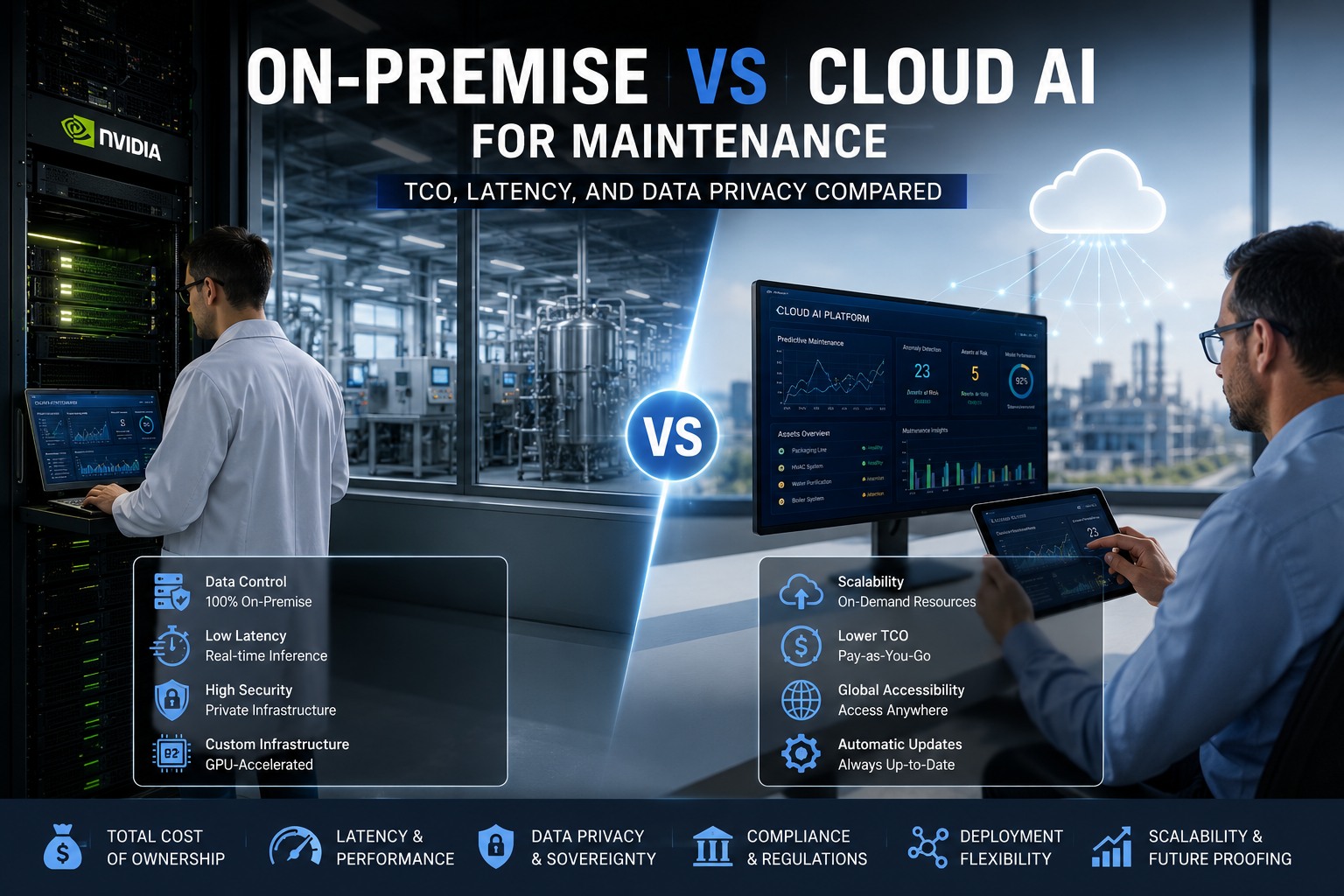
Cloud GPTs are excellent at general-purpose reasoning. Local LLMs are better at the specific work maintenance teams actually do. The eight-dimension matrix below compares them across the criteria that actually decide deployment success in industrial environments. The dimensions are weighted toward what matters in a plant — accuracy on YOUR equipment, data sovereignty, predictable cost — not toward generic chatbot benchmarks.
DIMENSION
CLOUD GPT
LOCAL LLM
WINNER
Data SovereigntyWhere your prompts live
Third-party servers
On-premises only
LOCAL
Domain AccuracyOn YOUR equipment + manuals
Generic — no plant context
RAG + fine-tuned on plant data
LOCAL
Open-Domain ReasoningMath, logic, code, general Q&A
405B+ params · best in class
8B–70B params · strong
CLOUD
Response LatencyTime to first token (TTFT)
~3 sec · variable
~38ms ITL · NIM-optimized
LOCAL
Cost Per TokenSteady-state usage
$0.50–$15 / 1M tokens
$0 marginal
LOCAL
Air-Gap OperationNo internet required
Internet always required
Fully air-gappable
LOCAL
Compliance PostureITAR, CMMC, GDPR, HIPAA
Vendor-dependent · gaps
By-architecture compliance
LOCAL
Initial CapexHardware + software setup
$0 (subscription only)
$72K–$94K per plant
CLOUD
Why RAG Changes Everything for Maintenance LLMs
The technical breakthrough that makes local LLMs viable for industrial use is Retrieval-Augmented Generation (RAG). Without RAG, an 8B-parameter local model knows what it was trained on — generic web text from 2023. With RAG, it knows everything in your equipment manuals, every work order in your CMMS history, every PLC code comment, and every troubleshooting note your team has ever written. The model retrieves relevant passages first, then generates an answer grounded in your data — with citations back to the source. Hallucinations drop dramatically because the model is no longer making things up; it's quoting your manuals. Book a demo to see RAG retrieving from your equipment library in real time.
01
Tech asks question
"Why is Pump 3 vibrating at 2× run speed?"
→
02
Vector search
RAG retrieves top 8 manual pages, 14 prior work orders, 3 root-cause analyses.
→
03
Local LLM grounds answer
Llama 70B on RTX PRO 6000 generates answer using only retrieved passages.
Not every local LLM needs a $19K Blackwell GPU. Smaller models run on edge appliances and deliver excellent maintenance Q&A performance. Larger models run on the central server and handle deeper reasoning, multi-step troubleshooting, and complex root-cause analysis. The OxMaint architecture deploys both — small models at the edge for fast technician chat, larger models at the center for harder problems. The table below shows which open-source LLMs fit which hardware tier and what each is best at. Sign up free to test these models on your maintenance use cases.
EDGE TIER
NVIDIA AGX Orin · 64GB
Llama 3.1 8B Instruct
~24 GB VRAM · 8B params
Fast technician chat · simple Q&A · log search
Mistral 7B Instruct v0.3
~14 GB VRAM · 7B params
Lightweight RAG · work order summarization
Phi-3 Medium 14B
~28 GB VRAM · 14B params
Balanced reasoning · code/PLC assistance
CENTRAL TIER
RTX PRO 6000 Blackwell · 96GB
Llama 3.1 70B Instruct
~80 GB VRAM · 70B params
Deep reasoning · multi-step RCA · the OxMaint default
Mixtral 8x22B Instruct
~88 GB VRAM · MoE 141B
Long-context manuals · 64K token window
Mistral Large
~70 GB VRAM · NIM-optimized
Enterprise-grade reasoning · multi-language
ENTERPRISE TIER
DGX Station GB300 Ultra
Llama 3.1 405B Instruct
~810 GB VRAM · 405B params
Frontier reasoning · synthetic data generation
DeepSeek-R1 Distill 70B
~80 GB VRAM · reasoning-tuned
Engineering analysis · math-heavy diagnosis
Custom fine-tunes
Trained on YOUR plant data
Domain-adapted via NeMo · LoRA / SFT / RLHF
Five Maintenance Workflows Local LLMs Run Today
Not theoretical. Not "future state." These are workflows running in production deployments today, where the cloud GPT alternative is either too slow, too expensive at scale, or too risky on data sovereignty grounds. Each workflow below is built into the OxMaint Synapse AI core out of the box. Sign up free to test these five workflows on your maintenance data.
1. Technician Chat Copilot
"How do I replace the seal on Pump 3?" → step-by-step procedure pulled from manual, with safety warnings, parts list, and prior work orders for the same task.
2. NLP Work Order Drafting
Sensor anomaly + voice description → fully populated work order with asset, fault category, severity, recommended procedure, and parts list.
3. Root Cause Analysis
Failure event + sensor history → 5-Why-style narrative cross-referencing manuals, prior failures, and operating-condition logs to identify probable root cause.
4. PLC Code Search & Generation
"Show me the alarm logic for Line 7" → retrieves Structured Text/ladder logic from PLC archive with explanation. Fine-tuned models can draft new code blocks.
5. Manual Search & Synthesis
Query 20 years of equipment manuals in seconds. Synthesize answers across multiple OEM documents into a single grounded response with full citations.
Owned, Not Rented — The OxMaint LLM Stack
The OxMaint AI Industrial LLM deployment isn't a SaaS subscription you pay every month forever. It's a pre-configured AI server bundled with the Synapse AI copilot — Llama 70B on the central server, smaller models on AGX Orin edge appliances, RAG over your equipment manuals and CMMS history, and the OxMaint dashboard tying it all together. Get a quote and order it like the hardware it is — pre-configured, pre-tested, ready to ingest your manual library and historical work orders within days, and owned outright the day delivery completes.
Perpetual License
No monthly fees, no per-seat charges, no per-token billing. Future costs are entirely optional and at your discretion.
Data Sovereignty
Manuals, work orders, prompts, fine-tuned weights all live on your server, behind your firewall. Air-gappable.
Source Access
Source code and modification rights included. Swap models, fine-tune freely, build custom RAG pipelines.
AI-Native Core
Predictive maintenance, anomaly detection, NLP work orders — built around the local LLM, not bolted on.
Pre-Configured · Pre-Trained · Ships in 6–12 Weeks
Order an OxMaint Industrial LLM Stack — Pre-Loaded, Owned
A complete on-prem industrial LLM deployment. AGX Orin appliances running Llama 8B / Mistral 7B for fast technician chat. RTX PRO 6000 Blackwell central server running Llama 70B + RAG pipeline + the OxMaint dashboard. NVIDIA NIM-optimized inference (5× throughput improvement). Pre-loaded with industrial corpora, ready to ingest your manual library, PLC archive, and CMMS history within days. NeMo fine-tuning toolchain included for plant-specific adaptation.
The OxMaint Industrial LLM Stack uses the standard per-plant architecture: central RTX PRO 6000 Blackwell server plus two AGX Orin edge appliances. Llama 70B + RAG, NIM-optimized inference, manual ingestion, fine-tuning toolchain, and CMMS connectors all included in the OxMaint AI Software + Integration line. Book a demo to walk through per-plant pricing for your LLM footprint.
Swipe to see breakdown
Component
Unit Cost
Per Plant
Notes
RTX PRO 6000 Blackwell 96GB Server
$19,000
$19,000
Llama 70B central inference
NVIDIA AGX Orin #1 (Chat Edge)
$4,000
$4,000
Llama 8B / Mistral 7B for tech chat
NVIDIA AGX Orin #2 (RAG Edge)
$4,000
$4,000
Vector store + embedding inference
Industrial Ethernet Switch + Cabling
~$2,500
~$2,500
Plant-floor switch, Cat6A, SFP modules
Local Electrical / Instrumentation
$8,000–$12,000
~$10,000
Rack power, UPS, network gateways
OxMaint AI Software + Integration
$35,000–$55,000
$45,000 avg
RAG pipeline, manual ingestion, fine-tuning
Per-Plant Total
$72,500–$94,500
~$84,500 avg
4-month delivery per plant
4-Plant Full Rollout (with Enterprise AI)
~$420,000–$520,000
Total programme
Parallel delivery + DGX Station GB300 Ultra
$84.5K
Avg per plant
4 mo
Delivery
$0
Per-token fees
∞
Perpetual
Perpetual · Owned · Source Access · Data Sovereignty
Stop Sending Plant Data to Cloud GPTs — Own Your AI
Local Llama 70B + RAG over your manuals. Sub-second responses. Zero data egress. Zero per-token billing. Air-gappable for ITAR/CMMC compliance. Your team owns the platform, the AI models, and the source code outright. The architecture every modern industrial AI program is converging on as cloud LLM costs and data sovereignty risks compound year over year.
Is a 70B local model really competitive with GPT-4 / Claude / Gemini for maintenance work?
For general-purpose reasoning, no — frontier cloud models with 400B+ effective parameters are still ahead on raw benchmarks. For domain-specific maintenance Q&A grounded in your manuals, yes, easily. The reason is RAG. A cloud GPT answering "what's the recommended bearing replacement procedure for our specific Pump 3" has only its general training data to work from — and it won't know your specific equipment unless you paste the entire manual into the prompt every time. A local Llama 70B with RAG has your full manual library indexed and retrieves the exact pages relevant to the question, then generates an answer grounded in those passages with citations. Peer-reviewed work from IEEE Senior Members published on arxiv (2312.14945) showed that ChatGPT-class LLMs paired with a local knowledge base "significantly improve performance" for industrial prognostics — accuracy, relevance, and insight all measurably better than the baseline cloud model. The local model wins because it knows your plant. The cloud model loses because it doesn't.
Can our equipment manuals (PDFs, scanned docs, OEM manuals) actually be ingested into the RAG system?
Yes — and this is the part most teams underestimate. The OxMaint deployment includes a full document-ingestion pipeline that handles: native PDFs (text extraction and chunking), scanned PDFs (OCR with tabular structure preservation), Word docs, plain text, HTML, and even images of nameplate diagrams. Equipment manuals from 1990s-era OEMs that exist only as scanned 300-DPI images can be processed — typical accuracy is 95%+ for text and 85%+ for tables and diagrams. The ingestion pipeline runs once during deployment and re-runs whenever new manuals arrive. Once indexed in the vector store, every page of every manual is searchable in milliseconds. Most plants we deploy with have 5,000-50,000 pages of manuals to ingest, which the AGX Orin edge appliance processes in 4-12 hours during initial setup.
What about model updates — don't cloud GPTs improve faster than local models?
In some senses, yes. OpenAI ships GPT updates roughly every 4-8 months and each is a bit smarter than the last. Open-source frontier models (Llama, Mistral, DeepSeek) ship updates every 3-6 months and have closed most of the gap to proprietary models — Llama 3.1 405B is comparable to GPT-4 on most benchmarks, and Llama 4 (released 2026) has narrowed it further. The OxMaint deployment supports rolling model upgrades: when a new Llama version drops, our team validates it against industrial benchmarks, then your stack is upgraded as part of normal maintenance — your fine-tunes and RAG indices migrate automatically. So you stay current with the open-source frontier, which is now within months of the proprietary frontier rather than years behind. The trade-off was much sharper in 2023 when GPT-4 was vastly ahead of any open model; in 2026 the gap is small enough that for domain-specific industrial work, RAG over your data plus a local 70B model wins for the reasons in the matrix above.
How does the cost math actually work — when does local LLM beat cloud GPT TCO?
Roughly speaking, at 5-10 million tokens per month of usage, local LLM TCO surpasses cloud GPT — and most maintenance deployments hit that within the first month of full rollout. A typical mid-size plant with 50 technicians using the LLM copilot 20 times per shift across 3 shifts generates 30-50 million tokens per month. At GPT-4 pricing (~$10 per million tokens for input + $30 per million for output), that's $1,000-$2,000 per month per plant. A 4-plant rollout: $4,000-$8,000 per month, $48,000-$96,000 per year, growing as adoption deepens. The OxMaint local stack: ~$84,500 per plant capex, ~$0 per-token marginal cost. Break-even is typically 12-18 months on token costs alone. Add in ITAR/CMMC compliance value, latency improvements, and predictability of TCO and most plants see breakeven inside 12 months. After that, every additional token is free.
How long until our maintenance team is actually using this in their daily work?
Most teams reach basic productivity within 2-3 weeks of deployment and full operational fluency within 2-3 months. The OxMaint deployment includes structured training: weeks 1-2 cover the chat copilot, work order drafting workflow, and mobile app basics; weeks 3-4 cover RAG-grounded troubleshooting, advanced query construction, and citation interpretation; weeks 5-12 cover power-user workflows including custom prompt templates, fine-tuning on plant-specific terminology, and integration with existing CMMS workflows. Adoption rates from production deployments: by week 4, typically 60-70% of technicians use the copilot at least daily. By month 3, 90%+ adoption with several queries per shift. The fastest adoption signal is when senior technicians start asking the LLM questions during shift handover meetings — that's a confidence indicator that the system has earned trust on the floor. Most plants hit that mark in the second month.