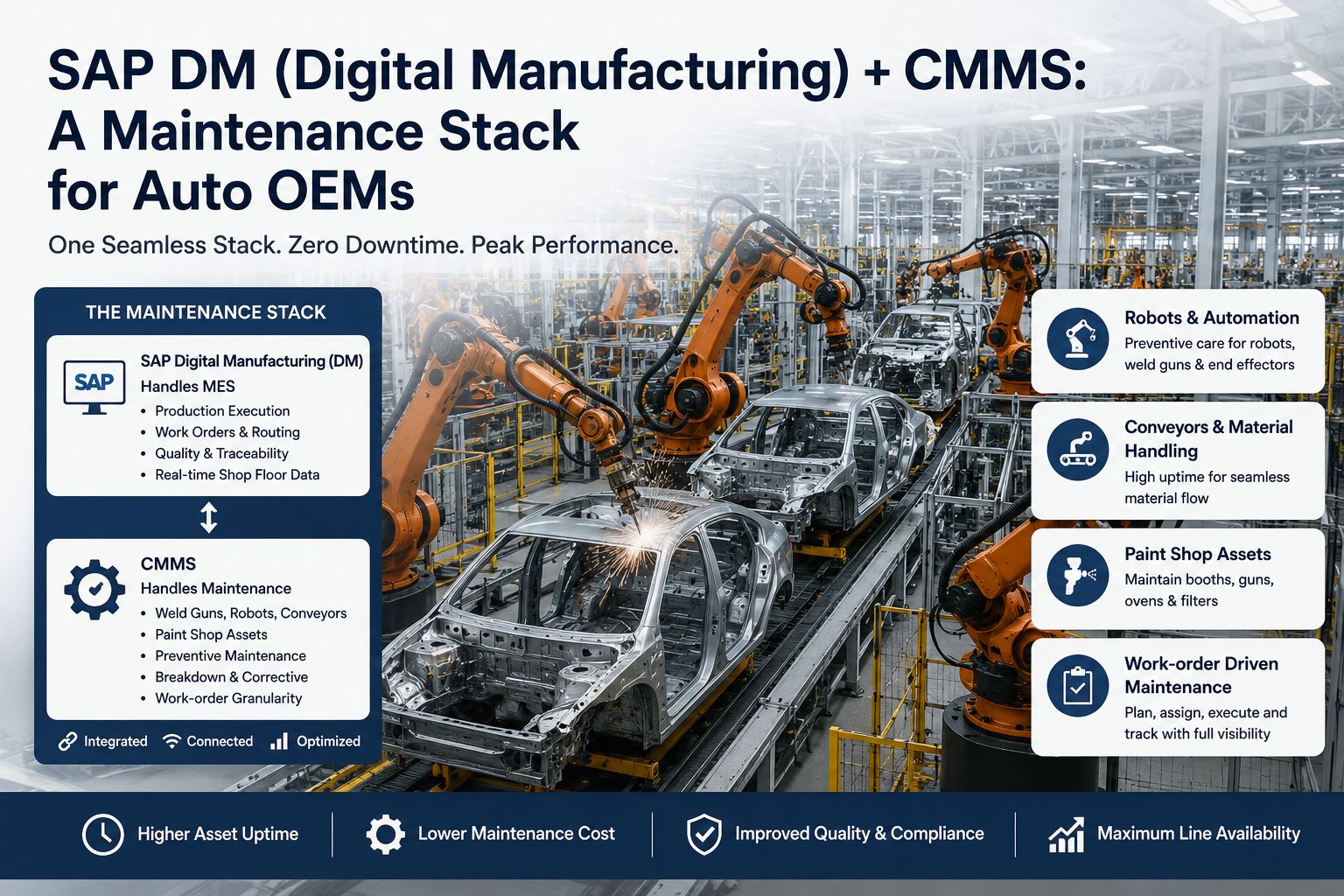
Automotive OEMs run two different clocks. The MES clock — tracking every vehicle through body, paint, and trim — and the maintenance clock — keeping every weld gun, robot arm, conveyor drive, and paint booth alive between shifts. SAP Digital Manufacturing (SAP DM) handles the first. OxMaint CMMS handles the second. This page lays out how the two systems compose into a single maintenance stack for auto OEMs — at work-order granularity, with on-premise and cloud deployment options to match plant-level IT policy.
Two Systems. One Plant. Clean Separation of Duties.
SAP DM is the cloud-native MES that orchestrates production execution — work centers, operator dashboards, genealogy, OEE. OxMaint is the asset-centric CMMS that keeps the physical equipment running — weld guns, robots, conveyors, paint shop, stamping, EV battery cells. They share data; they don't compete for ownership.
The Auto OEM Production Floor — Mapped to Two Software Layers
Every automotive plant runs the same five major zones: stamping, body shop, paint shop, trim/final assembly, and the battery/powertrain line. Each zone has a production execution problem (which SAP DM solves) and an asset reliability problem (which OxMaint solves). The line between the two software systems is not philosophical — it is operational, drawn cleanly through the shop floor.
- Production order release to press lines
- Coil traceability and material genealogy
- Cycle-time tracking and OEE reporting
- Scrap, rework, and quality holds
- Press tonnage monitoring and die wear
- Transfer system PM and lubrication routes
- Hydraulic system condition-based work orders
- Die change-out and refurb tracking
- Body-in-white sequencing and routing
- Weld map execution per VIN
- Build genealogy and traceability
- Quality station inspection results
- Weld gun cap change scheduling per spot count
- Robot servo, reducer, and arm joint health
- Fixture wear and clamping cylinder PM
- SPC defect-to-work-order auto-routing
- Color sequencing and batch tracking
- Booth occupancy and oven cycle execution
- Defect codes and rework loops
- Paint consumption per VIN
- Booth filter and arrestor change schedules
- Bell atomizer and applicator PM
- Oven burner, blower, and HVAC reliability
- Sludge system and waste handling assets
- Operator-by-operator build sequence
- Torque verification and DC tool data capture
- Marriage point and powertrain join
- End-of-line testing and rolls dispatch
- Skid, EMS, and overhead conveyor health
- DC tool calibration and torque audit cycles
- AGV battery and motor PM
- End-of-line tester instrumentation upkeep
- Cell-to-module-to-pack genealogy
- Formation cycle execution and binning
- High-voltage test results capture
- Powertrain assembly torque routing
- Formation chamber and chiller reliability
- High-voltage tester calibration cycles
- Dispensing and laser-welding equipment PM
- Cleanroom HVAC and ESD compliance routines
Why Auto OEMs Need Both Layers — Not One Generic Platform
It is tempting to imagine SAP DM extending into asset management or OxMaint stretching into MES territory. Neither works at automotive scale. The asset model, work-order granularity, and operational tempo of maintenance are fundamentally different from production execution. A few examples from real plants show why.
Different Time Horizons
SAP DM thinks in seconds — takt time, station dwell, cycle compliance. OxMaint thinks in weeks and months — PM frequency, MTBF, MTTR, asset lifecycle. Forcing one engine to handle both either over-engineers the production loop or under-serves the reliability loop.
Different Object Models
MES objects: production order, operation, work center, material lot. CMMS objects: equipment, functional location, maintenance plan, spare part, technician. Mapping one onto the other creates phantom objects that confuse audit trails and break upgrade paths.
Different User Personas
SAP DM is used by operators, line leads, and quality engineers — at terminals on the line. OxMaint is used by maintenance technicians, reliability engineers, and storeroom attendants — on mobile devices, often inside the machine. The UX requirements diverge sharply.
Different Release Cadences
SAP DM ships quarterly cloud releases tied to the SAP roadmap. OxMaint ships maintenance-specific updates — new sensor types, new analytics, new compliance templates — outside the MES release calendar. Coupling them tightly slows both.
The Maintenance Stack: How OxMaint Composes With SAP DM
A clean stack architecture has SAP DM at the execution layer, OxMaint at the asset layer, and your SAP S/4HANA or ECC ERP as the system of record below. Data flows between all three through standardized interfaces — no point-to-point spaghetti, no proprietary middleware that locks you in.
Deployment Choice Matters: On-Premise vs Cloud for Auto OEMs
Automotive IT environments rarely fit one deployment mold. Some plants run inside an air-gapped OT network with no external connectivity. Others connect directly to the corporate cloud backbone. OxMaint deploys both ways — and many OEMs run a hybrid: cloud for HQ analytics, on-premise for plant-level execution.
- OT network is air-gapped from corporate IT
- Local data residency mandates apply
- Plant has existing server infrastructure and SRE capacity
- Legacy SAP ECC integration is on-premise
- Full data residency, full IT control
- Customer-managed upgrades and backups
- Higher TCO for hardware and ops
- Slower feature adoption between releases
- Multi-plant OEM standardizing across sites
- Cloud-first IT strategy already in place
- SAP DM and S/4HANA Cloud already deployed
- Mobile-heavy technician workforce
- Zero plant-side server footprint
- Automatic feature releases and patches
- Outbound HTTPS only — no inbound firewall openings
- Centrally hosted, multi-tenant infrastructure
Real Asset Examples: Where OxMaint Owns the Work Order
SAP DM does not generate work orders for a weld gun whose cap-change counter just tripped. SAP DM does not schedule paint booth filter swaps based on differential pressure. OxMaint does. Here are the concrete asset-level workflows that an automotive CMMS owns end-to-end — with predictive signals feeding from the shop floor and confirmations flowing back to SAP through standard interfaces.
Weld Gun Cap Change
Trigger: Spot count threshold from robot controller
OxMaint receives the cumulative spot count, auto-generates a work order at the configured interval, dispatches it to the body-shop maintenance team, and confirms completion back to the asset record. SAP DM is informed only if the cell goes down.
Robot Servo Health Monitoring
Trigger: Vibration anomaly or torque drift
IIoT vibration sensors stream to OxMaint's predictive engine. A drifting servo motor on weld robot R-247 raises a predictive work order 18 days before estimated failure. Maintenance plans the intervention during the next scheduled non-production window.
Conveyor Drive Reliability
Trigger: Current draw or temperature anomaly
Skid and overhead conveyor drives feed motor current and bearing temperature into OxMaint. Trends are baselined per drive. Anomalies generate condition-based work orders before the conveyor stops a downstream marriage station.
Paint Booth Filter Cycle
Trigger: Differential pressure across filter bank
Booth controllers stream DP readings to OxMaint. Filter PM is no longer time-based — it is condition-based on overspray load. Reduces rework from contamination and extends filter life by 20–35% in published case material.
DC Tool Calibration Audit
Trigger: Torque audit cycle or quality drift
Final-assembly DC tools have a calibration audit cycle tied to torque verification. OxMaint manages the calibration schedule, audit records, and out-of-tolerance dispositions — keeping the IATF 16949 quality audit trail intact.
Battery Formation Chamber
Trigger: Chamber temp drift or chiller load anomaly
Formation chambers are mission-critical assets in the battery line. OxMaint tracks chiller capacity, chamber temperature stability, and high-voltage tester calibration — preventing cell binning errors that scrap entire production batches.
The Production Stop That Should Never Happen Twice
Every automotive OEM has a story of a single failure that stopped the line for hours — a robot reducer that seized, a paint booth that contaminated 40 bodies, a conveyor drive that took out an entire shift. The cost is brutal. Industry studies estimate unplanned automotive downtime at $1.3 million per hour on average. The maintenance stack exists precisely to make sure that failure never repeats — by encoding the lesson into a PM schedule, a predictive threshold, or a spare-part stocking rule.
Failure event captured
OxMaint records the breakdown notification, root cause, parts consumed, technician hours, and impact on the SAP DM production order.
Reliability analysis
Reliability engineer reviews failure pattern across asset class. Identifies systemic causes — bearing batch, control parameter, environmental factor.
Standard updated
PM schedule revised, predictive threshold tightened, spare-part stocking rule adjusted, technician SOP updated in the mobile app.
Standard enforced
Updated PM auto-generates work orders on the next cycle. Compliance is tracked. The same failure cannot recur silently.
Integration Patterns Between SAP DM and OxMaint
The connection between SAP DM and OxMaint runs through three concrete integration patterns. Each maps to a specific operational event. Together they produce a complete loop between production execution and asset maintenance — without forcing either platform to do work the other does better.
See the SAP DM + OxMaint Stack in Your Plant Layout
Book a working session with a solutions engineer who has architected the MES + CMMS stack for global auto OEMs. We will walk through your specific zone layout, SAP version, and on-premise versus cloud deployment fit — before any architecture diagram is signed off.