Your CMMS selection process will determine maintenance operations for the next seven to ten years. Get it right and your team gains a competitive advantage that compounds annually. Get it wrong and you'll be planning a costly replacement project before the contract amortizes. The challenge isn't a lack of options—it's that most RFP processes evaluate the wrong things, weight criteria poorly, and lean on demos that vendors choreograph for maximum effect. A rigorous RFP template levels the playing field. Book a free demo to walk through this evaluation framework before your next vendor selection.
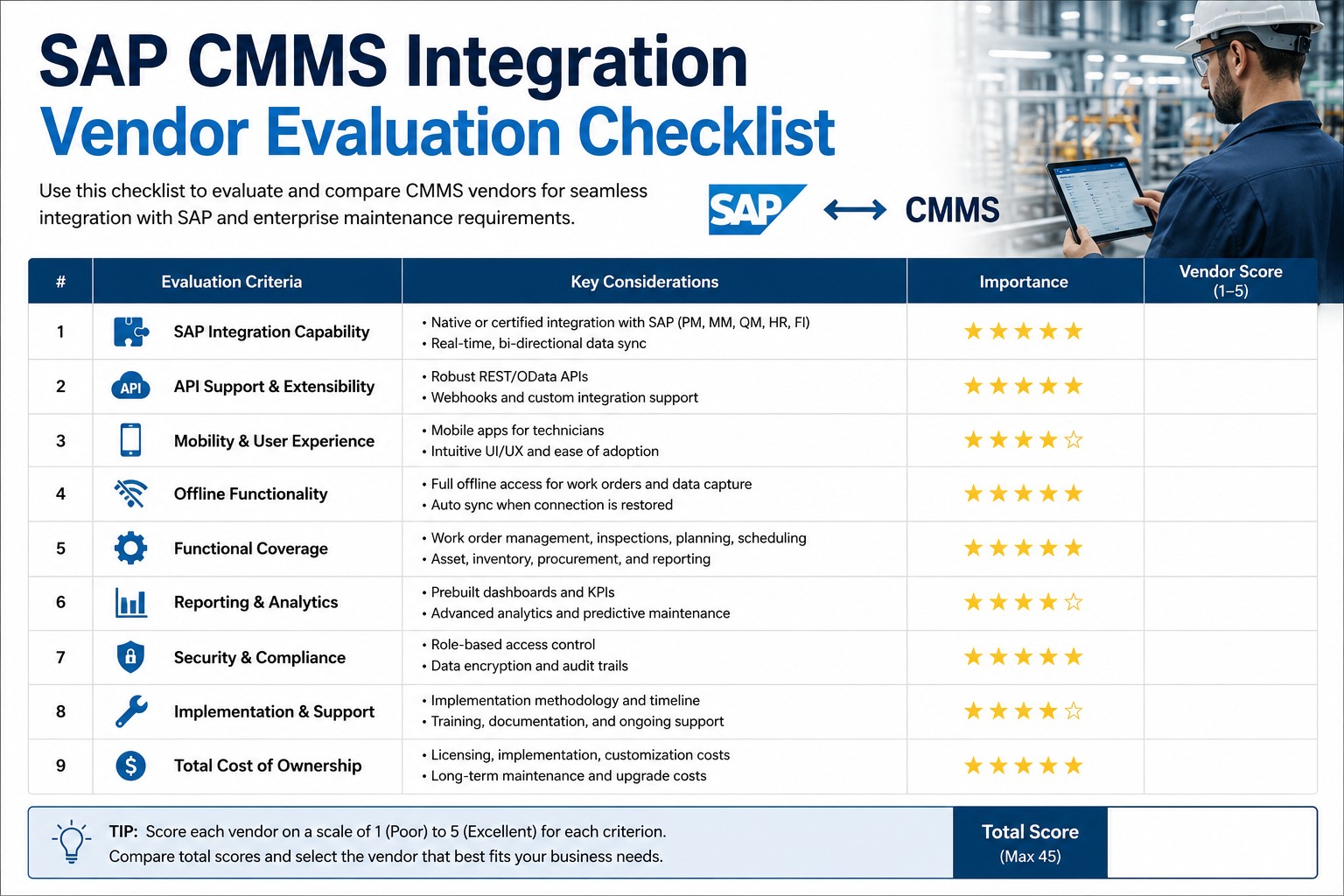
Vendor Evaluation Scorecard
Sample · 7 Weighted Criteria
Why Most CMMS RFPs End in Buyer's Remorse
Software Advice's 2025 CMMS buyer behavior research found that 64% of maintenance software purchasers regret some aspect of their selection within 24 months. The pattern is consistent: buyers fall in love with demo theatrics, underweight integration depth, and skip rigorous reference checks. The vendor who wins is usually the one with the best sales motion—not necessarily the best long-term fit. A defensible RFP template flips this dynamic by weighting evaluation criteria according to operational reality, requiring vendors to demonstrate specific capabilities (not just describe them), and forcing reference conversations into structured formats that surface real performance.
64%
of CMMS buyers regret selection decisions within 24 months
3.7x
higher satisfaction scores when buyers use weighted scoring matrices vs. ad-hoc evaluation
$850K
average switching cost when CMMS selection requires replacement within 3 years
The scoring matrix above isn't a vanity template—it forces honest conversations about what your operation actually needs versus what looks impressive in a sales demo. Book a free demo to see how disciplined scoring changes the way buying teams evaluate vendors.
The 7 Evaluation Criteria That Predict Long-Term Vendor Success
After analyzing post-implementation outcomes across hundreds of CMMS deployments, the seven criteria below consistently separate vendors who deliver from vendors who oversell. Notice that "feature count" and "user interface polish" aren't on the list—both score poorly as predictors of long-term success. The weights reflect typical priorities for SAP-integrated manufacturing operations; adjust them based on your specific context, but the categories should remain constant.
01
Native API support, IDoc handling, S/4HANA readiness, certified connectors, real-time vs batch sync capability
02
Offline mode, photo and voice capture, barcode scanning, ergonomic technician workflows, push notifications
03
Time-to-value benchmarks, pre-built SAP accelerators, configuration vs customization, change management tooling
04
Total Cost of Ownership
15%
5-year TCO including licensing, implementation, maintenance, integration platform fees, and internal team costs
05
Financial health, customer retention rates, product roadmap clarity, M&A risk, leadership tenure
06
Response SLAs, escalation paths, named CSM availability, community resources, training delivery model
07
Comparable industry references, willingness to share implementation challenges, post-go-live realities
Structuring the Technical Requirements Section
The technical requirements section is where most RFPs go wrong. Buyers either copy generic templates that vendors easily check-box past, or write hyper-specific requirements that lock out viable solutions. The right approach captures must-have capabilities at the integration architecture level while leaving room for vendors to propose superior approaches. Group requirements into mandatory (deal-breakers), highly preferred (heavily weighted), and nice-to-have (tiebreakers)—and require vendors to respond with specific configuration examples, not just yes/no answers.
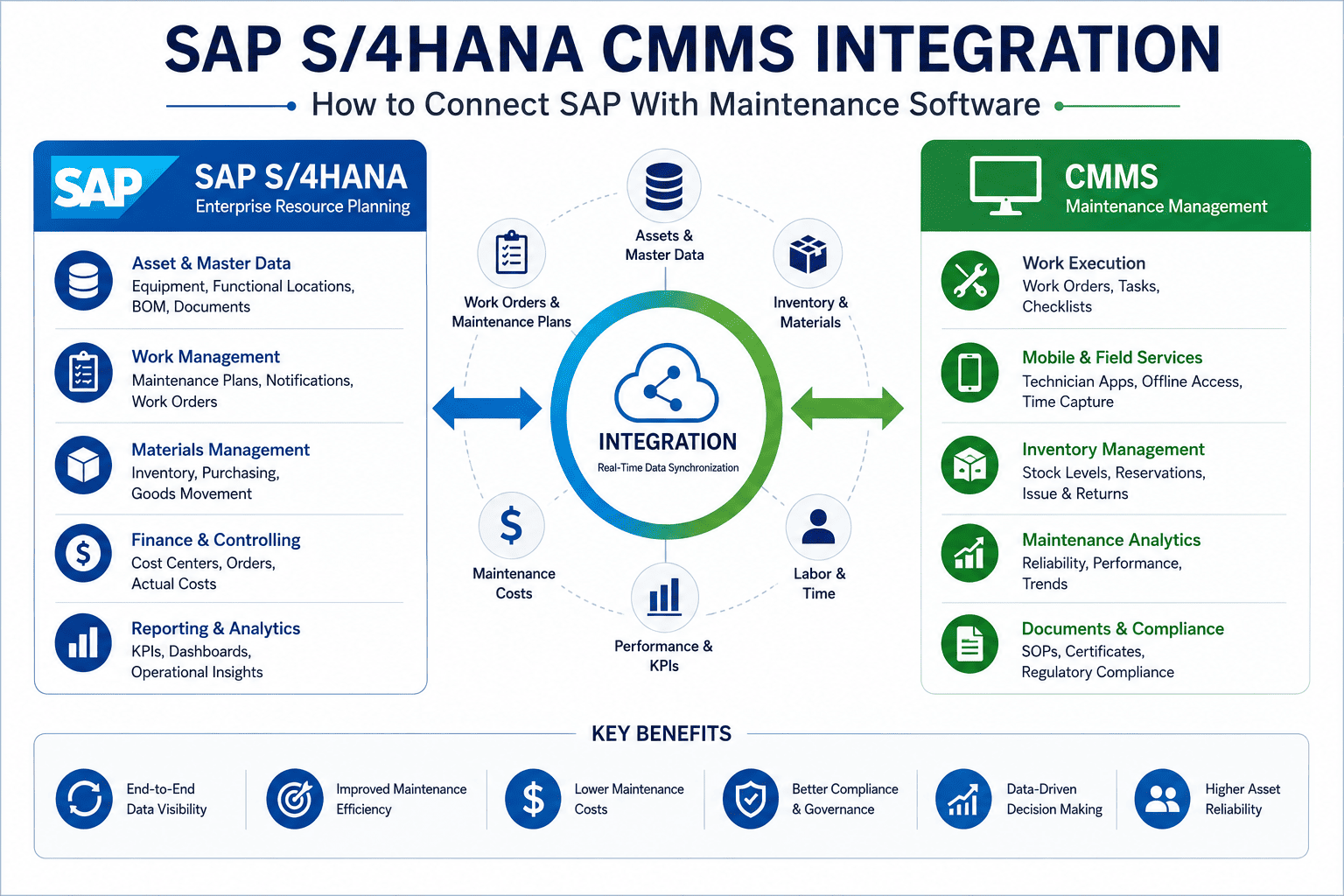
SAP integration architecture — REST API, OData, CPI, or direct connection with version compatibility detail
Master data sync requirements — equipment, functional location, BOM, materials, cost centers
Transactional flows — work order create/update, time confirmation, goods movement, notification routing
Mobile requirements — supported OS, offline behavior, security model, MDM compatibility
Security and compliance — SOC 2, ISO 27001, GxP capability, data residency, SSO support
Scalability targets — concurrent users, transaction volume, multi-plant rollout architecture
Reporting and analytics — embedded dashboards, data export, API access, BI tool integration
The full RFP template includes detailed sub-questions for each requirement plus a sample response evaluation rubric. Sign up free to access the complete RFP template with response evaluation guidance built in.
Designing Demo Scripts That Reveal Real Capability
Vendors arrive at demos with their best-foot-forward script. To find the truth, send them yours instead. A structured demo script forces every vendor to demonstrate the same workflows against the same scenarios—removing the variance that makes side-by-side evaluation impossible. The most revealing demos run for 90-120 minutes and cover three distinct scenarios: a routine workflow, an edge case, and a deliberately stressed scenario where the system should fail gracefully or recover.
Run This Demo Script Against Oxmaint
Use your own evaluation framework. Send us your demo script ahead of time, and we'll walk through every scenario—routine, edge case, and stressed—exactly as you would test any vendor. No theatrics, just capability demonstration.
Building a Defensible Scoring Matrix
The scoring matrix is what survives executive scrutiny when procurement asks "why this vendor over that one?" Weighted scoring with documented evidence per criterion eliminates the "gut feel" decisions that get challenged six months later. The methodology below produces auditable scoring outputs: each criterion gets a 1-5 rating tied to specific evidence from vendor responses, demos, and references—then multiplied by the criterion weight to produce a weighted score.
Operations ready to apply this scoring framework against current shortlist vendors can request a calibration session with our team. Book a free demo to apply this scoring matrix to your live vendor evaluation.
The Final 30 Days: Reference Checks & Contract Negotiation
The last 30 days of vendor selection are where buyers either confirm their choice or surface deal-breaker concerns. Reference checks deserve more rigor than they typically receive. Don't accept the references vendors offer—ask for two specific reference types: one comparable industry/scale operation, one that went live within the last 12 months. The first reveals fit; the second reveals current implementation reality. The questions below separate vendors who deliver from vendors who oversell.
What surprised you during implementation that wasn't in the original scope?
Which features did you expect to use that didn't deliver what was demonstrated?
How responsive is vendor support when you raise critical production issues?
If you were redoing the selection today, would you choose this vendor again?
What's your technician adoption rate today versus what you projected at signing?
How accurate were the vendor's TCO projections against your actual three-year spend?
Expert Perspective: How Buying Teams Lose Their Best Vendor
The most common mistake I see in CMMS selection isn't picking the wrong vendor—it's the right vendor losing because they refused to play the bad demo game. Vendors who insist on structured demos against your scenarios, who push back on unrealistic timelines, and who give honest answers about implementation challenges often score lower in "ease of working with" subjective ratings. But they're usually the ones who deliver. Buying teams should reward vendors who challenge assumptions, not penalize them. The vendor who tells you everything you want to hear during selection will not tell you what you need to hear during implementation.
Reward Honest Pushback
Vendors who question your scope, timeline, or assumptions during evaluation are demonstrating the consultative behavior you need during implementation.
Score Evidence, Not Charisma
Every score must trace to specific evidence from the response document, demo recording, or reference call. Subjective impressions don't survive procurement review.
Validate Implementation Reality
Talk to customers who went live in the last 12 months. Older references describe the vendor that existed; recent references describe the vendor you'll work with.
Teams entering final-round evaluations can request a structured walkthrough designed for procurement-grade vendor comparison. Book a free demo to validate your shortlist against this evaluation framework.
Test This Framework Against Real Capability
The best way to validate any RFP framework is to run it against a real vendor. Send us your evaluation criteria, your scoring weights, and your demo script—then watch us respond the way every vendor should.
Frequently Asked Questions
How long should an SAP-CMMS integration RFP process take?
Twelve to sixteen weeks from RFP release to signed contract is typical for mid-size deployments. Shorter timelines compromise reference checking and contract negotiation; longer timelines often signal indecisive buying teams or expanding scope. The breakdown most operations follow: requirements finalization (2 weeks), RFP distribution and response period (4 weeks), response evaluation and shortlist (2 weeks), demos and deep-dives (3 weeks), reference checks and contract negotiation (3 weeks). Compressing any phase below half these durations correlates strongly with later regret.
Should we use weighted scoring or pass/fail evaluation for technical requirements?
Both, sequentially. Use pass/fail for mandatory requirements that filter out viable vendors—security certifications, supported SAP versions, hosting model. Vendors failing any mandatory requirement are eliminated before scoring. Then apply weighted scoring to remaining vendors across the differentiating criteria. This two-stage approach eliminates the common failure mode where a vendor with one critical capability gap still scores well because they excel elsewhere—weighted scoring alone can mask deal-breakers that pass/fail filters catch immediately.
How many vendors should we invite to the formal RFP?
Four to six vendors is the practical sweet spot. Below four limits competitive tension and reduces negotiating leverage; above six creates evaluation fatigue and dilutes the depth of analysis any single vendor receives. Pre-RFP discovery calls with 8-12 vendors typically narrow to a formal RFP list of 4-6 viable candidates. Demo invitations should narrow further to 2-3 vendors who clear initial response scoring, with final negotiations against the top two.
What's the biggest red flag during vendor demos?
Vendors who refuse to demonstrate against your scenarios and insist on running their own demo script. Capable vendors welcome the chance to show their platform against real-world workflows. Vendors who deflect with "we'll customize that during implementation" are signaling either capability gaps or unwillingness to be transparent. A close second red flag: demo environments that show only happy-path workflows—real platforms have admin screens, error messages, and configuration interfaces, and vendors confident in their product will show all of them.
How do we handle vendors who refuse RFP response in our template?
Politely decline their participation. Vendors who won't conform to a structured response format are signaling either incapability (they don't have answers to the questions) or arrogance (they want to control the narrative). Neither bodes well for a multi-year implementation partnership. The exception: enterprise vendors with valid concerns about NDA constraints around specific technical details—those can be addressed with focused sub-meetings rather than abandoning the structured framework entirely.