If you run industrial operations on SAP, Joule is the AI copilot sitting inside your ERP, and it's compelling. But when finance asks what it actually costs over five years, the answer gets murky fast. SAP doesn't publish Joule pricing; it's metered through consumption-based AI Units whose rates aren't fixed in most contracts, and overage charges can run 150 to 200 percent of your contracted rate. OxMaint AI takes the opposite approach: an on-premises platform with a fixed, knowable hardware cost and no per-interaction meter. This comparison breaks down both on licensing, infrastructure, implementation, and scalability so you can see which delivers the lower total cost of ownership for maintenance-heavy operations. You can book a free demo to model your own numbers.
Two Fundamentally Different Cost Models
The single biggest TCO driver isn't a feature, it's the pricing architecture. Joule is a cloud copilot billed by usage; OxMaint is an owned, on-premises system billed once for hardware plus software. That distinction shapes every line of the budget, so before comparing capabilities it helps to see how each platform's costs actually accrue.
- Billed by AI Units drawn down per interaction
- Rates not published; vary by negotiation
- Requires RISE with SAP / S/4HANA Cloud
- Joule Agents consume far more units than copilot chats
- Overage billed at 150–200% of contract rate
- One-time hardware stack, roughly $84.5K per plant
- No per-interaction metering or unit drawdown
- Runs on-prem at the edge, no cloud lock-in
- Usage can scale without a rising meter
- Cost is knowable on day one and stays flat
The TCO Line Items That Actually Move the Needle
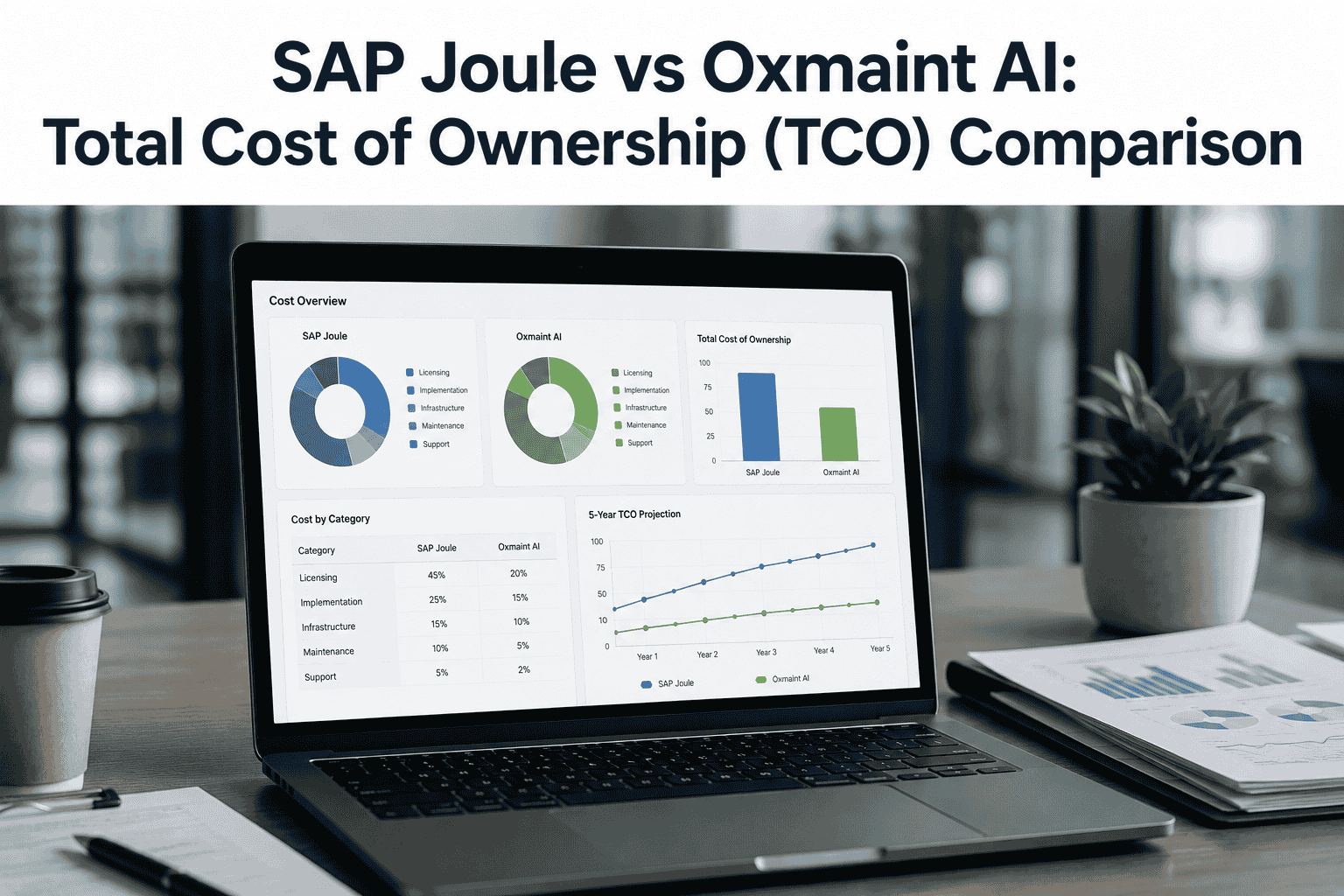
Total cost of ownership is more than a license fee. It's licensing plus infrastructure plus implementation plus the ongoing operational cost of running and scaling the system. When you lay the two platforms side by side across those categories, the trade-offs become concrete. SAP Joule wins on native ERP context if you're already deep in S/4HANA; OxMaint wins on cost predictability and on running independently of cloud consumption meters.
| Cost Dimension | SAP Joule | OxMaint AI |
|---|---|---|
| Pricing model | Consumption-based AI Units, unpublished rates | Fixed one-time hardware plus software |
| Cost predictability | Low; overage can hit 150–200% of rate | High; flat and knowable upfront |
| Infrastructure | Cloud-only on SAP BTP | On-prem edge servers, data stays local |
| Prerequisites | RISE with SAP / S/4HANA Cloud | None; deploys independent of ERP suite |
| Scaling cost | Rises with every additional interaction | Flat once hardware is in place |
| Data residency | Processed in SAP cloud | Stays on the plant floor, fully on-prem |
| Best fit | Deep S/4HANA shops wanting native copilot | Maintenance-heavy industrial sites |
The pattern is clear: Joule's value is tied to how embedded you already are in SAP's cloud, and its cost is tied to how much you use it, an equation that gets less favorable as adoption deepens. OxMaint's value is tied to predictable economics and local control. Teams weighing the two can sign up free to map their own maintenance workload against a fixed-cost model.
Where the Five-Year Numbers Diverge
TCO is a multi-year story, and that's where the consumption model deserves the most scrutiny. With Joule, light first-year usage often falls inside a bundled AI Unit allocation, so the early bill looks reasonable. The problem shows up in years two and three: as more roles adopt Joule and you start running unit-hungry Agents for tasks like maintenance planning, consumption climbs and overage invoices appear, with under-modeled customers facing six-figure annual surprises. A fixed on-premises cost doesn't bend that way, the curve stays flat regardless of how heavily your technicians lean on it. Teams can book a free demo to see both curves plotted on their own usage assumptions.
Capabilities: It's Not Just About Price
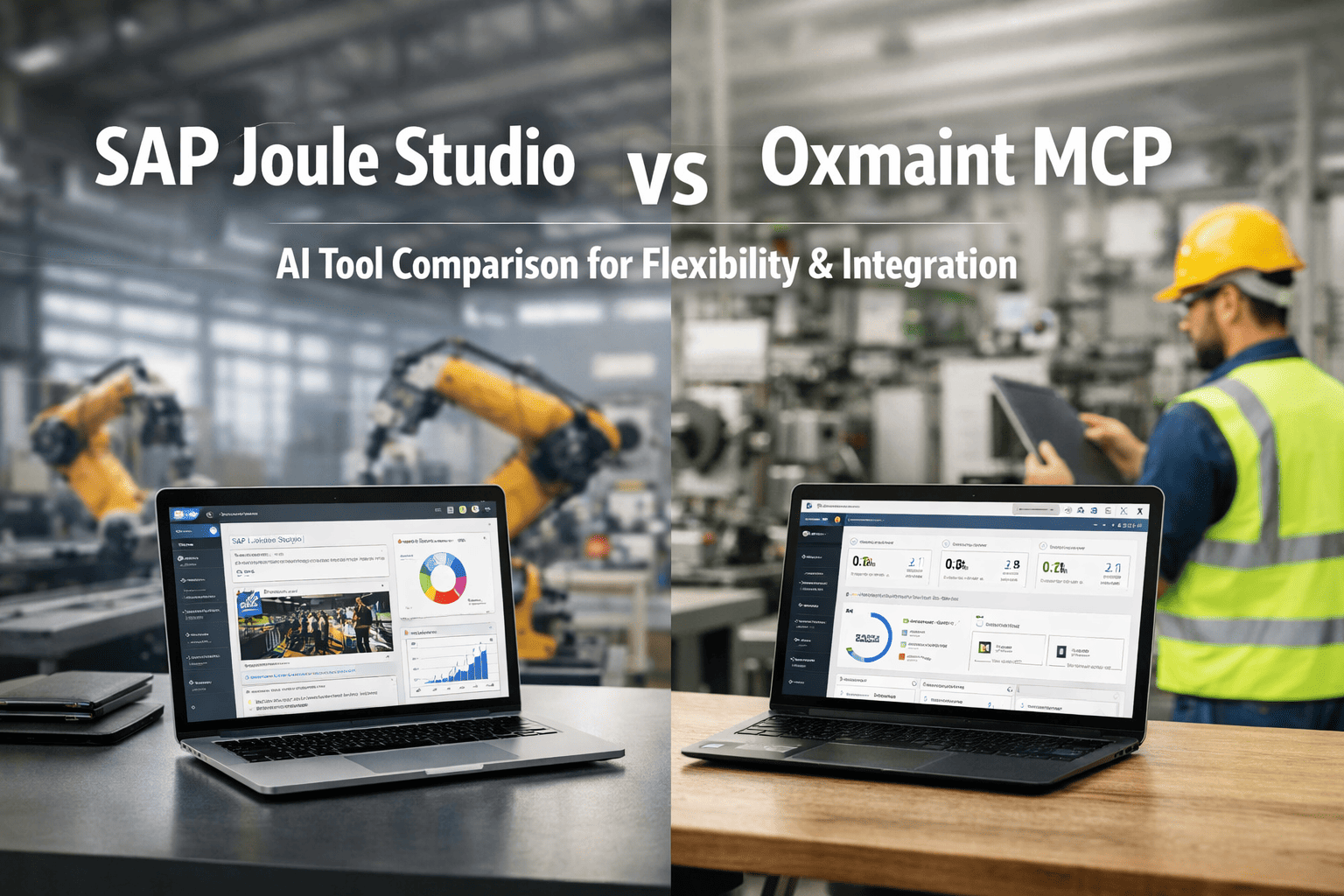
Cost only matters relative to what each platform does. SAP Joule is a broad enterprise copilot embedded across finance, procurement, HR, supply chain, and manufacturing, with Joule Agents that automate multi-step workflows including maintenance planning, all grounded in SAP's data and knowledge graph. Its strength is breadth and native ERP context. OxMaint is purpose-built for industrial maintenance: predictive maintenance, condition monitoring, work-order automation, and asset management running on edge hardware at the plant. Its strength is depth in maintenance and the ability to operate without routing plant data to the cloud. Maintenance teams can sign up free to explore the maintenance-specific capabilities firsthand.
Expert Perspective: Read the Meter Before You Sign
The most common TCO mistake with consumption-based AI is budgeting from year-one usage. The bundled allocation reflects what the vendor chose to include at a price point, not what your organization will actually consume once adoption spreads and agents run at scale. Model the full curve, including overage, before you commit, because that's where the real cost lives.
The Bottom Line on Total Cost of Ownership
There's no universal winner, only the right fit for your operation. If you live inside S/4HANA Cloud and want one assistant across the whole enterprise, Joule's native integration is hard to beat, provided you model consumption honestly and budget for the meter. But if your priority is maintenance reliability, predictable multi-year economics, and keeping plant data on-premises, a fixed-cost platform like OxMaint AI typically delivers the lower and more knowable total cost of ownership, especially as usage scales. The deciding question is simple: do you want a cost that grows with adoption, or one you can lock in on day one?
For maintenance-heavy industrial operations weighing AI platforms, the smartest move is to put both cost models on the same page against your real asset base and usage patterns. Teams ready to run that analysis can sign up free to scope a fixed-cost deployment for their plants.