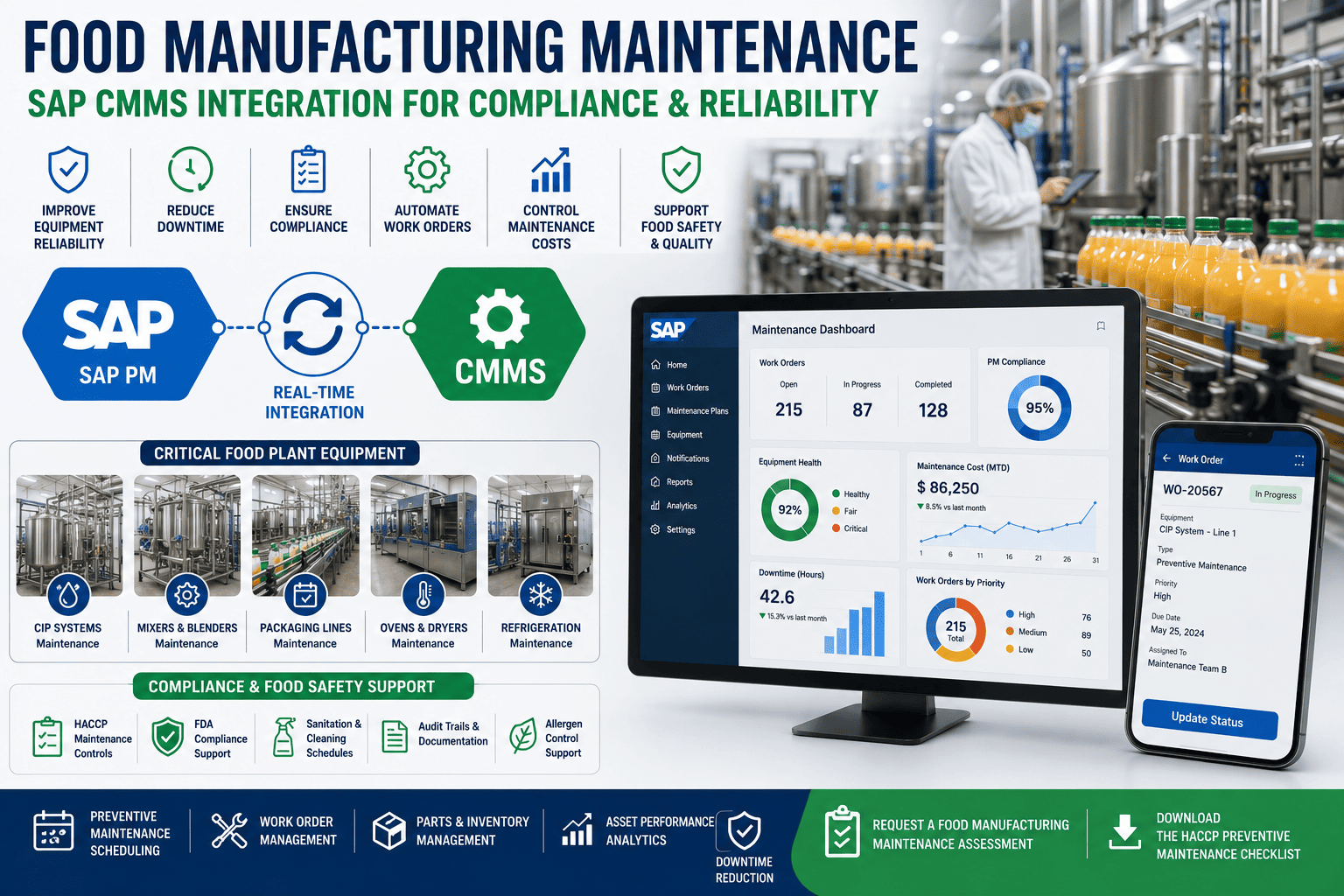
A line shutdown at a food plant doesn't just cost you production hours — it costs you a regulatory audit, a potential recall investigation, and the trust of your retail buyers. Every conveyor, filler, pasteurizer, and CIP circuit in your facility has a compliance obligation attached to it, not just an uptime number. Yet most food manufacturers are still managing preventive maintenance with spreadsheets, paper logs, and SAP PM modules that were never configured for the realities of food safety. That's the gap SAP CMMS integration was built to close. See how OxMaint connects your food plant assets to HACCP-compliant maintenance workflows — start free.
Why This Matters Now: FDA's Food Safety Modernization Act (FSMA) and HACCP regulations require documented, traceable maintenance records for food contact equipment. Unintegrated systems create audit gaps that cost manufacturers FDA warning letters, SQF deductions, and retail delists — all preventable with the right CMMS architecture.
Why Food Manufacturing Maintenance Is Fundamentally Different
A bearing failure in an automotive plant costs you production. A bearing failure in a food plant — specifically in a mixer, filler, or conveyor running above an open product line — can cost you a contamination event, a Class II recall, and your SQF certification. Maintenance in food manufacturing operates at the intersection of reliability engineering and food safety law. That intersection creates requirements no generic CMMS handles without intentional configuration.
Regulatory Traceability
Every PM task on a food contact surface must produce a timestamped, signed record. FDA, USDA, and third-party auditors require work order history going back three to five years — instantly retrievable, not stored in a filing cabinet.
Sanitation-Linked Scheduling
Maintenance windows in food plants are governed by sanitation cycles and production schedules — not just calendar intervals. A PM on a filler must be scheduled after CIP completion and before line qualification, or it creates a food safety gap.
Lubricant and Parts Compliance
Food-grade lubricants (NSF H1 certified), food-safe replacement parts, and approved chemical lists must be enforced at the work order level — not left to technician memory. A non-food-grade lubricant used on a food contact bearing is a HACCP violation.
Multi-Line Coordination
High-volume food facilities run multiple lines simultaneously across allergen zones, temperature-controlled areas, and wet processing environments. Maintenance activities must be planned without cross-contamination risk between zones.
The SAP PM Gap in Food Manufacturing
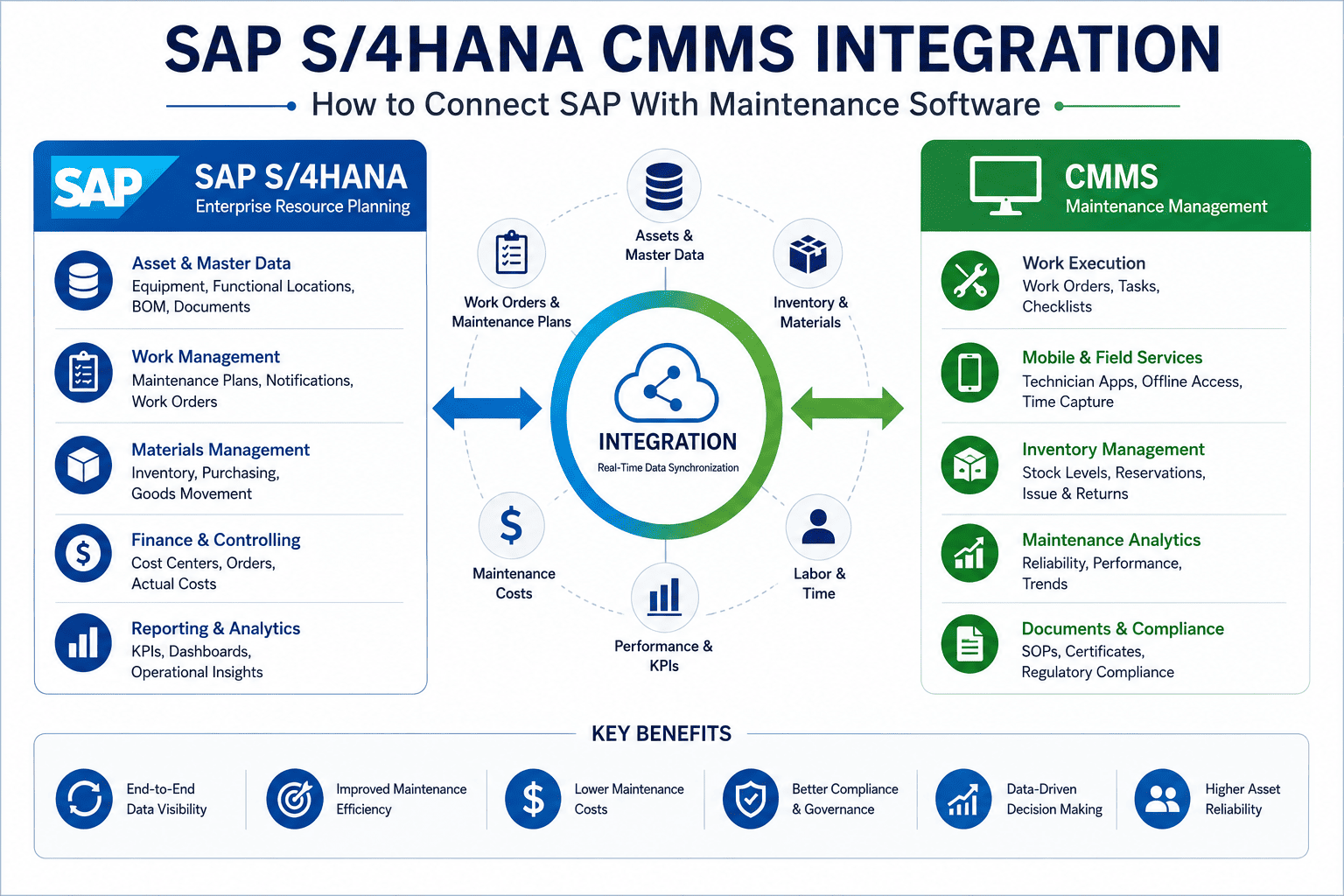
SAP Plant Maintenance is the most widely deployed maintenance management backbone in large food and beverage enterprises. It handles functional locations, equipment master data, work orders, and spare parts integration with MM. But SAP PM alone — particularly in older configurations — creates critical gaps when applied to food manufacturing without a purpose-built CMMS layer on top. Talk to an OxMaint engineer about closing your SAP PM gaps — book a free 30-minute session.
HACCP Maintenance Management: What the Regulation Actually Requires
HACCP (Hazard Analysis and Critical Control Points) is not just a food safety program — it has specific, enforceable implications for how maintenance is managed, documented, and verified. Most maintenance teams know they need to maintain their equipment. Fewer understand that HACCP requires them to prove it, in a specific format, on demand.
1
Identify Critical Control Points (CCPs) in your asset register
Every piece of equipment that directly contacts food, or whose failure could allow a biological, chemical, or physical hazard into product, must be tagged as a CCP in your CMMS. This is the foundation — if your equipment master data doesn't distinguish food contact from non-food contact assets, every downstream PM is built on an uncontrolled base.
CMMS Requirement: CCP flag on equipment master record
2
Build PM task lists with food-safety verification steps embedded
Standard PM checklists ask technicians to confirm tasks are done. HACCP-compliant PM checklists require technicians to record specific measurements, confirm approved materials were used, and sign off at defined checkpoints. The difference between "replaced bearing" and "replaced bearing with NSF H1 Part #FM-4421, verified no metal contamination" is the difference between a passing and failing audit finding.
CMMS Requirement: Structured checklist fields, required completion, digital signature
3
Enforce approved parts and lubricants at the work order level
Your CMMS must prevent — not just advise against — the use of non-food-grade materials on CCP assets. When a technician opens a work order for a food contact pump, the parts list should only surface NSF-certified, food-grade options. This is an enforcement problem, not a training problem, and it requires CMMS-level controls, not SOPs that rely on memory.
CMMS Requirement: Restricted parts catalog by asset type and zone
4
Coordinate maintenance within production and sanitation windows
In a food plant, maintenance timing is a food safety variable. Maintenance performed during production on open lines, or before CIP completion, creates contamination risk. A CMMS integrated with your production schedule and sanitation management system can gate work orders — preventing execution unless the line is in the correct state for safe maintenance.
CMMS Requirement: Schedule dependency rules, CIP status integration
5
Capture real-time completion with timestamps and technician identity
Paper-based maintenance logs are HACCP liabilities. Dates can be altered. Signatures can be forged. CMMS mobile completion with GPS timestamp, user authentication, and photo documentation creates an immutable record. During a regulatory inspection, the ability to pull up a complete work order history for any asset within seconds — with digital signatures and time stamps — is the difference between a rapid close and a 483 observation.
CMMS Requirement: Mobile execution, timestamped completion, photo attachment
6
Generate audit-ready reports on demand — by equipment, date, or inspector
Auditors — whether FDA, USDA, BRC, SQF, or a major retail customer — will request maintenance records for specific equipment during specific time periods. A CMMS that can filter, export, and present this data in a structured format without IT involvement is table stakes for any food plant operating at scale. Every minute spent locating records during an audit is a minute spent under a compliance microscope.
Outcome: Audit-ready documentation, zero findings on recordkeeping
Is Your Food Plant HACCP Maintenance-Ready?
OxMaint maps your current maintenance workflows against HACCP documentation requirements and builds the work order structure your auditors expect — in a 30-minute plant assessment.
CIP System Maintenance: The Highest-Risk Asset Class in Food Plants
Clean-in-Place systems are the immune system of a food manufacturing facility. When a CIP circuit fails — spray balls clog, pumps degrade, chemical dosing drifts — the contamination risk to everything downstream is immediate. Yet CIP systems are frequently the least well-documented assets in food plant maintenance programs, because they are invisible during production and their failures are latent rather than catastrophic. Connect your CIP assets to automated PM schedules in OxMaint — no setup fee.
Spray Ball Integrity
PM frequency: Every 90 days minimum (weekly visual check recommended)
Failure mode: Clogging reduces coverage pattern, creating unsanitized dead zones
CMMS requirement: Coverage verification photo attached to each PM completion
Audit flag: Missing spray ball records are a Category 1 BRC finding
CIP Pump Condition
PM frequency: Every 180 days with vibration check at every cycle
Failure mode: Degraded flow rate reduces temperature and chemical contact time
CMMS requirement: Flow rate baseline recorded and trended by work order
Integration: Condition monitoring alert triggers PM work order automatically
Chemical Dosing System
PM frequency: Weekly calibration check; daily concentration log
Failure mode: Under-dosing = inadequate sanitation; over-dosing = chemical residue in product
CMMS requirement: Concentration reading recorded as numeric field — not free text
Audit flag: Numeric data enables trend analysis; free text does not
Heat Exchanger / Return Line
PM frequency: Every 90 days with temperature profile test
Failure mode: Fouling reduces heat transfer, allowing insufficient temperature hold
CMMS requirement: Temperature hold time recorded per CIP cycle in CMMS log
Integration: Process historian data linked to maintenance record for full traceability
Expert Perspective: The Compliance-Reliability Intersection
The food manufacturers who struggle most with audits are usually not the ones with the worst maintenance programs — they're the ones with the best programs that aren't documented correctly. I've seen facilities with 98% PM compliance rates fail BRC audits because their work orders had free-text fields where structured data should be. The auditor doesn't care what you did. They care what you can prove you did, in a format they can verify. That's a CMMS design problem, not a maintenance execution problem.
SAP PM Is a Backbone, Not a Food Safety Tool
SAP PM was designed for industrial asset management. Its work order structure, equipment hierarchy, and notification system are powerful — but they require deliberate configuration and a mobile CMMS layer to meet the documentation specificity HACCP and BRC require from food manufacturers.
Downtime and Compliance Failures Share a Root Cause
Most unplanned downtime in food plants traces back to the same failure: deferred PMs. Deferred PMs also create HACCP documentation gaps. These aren't two separate problems — they're the same problem with two different auditors. A CMMS that drives PM completion solves both simultaneously.
The Real ROI Is in Retail Buyer Retention
A single major retailer delistment for a food safety audit failure can cost more than a full year of CMMS investment. The ROI of food manufacturing maintenance software isn't calculated in downtime hours alone — it's calculated in the value of certifications, contracts, and brand trust you protect by not having a maintenance-related recall.
Food Manufacturing Maintenance KPIs That Actually Matter
Most food plants track the wrong maintenance metrics. Overall Equipment Effectiveness is important, but it doesn't tell you whether your HACCP documentation is audit-ready or whether your CIP assets are trending toward a food safety failure. The KPIs below are the ones that matter for food manufacturing operations specifically — and the ones your CMMS should be tracking automatically.
98%+
CCP PM Compliance Rate
Percentage of scheduled preventive maintenance tasks on CCP-designated assets completed on time. Industry benchmark for BRC Grade AA certification is 98% or higher. Below 95% triggers audit scrutiny.
Target: ≥ 98% for BRC Grade AA
< 4 hrs
Mean Time to Respond (Food Lines)
Time from equipment fault notification to technician on-site for food contact equipment. Extended MTTR on filling, cooking, or cooling equipment can compromise product integrity held at incorrect temperatures.
Industry median: 6.2 hrs | Best-in-class: < 2 hrs
100%
Work Order Documentation Completeness
Percentage of closed work orders with all required fields completed — technician signature, parts used, completion timestamp, and any required measurement readings. Incomplete records are the top cause of HACCP documentation non-conformances.
Target: 100% — no exceptions for CCP assets
< 2%
Reactive Maintenance Ratio (Food Contact)
Percentage of total maintenance hours spent on unplanned reactive repairs on food contact equipment. High reactive ratios correlate directly with compliance risk — unplanned repairs often lack the documentation rigor of scheduled work orders.
World-class target: < 2% reactive on CCP assets
$500B
Annual cost of unplanned equipment downtime for global manufacturers — food and beverage among the top five affected sectors
Industry analysts, 2025
65%
Of HACCP non-conformances in FDA inspections cite inadequate maintenance records as a contributing factor
FDA inspection data
7:1
Return on preventive maintenance investment vs reactive repair costs — every $1 in PM saves $7 in emergency repair and downtime costs
CMMS ROI studies
30–90
Days advance warning from AI-driven predictive maintenance models — giving food plants time to schedule repairs within sanitation windows
2025–2026 deployments
Conclusion: The Maintenance System Your Auditors and Your Line Both Require
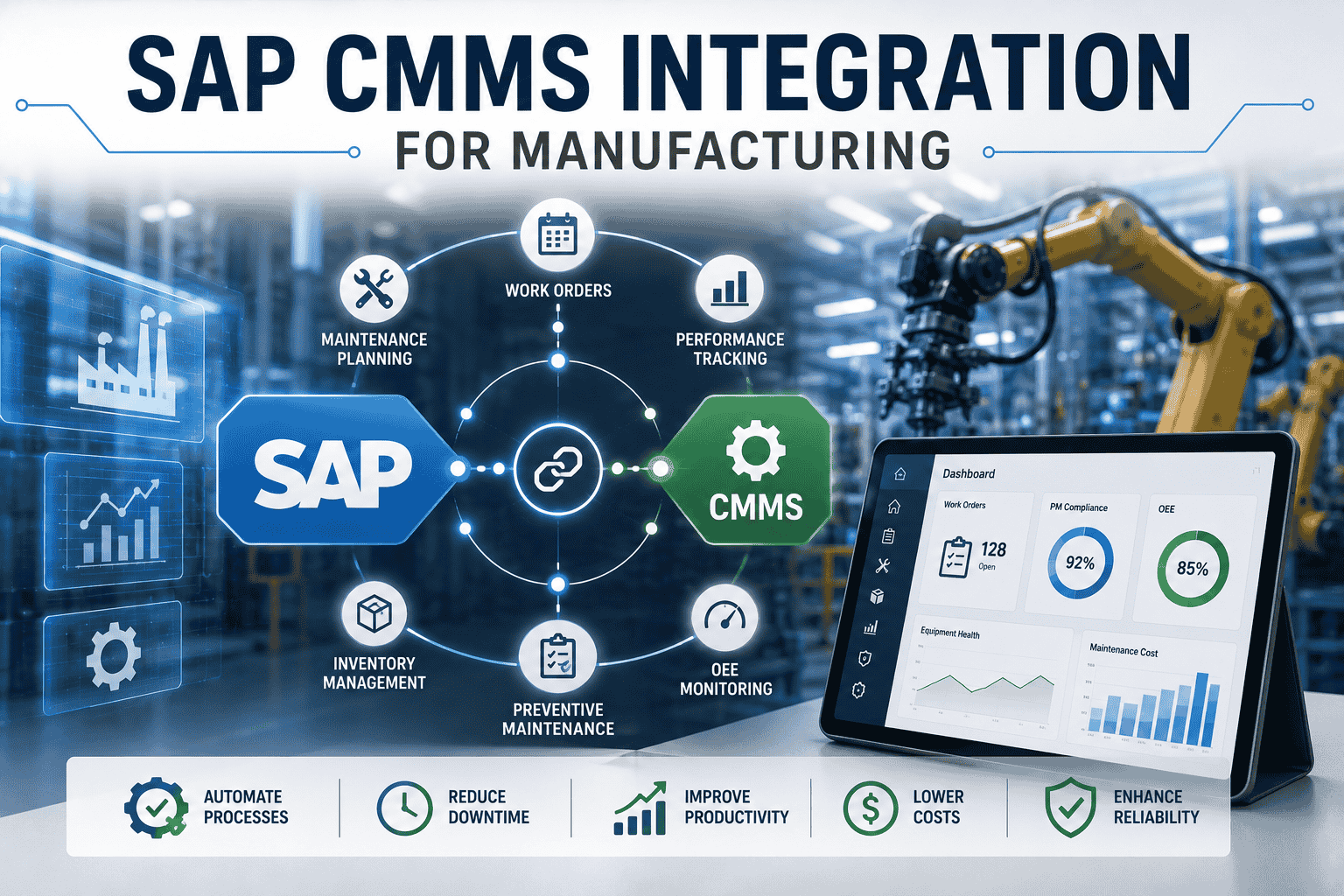
Food manufacturing maintenance isn't a trade-off between compliance and reliability — it's a recognition that they are the same objective expressed in two different languages. An equipment failure that shuts down your line is a reliability failure. The same failure, undocumented, is a HACCP compliance failure. A CMMS integrated with SAP PM, built for food safety documentation requirements, and connected to your CIP and production scheduling systems addresses both simultaneously.
The food manufacturers who consistently pass audits, maintain retail certifications, and hold downtime below industry benchmarks share one operational characteristic: their maintenance data is structured, current, and retrievable in under a minute. That's not an IT project. That's a CMMS configuration decision. Book a food plant maintenance assessment with OxMaint — see exactly where your SAP PM gaps are before your next audit. The market for predictive and compliance-driven maintenance is growing because the cost of getting it wrong — in food safety, brand damage, and retailer relationships — has never been higher. Start your free OxMaint account and connect your first food plant assets today.
Turn Your Food Plant Maintenance Into Audit-Ready Documentation
Whether you're closing SAP PM gaps, building HACCP work order templates, or connecting CIP system maintenance to automated scheduling — OxMaint gives food manufacturers the CMMS structure auditors expect and technicians can actually use in the field.
Frequently Asked Questions
What does HACCP compliance require from a maintenance management system?
HACCP requires that maintenance activities on food contact equipment be planned, executed with approved materials, documented with specific evidence, and retrievable for audit. This means your CMMS must tag CCP assets, enforce food-grade parts and lubricants, capture structured completion data (not just free text), timestamp and authenticate technician sign-offs, and allow instant retrieval by equipment, date range, or inspection type. Systems that rely on paper logs or unstructured digital fields fail these requirements even if the physical maintenance work is performed correctly.
Why isn't SAP PM alone sufficient for food manufacturing maintenance?
SAP PM is a powerful backbone for asset management, work order generation, and spare parts integration — but it was not designed specifically for food safety documentation requirements. Out of the box, SAP PM lacks mobile-first work order execution, food-grade parts enforcement at the work order level, CIP cycle integration, allergen zone-aware scheduling, and one-click audit report generation. These gaps require either extensive custom ABAP development or a purpose-built CMMS layer that integrates with SAP PM via standard interfaces and fills the compliance and usability gaps for food manufacturing environments.
How should CIP systems be managed in a food plant CMMS?
CIP system components — spray balls, pumps, heat exchangers, and chemical dosing systems — should be registered as individual assets in your CMMS with CCP designation where applicable. Each component needs a dedicated PM schedule with structured completion fields: coverage verification photos for spray balls, flow rate measurements for pumps, temperature hold records for heat exchangers, and concentration readings (as numeric values, not free text) for dosing systems. PM scheduling should be integrated with CIP cycle completion status to ensure maintenance windows align with sanitation program requirements and don't create cross-contamination risk.
What are the most common HACCP maintenance documentation failures found in FDA inspections?
The most frequently cited maintenance documentation failures in FDA Form 483 observations and Warning Letters include: missing or incomplete work order records for food contact equipment, inability to produce maintenance history for specific assets within a defined time range, free-text fields that cannot be trended or verified by auditors, absence of technician identity and timestamp on completed maintenance tasks, and evidence that non-food-grade materials were used on food contact equipment without documented justification or corrective action. All of these are preventable with a properly configured CMMS — they are documentation and system design failures, not maintenance execution failures.
How does CMMS integration with SAP PM improve food manufacturing reliability and reduce downtime?
SAP PM + CMMS integration improves food manufacturing reliability through three mechanisms. First, mobile work order execution increases PM completion rates because technicians can close work orders on the floor — reducing deferred PMs that lead to equipment failures. Second, condition-based triggers (from IoT sensors integrated with the CMMS) generate work orders based on actual equipment health rather than fixed calendar intervals, catching bearing wear, pump degradation, and temperature anomalies weeks before they cause production shutdowns. Third, CMMS data on repeat failures, mean time between failure trends, and parts consumption drives root cause analysis and PM task list refinement — continuously improving the maintenance program based on your plant's actual failure patterns rather than generic OEM recommendations.