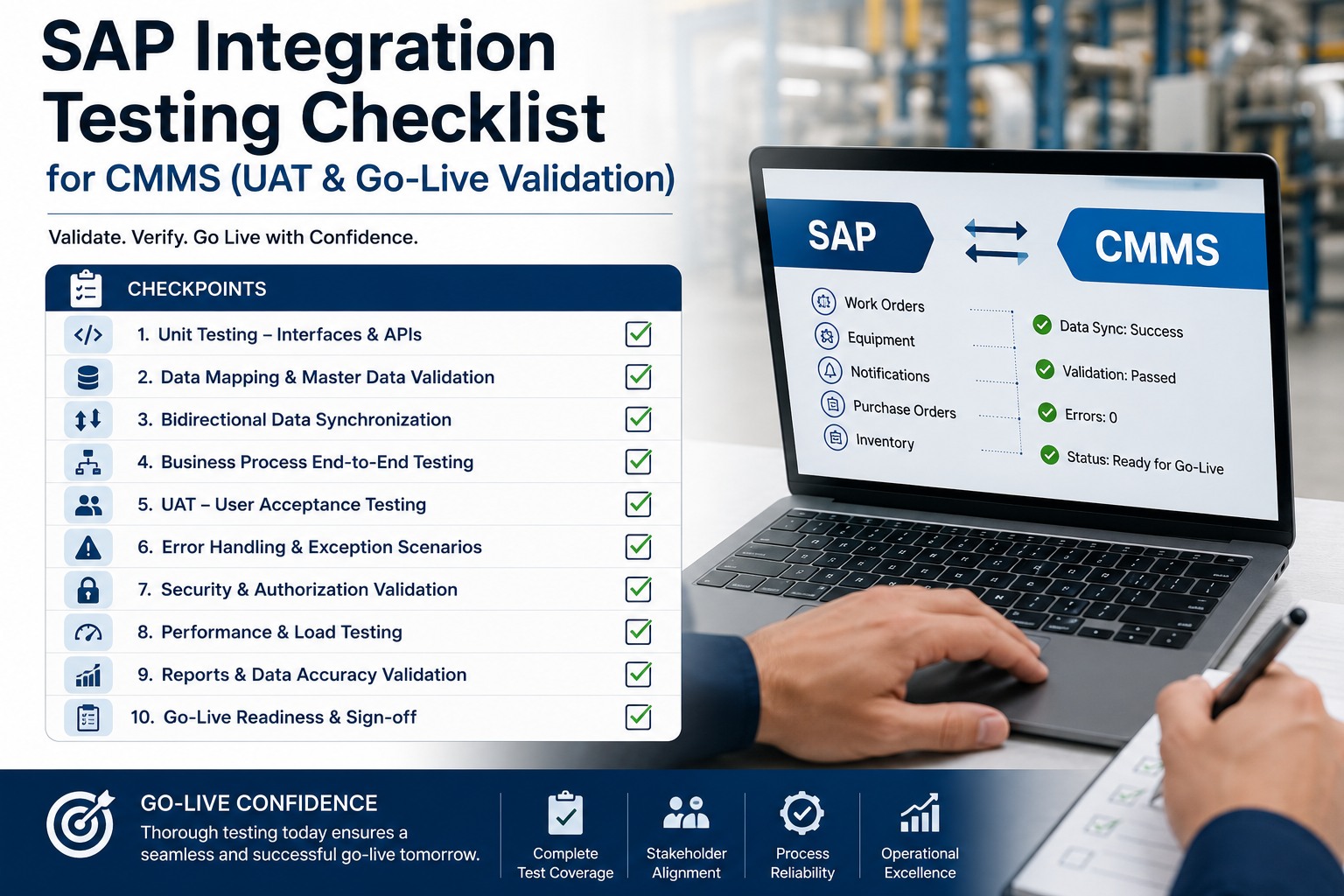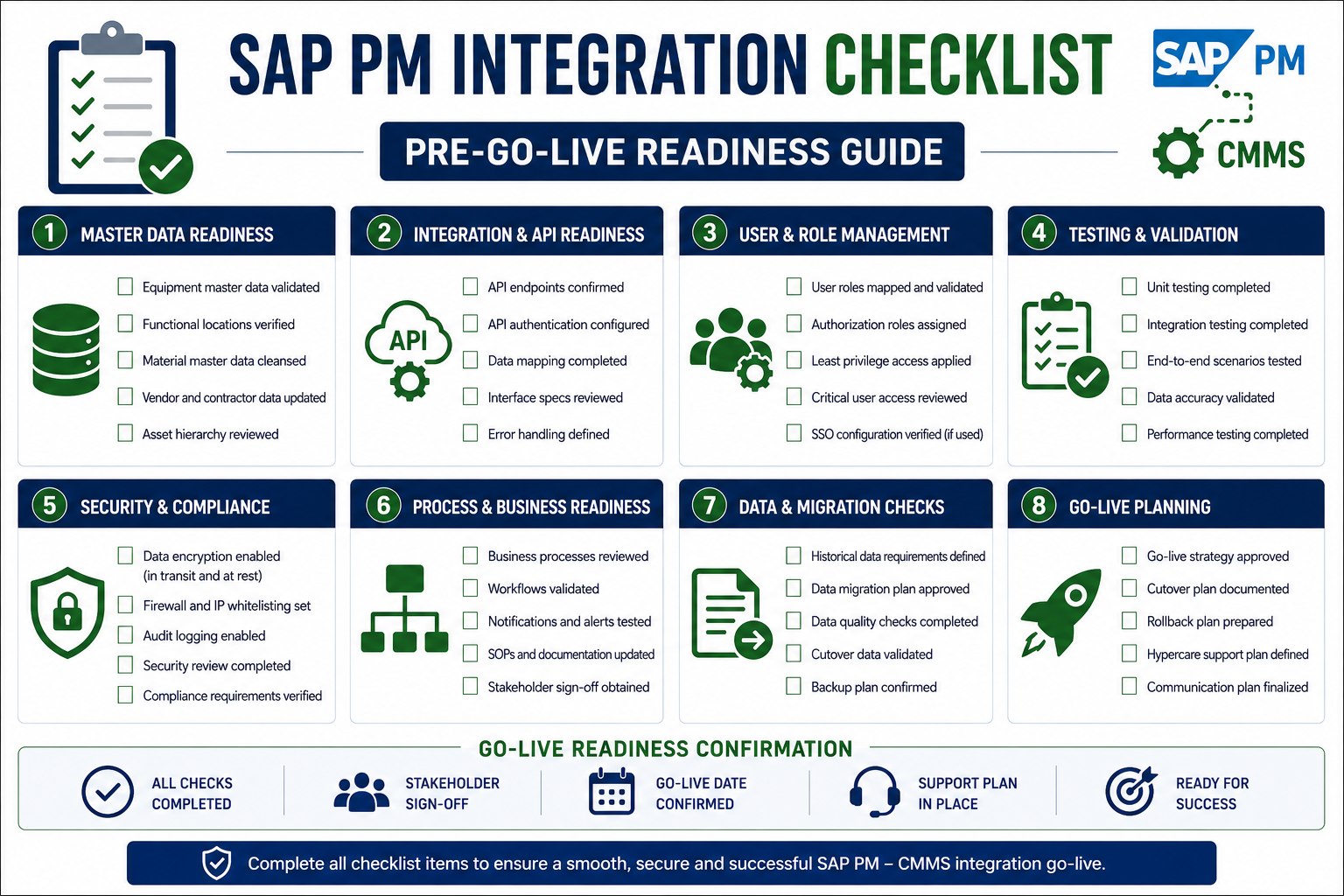
SAP PM integration go-lives don't fail at go-live—they fail in the weeks before, when readiness gaps that should have been caught in pre-flight surface in production. The most expensive integrations are the ones that went live before master data was clean, before API rate limits were tested, before RBAC was signed off, before rollback was documented. This checklist covers the six readiness domains every successful SAP-CMMS go-live validates before cutover—36 items that determine whether go-live is a non-event or a multi-week emergency. Book a free demo to walk through readiness on your project.
How to Use This Checklist
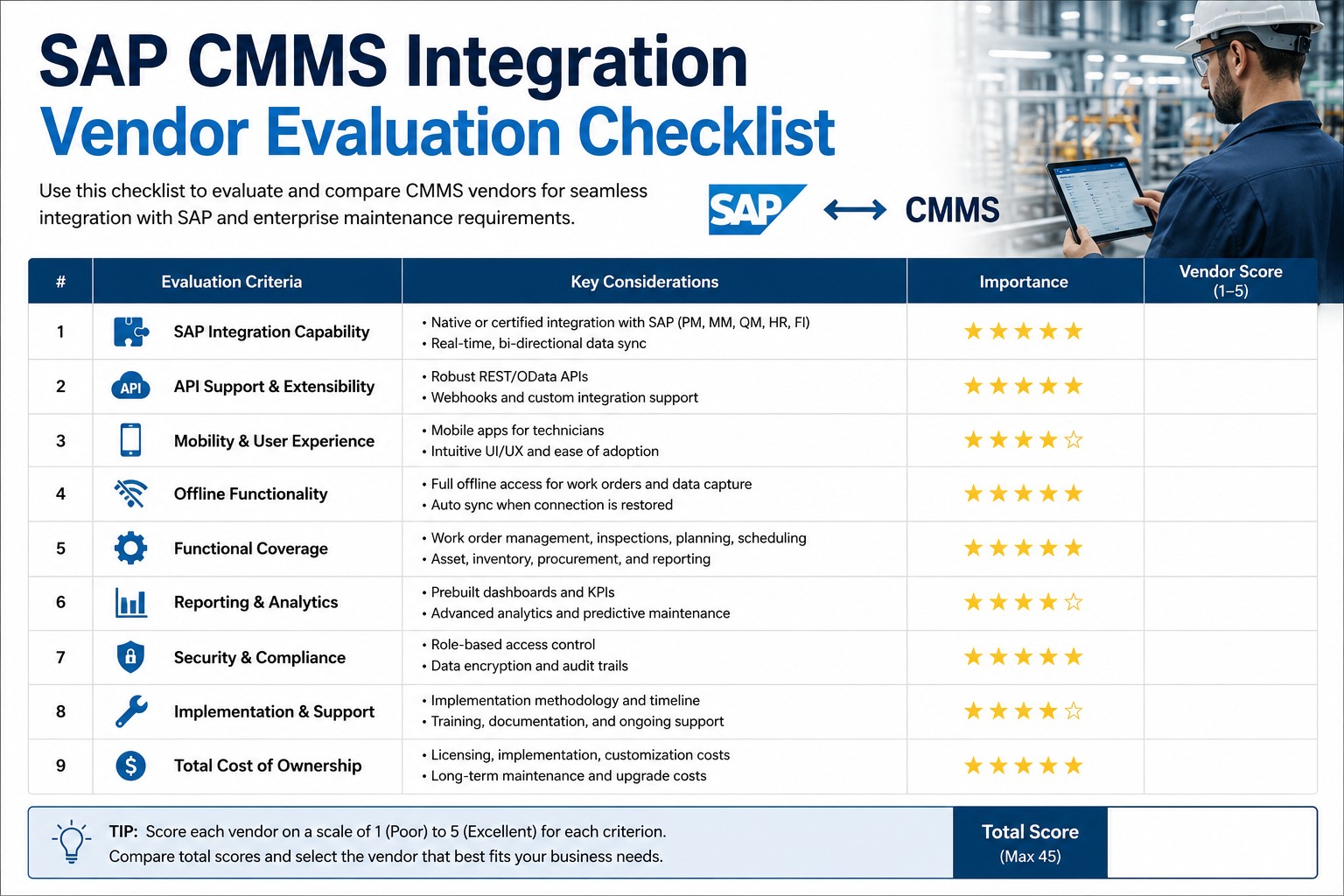
This is a 36-item, six-domain checklist used in production SAP-CMMS integration projects to determine pre-cutover readiness. Each domain has a recommended owner role, an estimated effort window, and items prioritized as Critical, Important, or Standard. The recommended cadence is to complete the checklist over a four-to-six-week pre-go-live window, with a final readiness review three to five business days before cutover. Critical items must be signed off; Important items must be addressed or have documented compensating controls; Standard items are best-practice but not absolute blockers.
Teams ready to operationalize this checklist against a live project plan can Sign up free to import these readiness items into a working SAP-CMMS project tracker.
The Six-Domain Pre-Go-Live Readiness Checklist
The six domains below collectively cover every pre-cutover dependency that has historically driven post-go-live incidents in SAP-CMMS integrations. Work through each domain sequentially; later domains depend on earlier ones being complete.
- Equipment master extracted, validated, and deduplicatedCritical
- Functional location hierarchy mapped to plant structureCritical
- Cost centers reconciled with SAP CO moduleCritical
- BOMs reviewed for completeness on critical assetsImportant
- Material masters cleaned of duplicate part numbersImportant
- Task lists validated against current SOPsStandard
- SAP Gateway / OData endpoints enabled and testedCritical
- Firewall rules and IP allowlists configured both directionsCritical
- TLS 1.3 enforced on all integration endpointsCritical
- OAuth 2.1 client credentials issued and stored in KMSCritical
- API rate limits configured at expected peak load + 30%Important
- Service account scope reviewed against least-privilege principleImportant
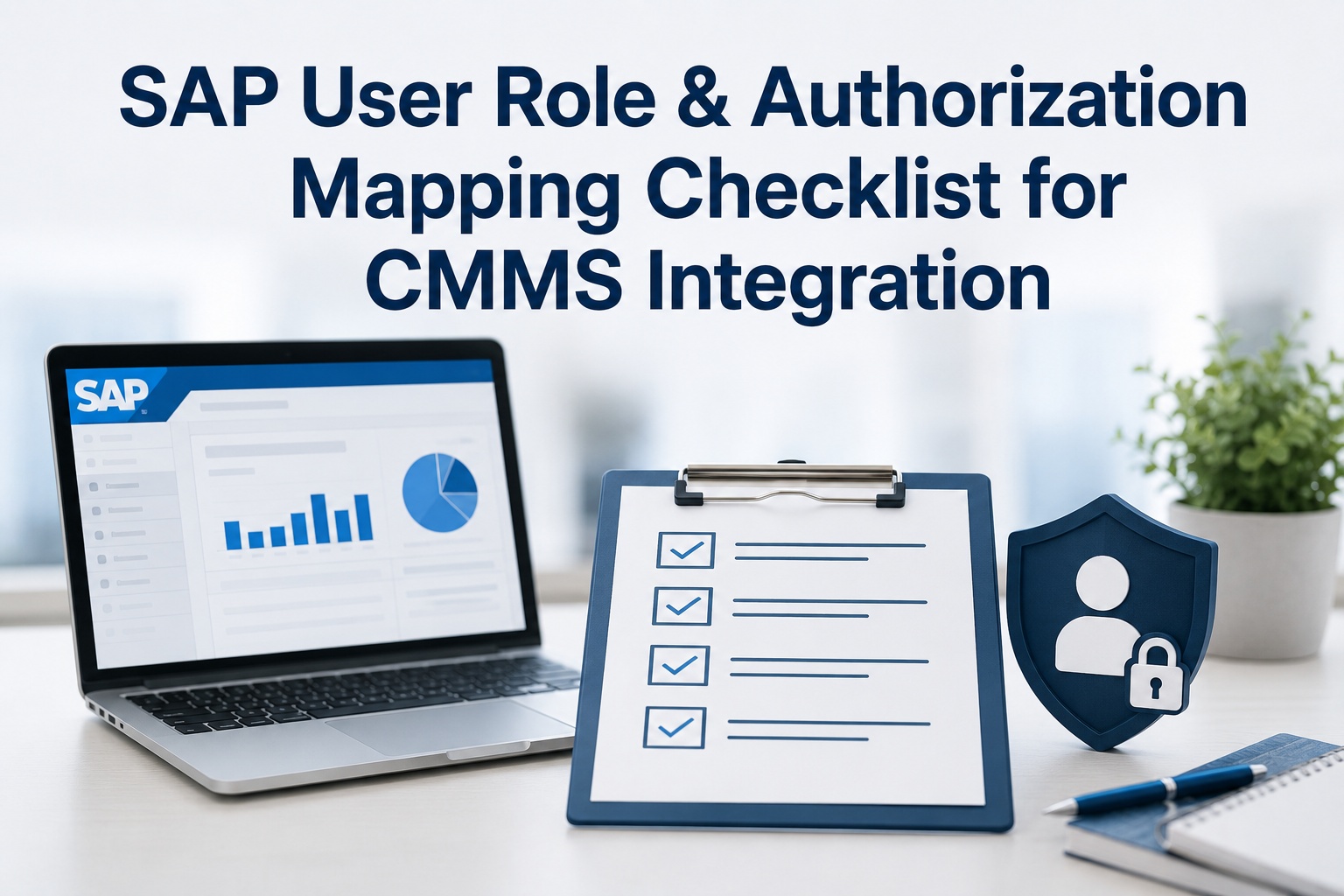
- All in-scope users mapped between SAP and CMMSCritical
- RBAC roles defined and authorization matrix signedCritical
- SSO integration tested with all user groups (if applicable)Important
- Manager and approver hierarchies validated end-to-endImportant
- Inactive accounts disabled before cutoverImportant
- Emergency access ("firefighter") accounts documentedStandard
- Sandbox / QA environment mirrors production configurationCritical
- End-to-end work order flow validated on all common scenariosCritical
- Bidirectional sync verified across SAP MM, FI/CO, and PMCritical
- Failure recovery and retry logic tested under fault conditionsImportant
- Performance load testing at peak + 30% completedImportant
- User acceptance testing sign-off from each role groupImportant
- Five-layer defense-in-depth controls verified per layerCritical
- ISO 27001 / SOC 2 control mappings documentedCritical
- Audit logging operational with retention policy appliedCritical
- Data classification reviewed and tokenization configuredImportant
- Incident response plan updated to include the integrationImportant
- Privacy impact assessment / DPIA filed where requiredStandard
- Cutover plan signed by all in-scope stakeholdersCritical
- Rollback plan documented, tested, and time-boxedCritical
- Training delivered and attested for all user rolesCritical
- Communication plan executed across affected teamsImportant
- Hypercare team identified with on-call rotation in placeImportant
- Day-1 success criteria defined and measurableImportant
The 16 Critical items in the checklist are the ones that, if missed, produce the post-go-live incidents that turn a planned cutover weekend into a multi-week emergency. The most common pattern: master data not deduplicated in D1, then phantom asset records causing work order assignment failures on day 3 of production. The second most common: API rate limits not load-tested in D2, then sync queue backups during peak afternoon shift on day 5. Both are caught by a disciplined pre-go-live readiness review. Teams ready to map this checklist to their current project plan can Sign up free to operationalize the readiness checklist as project milestones.
Common Readiness Gaps That Stall Go-Live
Three failure patterns account for the majority of post-go-live emergencies in SAP-CMMS integration projects. Each is recoverable but expensive; each is preventable through disciplined pre-flight readiness review.
The unifying pattern: every one of these gaps is caught in a thorough pre-go-live readiness review, and every one of them costs three to five times more to fix in production than it would have cost to address in pre-flight. Project leaders ready to compare their current readiness state against this checklist can Sign up free to run a readiness diagnostic on the current project state.
From Checklist Complete to Go-Live Sign-Off
The checklist itself is the input. The output is a documented go-live sign-off package that survives audit, satisfies project governance, and gives operating leadership the evidence they need to authorize cutover. The roadmap below shows how successful projects translate a completed checklist into go-live authorization.
By the end of week −1, every Critical item on the 36-item checklist has a documented owner signature, every Important item has either been completed or has a documented compensating control, and the go-live decision is a routine confirmation rather than a debated escalation. That's what separates a non-event cutover from a multi-week firefight. Project leaders ready to walk this final-week sequence on their actual timeline can Book a free demo to map the readiness cadence to current go-live dates.
Expert Perspective: What Distinguishes Successful Go-Lives
The successful SAP-CMMS go-lives I've seen share a property that's almost boring: the team treats the readiness checklist as a project deliverable, not a procedural formality. Each item has a named owner, a target completion date, and an evidence requirement—same rigor as any other engineering deliverable. The unsuccessful go-lives treat the checklist as a status meeting tool, where items get verbally affirmed without documented evidence. Three weeks in, when something breaks, nobody can prove what was actually tested. The checklist isn't bureaucracy. It's the contract between every workstream that the integration is genuinely ready, signed by the people whose accountability it is to know.