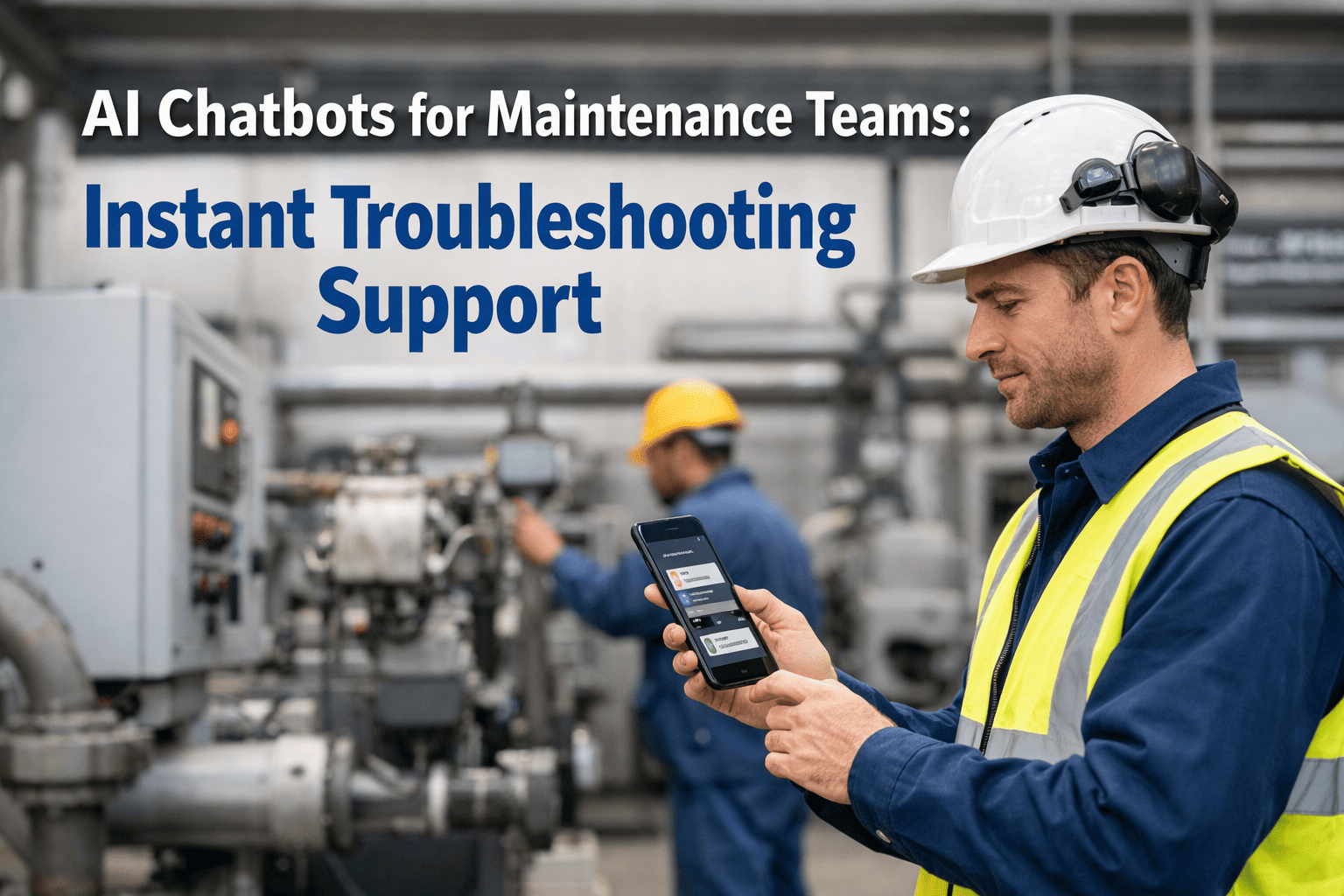
A maintenance technician walks up to a vibrating gearbox, holds up their phone, and says: "Main drive gearbox on Line 3 has unusual vibration, sounds like bearing noise, getting worse over the last shift." Within seconds, the AI maintenance assistant converts that observation into a fully populated work order — complete with asset code, failure history, ranked list of probable root causes, recommended spare parts with warehouse location and lead times, and step-by-step troubleshooting procedures pulled from the equipment manual. No typing. No searching. No guessing. Plants deploying voice-to-CMMS workflows trimmed administrative effort by 38% within six months, while work-order backlogs fell 32% at AI-pilot sites. This is not a future concept — 65% of maintenance teams plan to adopt AI within the next 12 months, and generative AI development for maintenance solutions can now be deployed in as little as one quarter. Oxmaint's CMMS platform is built to integrate generative AI capabilities directly into maintenance workflows — turning every technician into an expert troubleshooter.
This guide covers how generative AI maintenance assistants work, what they can actually do today, the measurable results early adopters are reporting, and the practical path from pilot to production-scale deployment.
What Generative AI Actually Does in Maintenance
Generative AI in maintenance is not a chatbot bolted onto a dashboard. It is a large language model (LLM) trained on equipment manuals, failure histories, manufacturer specifications, and maintenance best practices that can understand unstructured technician input and convert it into structured, actionable maintenance intelligence. The AI processes natural language — spoken or typed — and cross-references it against the complete knowledge base of your CMMS, BOMs, vendor catalogs, and sensor data to generate responses that would take a human planner 30-60 minutes to research manually.
Voice-to-Work-Order
Technicians speak observations naturally. The LLM extracts asset ID, failure symptoms, priority level, and safety flags — generating a fully populated CMMS work order in seconds. No forms. No keyboards. No data entry delays on the factory floor.
Root Cause Suggestion
Given symptoms, the AI searches failure history across every similar asset in the fleet, cross-references manufacturer technical bulletins, and ranks probable causes by likelihood — surfacing the diagnosis a 20-year veteran would reach, instantly available to a first-year technician.
Guided Troubleshooting
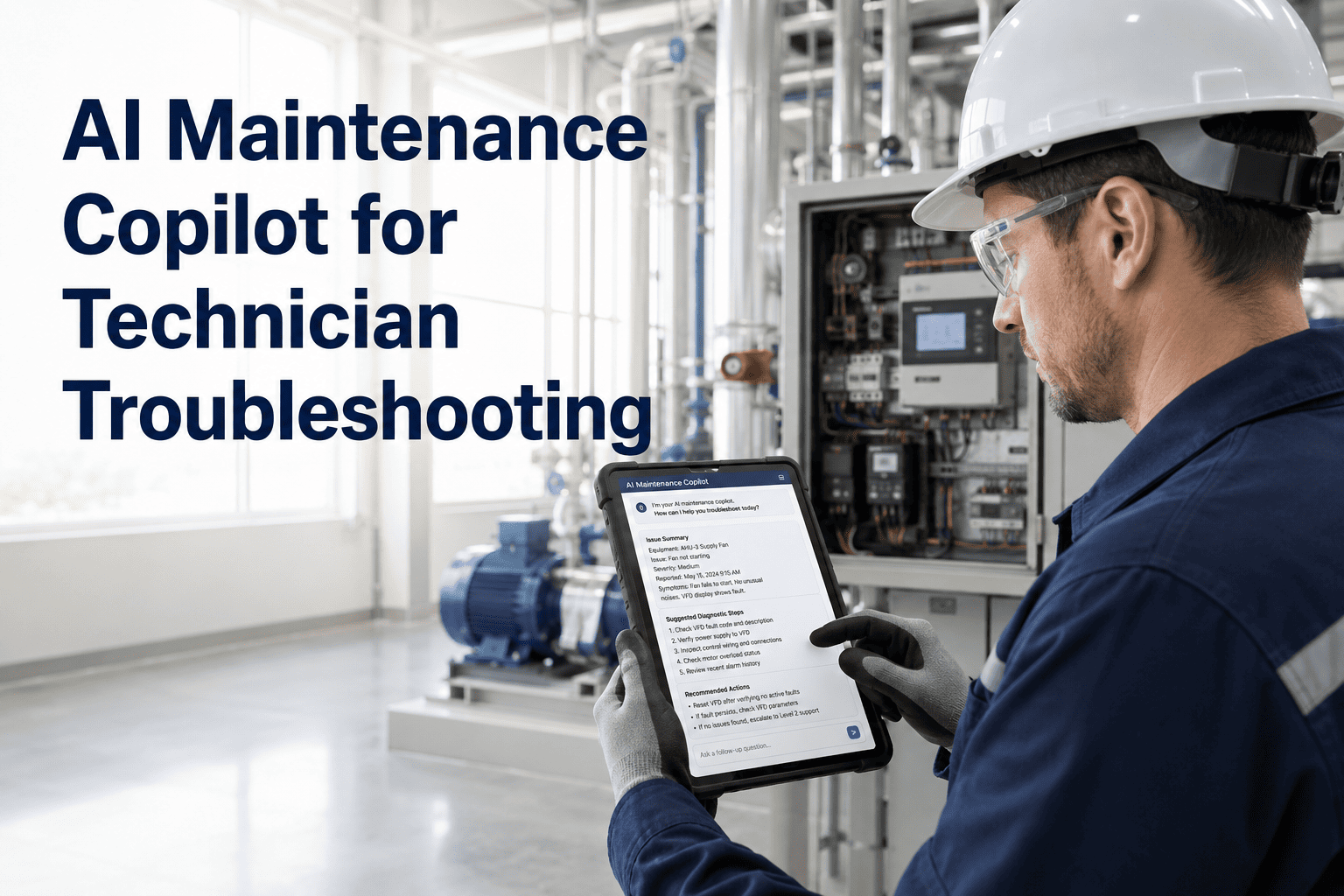
Step-by-step repair procedures generated dynamically based on the specific failure mode, asset configuration, and available tools. The AI adapts instructions based on technician experience level and updates procedures in real time as the technician reports findings at each step.
Smart Parts Matching
AI cross-references BOMs, vendor catalogs, and live inventory to suggest optimal spare parts. Technicians scanning a QR code receive a ranked list of compatible spares with lead times, warehouse bin locations, and supplier pricing — eliminating the manual search that wastes 23+ minutes per parts lookup.
Procedure Drafting
AI drafts maintenance procedures, estimates time requirements, and generates safety checklists tailored to the specific task and equipment. New procedures that previously took planners hours to write are generated in minutes — then reviewed and approved by engineers before release.
Knowledge Capture and Transfer
When a senior technician explains how they diagnosed a complex fault, the AI converts their verbal explanation into structured knowledge — documented procedures, failure signatures, and decision trees that stay in the CMMS permanently. 39% of leaders say knowledge capture is AI's most valuable maintenance use case.
Give Every Technician an AI-Powered Expert Partner
Oxmaint integrates generative AI directly into maintenance workflows — voice-to-work-order, intelligent troubleshooting, smart parts matching, and knowledge capture built into the CMMS your team already uses.
How AI Transforms the Technician's Day
The real measure of AI value is not in dashboards or analytics — it is in minutes saved per technician per shift. Here is what changes when an AI maintenance assistant is embedded into the daily workflow. The wrench-time impact alone justifies the investment: most plants discover that only one-third of maintenance time is actually spent doing maintenance. The other two-thirds goes to administrative work, parts searching, procedure lookup, and documentation. AI attacks every one of those non-wrench-time activities.
AI-Generated Shift Briefing
Instead of reading through overnight logs manually, the AI summarizes all events, open work orders, priority changes, and equipment status updates into a 2-minute voice briefing. Technician knows exactly what needs attention before leaving the control room.
Voice-Activated Diagnosis
Technician describes symptoms verbally while inspecting equipment. AI generates ranked root cause list, pulls relevant repair history for this specific asset, and suggests the most likely fix based on fleet-wide failure patterns. No laptop. No desk. No delay.
AI-Guided Parts Selection
Technician scans asset QR code. AI displays compatible parts with current stock levels, bin locations, and alternative options if primary part is unavailable. Parts are reserved in the system before the technician walks to the storeroom.
Step-by-Step Guided Repair
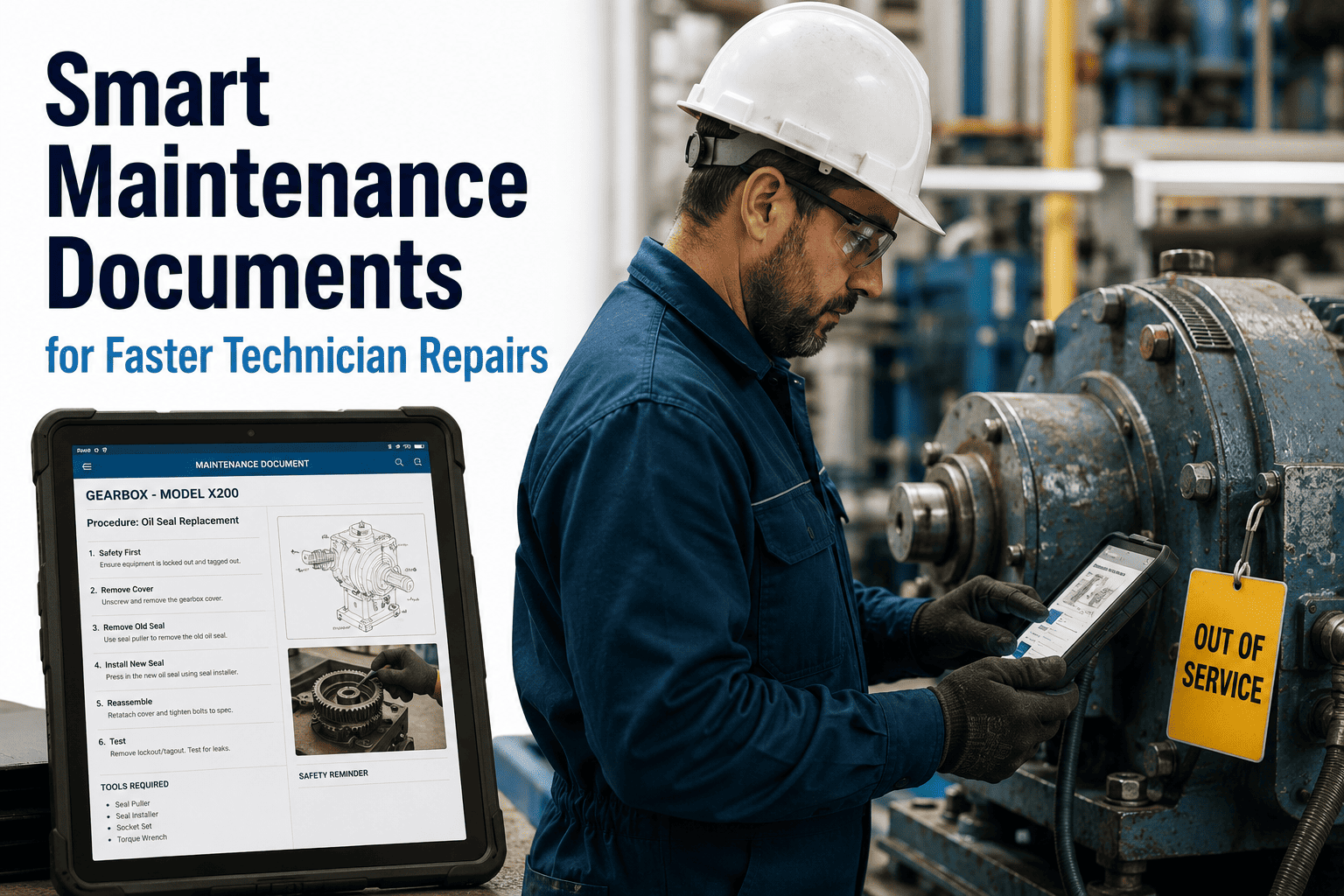
AI delivers repair instructions on the technician's mobile device, adapted to the specific failure mode and equipment variant. Safety warnings highlighted. Torque specs, clearance values, and test procedures displayed contextually as each step is completed.
Auto-Generated Work Order Closure
The AI compiles everything — diagnosis, parts used, repair steps completed, test results, time spent — into a complete work order closure record. Technician reviews and approves with one tap. Documentation that used to take 15-20 minutes is done in 30 seconds.
Knowledge Capture from Expert Repair
Senior technician explains a complex calibration technique. AI records, transcribes, structures, and saves the procedure as a reusable knowledge asset in the CMMS — available to every technician on every future occurrence of this issue.
Measured Results from Early Adopters
Generative AI in maintenance has moved past the hype cycle. 55% of manufacturers have moved at least one AI use case into full-scale production across multiple sites. The results below are from operational deployments — not pilots, not projections, not vendor claims. Start building your AI-ready CMMS foundation with Oxmaint today.
Implementation: From Pilot to Production
The gap between AI pilot and production deployment is where most projects stall — 68% of industrial leaders say AI projects are moving from pilot to production phase, but the transition requires deliberate planning. Here is the practical path that avoids "pilot purgatory." Sign up for Oxmaint to build your AI-ready CMMS data foundation now. Book a demo to see Oxmaint's AI-ready CMMS in action.
CMMS Data Foundation
Deploy digital work orders with standardized failure codes. Build complete asset registry. Begin capturing the structured maintenance history that AI models will use for training. Clean data is the single most important prerequisite — without it, AI produces unreliable outputs regardless of model sophistication.
AI Pilot on High-Impact Use Case
Deploy voice-to-work-order on one shift. Enable AI root-cause suggestion for the top 5 most-frequently-failing assets. Measure administrative time reduction, troubleshooting speed, and user adoption. Run AI in advisory mode alongside existing processes — let technicians verify AI suggestions before trusting them.
Scale and Integrate
Expand AI to all shifts and all production-critical assets. Connect AI to sensor data for predictive alerting. Enable smart parts matching with live inventory integration. Deploy knowledge capture for senior technician expertise. Integrate AI-generated insights into KPI dashboards for management visibility.
Autonomous Optimization
AI autonomously generates predictive work orders from sensor data. Maintenance scheduling optimized around production demands without manual planner intervention. Continuous model improvement as every completed work order feeds back into AI training. Cross-plant knowledge sharing for multi-site operations.
Make Every Technician an Expert — Starting Today
Oxmaint is the AI-ready CMMS that gives your maintenance team voice-to-work-order, intelligent troubleshooting, and knowledge capture from day one. No data science team required. Deploy in days.
Frequently Asked Questions
What is a generative AI maintenance assistant?
A generative AI maintenance assistant is a large language model (LLM) integrated into your CMMS that understands natural language input from technicians — spoken or typed — and generates actionable maintenance intelligence in response. It converts verbal equipment observations into structured work orders, suggests probable root causes ranked by likelihood based on fleet-wide failure history, recommends spare parts with live inventory status, drafts step-by-step troubleshooting procedures, and captures expert knowledge in reusable format. Unlike traditional monitoring that reacts to thresholds, generative AI understands context, interprets unstructured information, and produces human-readable guidance that any technician can follow.
How accurate are AI-generated troubleshooting suggestions?
Accuracy depends heavily on the quality and completeness of the underlying CMMS data. Plants with 12+ months of clean, standardized work order history and failure codes typically see AI suggestion accuracy above 80-85% for common failure modes. For well-documented asset types with extensive fleet-wide data (pumps, motors, compressors), accuracy can exceed 90%. The AI improves continuously as every completed work order feeds back into its training data. During initial deployment, running AI in advisory mode alongside experienced technicians allows accuracy validation before full trust is established.
Does AI replace maintenance technicians?
No — AI augments technicians, it does not replace them. With 40% of the manufacturing workforce retiring by 2030 and 45% of maintenance leaders citing labor shortage as their biggest challenge, AI is filling the expertise gap left by departing veterans rather than eliminating jobs. AI handles the administrative burden (documentation, parts lookup, procedure retrieval) that currently consumes two-thirds of a technician's shift, freeing them to spend more time on actual wrench-turning. The result is more maintenance completed by the same team, not fewer people needed.
What data does AI need to work effectively for maintenance?
The minimum data foundation is a CMMS with complete work order history (including failure codes, repair actions, parts used, and time spent), a structured asset registry with equipment hierarchy, and manufacturer documentation (manuals, technical bulletins, recommended procedures). Sensor data from IoT devices enhances predictive capabilities but is not required for troubleshooting and knowledge management functions. The critical requirement is data consistency — standardized failure codes used uniformly across all technicians and shifts. Inconsistent data produces inconsistent AI outputs regardless of model sophistication.
How long does it take to deploy an AI maintenance assistant?
Generative AI for maintenance can be developed and deployed in as little as 3 months with modern platforms, compared to 12-18 months for traditional analytics approaches. However, the prerequisite is clean CMMS data — if your work orders are on paper or in spreadsheets, add 1-2 months for CMMS deployment and data standardization before AI can be layered on top. Plants with an existing mature CMMS can enable AI capabilities within weeks. The fastest path is deploying voice-to-work-order first (immediate administrative time savings) then expanding to root cause suggestion and guided troubleshooting as the AI learns from accumulated data.
What is the ROI of AI maintenance assistants?
Documented ROI metrics include: 38% reduction in administrative effort (voice-to-work-order), 32% reduction in work-order backlogs, 28% fewer spare parts pick errors, 19% cumulative parts-spend reduction over three years, 20-25% overall maintenance cost reduction, and 30-50% reduction in unplanned downtime when combined with predictive capabilities. Plants typically achieve positive ROI within 6-12 months through administrative time savings alone — before the full predictive and troubleshooting benefits are even realized. A Fortune 500 manufacturer saved $2.8M annually after implementing AI-powered predictive maintenance.
Can AI maintenance work without IoT sensors?
Yes — many of the highest-value AI maintenance capabilities do not require sensors at all. Voice-to-work-order, root cause suggestion from failure history, guided troubleshooting from equipment manuals, smart parts matching from inventory data, and knowledge capture from expert technicians all operate entirely on CMMS data and documentation. IoT sensors enhance AI with predictive capabilities (forecasting failures before symptoms appear), but the troubleshooting, knowledge management, and administrative efficiency benefits are available immediately with just a well-maintained CMMS. Start with data-driven AI, add sensor-driven AI as the foundation matures.