A forklift that runs 800 hours in one month and 200 hours the next is not well served by a monthly PM interval. The forklift that ran 800 hours needed servicing three weeks ago; the one that ran 200 hours still has two months of service life remaining. Calendar-based maintenance treats them identically — which means one gets over-maintained and one gets under-maintained, both at a cost. Meter-based maintenance corrects this by triggering PM when the asset reaches a usage threshold rather than a calendar date. The tradeoff is complexity: meter-based scheduling requires meter readings, sensor integration, or manual usage tracking — and if that data pipeline fails, so does the PM trigger. Most facilities use both methods simultaneously: calendar triggers for assets where time-driven degradation dominates, meter triggers for assets where usage-driven wear dominates, and hybrid triggers (whichever comes first) for critical assets where neither risk alone is acceptable. OxMaint supports all three trigger types — start free today and configure the right PM trigger for every asset in your register, or book a demo to see the scheduling engine.
Comparison · Maintenance Scheduling · Preventive Maintenance · OxMaint
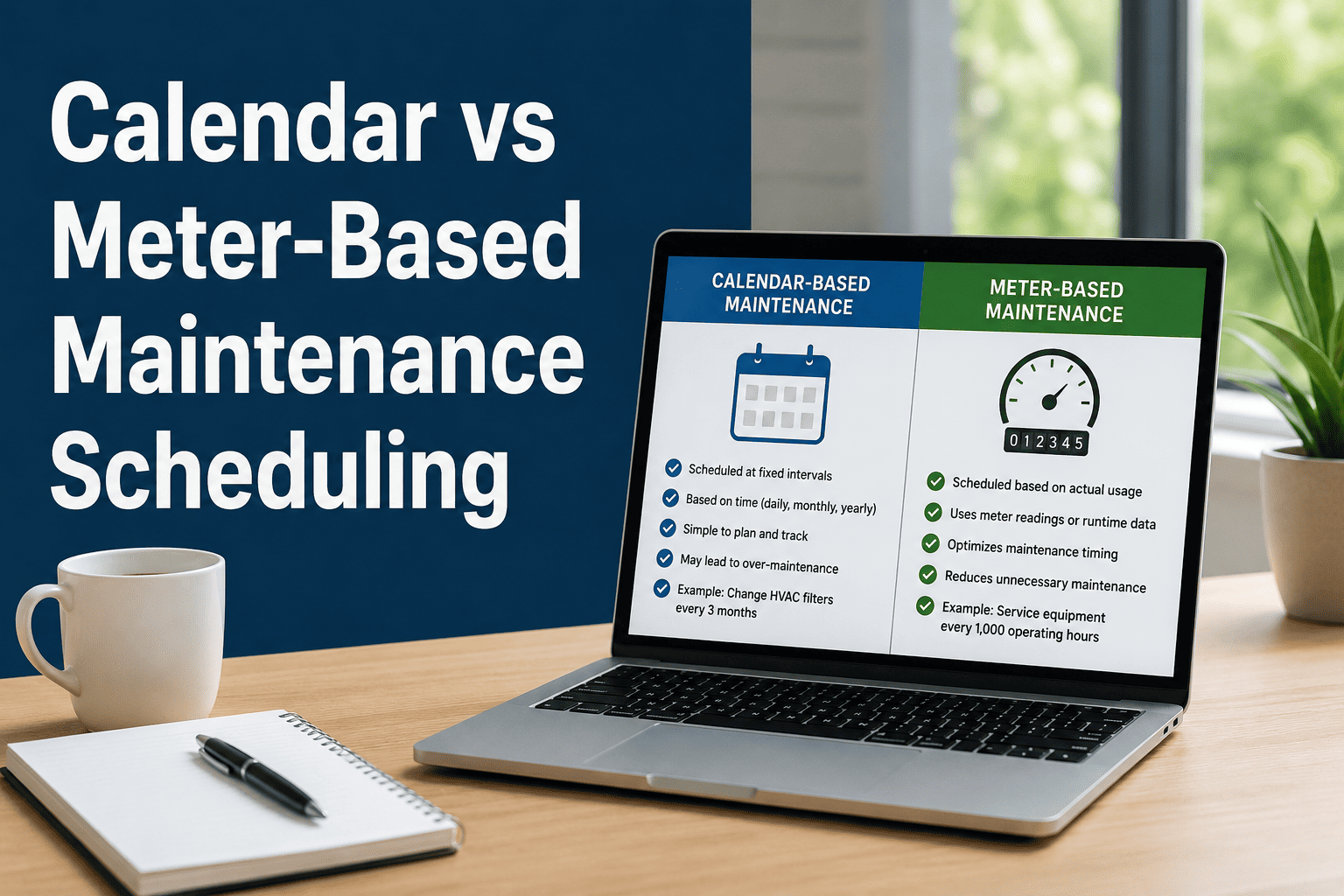
Calendar-Based vs Meter-Based Maintenance: Which Should You Use?
A practical framework for choosing between time-triggered and usage-triggered PM schedules — and when to use a hybrid approach to protect against the failure modes of each.
Calendar-Based
PM triggers on a date
Every 3 months — regardless of use
Best for: Fixed-interval degradation, compliance requirements, low-variation use
VS
Meter-Based
PM triggers on a usage reading
Every 500 hours — whenever that's reached
Best for: High-variation use, wear-driven degradation, high downtime cost assets
Calendar-Based Maintenance — When Time Is the Right Trigger
Calendar-based PM triggers on a date or time interval — daily, weekly, monthly, quarterly, annually — regardless of how much the asset was used. This method works well when the primary driver of degradation is time, not usage.
Works Well When
Usage is consistent and predictable — similar hours or cycles each calendar period
Degradation is time-driven (oil oxidation, rubber hardening, lubricant separation, battery discharge) rather than wear-driven
Regulatory standards mandate specific calendar intervals — ASME, NFPA, OSHA, Joint Commission
No meter infrastructure is available or practical — no run-hour counter, no odometer, no cycle counter
The asset is low-criticality and over-maintenance cost is acceptable in exchange for simplicity
Fails When
Usage varies significantly — a seasonal asset, a backup generator, or a production machine running variable shift patterns
Over-maintenance cost is significant — replacing oil that still has 60% of its useful life wastes money and creates unnecessary disassembly risk
Under-maintenance is dangerous — the calendar date is reached but the asset has accumulated 3× the expected usage due to a high-demand period
The asset is high-criticality and the consequences of missing a service due to calendar misalignment are severe
Best calendar-based examples in practice
Fire extinguisher visual inspection — NFPA 10 mandates weekly visual check regardless of use
HVAC filter change in a low-traffic corridor — occupancy is consistent, filter loading is predictable
Annual elevator safety test — ASME A17.1 mandates annual regardless of cycle count
Hydraulic fluid change at 6-month interval in a seasonal machine — time-driven oxidation dominates, not wear
Safety valve pressure test at 2-year interval — code-mandated interval, no meter alternative accepted
Meter-Based Maintenance — When Usage Is the Right Trigger
Meter-based PM triggers when an asset reaches a usage threshold — operating hours, production cycles, kilometres driven, strokes completed. This method works well when the primary driver of degradation is the work the asset does, not the time elapsed.
Works Well When
Usage varies significantly — some periods see 3× the normal operating hours; calendar PM would miss the high-use periods
Wear is directly proportional to usage — bearing hours, seal cycles, filter loading, clutch engagements, piston strokes
Over-maintenance cost is significant — unnecessary oil changes or bearing replacements create both cost and disassembly risk
Meter data is available or easy to capture — run-hour counters, odometers, cycle counters, or SCADA integration
OEM specifies usage-based intervals — most engine, compressor, and vehicle OEMs specify service at usage milestones, not calendar dates
Fails When
Meter data is unreliable — manual counter entry introduces human error; if readings are missed, PM triggers are missed
Usage is very low and time-driven degradation dominates — a backup generator at 12 hours/year still needs annual inspection for oil degradation, not usage
Compliance requires calendar intervals — regulatory standards specify annual, quarterly, or monthly — not "500 hours"
No practical meter infrastructure exists for the asset type — many HVAC, electrical, and structural assets have no usage counter
Best meter-based examples in practice
Forklift engine oil — OEM specifies every 250 operating hours; forklift usage varies 80–400 hours/month
Compressor oil and filter — every 2,000 runtime hours; compressors run variably based on demand
Fleet vehicle service — every 5,000 miles; vehicles used differently by route and driver
Stamping die inspection — every 50,000 strokes; production cycles vary by product mix
FANUC robot gearbox grease — every 3,850 runtime hours; robots in multi-shift facilities hit this faster than calendar suggests
OxMaint Supports Calendar, Meter, and Hybrid Triggers — Set the Right One for Every Asset in Minutes.
Every asset in your OxMaint register gets its own PM trigger configuration — calendar, usage, or hybrid. OxMaint generates the work order automatically when the trigger condition is met, whether that is a date, a meter reading, or whichever comes first.
The Hybrid Trigger — Whichever Comes First
For critical assets where neither calendar nor meter alone is sufficient, a hybrid trigger fires PM when either condition is met — the calendar date or the meter threshold, whichever arrives first. This is the approach for assets where missing either trigger type creates an unacceptable risk.
How it works in OxMaint
Configure both a calendar interval and a meter threshold on the same PM template. OxMaint generates the work order when the first condition is reached — if the calendar date arrives first, PM is triggered. If the meter threshold is reached first, PM is triggered. The remaining condition resets from the point of completion. A vehicle configured for "every 6 months or 5,000 miles" gets service after 5,000 miles even if only 3 months have elapsed — and the 6-month clock resets.
When to use hybrid triggers
Hybrid is most appropriate when: the asset is critical enough that the failure of either trigger type alone creates unacceptable risk; when OEM specifications include both calendar and usage thresholds (common for engines, compressors, and medical equipment); or when meter data quality is uncertain — the calendar trigger acts as a failsafe if the meter reading is missed or incorrect.
Real examples where hybrid prevents failures
Emergency generators: annual service (calendar) plus every 750 run-hours (meter) — a generator that runs 200 hours/year needs annual service for time-driven degradation; a generator that runs 1,200 hours/year needs usage-based service more frequently than annual. MRI compressors: annual maintenance plus every 10,000 hours — whichever comes first.
Decision Framework — Which Trigger Type to Use
Is there a regulatory or code-mandated calendar interval for this asset?
Yes → Calendar trigger (mandatory — cannot substitute meter)
No → Continue to next question
Does usage vary significantly between periods (2× or more)?
Yes → Meter trigger (calendar would over/under-maintain)
No → Calendar trigger (usage is consistent enough)
Is wear primarily driven by operating hours, cycles, or distance — not time?
Yes → Meter trigger (usage drives degradation)
No → Calendar trigger (time drives degradation)
Is reliable meter data available — run-hour counter, odometer, cycle counter?
Yes → Meter or hybrid trigger
No → Calendar trigger (no data, no meter PM)
Is this a critical asset where missing either trigger type creates significant risk?
Yes → Hybrid trigger (whichever comes first)
No → Use the single trigger type indicated above
Expert Review
"The calendar versus meter debate in maintenance scheduling becomes significantly less theoretical when you look at the actual failure cost data. The most expensive maintenance programmes are the ones applying calendar triggers to high-variation-use assets — specifically because the over-maintenance cost on low-use periods is visible and budgeted, while the under-maintenance cost on high-use periods is invisible until the failure occurs. A fleet of forklifts maintained on the 1st of each month regardless of hours run will periodically experience bearing failures in months where two forklifts ran 400 hours each because the quarterly service schedule had not yet reached them. The failure is attributed to 'bad luck' or 'older equipment' rather than to a scheduling decision that could have been corrected by replacing the calendar trigger with a meter trigger for every 250 run-hours. The hybrid trigger is the right choice when the cost of a missed trigger — in either direction — justifies the configuration overhead. For critical assets with available meter data, that threshold is almost always met."
Marcus Webb, CMRP, CRL
Certified Maintenance and Reliability Professional (SMRP) · Certified Reliability Leader · 19 years industrial maintenance operations · Specialist in preventive maintenance programme design, PM trigger optimisation, and maintenance scheduling for mixed-use asset portfolios
Frequently Asked Questions
Can I mix calendar and meter triggers for the same asset in OxMaint?
Yes — OxMaint supports hybrid PM triggers on a single asset: configure a calendar interval, a meter threshold, or both simultaneously. When both are set, OxMaint generates the PM work order when whichever condition is met first — the date or the meter reading. After the PM is completed, both counters reset from the completion date and reading, and the next trigger is calculated from the new baseline. For a vehicle with a "6 months or 5,000 miles — whichever comes first" PM, OxMaint manages the dual tracking automatically. You do not need to manually compare the date and the odometer reading to decide when to schedule service.
Start free on OxMaint to configure your first hybrid PM trigger.
What happens in OxMaint if a meter reading is missed or not updated?
For pure meter-based PM, a missed meter reading means the system cannot determine whether the threshold has been reached — creating a potential gap. OxMaint handles this through two mechanisms: meter reading reminders — scheduled prompts for meter reading submission on assets where manual reading is required; and hybrid trigger fallback — for critical assets, configuring a calendar interval alongside the meter threshold ensures that even if the meter reading is missed, the calendar trigger fires as a safety net. For facilities with variable-use assets and limited meter infrastructure, the hybrid approach is strongly recommended for any asset in the Critical or Major tier. The alternative — missing a PM because a meter reading was not entered — is a risk that the hybrid trigger eliminates at minimal configuration cost.
What meter types does OxMaint support for usage-based PM triggers?
OxMaint supports all common meter types for usage-based PM: runtime hours — for engines, motors, compressors, and any asset with an hour meter; odometer / mileage — for fleet vehicles, mobile plant, and trucks; production cycles — for presses, pumps, and any asset with a cycle counter; and custom units — for specialised meters such as boiler firing cycles, elevator trip counts, or printing press impressions. Meter readings can be entered manually by the technician at the point of inspection, submitted via mobile app, or received automatically via IoT sensor or SCADA integration. For assets without a physical meter, OxMaint can estimate meter readings based on logged operating hours from work order records.
Does switching from calendar to meter PM improve maintenance compliance rates?
For variable-use assets, switching from calendar to meter PM typically improves both compliance rate and maintenance effectiveness simultaneously. Compliance improves because the trigger fires when maintenance is actually needed — a meter-based PM on a high-use asset is triggered more frequently when it matters, and less frequently when usage is low, matching service capacity to actual need. Effectiveness improves because the asset is maintained at the right interval rather than at an arbitrary calendar date. The caveat is that PM compliance rate must be measured against the correct trigger type — comparing a meter-based PM completion to a calendar schedule will always show apparent over/under-compliance. OxMaint tracks compliance rate per trigger type separately, so the reported figures reflect actual performance against the configured schedule, not against a calendar baseline that no longer applies.
PREVENTIVE MAINTENANCE · SCHEDULING · OXMAINT
Calendar. Meter. Hybrid. The Right Trigger for Every Asset — Configured in OxMaint.
OxMaint's PM scheduling engine supports all three trigger types on every asset in your register. Set the trigger that matches how each asset actually degrades — not what is easiest to administer — and OxMaint generates work orders automatically, tracks meter readings, manages hybrid conditions, and measures PM compliance against the correct schedule type for every asset.