A 15-year-old cement mill gearbox fails on a Tuesday afternoon. The maintenance manager authorizes an emergency rebuild at $185,000. Three weeks later, the plant manager discovers that the same gearbox was scheduled for capital replacement in next year's budget at $210,000 — and that the engineering team had already specced a higher-efficiency unit that would have cut energy consumption by 12%. The $185,000 emergency repair bought 14 months of life on a component that should have been replaced proactively 6 months earlier. This is the cost of managing assets without lifecycle visibility. Every industrial asset — from a $500 pump to a $5 million kiln drive — follows a predictable economic curve: acquisition cost, declining reliability, rising maintenance expense, and an optimal replacement window where total cost of ownership is minimized. The problem is that most plants manage each phase in isolation: procurement handles purchase, maintenance handles repairs, and finance handles depreciation — nobody tracks the full lifecycle or identifies when an asset crosses from "worth maintaining" to "cheaper to replace." Book a demo with Oxmaint to see how lifecycle tracking connects maintenance history, cost data, and condition trends into a single decision-support view for every asset in your plant.
Asset lifecycle management is the discipline of tracking every asset from procurement to disposal, using accumulated cost and condition data to make optimal repair-vs-replace decisions at every stage. When connected to a CMMS, it transforms maintenance from a reactive cost center into a strategic function that directly impacts capital efficiency and production reliability. Sign up for Oxmaint to start building lifecycle profiles for every asset in your fleet today.
The Six Phases of Asset Lifecycle Management
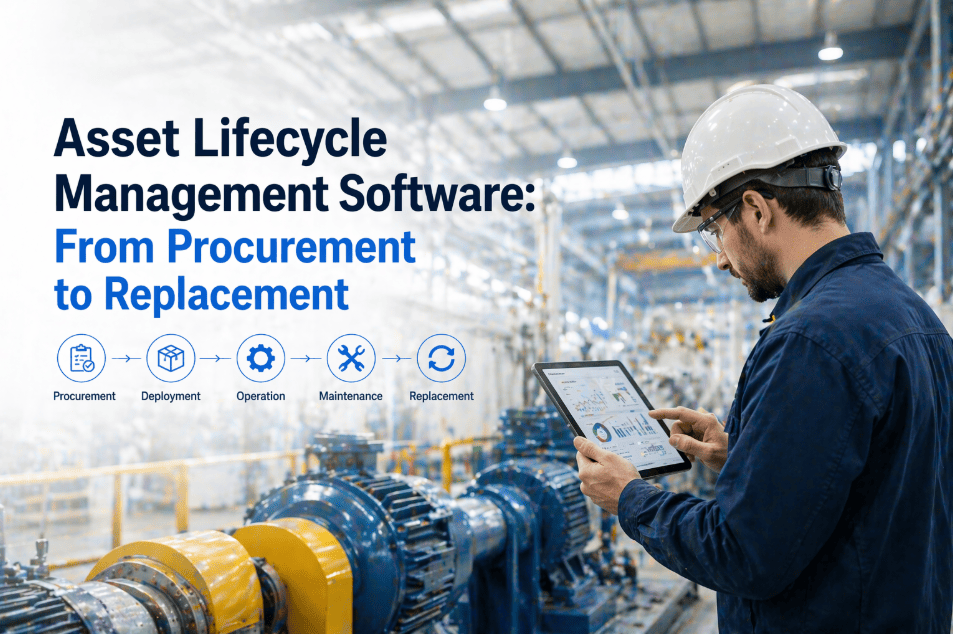
Every industrial asset moves through six distinct phases. Each phase has specific management requirements, cost characteristics, and data needs. The plants that outperform their peers are the ones that actively manage each phase — not just the "operate and maintain" middle — using a connected digital system that carries data forward from one phase to the next.
Planning & Specification
Defining requirements, evaluating options, and selecting the right asset for the application. This phase determines 70–80% of lifecycle costs through specification decisions — motor efficiency class, bearing quality, material grade, vendor support availability.
Procurement & Installation
Purchasing, receiving, installing, and commissioning the asset. Quality of installation directly impacts the entire maintenance trajectory — a misaligned motor mount creates a bearing problem that surfaces 8 months later as an "unexpected" failure.
Early Life & Burn-In
The infant mortality phase where manufacturing defects, installation errors, and design weaknesses surface. Failure rates follow the classic bathtub curve — high initially, then dropping to a stable baseline. Condition monitoring during this phase is critical to catch installation-related issues before they cause collateral damage.
Productive Maturity
The longest and most valuable phase — where the asset delivers its intended function at acceptable reliability. Preventive and predictive maintenance sustains this phase as long as possible. The goal: maximize the ratio of productive output to total maintenance spend during this window.
Degradation & Decision Point
Reliability declines, maintenance costs accelerate, and the asset increasingly becomes a production risk. This is the critical decision phase: refurbish, retrofit, or replace? The answer depends entirely on data — cumulative maintenance cost, current condition, remaining capacity, and the economics of alternatives.
Disposal & Knowledge Capture
Decommissioning, disposal or resale, and — critically — capturing what was learned. Every retired asset holds a decade of maintenance intelligence that should feed forward into the specification for its replacement. Without this feedback loop, the same specification mistakes repeat.
What if every asset in your plant had a complete lifecycle record — from installation baseline to today's condition — in one searchable system that tells you exactly when to repair, refurbish, or replace?
The Repair vs. Replace Decision: A Data-Driven Framework
The most expensive mistake in asset management is not a failed repair — it is continuing to repair an asset past its economic replacement point. Equally costly is replacing an asset prematurely when it still has years of productive life remaining. The framework below uses four data inputs to calculate the optimal decision at any point in an asset's lifecycle.
Cumulative Maintenance Cost
Total spend on the asset since installation — parts, labor, contractor, and downtime cost. When cumulative maintenance exceeds 50% of replacement value, the replacement clock starts ticking.
Reliability Trend (MTBF)
Mean Time Between Failures plotted over the asset's life. A declining MTBF trend confirms accelerating degradation. When MTBF drops below 50% of the original baseline, the asset is in its end-of-life phase.
Current Condition Assessment
Latest vibration analysis, oil analysis, thermography, and visual inspection data. The physical condition determines whether the next repair will restore function or merely delay the next failure.
Technology & Efficiency Gap
The performance difference between the current asset and what's available today. A 15-year-old motor running at IE1 efficiency replaced by an IE4 unit saves 5–8% energy — the replacement pays for itself through operating cost reduction alone.
Lifecycle KPIs: Measuring Asset Performance Over Time
Lifecycle management requires KPIs that span the full asset life — not just monthly maintenance metrics. These six indicators tell you whether your assets are delivering value, approaching replacement, or silently draining your budget.
Total Cost of Ownership (TCO)
All costs from purchase to disposal: acquisition + installation + maintenance + energy + downtime + disposal. The only metric that reveals the true cost of an asset — not just the purchase price.
MTBF Trend Over Asset Life
Mean Time Between Failures plotted quarterly. Stable or rising MTBF = healthy maturity phase. Declining MTBF = entering degradation. The slope of decline predicts the remaining economic life.
Maintenance Cost Ratio
Annual maintenance cost divided by current asset replacement value. The single most powerful repair-vs-replace indicator. Tracks whether you are spending proportionally more to keep aging equipment running.
Asset Availability Rate
Percentage of scheduled production time the asset is actually available to operate. Captures the combined impact of all maintenance interventions — planned and unplanned — on productive capacity.
Remaining Useful Life (RUL)
Estimated time or operating hours remaining before the asset reaches end-of-economic-life. Combines condition data, MTBF trends, and maintenance cost trajectory into a single forward-looking projection.
Warranty Recovery Rate
Percentage of eligible warranty claims actually submitted and recovered. Most plants lose 30–50% of warranty value because failures aren't tracked against warranty dates, or claims are filed after the window closes.
How CMMS Powers Lifecycle Asset Management
Lifecycle management without a CMMS is like navigation without a map — you can see where you are but not where you've been or where you're going. A CMMS connected across all six lifecycle phases creates the institutional memory that drives optimal decisions at every stage. Book a demo to see how Oxmaint tracks full asset lifecycles.
Complete Asset Registry
Every asset documented with specs, installation date, warranty, BOM, location, criticality rating, and parent-child hierarchy. The single source of truth for what you own and where it sits in its lifecycle.
Full Cost History
Every work order carries labor hours, parts consumed, and contractor charges — accumulating the total cost of ownership automatically. No spreadsheet reconciliation. The TCO builds itself from real maintenance activity.
Reliability Trending
MTBF, MTTR, and failure frequency calculated automatically per asset. Trend lines reveal which assets are in stable maturity and which are entering degradation — triggering replacement planning before emergency failures force the decision.
Condition-Based Monitoring
IoT sensor data and inspection records feed condition assessments for every monitored asset. Vibration trends, temperature profiles, and oil analysis results build the physical evidence base for repair-vs-replace decisions.
Repair-vs-Replace Analytics
Automated calculation of maintenance cost ratio, TCO projection, and MTBF trajectory for any asset. Generates data-backed recommendations that finance teams and plant managers can act on — not maintenance opinion, but maintenance evidence.
Capital Planning Integration
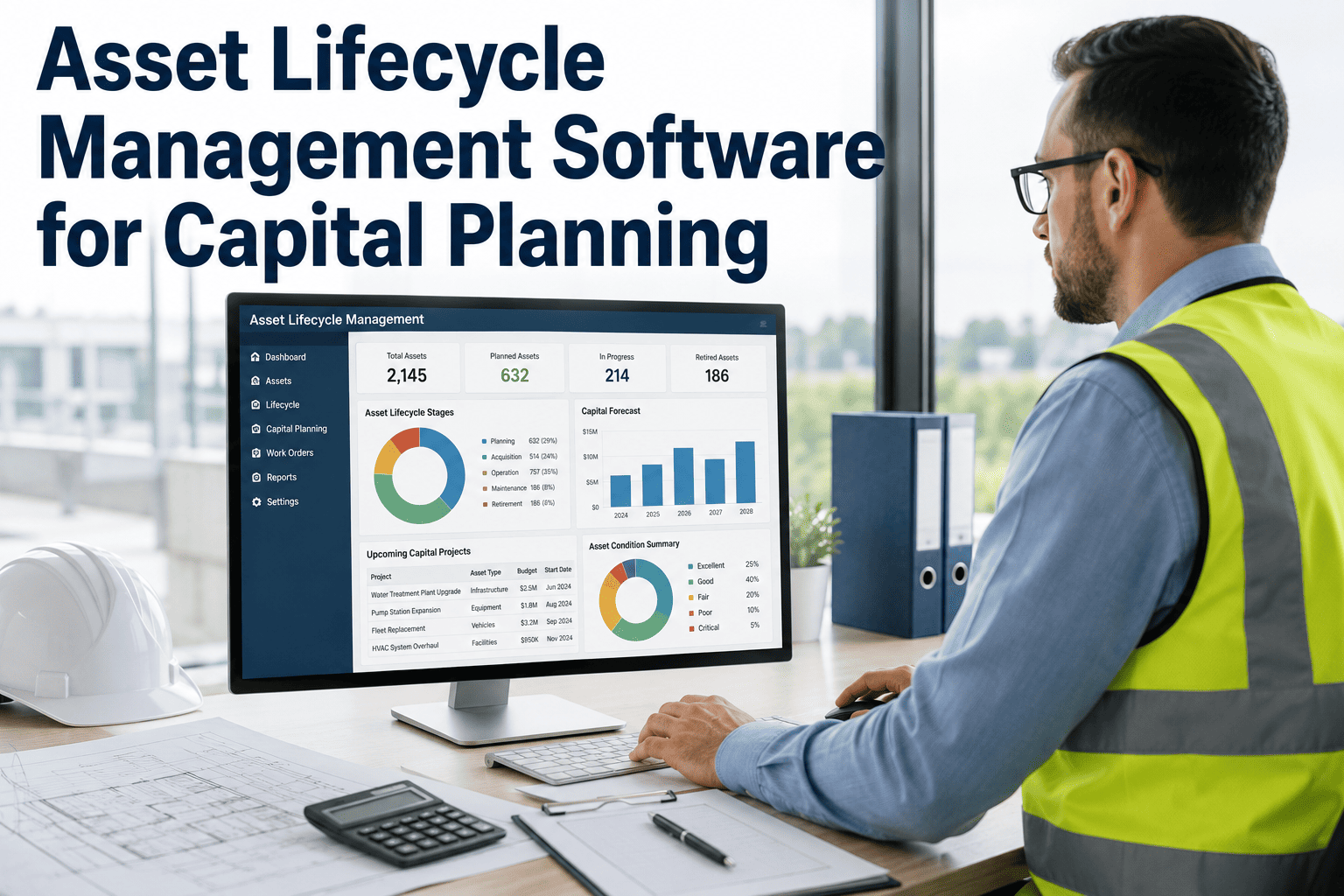
RUL projections for all assets feed into a 1–5 year capital replacement plan. Finance sees which assets need replacement when, at what cost, and with what operational justification — connected directly to maintenance history.
Documented Results from Lifecycle Asset Management
Start Managing Asset Lifecycles, Not Just Breakdowns
Oxmaint builds a complete lifecycle record for every asset — from installation baseline through every work order to the repair-vs-replace decision point. One platform connecting maintenance, reliability, cost, and capital planning.
Frequently Asked Questions
What is asset lifecycle management?
Asset lifecycle management is the practice of tracking every industrial asset from specification and procurement through installation, operation, maintenance, and eventual disposal or replacement. It uses accumulated cost data, condition monitoring, and reliability trends to make optimal decisions at each phase — particularly the critical repair-vs-replace decision that determines whether maintenance spending creates value or wastes it. The goal is minimizing total cost of ownership while maximizing productive life and availability.
When should an asset be replaced instead of repaired?
Four indicators signal that replacement is more economical than continued repair: annual maintenance cost exceeding 15–20% of current replacement value, MTBF declining for three or more consecutive measurement periods, physical condition rated "poor" or "critical" on standardized assessments, and a significant technology or efficiency gap between the current asset and available alternatives. When two or more of these indicators are present simultaneously, the asset has almost certainly crossed its economic replacement point.
What percentage of asset cost occurs after purchase?
Approximately 80% of an asset's total lifecycle cost occurs after the initial purchase — in operations, maintenance, energy consumption, and eventual disposal. The purchase price represents only 15–25% of total cost of ownership for most industrial equipment. This is why specification decisions at the planning phase have such outsized impact — choosing a higher-efficiency motor or premium-quality bearing at 10% higher purchase price can reduce total lifecycle cost by 20–30% through lower maintenance and energy costs over the asset's 10–20 year operating life.
How does a CMMS support asset lifecycle management?
A CMMS supports lifecycle management by creating a continuous digital record for every asset: installation data, every work order executed, all costs incurred (parts, labor, contractor, downtime), condition monitoring data, and reliability metrics (MTBF, MTTR). Over years, this builds the complete cost and condition history needed to calculate total cost of ownership, identify declining reliability trends, and generate data-backed repair-vs-replace recommendations. Without a CMMS, this data exists in fragments across spreadsheets, paper files, and individual memories — making lifecycle decisions based on incomplete information.
What is the optimal replacement window for industrial equipment?
The optimal replacement window is the point where the annualized cost of continued operation (including rising maintenance costs and declining reliability) exceeds the annualized cost of a new asset (including purchase, installation, and expected maintenance). This window typically opens when cumulative maintenance cost reaches 50% of replacement value and the asset's MTBF is declining. For most industrial equipment, this occurs between 60–80% of the asset's maximum physical life — meaning the last 20–40% of an asset's life often costs more per productive hour than the entire preceding period.
How far ahead should replacement planning start?
Capital replacement planning should begin 12–24 months before the anticipated replacement date for standard equipment and 24–36 months for long-lead-time assets (kiln drives, large transformers, specialty gearboxes). This lead time allows for proper specification development, competitive bidding, budget allocation through capital approval cycles, and scheduling the replacement during a planned shutdown window rather than forcing an emergency installation during production time.
How does Oxmaint handle asset lifecycle tracking?
Oxmaint creates a full digital lifecycle record for every asset starting from installation. Every work order, cost entry, condition reading, and reliability metric accumulates automatically over the asset's life. The platform calculates total cost of ownership in real-time, tracks MTBF trends quarterly, auto-flags assets whose maintenance cost ratio exceeds configurable thresholds, and generates repair-vs-replace reports that compare continued maintenance cost against replacement economics. Warranty dates are tracked with automatic alerts before expiration. The complete lifecycle dataset feeds into capital planning views that show which assets need replacement, when, and at what projected cost.


.png)