A stopped automotive production line costs between $10,000 and $50,000 per minute depending on the plant throughput and model mix. This is not a theoretical calculation — it is the operational reality that every automotive maintenance manager lives with every shift. A weld robot that stops mid-cycle, a paint booth conveyor that trips a drive fault, a press line transfer bar that loses hydraulic pressure: each of these events creates a production stop that propagates instantly through the takt-time-constrained sequence of an automotive assembly operation. The maintenance management discipline required to prevent these events is more demanding than almost any other manufacturing environment — the asset base includes thousands of robots, hundreds of automated systems, and complex pneumatic, hydraulic, and electrical infrastructure — all of which must be maintained on precise intervals calibrated to production cycle counts rather than calendar dates. Sign UP for Automotive manufacturing CMMS that is purpose-built for production line environments — not adapted from a general maintenance tool — is the operational foundation that keeps automotive plants at the throughput and quality rates their customers expect.
Automotive Manufacturing CMMS:Production Line Maintenance
Purpose-built CMMS for automotive plants — production-line aware, robot-maintenance capable, and built to keep assembly, stamping, welding, and paint operations running at takt time.
Automotive Plant Maintenance by Production Zone
Every zone in an automotive plant has a distinct asset profile and maintenance management requirement. OxMaint configures zone-specific asset hierarchies, PM templates, and SLA tiers for each production area. Book a demo to walk through your plant zones with OxMaint.
Stamping / Press Shop
High-cycle presses with die change as the primary maintenance event. Cycle-count-triggered PM — press PM intervals measured in strokes, not days. Die wear measurement, transfer bar inspection, and hydraulic system PM are the high-frequency tasks. Press downtime creates a cascade into body assembly — the highest-consequence zone for line stoppage upstream impact.
Body in White (Welding)
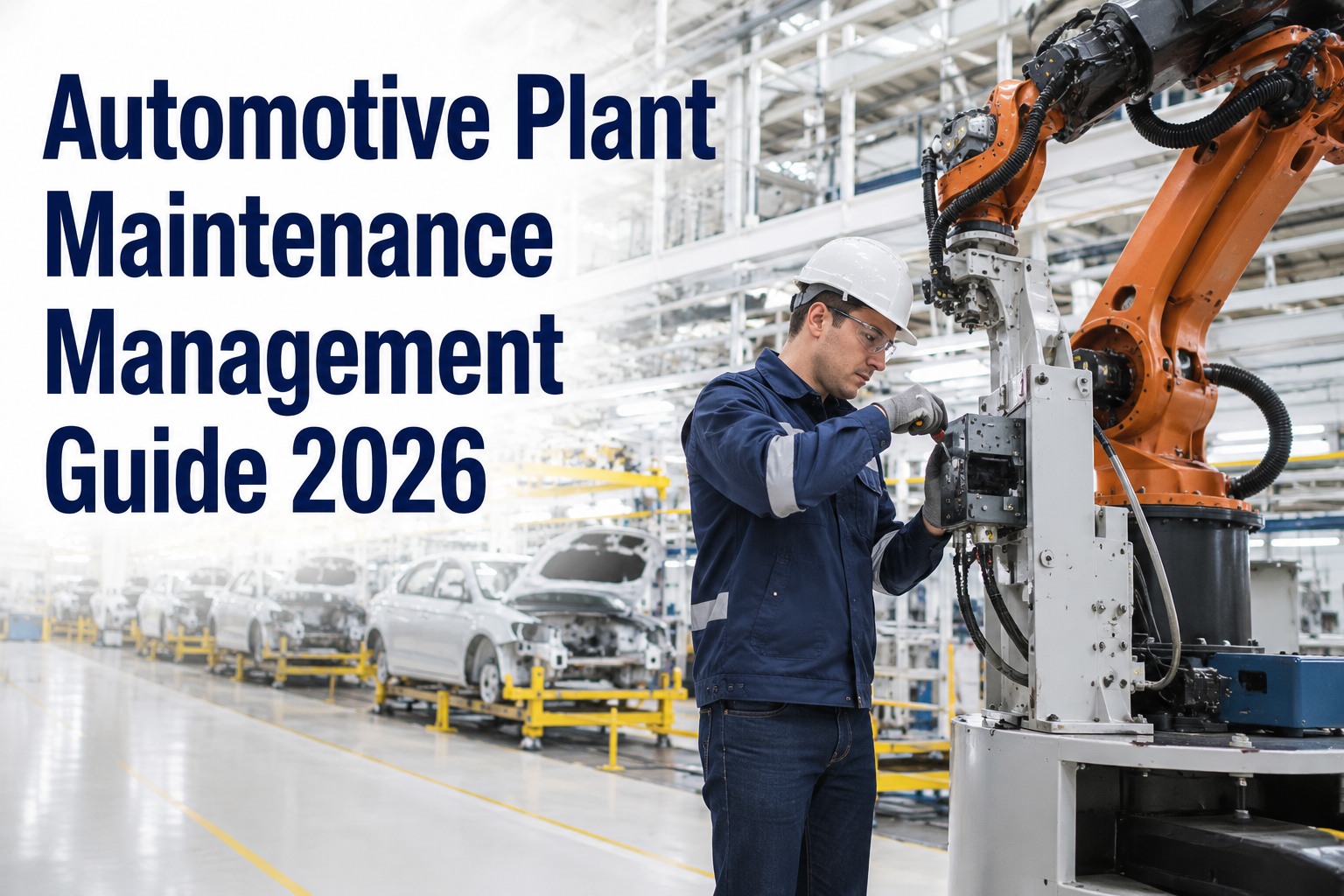
Robot-dense environment — 200–800 welding robots per body shop in a typical OEM plant. Robot PM intervals are measured in weld cycles: tip dress frequency, electrode cap replacement, TCP (tool centre point) recalibration schedule, and servo axis inspection. Spot weld quality monitoring data should feed directly into maintenance triggers when quality deviations indicate a maintenance requirement.
Paint Shop
Paint shop maintenance is the most contamination-sensitive zone in automotive. Atomiser cleaning, booth filter replacement, conveyor system PM, and spray gun calibration are all quality-critical — a maintenance failure in paint does not just stop the line, it produces a batch of vehicles requiring costly rework. Air handling maintenance, temperature/humidity control systems, and pretreatment bath chemistry equipment all require structured PM programmes.
Trim, Chassis & Final Assembly
Assembly line maintenance is driven by takt time — maintenance response must be faster than the takt interval to avoid line stoppage. Conveyor system PM, torque tool calibration (safety-critical on vehicle fasteners), ergonomic assist device maintenance, and AGV/AMR fleet maintenance are the primary maintenance categories. Torque tool calibration records are a product safety compliance requirement in automotive.
Managing Robot Maintenance in Automotive Plants
An automotive body shop with 400 welding robots has 400 individual assets, each requiring PM tracked by weld cycle count rather than calendar interval. Without a CMMS that supports cycle-count triggers, robot PM is either massively over-scheduled (every robot at the same calendar interval regardless of utilisation) or systematically under-maintained (calendar intervals that underestimate actual cycle accumulation). Sign up to configure robot PM in OxMaint — free.
OxMaint PM work orders for robots trigger on weld cycle count, not calendar date. Each robot asset has a cycle counter — incremented via API from the robot controller or production MES — and PM work orders fire when the counter reaches the configured interval. A high-utilisation robot on a three-shift operation gets serviced at the correct interval. A robot on a single-shift line that accumulates half the cycles gets serviced accordingly.
Tool Centre Point (TCP) recalibration records are maintained in OxMaint as a PM work order closure — the recalibration date, the measured deviation before and after, the technician identity, and the calibration certificate are all stored in the robot's asset record. When a robot produces a weld quality deviation, the maintenance history is searchable within seconds to determine whether a TCP calibration is overdue or whether the deviation has another cause.
Servo axis wear and gearbox oil degradation are the highest-cost maintenance events in robot fleets. OxMaint receives vibration and temperature data from robot condition monitoring systems via API and creates work orders automatically when parameters cross configured thresholds. This predictive trigger prevents the robot arm fault that causes a mid-cycle production stop — the most expensive robot failure mode.
The OxMaint robot fleet dashboard shows the PM status of every robot in the body shop — colour-coded by PM compliance (current, due, overdue), grouped by production zone and line segment. A maintenance supervisor managing 400 robots can see immediately which robots have approaching or overdue PM, without reviewing 400 individual asset records. PM coverage is visible at a fleet level, not only at the individual asset level.
IATF 16949 Maintenance Requirements: What OxMaint Delivers
IATF 16949 — the quality management standard for automotive production — contains specific requirements for maintenance management that go beyond ISO 9001. These are the requirements OxMaint addresses directly. Book a demo to map OxMaint's capabilities to your IATF audit requirements.
IATF requires a documented preventive maintenance system covering key manufacturing process equipment — with written PM instructions, scheduled preventive maintenance activities, and records demonstrating that PM activities have been performed. OxMaint's auto-generated PM work orders with mandatory completion checklists, SLA enforcement, and closed-record audit trail directly address this clause. PM compliance reports provide the evidence of systematic PM execution required for IATF audit.
IATF 16949 explicitly encourages predictive maintenance methods as part of the manufacturing equipment maintenance system. OxMaint's AI pattern detection — flagging recurring fault patterns for root-cause investigation — and condition monitoring data integration for threshold-triggered work orders both support the predictive maintenance intent of this clause.
IATF requires calibration records for all measurement and monitoring equipment used in automotive quality assurance. OxMaint tracks calibration due dates, stores calibration certificate attachments, generates overdue calibration alerts, and provides a calibration status report by equipment category — covering torque tools, gauges, test equipment, and CMMs used in production quality control.
IATF's TPM requirements include OEE measurement and improvement targets for critical equipment. OxMaint's KPI dashboard provides the MTBF, MTTR, availability, and PM compliance metrics that feed OEE calculation and demonstrate progressive improvement — the evidence trail that IATF auditors look for when reviewing TPM programme effectiveness. Sign up to activate OxMaint's TPM metrics dashboard — free.
OxMaint for automotive — production-line aware, robot-maintenance capable, IATF-compliant records. Free to start.
Frequently Asked Questions
How does OxMaint handle robot maintenance in automotive body shops?
Does OxMaint support IATF 16949 maintenance documentation requirements?
How does automotive line takt time affect work order priority and dispatch?
Every Robot Serviced. Every Line Running.Every IATF Record Ready.
OxMaint delivers cycle-count robot PM, takt-aware dispatch, calibration tracking, and IATF 16949-compliant maintenance records for automotive production plants — free to start, live in days.


.png)