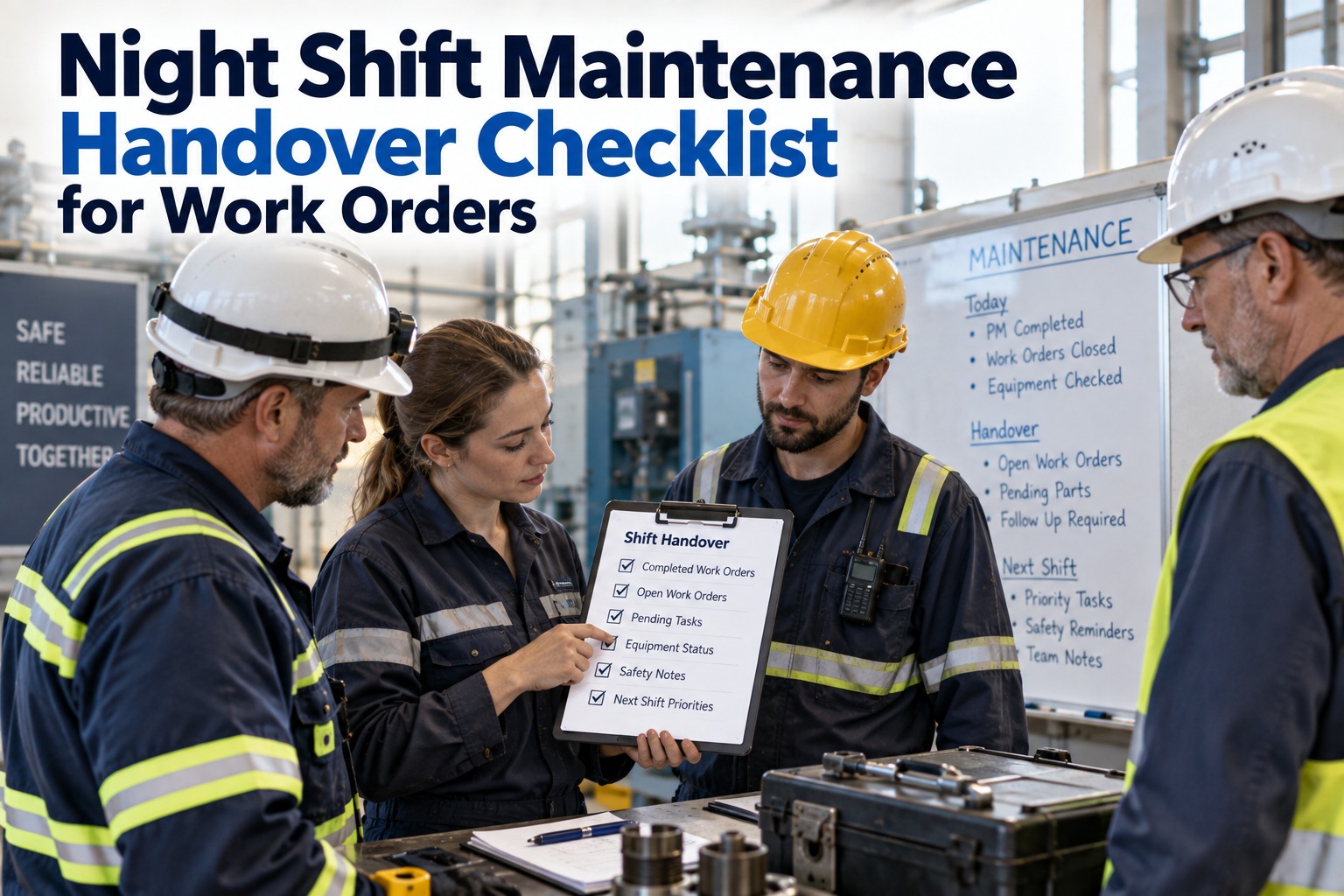
Siemens' 2024 plant survey found facilities average 25 unplanned downtime incidents per month and lose 27 hours per plant to unplanned downtime. Not every one of those incidents starts at shift change — but weak handovers make every recovery slower, because the incoming crew spends the first 20 minutes figuring out what happened rather than acting on clear information that was already known by the team they replaced. The outgoing shift knows. The incoming shift doesn't. That gap — 8 hours of operational context disappearing in a conversation held in a noisy corridor — is the most preventable source of avoidable downtime in any 24/7 operation. Book a demo to see OxMaint's Shift Logbook — or start free and log your first shift handover today.
Problem-Solution · Shift Logbook · Maintenance Communication
Digital Shift Handover: Stop Losing Maintenance Context Between Teams
What gets lost at shift change, why verbal handovers fail under pressure, and how a structured digital shift log gives every incoming team the complete picture — before the first work order of the day is opened.
27 hrs
Lost per plant per month to unplanned downtime (Siemens 2024)
$2.3M
Cost per hour of downtime in large automotive plants (Siemens 2024)
3–5×
Cost of emergency repair vs planned — the penalty for faults missed at handover
What a Single Missed Fault at Shift Change Actually Costs
This is a real scenario pattern that repeats in facilities relying on verbal handovers. Every step in this chain is preventable with a digital shift log.
11:45 PM
Night shift technician notices conveyor motor running hot
Mentioned verbally to the colleague going off shift. No digital record created. "I told them about it" is the only evidence this observation was ever made.
12:15 AM
Morning shift begins — no record of the fault
The incoming supervisor was not present for the verbal exchange. The shift log notebook has one line: "All normal." The conveyor runs for two more hours before motor failure. No one on the morning crew knew the clock was running.
2:30 AM
Motor failure — unplanned downtime begins
Production stops. Emergency callout raised. The technician who noticed the heat last night is now off shift and unreachable. The incoming team starts the diagnostic process from zero — 2.5 hours of context already lost.
3:15 AM
Emergency part ordered — already staged by the outgoing crew
A technician from the night shift had pulled the replacement bearing and staged it at the machine before leaving. No one documented it. The morning crew orders the same part again — doubling cost and extending downtime by half a day while the part ships overnight.
Resolution
Total incident cost: emergency repair + 6 hrs downtime + duplicate part order
The motor failure was not inevitable. The bearing was already staged. The fault was already observed. The digital record was the only thing missing — and its absence converted a 45-minute planned repair into a 6-hour unplanned outage.
Why Verbal and Paper Handovers Fail Under Pressure
01
Memory is unreliable at shift end
A technician finishing a 12-hour shift has been managing 6–10 parallel activities. Asking them to recall and accurately communicate every open issue in a 5-minute verbal exchange is not a process — it is a gamble. Tired people abbreviate, prioritise instinctively, and forget the details that seem minor but are not.
02
No acknowledgement — no accountability
There is no record of whether the incoming supervisor read and understood the handover. A verbal "yes, got it" in a noisy corridor is not acknowledgement. When the flagged issue is not actioned and an incident follows, the investigation cannot establish whether the information was transferred, received, or simply not acted on.
03
Context missing from brief notes
Paper logs that say "motor issue — check in morning" convey nothing about the diagnostic work already done, the parts already ordered, or the urgency of the decision to be made at 6:01 AM. The incoming supervisor starts the investigation that the outgoing crew already half-completed — duplicating effort and extending downtime.
04
Production and maintenance on different information
The production manager often is not present during the maintenance handover. Equipment status information that should be shaping production scheduling decisions for the morning run is trapped in a logbook in the maintenance office. The two teams start their shifts with different pictures of the same plant.
SHIFT LOGBOOK · OXMAINT
Every Shift Should Start with the Same Information the Last Shift Had.
OxMaint's Shift Logbook captures open faults, downtime events, staged parts, safety observations, and work-in-progress notes in a structured digital record — with mandatory acknowledgement from the incoming supervisor before the shift begins.
The 6 Fields Every Shift Handover Must Capture
A shift log that misses any of these six categories has gaps that will create operational problems within the first two hours of the next shift.
| Field Category |
What to Record |
What Happens Without It |
OxMaint Feature |
| Open faults and abnormal conditions |
Asset ID, observed symptom, urgency, and diagnostic work already completed |
Incoming crew restarts diagnosis from zero — duplicating effort already done |
Fault entries linked to asset record and open work order — incoming team sees full context in one tap |
| Downtime events |
Asset, duration, cause, current status (repaired / temporary fix / monitoring), and action required |
Downtime not escalated or followed up — temporary fix assumed permanent until re-failure |
Downtime events auto-linked to work orders; status visible on asset dashboard without reading logbook |
| Safety observations and near-misses |
Hazard location, description, control in place, and whether an investigation has been raised |
Incoming crew exposed to known hazard they were not warned about — liability and incident risk |
Safety entries flagged with mandatory acknowledgement — incoming supervisor cannot skip safety notes during handover sign-off |
| Parts staged or on order |
Part description, location, work order it is staged for, and expected delivery if on order |
Parts ordered twice; staged parts not found; work order held waiting for stock that is already on-site |
Staged parts linked to work order and visible in inventory — no duplicate orders, no missing parts |
| Work in progress (WIP) |
Incomplete work orders, next steps, and any access restrictions or isolations still in place |
Incoming crew re-energises equipment that the outgoing crew had isolated for a repair still in progress |
Active LOTO and permit status visible in handover — incoming crew cannot close out a permit without confirming WIP completion |
| Priorities for the incoming shift |
Top 3 actions the incoming supervisor should take in their first hour, in priority order |
Incoming supervisor sets their own priorities without the benefit of the outgoing crew's operational picture |
Priority section is a required field in OxMaint shift log — must be completed before outgoing supervisor can sign off |
Expert Review
"In twenty years of maintenance operations consulting, I have never visited a plant where the shift handover was not a problem. The symptoms vary — some plants have too much information in undifferentiated paper logs that no one reads, others have too little information in brief verbal exchanges that no one remembers. But the root cause is always the same: the handover is treated as a communication event rather than a process with defined inputs, mandatory fields, and documented acknowledgement. The moment you make the incoming supervisor sign off on a digital record that they have reviewed — not just been present for a conversation — the dynamic changes. They ask questions before the handover closes. They confirm their understanding of the active isolations. They establish their priorities before they walk onto the floor. That is not more work. That is less work — because the 45-minute discovery process that the incoming supervisor normally runs for the first hour of their shift is replaced by a 5-minute structured review that tells them exactly where to focus."
Marcus Webb, CMRP, CRL
Certified Maintenance and Reliability Professional (SMRP) · Certified Reliability Leader · 19 years industrial maintenance operations · Specialist in maintenance workflow design and shift-to-shift operational continuity
Frequently Asked Questions
What should a maintenance shift handover log always include?
A complete maintenance shift handover must capture six categories without exception:
open faults and abnormal conditions (with diagnostic work already done);
downtime events with current status and required action;
safety observations and near-misses with the control in place;
parts staged or on order so the incoming team does not duplicate procurement;
work in progress including active isolations and permit status; and
incoming shift priorities — the top 3 actions the incoming supervisor should take in their first hour. A log missing any of these categories will create operational problems within the first two hours of the next shift.
Book a demo to see OxMaint's structured shift log template.
Why do verbal handovers fail in maintenance operations?
Verbal handovers fail for three structural reasons: memory is unreliable at the end of a 12-hour shift — tired technicians abbreviate and forget details that do not feel significant in the moment; no acknowledgement record exists — there is no way to prove the incoming crew received, understood, or acknowledged the information; and context is lost — a brief verbal note cannot convey the diagnostic work already completed, the parts already staged, or the urgency of the decision facing the incoming team. These are not cultural failures. They are structural failures of a process that requires reliable performance from people in a tired, noisy, time-pressured environment. Digital shift logs solve all three by capturing structured information before the shift ends and requiring digital acknowledgement before the next shift begins.
How does OxMaint's Shift Logbook connect to work orders and asset records?
In OxMaint, every shift log entry is linked to the relevant asset record and open work order — not stored as a separate text document. When the incoming supervisor reviews an open fault in the shift log, they see the full asset maintenance history, the work order status, any parts reservations, and the active permit or isolation status in the same view. This means the 5-minute shift log review replaces what would otherwise be a 30-minute process of checking the CMMS, the storeroom, and the permit board separately. Downtime events logged during the shift automatically update the asset's availability record. Safety observations automatically trigger a follow-up work order if no investigation is already linked.
Start free to connect your shift log to your asset and work order data.
Does digital shift logging add workload for technicians?
When implemented correctly, digital shift logging reduces end-of-shift workload rather than adding to it. The key is that OxMaint captures shift data progressively throughout the shift — as work orders are updated, faults are logged, and parts are reserved, the shift log is building automatically. The technician's end-of-shift action is to review and confirm what the system has captured, add the priority notes for the incoming team, and sign off — not to construct a report from memory. The biggest friction point in traditional shift reporting is asking technicians to write a report at the end of a long shift from memory. OxMaint eliminates that friction by making the report a by-product of the normal workflow rather than a separate documentation task.
SHIFT LOGBOOK · OXMAINT
The Next Shift Shouldn't Start by Figuring Out What the Last Shift Already Knew.
OxMaint Shift Logbook captures open faults, downtime events, staged parts, safety observations, active isolations, and incoming priorities — with mandatory acknowledgement before the next shift begins, so every team starts with full context, not a 20-minute discovery process.