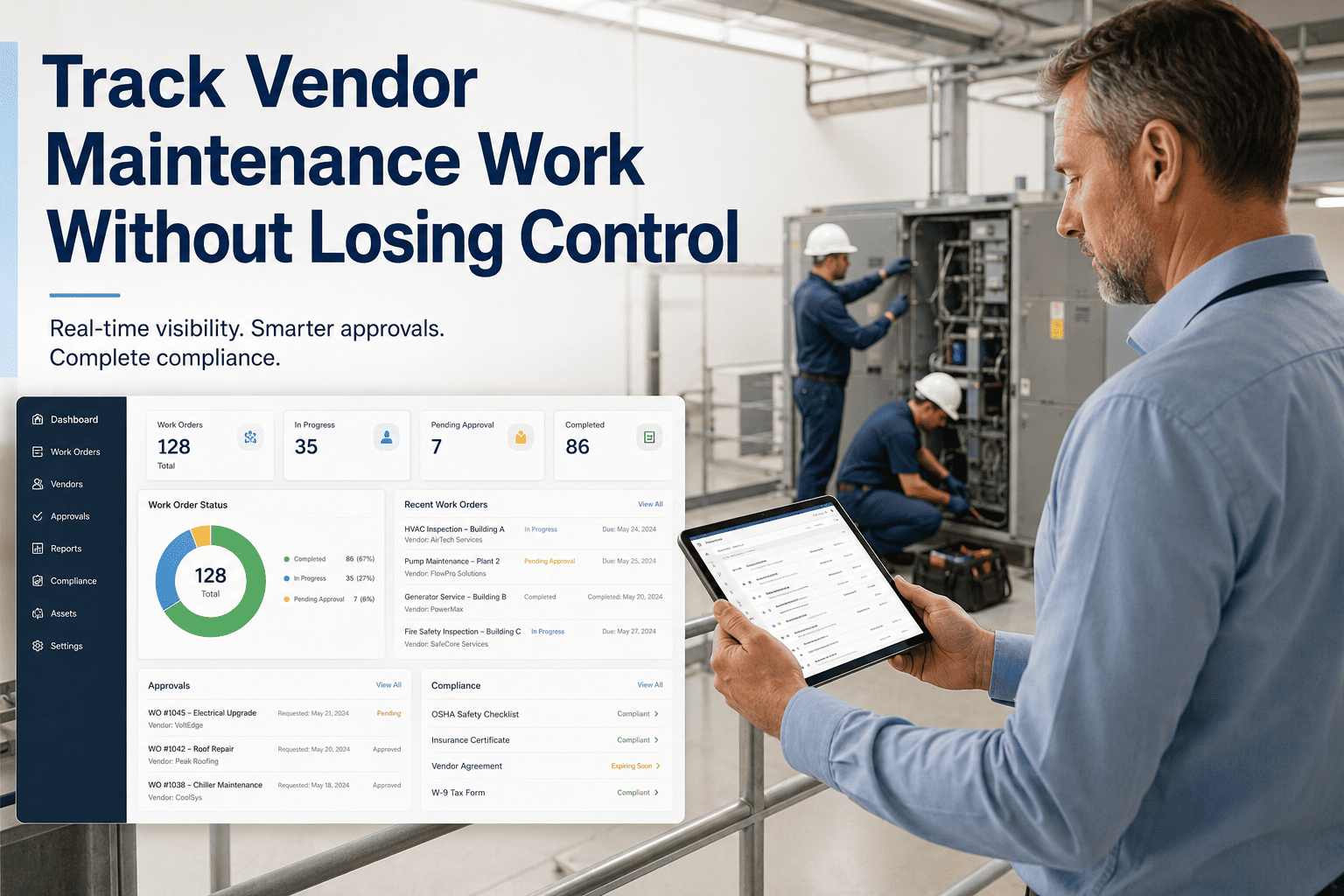
The average facilities organisation outsources 35–55% of its maintenance work to external vendors — HVAC contractors, lift companies, fire suppression specialists, electrical crews, and general maintenance contractors — and in most cases has almost no real-time visibility into what those vendors are actually doing, when they did it, or whether the invoice they submitted matches the work that was performed. A vendor who invoices for 4 hours on a job that took 90 minutes is not committing fraud in their own view — they are billing to the scope they were given and the time they can justify. Without digital work order records, timestamped photo completions, and a structured approval workflow, the facility manager pays the invoice because there is no evidence to dispute it. OxMaint's vendor and supplier management module gives every contractor a role-based portal — limited to their assigned jobs — where they confirm arrival, log work, upload photo evidence, and submit completion for approval. Every step is timestamped, every invoice has a matching work order record, and every SLA breach is visible before the invoice lands.
How to Track Vendor Maintenance Work Without Losing Control
Work order assignment. Arrival confirmation. Timestamped photo completion. Invoice-to-work-order matching. SLA compliance tracking. The complete framework for managing outsourced maintenance as rigorously as in-house work — without adding headcount.
The Vendor Control Problem: Where Facilities Teams Lose Oversight
The breakdown in vendor maintenance control follows a predictable pattern. Each failure point is structural — it exists because the workflow was designed for in-house technicians and then extended to vendors without the governance layer that external relationships require.
The OxMaint Vendor Workflow: Control at Every Stage
Vendor SLA Tracking: What to Measure and How
| SLA Metric | Definition | Typical Standard | Poor Performance Signal | OxMaint Measurement |
|---|---|---|---|---|
| Response Time | Time from work order creation to vendor arrival confirmation | P1: 4 hrs · P2: 24 hrs · P3: 72 hrs | More than 25% of jobs missing response SLA | Automatic — SLA clock starts at WO creation, stops at arrival scan |
| First-Time Fix Rate | Percentage of jobs where the fault is fully resolved on the first visit | >80% for routine work · >65% for complex | Below 60% — indicates poor diagnosis or inadequate parts preparation | Tracked per vendor and job type — return visits linked to original WO |
| Completion Accuracy | Percentage of work orders completed with all required evidence submitted | >95% | Below 80% — vendor is routinely submitting incomplete documentation | Photo and sign-off completion rate tracked per vendor |
| Invoice Accuracy | Percentage of invoices that match approved work order scope and hours without requiring adjustment | >90% | Below 75% — systematic over-billing or scope drift pattern | Invoice-to-WO variance flagged automatically on submission |
| Cost per Job Type | Average cost per job category (e.g., chiller PM, elevator callout, fire panel test) across all vendors performing that type | Track trend — declining is good | Vendor consistently above portfolio average for same job type | Cost benchmarked across vendors for comparable job types |
| Recall Rate | Percentage of jobs where the same fault recurs within 30 or 90 days of the original repair | <10% within 90 days | Above 20% — repair quality issues or parts quality problems | Recurring fault pattern detected by asset ID and fault type |
The Vendor Access Model: Role-Based Permissions in OxMaint
The most expensive decision in facilities management is renewing a vendor contract based on the relationship rather than the data. I have sat through contract renewals where nobody in the room could answer basic questions: What is this vendor's average response time? What percentage of their invoices have required adjustment? How often do their repairs hold for 90 days before we call them back? When those questions can't be answered from a system, the contract renews by default — usually at a small uplift — and the performance problems that have been absorbing budget silently for three years continue for another cycle. The fundamental issue is that managing vendors with email threads and verbal agreements is structurally the same as managing in-house technicians with paper work orders. It might work well enough that you don't notice the leakage, but the leakage is there. Digital vendor management isn't about distrust — it is about creating a shared record that protects both parties and gives the facilities team the data to have performance conversations backed by evidence rather than impression.
Frequently Asked Questions
Do vendors need their own OxMaint account, and does it cost extra?
Vendors are added to OxMaint as external portal users — they access only the jobs assigned to them through a role-limited view that costs nothing additional for the vendor to use. The vendor portal is accessed via mobile browser or the OxMaint app without requiring a paid licence. Each vendor sees exclusively their assigned work orders, the asset QR code for check-in, and their own historical job records — nothing else. The facilities team retains full control of what each vendor can access, approve, and view. Start your free trial to configure the vendor portal for your first contractor.
How does OxMaint flag when a vendor's invoice doesn't match the work order?
When a vendor submits an invoice, OxMaint compares it against the approved work order record on three dimensions: hours claimed vs. time-on-site (from arrival scan to departure sign-off), parts invoiced vs. parts logged during the job, and line items invoiced vs. scope items in the work order. Any variance above a configurable threshold — say, more than 15% on hours or any uninvoiced parts — generates an automatic flag before the invoice enters the approval queue. The approver sees the discrepancy before clicking approve. Book a demo to see the invoice matching workflow for your vendor types.
Can OxMaint track vendor SLA compliance across multiple facilities with different vendors?
Yes. OxMaint supports multi-site, multi-vendor configurations where each facility has its own vendor roster and its own SLA definitions — emergency response at a data centre may be 2 hours, while a retail store may have 24-hour requirements for the same vendor and job type. The portfolio-level vendor dashboard aggregates performance across all sites and all vendors simultaneously — a regional FM sees all vendors across their cluster, the portfolio director sees all vendors across every building. SLA compliance rates are calculated separately per vendor-site-job-type combination. Start your free trial to configure multi-site vendor SLAs.
How do you use OxMaint data to renegotiate or replace underperforming vendors?
OxMaint's vendor performance export provides the data package for contract negotiations: response time distribution (median, average, worst case), first-time fix rate by job type, invoice accuracy rate and total adjustment value over the contract period, recall rate for repairs within 30 and 90 days, and cost per job type benchmarked against other vendors in your network performing equivalent work. Presenting this data in a contract review meeting changes the dynamic entirely — the conversation moves from "we've been happy with your service" to "your first-time fix rate has been 58% against a contracted 75% for the last two quarters." Book a demo to see the vendor performance export format.
Your Vendors Are Managing Your Assets. You Should Be Managing Your Vendors.
OxMaint gives every vendor a structured digital workflow — work order assignment, arrival confirmation, photo completion evidence, invoice matching, and SLA tracking — while giving your facilities team the performance dashboard to make contract decisions based on data, not assumption.

.png)
