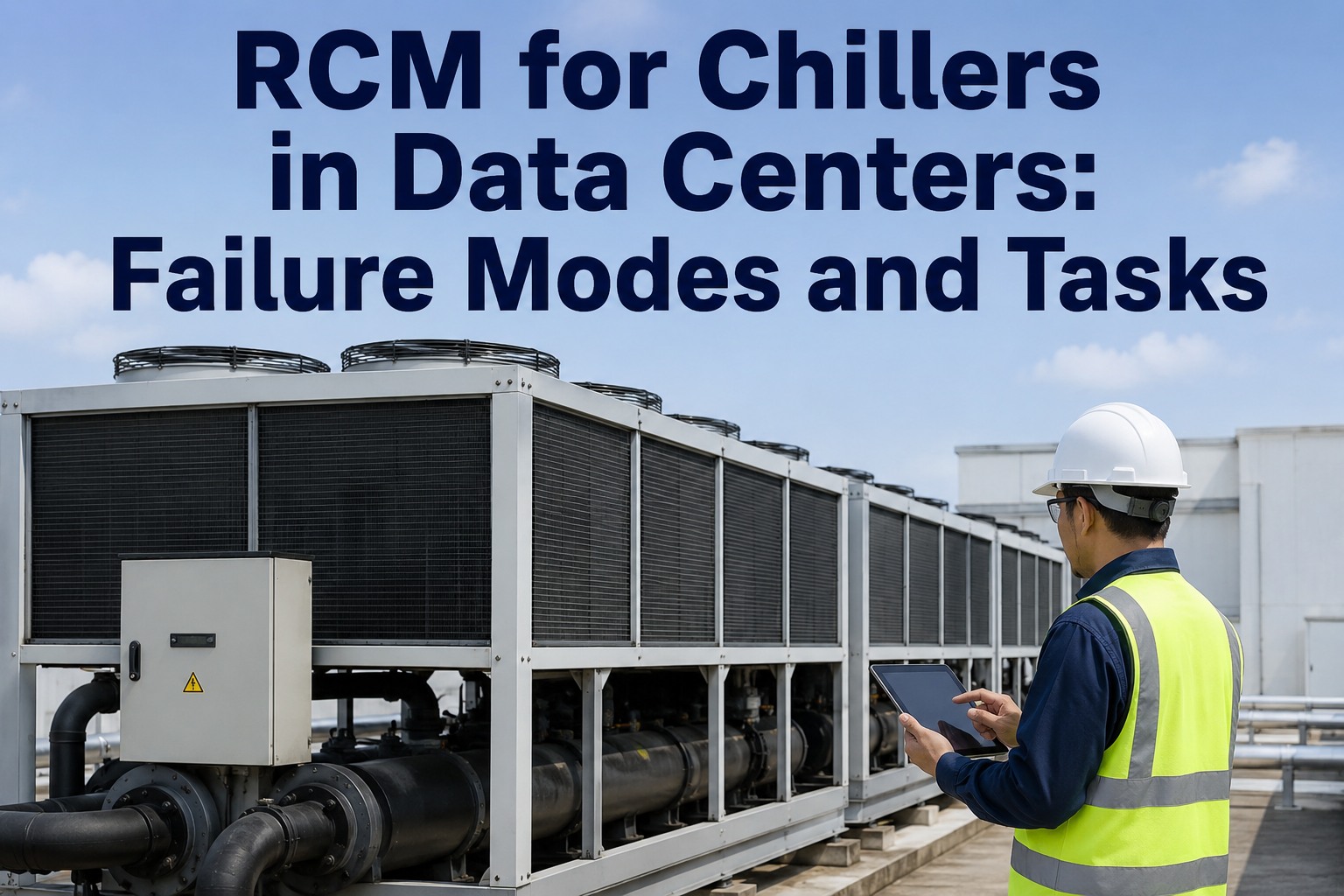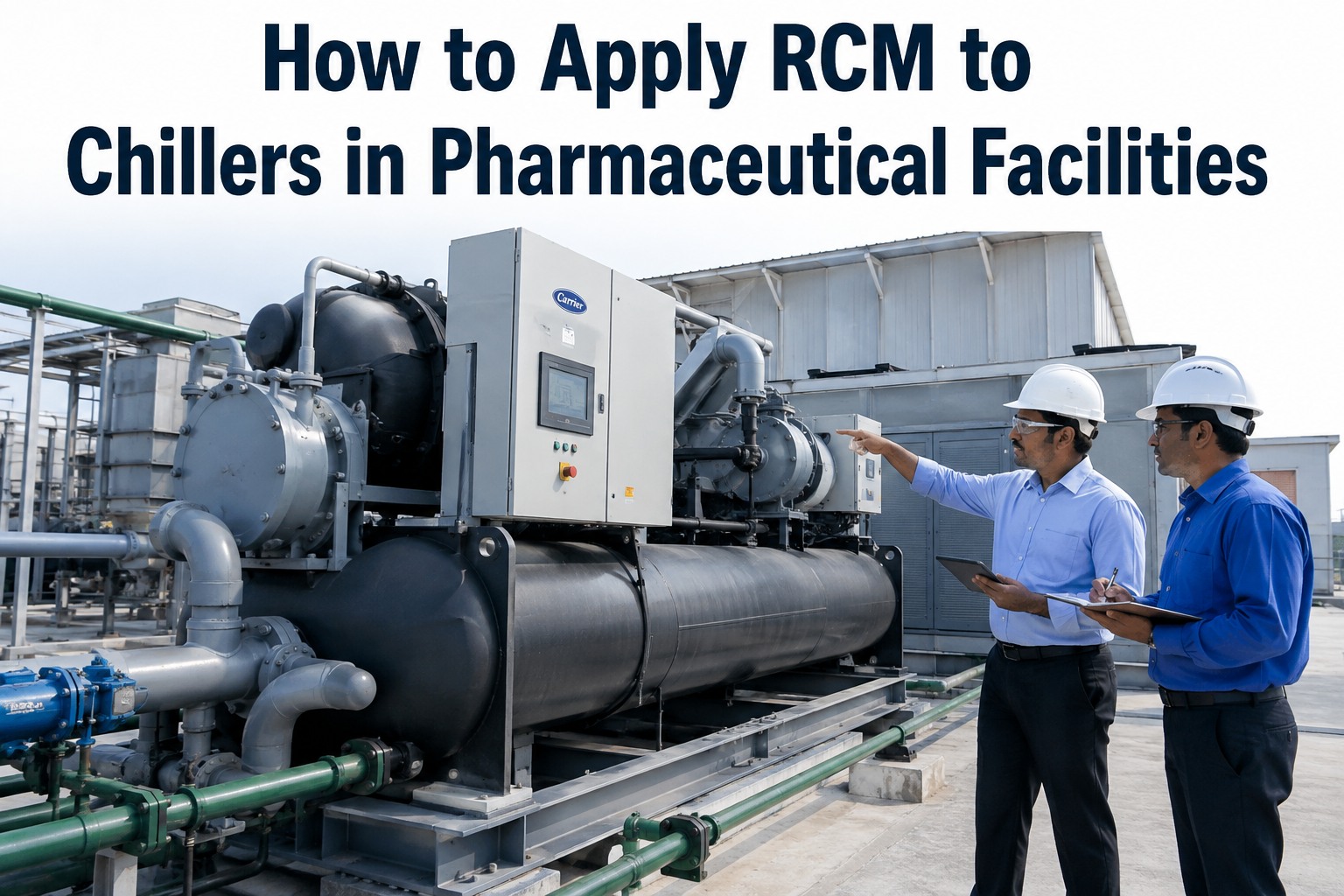
Reliability-Centered Maintenance (RCM) applied to chillers in pharmaceutical facilities is the systematic process of identifying every critical failure mode—from refrigerant leaks to compressor bearing degradation—and matching it to the most cost-effective maintenance task, whether that is a condition-based monitor, a scheduled restoration, or a run-to-failure strategy. Pharmaceutical chillers operate under strict regulatory scrutiny (cGMP, FDA 21 CFR Part 11) where a single temperature excursion can destroy millions of dollars of product and trigger batch failures. Moving from reactive firefighting to a controlled, RCM-driven reliability program requires mapping asset hierarchies, automating preventive maintenance schedules, and capturing real-time condition data; OxMaint's AI-powered CMMS is built precisely for this transition, giving maintenance teams the work order workflows, mobile execution tools, and analytics needed to turn maintenance data into compliance-ready decisions. Ready to modernize your maintenance approach? You can Start Free Trial today.
RCM STRATEGY FOR PHARMA CHILLERS
Is a single chiller failure putting your next batch validation at risk?
Pharmaceutical chillers operate under strict cGMP and FDA regulations where an unplanned temperature excursion can destroy millions in product and trigger costly audit findings. Applying a structured Reliability-Centered Maintenance (RCM) strategy eliminates reactive firefighting and ensures continuous, compliant cooling.
FAILURE ANALYSIS
Critical pharmaceutical chillers failure modes to target with RCM
A pharmaceutical chiller has over 15 distinct failure modes, but roughly 80% of unplanned downtime traces back to just six critical areas. Your RCM strategy must prioritize these high-impact vulnerabilities first.
Compressor Bearing Wear
Vibration and oil degradation cause bearing failure, representing the highest cost repair on a chiller. Without condition monitoring, failure is sudden and total. RCM assigns vibration analysis and oil sampling to detect pitting weeks before seizure.
Refrigerant Leaks
Micro-leaks reduce cooling capacity gradually, causing compressors to overwork and push process temperatures out of validated ranges. RCM dictates continuous pressure logging and ultrasonic leak detection as predictive tasks.
Condenser Tube Fouling
Scale and biological growth in cooling towers drop heat-transfer efficiency by 15-30%, spiking energy consumption. RCM schedules predictive cleanings based on approach temperature trends rather than arbitrary calendar dates.
Control Sensor Drift
Temperature and pressure sensors drift over time, causing false alarms or unsafe cycling. RCM mandates quarterly calibration checks tied to FDA compliance documentation to maintain data integrity.
Evaporator Freezing
Low refrigerant charge or failed expansion valves leads to evaporator freezing, cracking tubes and flooding the system. RCM applies flow-switch testing and continuous delta-T monitoring to prevent catastrophic tube rupture.
Electrical Component Degradation
Contactors and capacitors degrade from thermal cycling, leading to single-phasing and motor burnout. RCM requires infrared thermography scans during peak load to catch loose connections before they arc.
CHECKLIST
Pharmaceutical chillers RCM checklist: Tasks to implement
Translating failure modes into actionable maintenance requires a tiered RCM checklist. Use this framework to assign condition-based, preventive, and reactive tasks based on criticality and failure predictability.
Predictive Monitoring
- Continuous vibration analysis on compressor bearings (ISO 10816 standards)
- Real-time approach temperature logging for heat-transfer efficiency
- Monthly oil sampling for spectrometric wear-metal analysis
- Quarterly infrared thermography on motor control centers
Scheduled Restoration
- Calibrate all pressure and temperature sensors every 90 days
- Clean condenser tubes based on approach trend data (typically 6-12 months)
- Replace filter-driers and inspect expansion valves annually
- Test safety controls, flow switches, and low-temp cutoffs monthly
Non-Critical Spares
- Maintain redundant secondary pumps; replace upon failure
- Swap non-critical indicating lights and panel gauges as they burn out
- Keep sealed bearings in stock for auxiliary motors rather than time-based swapping
- Replace flexible couplings on secondary loops during planned outages only
| Failure Mode | RCM Task Type | Monitoring Interval | Risk if Ignored |
|---|---|---|---|
| Bearing Degradation | Condition-Based (PdM) | Continuous / 30-day trend | $50K+ compressor rebuild |
| Tube Fouling | Predictive Restoration | Approach temp trend review | 25% efficiency loss, batch alarm |
| Sensor Drift | Time-Based PM | 90 days | cGMP compliance violation |
| Refrigerant Leak | Condition-Based (PdM) | Continuous pressure log | Catastrophic low-temp freeze |
| Contactor Failure | Condition-Based (IR) | Quarterly thermography | Motor burnout, 48-hr downtime |
HOW OXMAINT HELPS
How OxMaint powers your pharmaceutical chillers RCM strategy
Executing an RCM strategy across multiple chillers, shifts, and regulatory audits is impossible with spreadsheets and paper logbooks. OxMaint's AI-powered CMMS translates your RCM checklist into automated, compliant, and measurable maintenance workflows.
Automated PM Scheduling & Mobile Work Orders
Map every RCM task—whether a 90-day calibration or a continuous vibration trend—into OxMaint's automated scheduler. Technicians receive mobile work orders with step-by-step checklists, safety protocols, and mandatory sign-offs, ensuring every chiller PM is executed exactly to validated specifications. Outcome: Eliminate missed PMs and achieve 100% audit-ready execution.
Condition Monitoring Integration
Connect IoT vibration sensors and SCADA trend data directly into OxMaint. Our AI engine analyzes approach temperatures, oil spectrometric data, and bearing vibration spikes to automatically generate predictive work orders before a failure escalates. Outcome: Cut unplanned chiller downtime 30–50%.
21 CFR Part 11 Compliance Documentation
Every work order, sensor reading, and spare part replacement is automatically time-stamped and electronically signed in an unalterable audit log. OxMaint ensures your chiller maintenance records survive FDA and cGMP inspections without manual data reconstruction. Outcome: Pass regulatory audits with zero documentation findings.
Spare Parts & Reliability Analytics
Maintain critical spares inventory (compressors, bearings, refrigerant) with min-max triggers tied directly to RCM run-to-failure strategies. OxMaint's analytics dashboard tracks MTBF, MTTR, and asset availability across your entire chiller fleet to identify systemic reliability gaps. Outcome: Reduce spare parts holding costs 20% while eliminating stockouts.
REAL-WORLD IMPACT
The cost of reactive vs. RCM-driven chiller maintenance
Consider a mid-size pharmaceutical facility running four 500-ton process chillers. Moving from a reactive calendar-based approach to a true RCM strategy powered by CMMS automation fundamentally shifts the operational economics.
Asset Hierarchy & Failure Mode Mapping
Build the complete asset hierarchy for all chillers in OxMaint. Document FMEA (Failure Modes and Effects Analysis) for compressors, condensers, and control panels. Assign criticality ratings based on batch impact.
Task Migration & Sensor Deployment
Translate existing calendar-based PMs into RCM-appropriate tasks. Install IoT vibration and temperature sensors on critical compressor bearings. Input all tasks into OxMaint's automated scheduler.
Condition-Based Execution & Baseline
Technicians execute RCM tasks via mobile work orders. OxMaint AI establishes baseline vibration, approach temp, and oil quality trends, automatically flagging deviations for predictive maintenance review.
Optimization & Audit Readiness
Continuous reliability improvement. The facility achieves a 40% reduction in unplanned chiller downtime, $120K annual energy savings from optimized heat transfer, and a clean FDA inspection with zero maintenance documentation findings.
See how OxMaint automates your chiller RCM strategy
Stop relying on paper logs and reactive firefighting. Book a 30-minute demo to see how OxMaint's AI-powered CMMS enforces your RCM tasks, monitors condition data, and keeps you audit-ready.
FAQ
Pharmaceutical chillers RCM strategy: Common questions
What is RCM for chillers in pharmaceutical facilities?
RCM (Reliability-Centered Maintenance) for pharmaceutical chillers is a structured methodology that identifies critical failure modes—like bearing wear, tube fouling, and sensor drift—and assigns the most effective maintenance task to each, whether condition-based monitoring, scheduled restoration, or run-to-failure. The goal is to ensure continuous, compliant cooling while optimizing maintenance costs and eliminating unnecessary calendar-based PMs. You can map this entire framework inside OxMaint.
How often should pharmaceutical chillers be inspected under an RCM program?
Inspection frequency under an RCM program is driven by failure data, not arbitrary dates. Safety controls and flow switches should be tested monthly, sensors calibrated every 90 days, and condenser tubes cleaned based on approach temperature trends (typically 6 to 12 months). Continuous condition monitoring via vibration and temperature sensors provides real-time oversight between scheduled inspections.
What are the most common failure modes for chillers in pharma?
The most common and costly failure modes include compressor bearing degradation due to vibration, refrigerant micro-leaks that compromise temperature control, condenser tube fouling that spikes energy use, and control sensor drift that causes unsafe cycling. Electrical contactor degradation and evaporator freezing are also critical risks that RCM aims to detect early through predictive monitoring.
How does CMMS software improve pharmaceutical chiller reliability?
CMMS software like OxMaint improves reliability by automating RCM task scheduling, digitizing mobile work order execution, and integrating IoT sensor data for predictive maintenance. It eliminates missed PMs, ensures 21 CFR Part 11 compliant documentation, and provides analytics on MTBF and asset availability, allowing teams to shift from reactive repairs to data-driven reliability management.
Can OxMaint integrate with existing chiller monitoring sensors?
Yes, OxMaint is designed to integrate with IoT vibration sensors, SCADA systems, and building management systems. By feeding continuous temperature, pressure, and vibration data into the CMMS, our AI engine automatically generates predictive work orders when readings deviate from established baselines. To see the integration architecture for your specific setup, Book a Demo with our team.
Transform your chiller reliability program today
Join the pharmaceutical maintenance teams using OxMaint to automate RCM tasks, predict failures before they happen, and pass audits with confidence.
Free 14-day trial · No credit card required