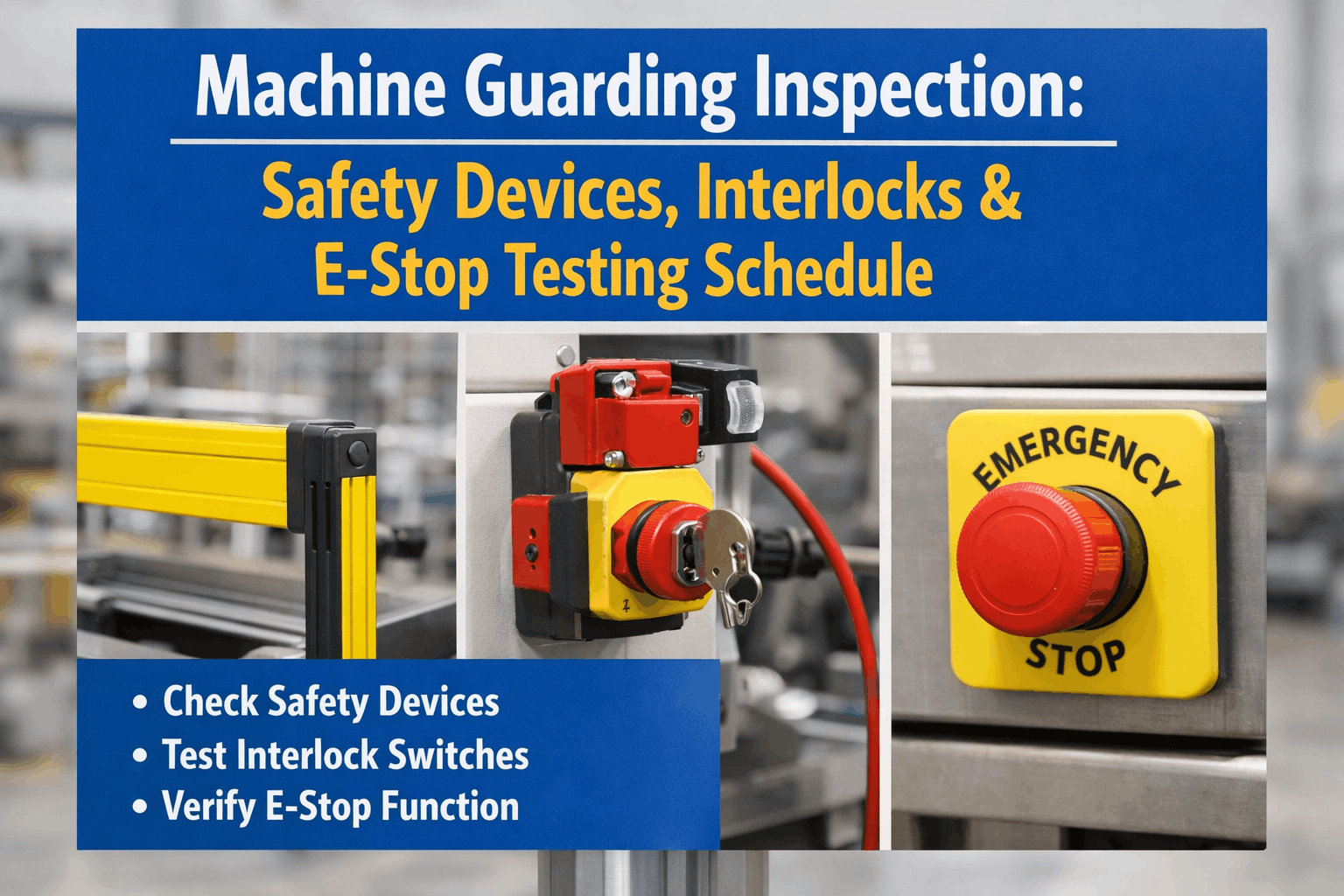
At 6:47 AM on a Tuesday in a Midwest automotive stamping plant, a press operator reached past a displaced barrier guard to clear a misfed blank from a 600-ton progressive die. The light curtain had been bypassed three weeks earlier because it kept nuisance-tripping during rapid cycling, and nobody had logged the bypass or scheduled a repair. The operator's left hand entered the point of operation 0.4 seconds before the ram descended. OSHA's subsequentinvestigation found that the guard had been damaged six months prior, two of three safety interlocks on the press had failed their last quarterly test but no corrective action was ever completed, and the emergency stop button closest to the operator was physically obstructed by a parts bin. The total penalty: $1.2 million in willful and repeat citations under 29 CFR 1910.217 and 1910.212. But the real cost — a permanent disability — has no dollar figure. Every one of these failures would have been caught by a CMMS-managed machine guarding inspection programme with automated interlock testing schedules and E-stop verification tracking. Talk to our specialists about building a CMMS-automated machine guarding inspection programme that prevents amputations, eliminates OSHA citations, and proves compliance at every audit.
Deploy CMMS-automated guard integrity checks, safety interlock verification, and emergency stop testing schedules to achieve zero bypass incidents and full OSHA 1910.212/217 compliance.
4,000+Amputation injuries per year from unguarded machinery (BLS)
97%Interlock test compliance with CMMS scheduling
100%OSHA 1910.212 / 1910.217 audit readiness
UnifiedGuards + interlocks + E-stops in one CMMS
Why Machine Guarding Failures Keep Happening
OSHA's machine guarding standards — 1910.212 (General Requirements) and 1910.217 (Mechanical Power Presses) — have existed for decades, yet machine guarding violations remain in OSHA's top-10 most cited every year. The problem isn't that facilities lack guards; it's that guards get damaged and aren't repaired, interlocks fail and aren't tested, E-stops get obstructed and aren't verified, and bypasses get implemented for "temporary" production reasons and become permanent because nobody tracks them. Paper-based inspection logs can't enforce accountability across hundreds of guarded machines. Book a Demo.
The Five Machine Guarding Gaps That Cause Injuries
01
Guard Integrity Failures
Barrier guards, fixed enclosures, and point-of-operation guards sustain impact damage, become loose, or are removed for maintenance and never reinstalled. Without scheduled inspections, damage goes undetected until an incident.
02
Interlock Testing Gaps
Safety interlocks on gate switches, hinged guards, and presence-sensing devices must be functionally tested on documented schedules. Without CMMS tracking, interlock tests are skipped, falsified, or performed without proper procedure.
03
E-Stop Obstructions
Emergency stop buttons must be accessible, visible, and functional at all times. In practice, E-stops get buried behind material, covered by production fixtures, or fail mechanically — and nobody verifies function until an emergency.
04
Undocumented Bypasses
Light curtains, two-hand controls, and safety PLCs get bypassed for production convenience. Without a formal bypass permit system tracked in CMMS, "temporary" bypasses become permanent invisible hazards.
05
Missing Audit Evidence
OSHA requires documented evidence of periodic guard inspections, interlock tests, and corrective actions. Paper logs are incomplete, illegible, or lost — turning a compliant programme on the floor into a citation on paper.
The CMMS Machine Guarding Inspection Stack
A modern machine guarding programme layers five integrated capabilities: physical guard integrity inspection on every machine, functional interlock testing on documented schedules, emergency stop accessibility and function verification, safety bypass permit management with automatic expiry, and a CMMS like Oxmaint that ties it all together with mobile checklists, corrective action tracking, and audit-ready compliance documentation. Book a Demo.
Machine Guarding Inspection Layers
From point-of-operation guard to OSHA compliance dashboard
1
Guard Integrity Inspection
Visual and physical inspection of barrier guards, fixed enclosures, interlocked gates, adjustable guards, and point-of-operation devices. Check for damage, looseness, missing fasteners, gaps exceeding OSHA table O-10 distances, and unauthorised modifications.
Weekly / Monthly
2
Safety Interlock Functional Testing
Verify that every safety interlock achieves its intended function: gate switches stop machine motion when guard opens, presence-sensing devices arrest the ram before operator reach-in, safety PLCs execute correct stop category (0, 1, or 2) within rated response time.
Monthly / Quarterly
3
E-Stop Verification Programme
Test every emergency stop device: mushroom-head buttons, pull-cord switches, foot-operated E-stops, and safety mat systems. Verify accessibility (no obstructions within 12 inches), latching function, and that activation achieves full machine stop within rated time.
Monthly Testing
4
Safety Bypass Permit Management
Formal permit system for any temporary safety device bypass — documenting reason, risk assessment, compensating measures, authorised duration, and responsible person. CMMS auto-expires permits and escalates unresolved bypasses to safety management.
Permit-Based
5
CMMS Compliance Layer (Oxmaint)
Oxmaint schedules every guard inspection, interlock test, and E-stop verification automatically. Mobile checklists capture pass/fail results with photos. Failed items auto-generate corrective work orders. Complete audit trail satisfies OSHA 1910.212 and 1910.217.
Audit-Ready
Automate Every Guard Inspection & Interlock Test
Oxmaint CMMS schedules machine guarding inspections across your entire floor, tracks interlock test results with pass/fail evidence, manages E-stop verification programmes, and generates OSHA-ready audit documentation — so your compliance evidence is built as you work, not reconstructed when OSHA arrives.
Machine Guarding vs. Unguarded: The Compliance Advantage
The difference between a CMMS-managed machine guarding programme and ad-hoc paper-based inspections isn't just efficiency — it's the difference between zero incidents and an OSHA willful citation. CMMS-managed programmes generate timestamped, photo-verified digital evidence for every inspection. Paper-based programmes rely on clipboards, memory, and hope that the file cabinet is where someone left it. When OSHA asks "show me your interlock test records for the last 12 months," one approach delivers confidence; the other delivers anxiety.
CMMS-Managed vs. Paper-Based Machine Guarding
CMMS-Managed (Proactive)
Guards: Scheduled inspections with photo evidence
Interlocks: Functional tests on documented schedule
E-Stops: Monthly verification with timestamped results
Bypasses: Formal permits with auto-expiry in CMMS
vs
Paper-Based (Reactive)
Guards: Checked "when someone notices" damage
Interlocks: Tested annually (maybe) with no records
E-Stops: Assumed working until an emergency proves otherwise
Expert Perspective: Zero Amputations Is the Only Acceptable Target
We run 340 machines across three shifts — presses, lathes, mills, injection moulders, and robotic welding cells. Before CMMS, our machine guarding programme was a binder of checklists that the safety coordinator tried to keep current manually. He couldn't. With 340 machines requiring monthly guard inspections, quarterly interlock tests, and monthly E-stop verifications, that's over 2,700 inspection tasks per quarter. Paper couldn't scale. When we implemented Oxmaint, we mapped every guard, every interlock, and every E-stop on every machine to a scheduled inspection task with a mobile checklist. Technicians scan a QR code on the machine, complete the checklist on their phone with pass/fail and photos, and any failure auto-generates a corrective work order with the machine tagged, the deficiency described, and a 48-hour deadline. Bypasses require a formal CMMS permit that auto-expires after 72 hours and escalates to the plant manager if not resolved. In 14 months, we went from 23 open guarding deficiencies at any given time to an average of 1.4. Our OSHA recordable rate for machine-contact injuries dropped from 2.8 to zero. Not reduced — zero. The CMMS didn't just organise our inspections; it created a culture where every guard deficiency gets fixed because the system won't let it be forgotten.
— EHS Director, Multi-Plant Precision Manufacturing Group
Zero
Machine-contact injuries in 14 months
2,700+
Automated inspection tasks per quarter
48hr
Max corrective action deadline for deficiencies
Manufacturing facilities operating presses, lathes, mills, robotic cells, and any machinery with points of operation can no longer afford the injury risk, OSHA citation exposure, and audit liability of paper-based machine guarding programmes. CMMS-automated guard inspection, interlock testing, and E-stop verification delivers the documented evidence, corrective action tracking, and bypass management that modern regulatory enforcement demands. The technology is proven, the ROI is measured in injuries prevented, and every month of delay represents another month of unverified machine safeguards putting workers at risk. Start your free trial today and build a machine guarding programme where zero amputations isn't a goal — it's a documented reality.
Your Workers Deserve Machines That Are Guarded, Tested, and Verified
Oxmaint CMMS provides the complete digital backbone for machine guarding compliance — scheduling guard integrity inspections, interlock functional tests, and E-stop verifications automatically, capturing results with photo evidence and digital signatures, managing safety bypass permits with auto-expiry, tracking every corrective action to verified closure, and generating OSHA audit-ready documentation packages on demand.
What does OSHA 1910.212 require for machine guarding inspections?
OSHA 29 CFR 1910.212 (General Requirements for All Machines) mandates that one or more methods of machine guarding must protect operators and other employees from hazards including point of operation, ingoing nip points, rotating parts, flying chips, and sparks. While OSHA does not prescribe a specific inspection frequency in 1910.212, the General Duty Clause (Section 5(a)(1)) and enforcement policy require that guards be maintained in effective condition — which functionally means regular documented inspections. Best practice and ANSI B11 series standards recommend monthly visual inspections for guard integrity, quarterly functional tests for interlocked guards, and immediate inspection after any guard removal for maintenance. Oxmaint CMMS automates all of these schedules with mobile checklists, photo capture, and auto-generated corrective actions for any deficiency found.
How often should safety interlocks be functionally tested?
Safety interlock testing frequency depends on the machine type, risk level, and applicable standard. For mechanical power presses under OSHA 1910.217, the standard explicitly requires that the safety system (including interlocks) be inspected and tested at the start of each shift and after die changes. For general machinery, ANSI/NFPA 79 and ISO 14119 recommend functional testing of safety interlocks at least quarterly, with higher-risk machines tested monthly. Each functional test must verify that the interlock achieves its intended safety function — specifically, that opening or removing the guard stops hazardous machine motion within the rated response time. Oxmaint schedules these tests per machine with guided checklists that walk technicians through each interlock point, record pass/fail results with timestamps, and auto-generate corrective work orders for any failed test.
What is included in an E-stop verification programme?
A comprehensive E-stop verification programme includes four elements tested on each emergency stop device: (1) Accessibility — verify no physical obstructions within reach distance, E-stop is visible and clearly marked with standardised red/yellow colouring per IEC 60204-1. (2) Mechanical function — verify the mushroom-head button or pull-cord latches in the activated position and requires deliberate manual reset. (3) Electrical function — activate E-stop and confirm machine achieves full stop within rated time with no coast or creep. (4) Circuit integrity — verify E-stop wiring has not been jumpered, bypassed, or degraded. Oxmaint manages E-stop verification as a monthly recurring inspection with a guided checklist covering all four elements, photo documentation of each E-stop location, and automatic escalation if any device fails testing. Sign up for Oxmaint to configure E-stop verification for your facility.
How should safety device bypasses be managed?
Every safety device bypass must be formally permitted, time-limited, and tracked to closure. Best practice follows a five-step permit process: (1) Written justification documenting why the bypass is necessary and what alternative protective measures will be implemented. (2) Risk assessment by qualified safety personnel approving or rejecting the bypass request. (3) Compensating measures — additional safeguards such as reduced operating speed, increased supervision, or restricted access barriers. (4) Time limit — every bypass permit must have a maximum duration (typically 72 hours) after which it auto-expires. (5) Verification of restoration — documented confirmation that the safety device has been restored to full function. Oxmaint CMMS manages the entire bypass permit lifecycle digitally — any permit not resolved within the authorised timeframe triggers automatic escalation to plant management, ensuring no bypass becomes permanent.
What is the ROI of a CMMS-managed machine guarding programme?
The ROI is measured in three dimensions: injury prevention, citation avoidance, and operational efficiency. A single amputation injury averages $540,000 in direct workers' compensation costs plus $1.6 million in indirect costs (OSHA estimates). A single willful violation of 1910.212 carries a maximum penalty of $165,514 per instance as of 2025. A facility with 200 guarded machines running paper-based inspections typically has 15-30 open guarding deficiencies at any given time — each representing both injury risk and citation exposure. CMMS implementation typically costs $15,000-$40,000 annually for a mid-sized plant and reduces open deficiencies by 85-95% within 90 days. The cost of preventing one amputation or one willful citation pays for decades of CMMS subscription. Book a demo to calculate projected savings for your specific machine population.