The global oil and gas operations and maintenance services market is expanding rapidly, with the AI segment alone projected to grow from $4.28 billion in 2026 to $7.91 billion by 2031 at a 13.03% CAGR — and predictive maintenance captures 37.60% of that spending because it delivers the clearest documented ROI of any digital investment in the sector. Across the value chain, the stakes are staggering: upstream operations lose millions per day from unplanned well shutdowns, midstream pipeline failures trigger both environmental catastrophe and regulatory penalty, and downstream refinery turnarounds can consume 30-40% of annual maintenance budgets in a single planned event. As of mid-2025, approximately 50% of active oil and gas digital projects incorporate predictive maintenance or anomaly detection modules, digital twins are embedded in over 40% of new projects, and IoT sensor deployment in upstream settings rose 40% year-over-year. The operators who are winning in 2026 have replaced reactive firefighting with data-driven maintenance strategies that span every segment of the value chain — from wellhead to retail terminal. Still running maintenance on paper or disconnected spreadsheets? Sign up for Oxmaint to unify upstream, midstream, and downstream maintenance on a single cloud platform — or book a demo to see how integrated work order management, asset tracking, and compliance automation work across your entire operation.
The Oil & Gas Value Chain: Where Maintenance Makes or Breaks Profitability
Oil and gas is the most capital-intensive industry on earth, and maintenance is the single largest controllable operating cost across all three segments. Understanding how maintenance requirements differ — and overlap — between upstream, midstream, and downstream operations is the foundation of any effective asset management strategy.
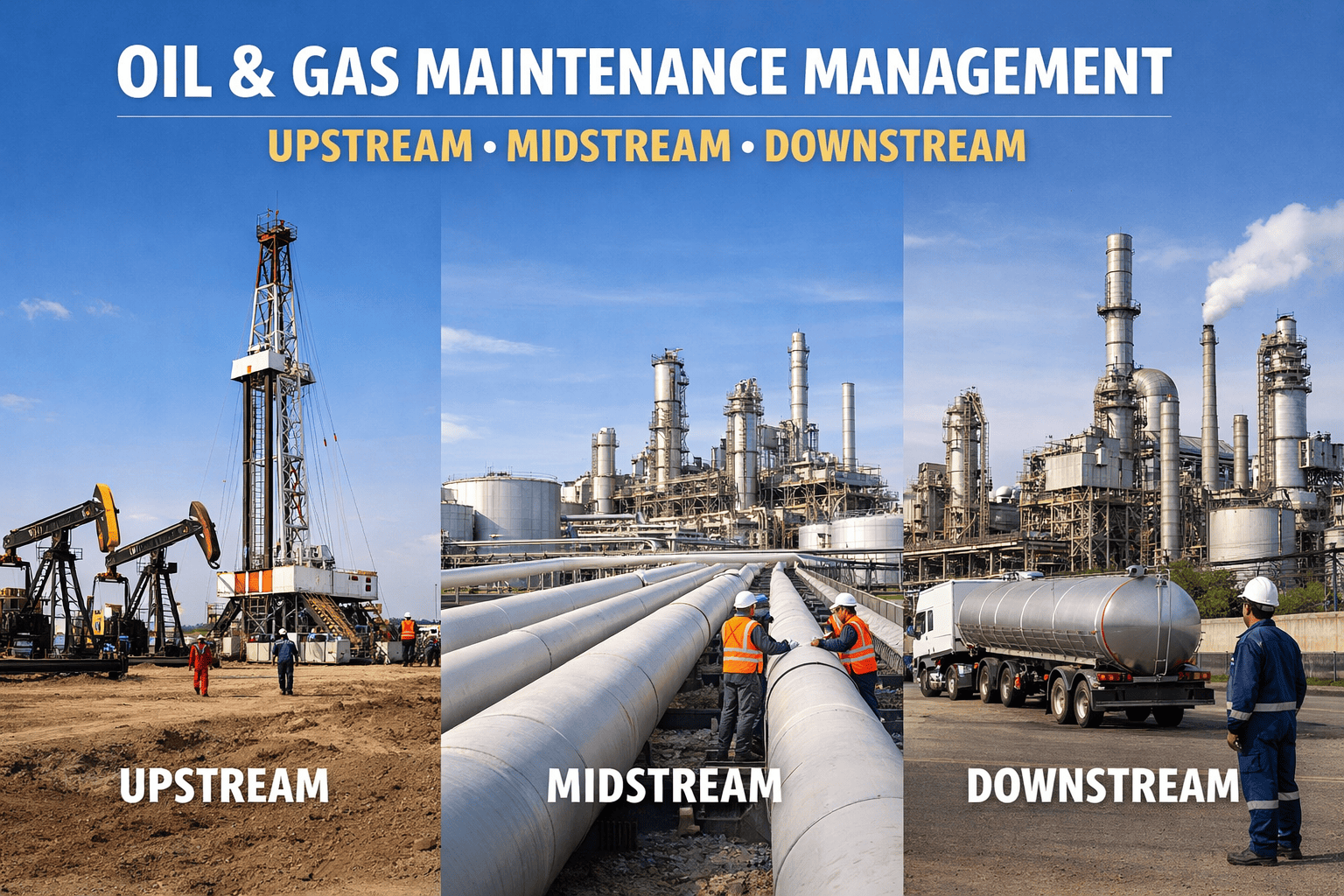
Upstream
Exploration & ProductionDrilling rigs, wellheads, christmas trees, separators, compressors, pumping units, offshore platforms, FPSO vessels
Midstream
Transportation & StorageTransmission pipelines, gathering systems, pump stations, compressor stations, tank farms, LNG terminals, marine loading
Downstream
Refining & DistributionDistillation columns, heat exchangers, reactors, furnaces, cooling towers, blending systems, storage terminals, retail infrastructure
Upstream Maintenance: Keeping Wells Producing and Rigs Running
Upstream operations face the harshest environmental conditions of any industrial segment — extreme temperatures, high pressures, corrosive fluids, remote locations, and 24/7 production demands that make every minute of downtime directly measurable in lost barrels. Maintenance strategy here is not about efficiency — it is about survival.
Critical Maintenance Challenges
Wellhead and Christmas Tree Integrity
Valves, seals, and pressure containment components operate under extreme stress. Corrosion, erosion, and mechanical fatigue create failure modes that can trigger blowout events. Regular inspection scheduling, pressure testing programs, and corrosion monitoring through a CMMS prevent catastrophic failures that cost millions and create environmental liability.
Artificial Lift System Reliability
Rod pumps, ESPs (electric submersible pumps), and gas lift systems are the mechanical heartbeat of producing wells. ESP failures alone can cost $100,000-$500,000 per event including workover rig mobilization, lost production, and replacement components. Vibration monitoring, amperage trending, and condition-based replacement schedules dramatically reduce these costs.
Remote Asset Monitoring
Upstream assets are distributed across vast geographic areas — often hundreds of well sites managed by a single field operations team. IoT sensors connected to cloud CMMS platforms enable remote condition monitoring, automated alarm generation, and work order dispatch without requiring daily physical site visits. IoT sensor deployment in upstream rose 40% year-over-year as of 2025.
Drilling Equipment Maintenance
Rig components — top drives, mud pumps, draw works, rotary tables — operate under enormous mechanical loads. Predictive maintenance using vibration analysis and thermal imaging catches degradation 2-4 weeks before failure, enabling planned repairs during crew changes rather than emergency shutdowns that halt drilling progress.
Oxmaint's mobile-first platform enables field technicians to receive, complete, and document work orders at remote wellsites without returning to an office. GPS-tagged asset records, barcode scanning for equipment identification, and offline-capable mobile apps ensure complete maintenance documentation even in zero-connectivity environments. Start your free trial and deploy across your upstream operations in under one week.
Midstream Maintenance: Pipeline Integrity and Compressor Reliability
Midstream operations move hydrocarbons from wellhead to refinery through thousands of miles of pipeline, compressor stations, and storage infrastructure. A single midstream failure can shut down production across an entire basin, trigger regulatory action, and create environmental remediation costs that dwarf the original repair. Digital monitoring is now increasing utilization of existing pipeline infrastructure and deferring the need for new construction.
Critical Maintenance Challenges
Pipeline Integrity Management
Internal corrosion, external corrosion, stress corrosion cracking, and third-party damage are the four primary pipeline failure modes. Inline inspection (ILI) pigging programs, cathodic protection monitoring, and ECDA (External Corrosion Direct Assessment) require rigorous scheduling, data management, and regulatory documentation. CMMS platforms automate inspection scheduling and maintain the audit trail required by pipeline safety regulations.
Compressor Station Optimization
Gas transmission compressors are the highest-value rotating equipment in midstream operations. Vibration monitoring, oil analysis, and performance trending detect bearing wear, valve seat degradation, and driver alignment issues weeks before failure. Each unplanned compressor shutdown reduces pipeline throughput capacity for every upstream producer connected to that system.
Methane Leak Detection and Repair (LDAR)
EPA regulations require systematic leak detection and repair programs across midstream infrastructure. While implementation timelines have shifted, the requirement to automate LDAR with sensor networks, drone surveys, and real-time reporting is accelerating. CMMS platforms that integrate LDAR scheduling with automated compliance documentation eliminate the gap between detection and repair that regulators penalize.
Tank Farm and Terminal Maintenance
Storage tanks require API 653 inspection programs, roof and floor integrity assessments, cathodic protection monitoring, and environmental containment system maintenance. Each tank represents a significant compliance liability — missed inspections result in regulatory citations and potential operational shutdowns. Automated PM scheduling with integrated inspection checklists ensures zero missed compliance deadlines.
Oxmaint connects pipeline integrity data, compressor performance trends, and LDAR compliance scheduling in a single platform accessible from field tablets, SCADA integration points, and management dashboards. Track every inspection, repair, and regulatory submission across hundreds of miles of infrastructure. Book a demo to see midstream maintenance workflows in action.
Unify Upstream, Midstream, and Downstream Maintenance on One Platform
Oxmaint gives integrated O&G operators single-pane visibility across every asset, every segment, and every compliance requirement — from wellhead to retail terminal. Deploy in days, not months.
Downstream Maintenance: Refinery Turnarounds and Process Unit Reliability
Downstream operations are the most maintenance-intensive segment of the oil and gas value chain. Refineries operate complex, interconnected process units where a single equipment failure can cascade through the entire facility. Turnaround planning, process unit reliability, and regulatory compliance (OSHA PSM, EPA RMP) drive maintenance strategies that consume 30-40% of annual operating budgets. US Gulf Coast refining margins fell over 50% between 2022 and 2025 — making maintenance cost efficiency an existential priority.
Critical Maintenance Challenges
Turnaround Planning and Execution
Planned shutdowns for major inspection and repair consume weeks of production and tens of millions of dollars. Effective turnaround management requires 12-18 months of planning, precise work packaging, resource scheduling, and critical path management. CMMS-driven turnaround modules track every work item from scope definition through execution and closeout, ensuring no scope creep and maximum wrench-time efficiency.
Heat Exchanger and Furnace Reliability
Fouling, corrosion under insulation (CUI), and tube failures in heat exchangers and fired heaters are leading causes of refinery unit shutdowns. Thickness monitoring programs, infrared thermographic surveys, and cleaning schedule optimization require systematic tracking and trending that only a digital maintenance platform can deliver at scale across hundreds of exchangers per refinery.
Rotating Equipment Programs
Pumps, compressors, blowers, and agitators across a refinery number in the thousands. Each requires vibration monitoring, oil analysis, alignment checks, and performance trending. Condition-based maintenance programs that route predictive data directly into CMMS work order generation reduce rotating equipment failures by 70% compared to time-based approaches.
Process Safety Management Compliance
OSHA 29 CFR 1910.119 mandates documented maintenance procedures, mechanical integrity programs, and management of change processes for covered process units. Every inspection, repair, and modification must be recorded with full traceability. Non-compliance carries citations averaging $15,000+ per violation and potential facility shutdown orders. CMMS platforms that automate PSM documentation eliminate the compliance gaps that trigger enforcement actions.
Oxmaint handles turnaround work packaging, mechanical integrity tracking, PSM compliance documentation, and day-to-day process unit maintenance in a unified system. Digital inspections with mobile checklists, photo documentation, and automatic compliance report generation keep your refinery audit-ready at all times. Sign up free and bring your downstream maintenance into a single digital platform.
The Digital Transformation: O&G Maintenance by the Numbers
The oil and gas industry's digital transformation is no longer theoretical — investment is accelerating across all three segments, with maintenance technology leading the spend because it delivers the fastest, most measurable returns. These figures represent the current state of digital maintenance adoption across the global O&G sector:
Cross-Segment Maintenance Strategy: What Connects All Three Streams
While each segment has unique equipment and challenges, the maintenance principles that drive reliability and cost efficiency are universal across the entire oil and gas value chain. Integrated operators who apply these strategies consistently across upstream, midstream, and downstream operations achieve compounding benefits that siloed approaches cannot match.
Criticality-Based Asset Prioritization
Not every asset deserves the same maintenance investment. Rank equipment by production impact, safety consequence, environmental risk, and repair cost. The top 20% of critical assets — kilns, compressors, reactors, wellhead systems — should receive 60-70% of predictive and preventive resources. This principle applies identically whether you are managing a drilling rig, a pipeline compressor station, or a catalytic cracking unit.
Condition-Based Maintenance over Calendar-Based
Roughly 30% of scheduled preventive maintenance across industrial operations is performed too frequently, and only 18% of age-related failures follow predictable time patterns. Shifting from fixed-interval PMs to condition-triggered interventions — using vibration data, oil analysis, thermal imaging, and process parameter trending — saves 8-12% versus pure preventive programs and up to 40% versus reactive approaches.
Integrated Compliance Documentation
Every O&G segment faces intense regulatory scrutiny — PSM, API inspections, DOT pipeline regulations, EPA LDAR, OSHA standards. A CMMS that captures compliance-related maintenance activities within normal work order execution eliminates the double-entry burden and creates audit-ready records automatically. This compliance-first approach applies across all three segments and dramatically reduces audit preparation time.
Mobile-First Field Execution
Whether a technician is at a remote wellsite, a pipeline right-of-way, or a refinery process unit, mobile access to work orders, procedures, equipment history, and parts availability determines maintenance execution quality. Cloud CMMS platforms with offline-capable mobile apps ensure that every work order is completed digitally — no paper, no data re-entry, no lost documentation.
Predictive Analytics and AI Integration
AI-powered anomaly detection and failure prediction are the fastest-growing investment category across all O&G segments. Machine learning algorithms trained on equipment-specific failure patterns deliver 30-90 day advance warning of developing faults. The 37.6% of AI spending directed to predictive maintenance reflects documented cuts in unplanned downtime and maintenance costs that consistently deliver payback within the first year.
Knowledge Capture Before It Walks Out the Door
The average maintenance professional in industrial settings is 54 years old with 26 years of experience. Retirements are accelerating across all three O&G segments, taking decades of equipment-specific knowledge with them. 39% of maintenance leaders identify knowledge capture as the most valuable AI use case — digital work procedures, failure mode libraries, and structured inspection checklists within CMMS preserve institutional expertise permanently.
One Platform for Every Segment of Your O&G Operation
From wellhead to retail terminal, Oxmaint tracks every asset, work order, inspection, and compliance requirement — with mobile access for field crews and real-time dashboards for management. Join the 50%+ of O&G digital projects investing in predictive maintenance.