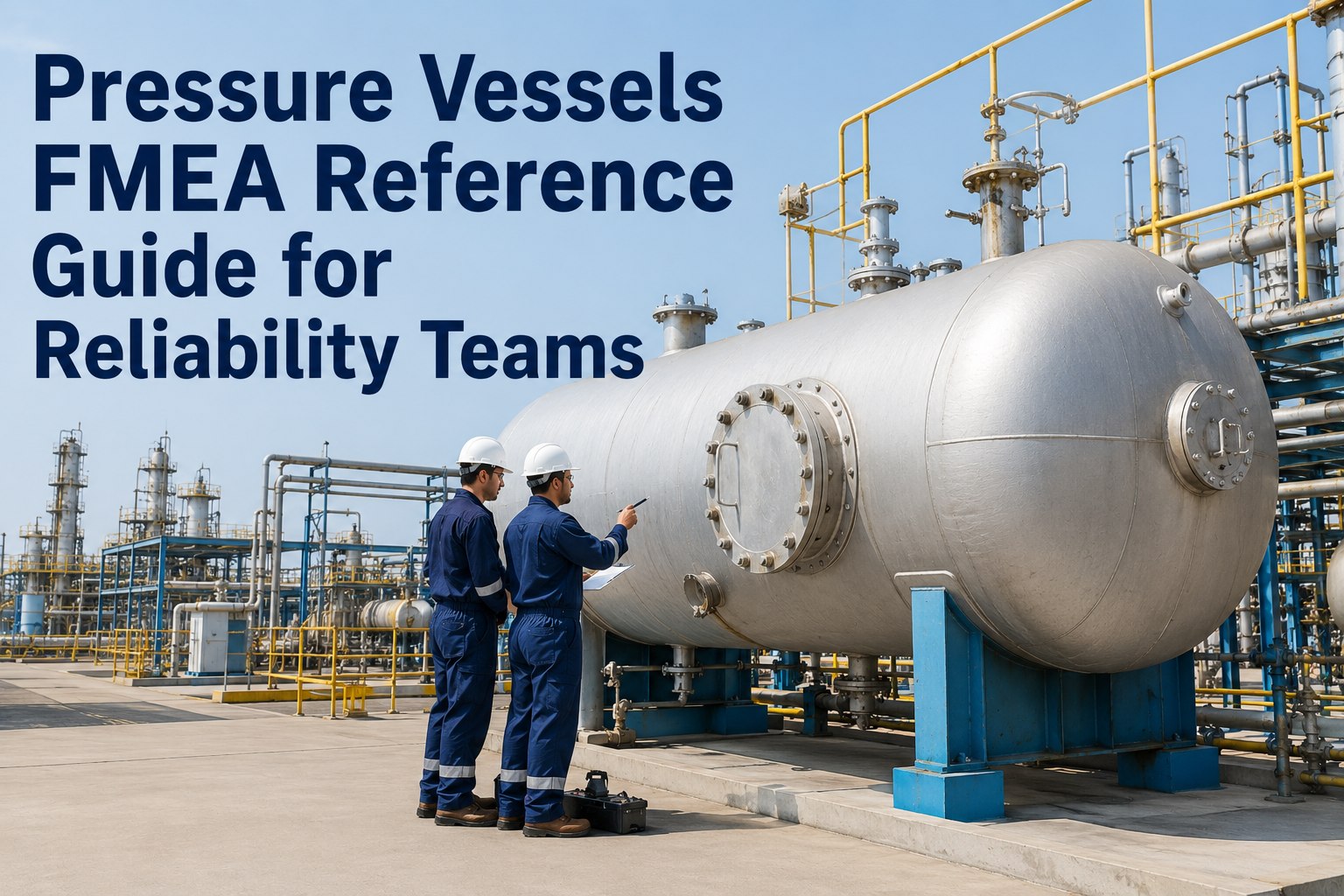
Pressure vessels failure modes and effects analysis is the backbone of any defensible reliability program for pressurized assets — every crack, corrosion path, and relief-valve failure has a detectable root cause and a downstream effect on production, safety, and cost. This FMEA reference guide catalogs the most common pressure vessel failure modes your team will encounter on the floor, mapping each to its likely root cause, severity rating, and a recommended RCM maintenance task that can be operationalized inside a CMMS. A well-structured pressure vessels FMEA template doesn't just satisfy audit requirements; it becomes the engine that drives your preventive, predictive, and condition-based maintenance work orders. You can turn this entire reference into daily action — logging failure modes against each asset and triggering the right task at the right interval — when you Start Free Trial of OxMaint's AI-powered CMMS.
What if your next pressure vessel failure was predicted — not discovered?
23,000+ pressure vessel incidents are reported globally each year. 68% trace back to failure modes that a structured FMEA would have caught weeks or months earlier. This guide maps every common failure mode, root cause, and RCM task — so your team can act before rupture, leakage, or regulatory shutdown.
Pressure Vessels Failure Mode List: Root Causes & Severity Ratings
The table below catalogs the seven most common pressure vessels failure modes ranked by severity (1–10 scale per FMEA convention), their dominant root causes, and the recommended detection method. Use it as the backbone of your pressure vessels FMEA template.
| Failure Mode | Primary Root Cause | Severity | Detection Method | RCM Task |
|---|---|---|---|---|
| Corrosion (General / Pitting) | Oxygen ingress, chlorides, acidic process fluid, stagnant zones | 8 | Ultrasonic thickness mapping | Time-based UT inspection + coating renewal |
| Stress Corrosion Cracking (SCC) | Tensile stress + chloride/caustic environment at temperature | 9 | Wet fluorescent MPI, phased-array UT | Condition-based NDE at weld toes & HAZ |
| Fatigue Cracking | Cyclic pressure/thermal loading beyond design cycles | 9 | Vibration analysis, MPI on nozzles | Cycle counting + predictive NDE scheduling |
| Creep Damage | Long-term operation above design temperature | 8 | Replica metallography, dimensional bulge check | Condition-based assessment at intervals |
| Overpressure Rupture | PSV failure, blocked discharge, thermal expansion | 10 | PSV bench testing, process historian trends | Time-based PSV pop testing & calibration |
| Gasket & Flange Leakage | Bolt load loss, gasket degradation, flange misalignment | 5 | Visual, LDAR sniffing, acoustic emission | Condition-based torque check + gasket replacement |
| Internal Lining Failure | Thermal shock, abrasion, chemical attack on refractory | 6 | Thermography of shell, internal inspection | IR thermography scan + planned reline |
How to Calculate RPN and Prioritize Pressure Vessels Failure Prevention
A pressure vessels FMEA is only useful if it drives action. The Risk Priority Number (RPN) ranks which failure modes deserve budget and attention first — combining severity, occurrence, and detectability on a 1–10 scale.
Pressure Vessels Maintenance Checklist Driven by FMEA
Each failure mode maps to a specific, schedulable maintenance task. Here is the tiered checklist a reliability team should build from the FMEA — categorized by inspection type and frequency.
- Visual leak check at flanges, nozzles, and manways
- Verify operating pressure/temperature within design envelope
- Confirm PSV inlet/outlet valves are car-sealed open
- Log unusual vibration, noise, or odor near the vessel
- IR thermography scan of shell and jacket for hot spots
- Acoustic emission monitoring for active crack growth
- Bolt torque audit on critical flanged joints (25% sample)
- LDAR sniffing at gasket interfaces and valve packing
- Ultrasonic thickness mapping at 8–12 critical locations
- Wet fluorescent MPI on all weld seams and nozzles
- PSV pop-test, bench calibration, and tag renewal
- Internal inspection per API 510 / NBIC interval
Real-World Scenario: From FMEA Finding to Prevented Failure
Consider a mid-sized chemical plant operating 14 carbon-steel pressure vessels across a reaction train. Without an FMEA-driven program, the team was running calendar-based UT inspections every 3 years and reacting to leaks as they appeared.
Turn This FMEA Reference Into Daily Maintenance Action
An FMEA spreadsheet on a shared drive prevents nothing. OxMaint operationalizes your pressure vessels FMEA — converting every failure mode into a trigger that fires the right work order, at the right interval, against the right asset — so your team shifts from firefighting to planned, defensible reliability.
Attach each failure mode, severity rating, and RPN directly to the asset record. When a technician opens a work order, the full failure history and recommended RCM task are visible in one click — eliminating tribal knowledge dependency.
Link inspection results (UT thickness, thermography, PSV test) to automated work-order generation. When a reading crosses a threshold, OxMaint creates the next task without manual intervention or reminder emails.
Map critical spares (gaskets, PSV seats, refractory material) to the failure modes they mitigate. OxMaint flags low stock before a scheduled turnaround so parts are always on the shelf when the work order opens.
OxMaint's AI engine analyzes inspection trends and process data across your vessel fleet, predicting which asset is trending toward a failure mode — and recommending the optimal intervention window before severity escalates.
See OxMaint on Your Pressure Vessels — Book a 30-Min Demo
We'll load your FMEA data, map failure modes to assets, and show you exactly how condition-based triggers replace spreadsheet-driven maintenance.
Pressure Vessels FMEA: What Reliability Teams Ask Most
The most common pressure vessels failure modes are general and pitting corrosion, stress corrosion cracking, fatigue cracking at welds and nozzles, creep damage from high-temperature service, overpressure rupture from PSV failure, gasket and flange leakage, and internal lining or refractory failure. Corrosion alone accounts for roughly 25–30% of all reported vessel degradation events in process industries.
Start with each vessel's design data (MAWP, temperature, material, service fluid), then list every credible failure mode, its root cause, severity rating (1–10), occurrence likelihood, detection method, and recommended RCM task. Calculate the RPN for each mode and prioritize any with RPN ≥ 100 or severity ≥ 9. You can operationalize this template inside OxMaint by attaching each failure mode to the asset record — see how in a Book a Demo session.
Overpressure rupture should receive a severity rating of 10 — the maximum — because it represents a catastrophic failure with potential for loss of life, total asset destruction, and widespread environmental damage. Any failure mode with severity 9 or 10 demands an immediate corrective action plan regardless of the overall RPN score, and should be backed by redundant safeguards.
FMEA reviews should occur at least annually for high-risk vessels and after any significant change in service conditions, process fluid, or operating envelope. Any inspection finding, near-miss, or actual failure should trigger an immediate FMEA update. OxMaint makes this continuous — every work order and inspection result feeds back into the asset's failure history automatically. You can Start Free Trial and begin logging failure data today.
The primary standards are ASME BPVC Section VIII for design and fabrication, API 510 for in-service inspection and rating, NBIC for repair and alteration, and API 579 for fitness-for-service evaluation. ISO 55000 provides the overarching asset management framework. Your FMEA and maintenance program should be cross-referenced to these standards so that audit readiness is built into every work order.
Stop Reacting to Pressure Vessel Failures — Start Preventing Them
Upload your FMEA, map failure modes to assets, and let OxMaint's AI trigger the right maintenance task before failure happens. Your reliability program becomes defensible, auditable, and predictive.
Free 14-day trial · No credit card