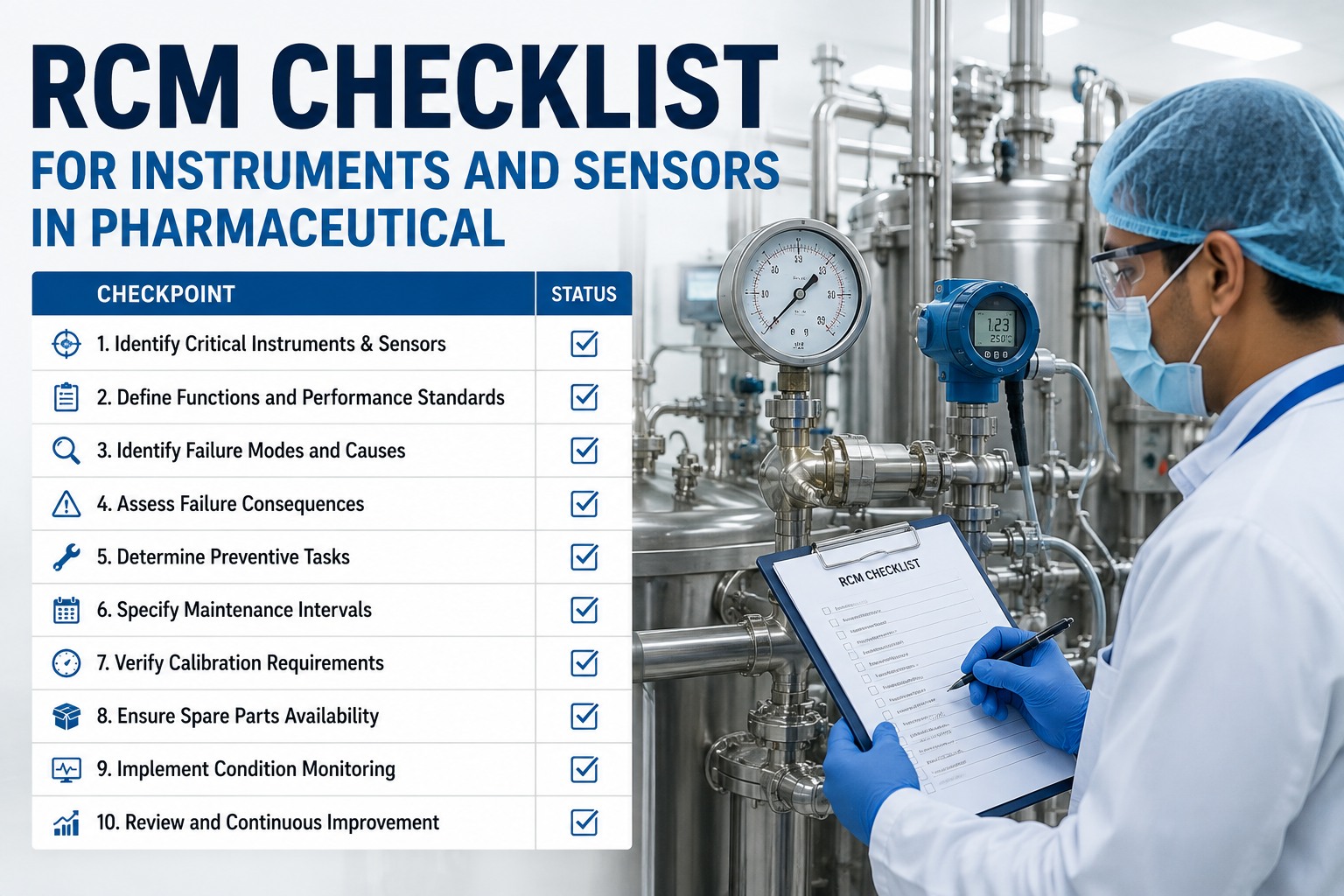
Reliability-centered maintenance (RCM) for instrumentation and sensors in pharmaceutical manufacturing is the systematic process of identifying failure modes—calibration drift, signal degradation, sensor fouling—and applying the right maintenance strategy to prevent deviations before they compromise product quality or regulatory compliance. A structured RCM checklist for instrumentation and sensors ensures that every pressure transmitter, temperature probe, pH sensor, and flow meter is inspected, calibrated, and monitored at intervals aligned with GMP requirements and manufacturer specifications. This checklist transforms reactive calibration fixes into a predictable, audit-ready preventive maintenance schedule. You can load these production-ready templates directly into your CMMS or Start Free Trial to deploy them as digital work orders immediately.
RCM Checklist for Instruments & Sensors
Standardize pharmaceutical instrumentation & sensors reliability before the next FDA audit
Eliminate untracked calibration drift and missing inspection records. Deploy a digitized RCM strategy that captures every reading, enforces mandatory sign-offs, and prevents silent sensor failures from ruining batch yields.
Pharmaceutical Instrumentation Impact
The cost of silent sensor failures in pharma manufacturing
In pharmaceutical facilities, a single drifted temperature sensor in a bioreactor or a fouled dissolved oxygen probe can invalidate a batch worth $500K to $2M, while triggering FDA Form 483 observations during routine audits.
A robust instrumentation and sensors maintenance program in pharmaceutical environments is not just about keeping equipment running—it is about guaranteeing data integrity and patient safety. When maintenance teams rely on paper logs or disconnected spreadsheets, calibration intervals slip, "as-found" readings are lost, and technicians spend hours searching for documentation during audits. OxMaint's AI-powered CMMS replaces this chaos with automated PM triggers, mandatory digital sign-offs, and real-time reliability analytics that prove every sensor is operating within validated parameters.
Instrumentation & Sensors Failure Modes Pharmaceutical
Common pharmaceutical instrumentation failure modes and RCM strategies
Applying RCM to pharmaceutical instrumentation requires mapping specific failure modes to their root causes and selecting the correct maintenance task—run-to-failure, time-based PM, or condition-based monitoring.
Temperature Probes & RTDs
Critical for bioreactors, lyophilizers, and SIP cycles
- Failure Mode: Calibration drift due to thermal cycling fatigue
- RCM Task: Quarterly 3-point calibration verification (0°C, 50°C, 121°C)
- Mandatory Check: Record "as-found" and "as-left" deviations on the work order
- Condition Monitoring: Cross-reference dual-sensor probes for divergence alerts
Pressure Transmitters
Used in chromatography, filtration, and WFI loops
- Failure Mode: Diaphragm fouling and zero-point shift
- RCM Task: Monthly zero verification and annual 5-point calibration
- Mandatory Check: Inspect diaphragm seal for process media intrusion
- Condition Monitoring: HART diagnostics for sensor self-check alerts
pH & Dissolved Oxygen Sensors
Critical for fermentation and cell culture processes
- Failure Mode: Electrode coating, electrolyte depletion, and response lag
- RCM Task: Bi-weekly cleaning, buffer standardization, and electrolyte replacement
- Mandatory Check: Verify slope percentage (must be >95%) and zero offset
- Condition Monitoring: Track response time trends to predict electrode end-of-life
Mass Flow Meters
Used for gas flow in HVAC, fermenters, and filling lines
- Failure Mode: Tube coating, density measurement error, and zero drift
- RCM Task: Semi-annual zero-point verification and annual factory calibration
- Mandatory Check: Inspect impulse lines for condensate or particulate blockage
- Condition Monitoring: Monitor drive gain trends for early fouling detection
PM Schedule Pharmaceutical
Instrumentation and sensors PM schedule for pharmaceutical compliance
A standardized preventive maintenance schedule ensures sensors are calibrated before they drift out of validation tolerances. Use this baseline to structure your PM triggers in your maintenance management system.
| Instrument Type | PM Frequency | Key Inspection Tasks | Acceptance Criteria |
|---|---|---|---|
| Temperature RTDs / Thermocouples | Every 3 Months | 3-point calibration check, terminal tightness, thermowell inspection | Deviation ≤ ±0.5°C from reference |
| Pressure Transmitters | Every 1 Month | Zero trim, impulse line blowdown, diaphragm visual check | Zero shift ≤ 0.25% of span |
| pH / DO Electrodes | Every 2 Weeks | Buffer calibration (pH 4, 7, 10), electrolyte top-up, electrode cleaning | Slope > 95%, Response time < 30 sec |
| Conductivity Sensors | Every 1 Month | Cell constant verification, electrode cleaning, temperature compensation check | Variance ≤ 2% of certified standard |
| Mass Flow Controllers | Every 6 Months | Zero verification, leak test, filter element replacement | Flow accuracy ≤ ±1% of reading |
When this PM schedule is digitized in OxMaint, the system automatically generates work orders based on calendar intervals, usage hours, or batch cycles. If a technician records an "as-found" reading outside the acceptance criteria, OxMaint instantly escalates a corrective work order and flags the asset for a deviation investigation—closing the loop between maintenance execution and quality assurance.
Condition Monitoring & Reliability
Transitioning from time-based PM to condition-based monitoring
Pharmaceutical instrumentation and sensors reliability programs increasingly leverage condition monitoring to predict failures before they impact production, reducing unnecessary calibrations by up to 40%.
Baseline Sensor Performance
Collect 90 days of high-frequency data (HART, Foundation Fieldbus, or PLC logs) to establish the normal operating envelope for each critical sensor. OxMaint integrates with your control system to automatically ingest and aggregate this baseline data.
Set Predictive Alert Thresholds
Define statistical warning limits (e.g., 2-sigma deviations) for sensor drift, response lag, and signal noise. When a sensor crosses these thresholds, OxMaint's predictive analytics engine auto-generates an inspection work order before a calibration limit is actually breached.
Optimize Calibration Intervals
Use accumulated "as-found" and "as-left" calibration data to justify extending PM intervals for stable sensors and shortening them for problematic ones. This risk-based calibration approach aligns with FDA process validation guidelines and reduces maintenance labor costs.
How OxMaint Helps
How OxMaint enforces your instrumentation & sensors RCM strategy
OxMaint translates this RCM checklist into a controlled, digital workflow that guarantees execution, captures compliance-ready data, and uses AI to predict which sensors will fail next—cutting unplanned instrumentation downtime by 30–50%.
Mandatory Digital Work Orders
Convert paper checklists into mobile work orders with forced data entry for "as-found" readings, mandatory photo capture of sensor tags, and automatic escalation if a critical tolerance fails. Quality no longer depends on which technician showed up that day.
Predictive Drift Analytics
OxMaint's AI engine analyzes historical calibration records and live process data to identify drift patterns, predicting sensor failures 7–14 days before they breach GMP limits. This shifts maintenance from reactive fixes to proactive intervention.
21 CFR Part 11 Audit Trails
Every calibration action, reading, and sign-off is captured in a tamper-proof electronic record with secure electronic signatures. Generate audit-ready calibration histories in seconds, eliminating the panic of FDA, EMA, or MHRA inspections.
Automated PM Scheduling
Trigger preventive maintenance based on calendar time, batch cycles, or equipment runtime. Spare parts for calibration kits are automatically reserved in inventory, ensuring technicians have the right buffers and reference standards before dispatch.
Stop reacting to sensor failures. Start standardizing your RCM strategy.
See how OxMaint digitizes your instrumentation checklists, enforces GMP compliance, and predicts calibration drift before it costs you a batch.
Frequently Asked Questions
Pharmaceutical instrumentation & sensors RCM FAQs
What is RCM for instrumentation and sensors in pharmaceutical manufacturing?
RCM (Reliability-Centered Maintenance) for pharmaceutical instrumentation is a structured methodology that identifies specific failure modes—like calibration drift, signal degradation, or electrode fouling—and applies the optimal maintenance task to prevent them. It ensures sensors remain within validated tolerances, protecting product quality and regulatory compliance. You can digitize this entire RCM strategy by setting up your account via Start Free Trial.
How often should pharmaceutical instruments be calibrated?
Calibration frequency depends on the instrument's criticality and historical stability. Generally, temperature probes require quarterly verification, pressure transmitters monthly zero-checks, and pH/DO sensors bi-weekly buffer calibrations. Risk-based intervals can be extended or shortened based on "as-found" data trends analyzed within a CMMS like OxMaint.
What are the most common failure modes for pharmaceutical sensors?
The most common failure modes include calibration drift due to thermal cycling, diaphragm fouling from process media, electrode coating and electrolyte depletion in analytical sensors, and zero-point shifts in pressure transmitters. Environmental factors like vibration, humidity, and temperature extremes accelerate these failures, making regular condition monitoring essential.
How does a CMMS improve instrumentation maintenance in pharma?
A CMMS like OxMaint replaces paper checklists with mandatory digital work orders, ensuring technicians capture "as-found" and "as-left" readings with photo verification. It automates PM scheduling based on calendar or runtime triggers, provides 21 CFR Part 11 compliant audit trails, and uses predictive analytics to flag drifting sensors before they cause batch deviations.
Can OxMaint help with FDA audit readiness for calibration records?
Yes. OxMaint automatically logs every calibration action, reading, and electronic signature in a secure, tamper-proof audit trail compliant with 21 CFR Part 11 and EU Annex 11 requirements. During an FDA or EMA inspection, you can instantly pull complete calibration histories for any instrument, eliminating the documentation gaps that typically lead to Form 483 observations.
Deploy your RCM checklist with OxMaint today
Join pharmaceutical maintenance teams using OxMaint to eliminate paper work orders, predict sensor failures, and achieve 100% audit readiness.
Free 14-day trial · No credit card required